Pythia
- エキスパート
- バージョン: 2.0
- アクティベーション: 10

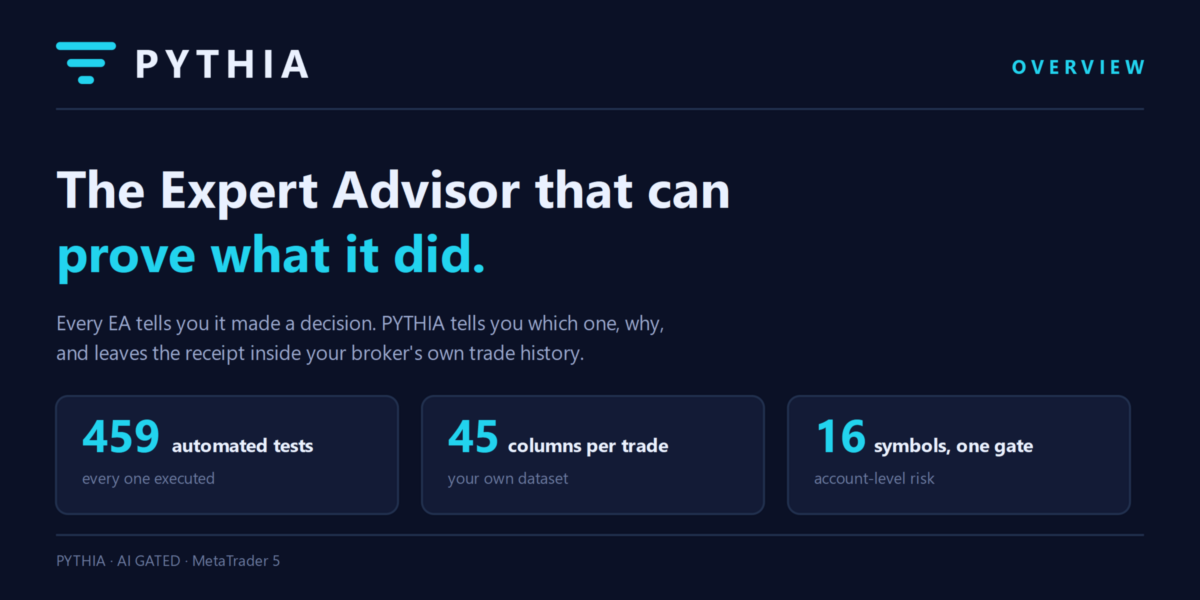
PYTHIA is the Expert Advisor that can prove what it did.
Every EA tells you it made a decision. PYTHIA tells you which one, why, on what evidence — and leaves the receipt inside your broker's own trade history.
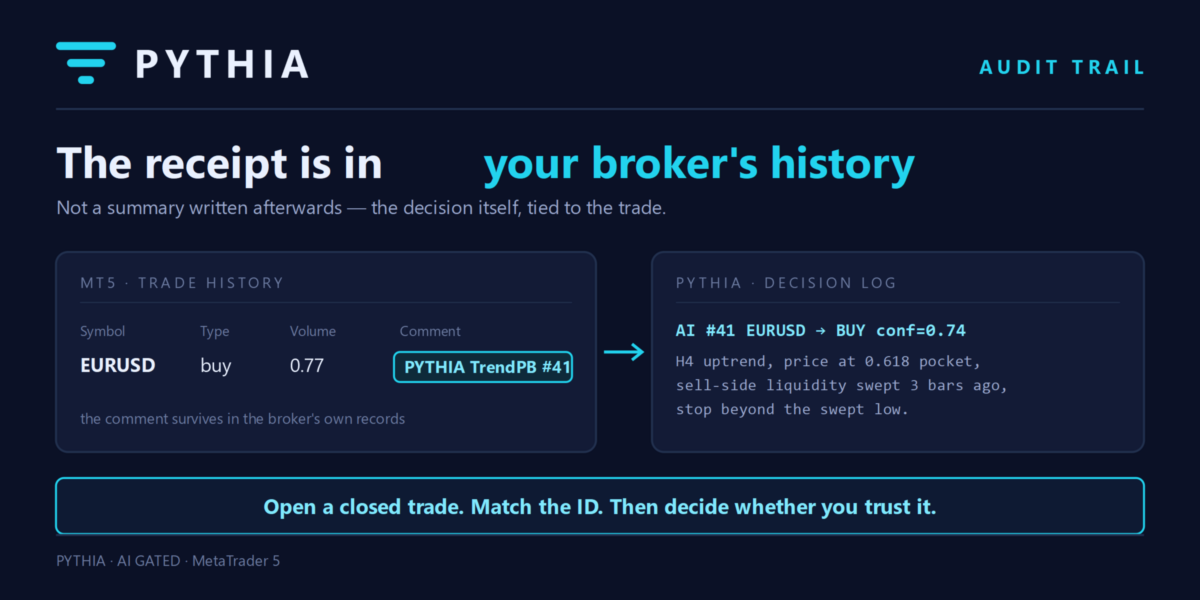
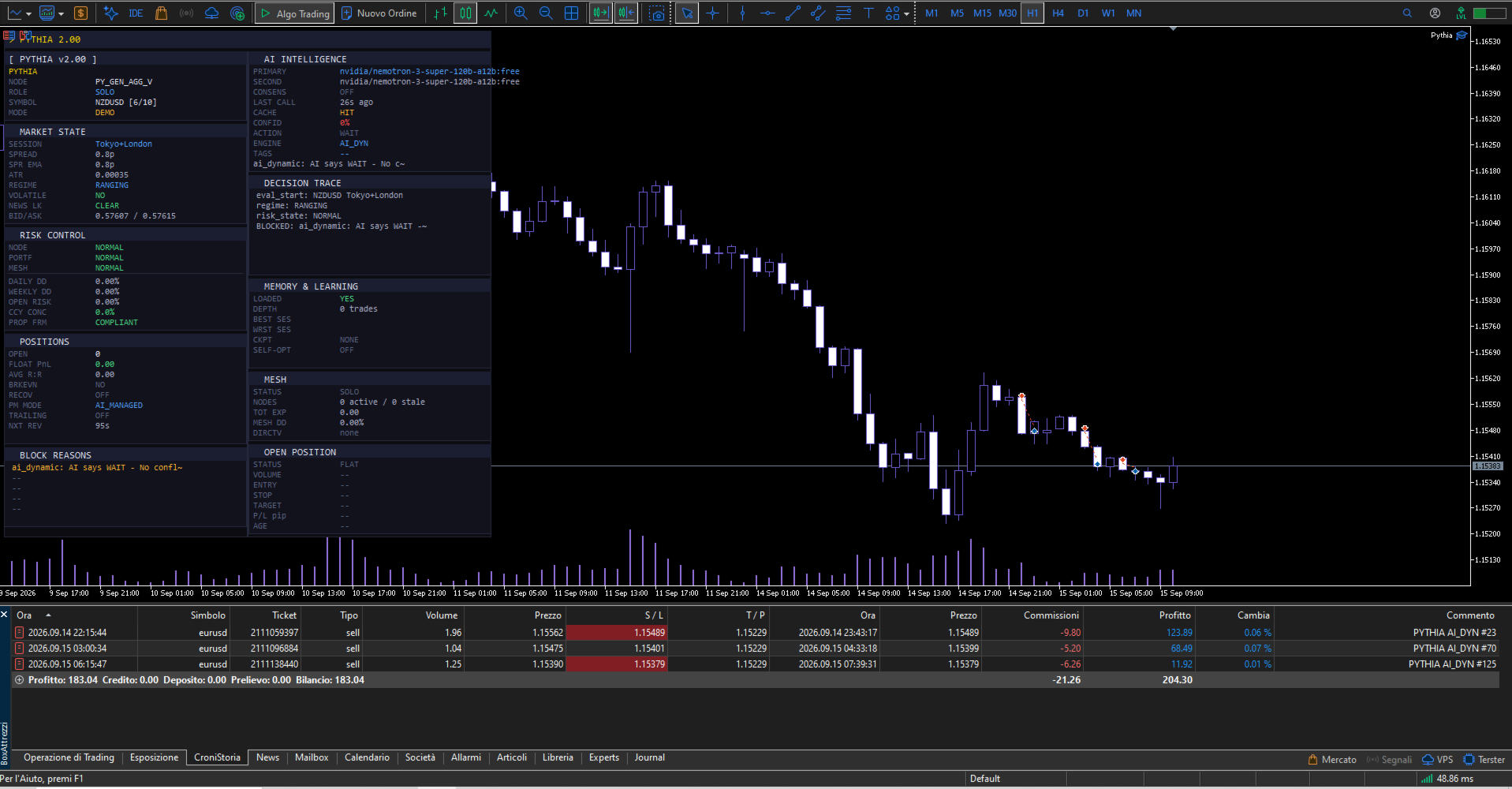
Open any closed PYTHIA position in MetaTrader. In the order comment you will find a decision ID. That ID matches a line in the log where the AI stated its reasoning, its confidence, and the structure it read.
Not a summary written afterwards. The actual decision, tied to the actual trade, in a field your broker recorded — not us.
Most systems ask you to trust the equity curve.
PYTHIA hands you the audit trail.
Why this matters more than another backtest
The market is full of Expert Advisors with beautiful historical curves. You already know how those are made.
We took the opposite route. PYTHIA ships with:
- 459 automated assertions covering JSON parsing, risk state, position state, sizing, sessions, cache isolation, execution and security. Every one executed, every result read.
- A published limitations document listing what the system cannot do and does not know.
- A behaviour contract stating exactly when it enters, when it refuses, when it blocks, and what happens when things fail.
- A secret scanner verifying that no API key ever reaches a log file.
We publish the things most vendors hide. Not as a posture — because a system managing your capital should be inspectable.
We would rather show you the engineering than a curve.
What PYTHIA actually is
An AI-native decision system for MetaTrader 5, built as two layers that cannot be collapsed into one.
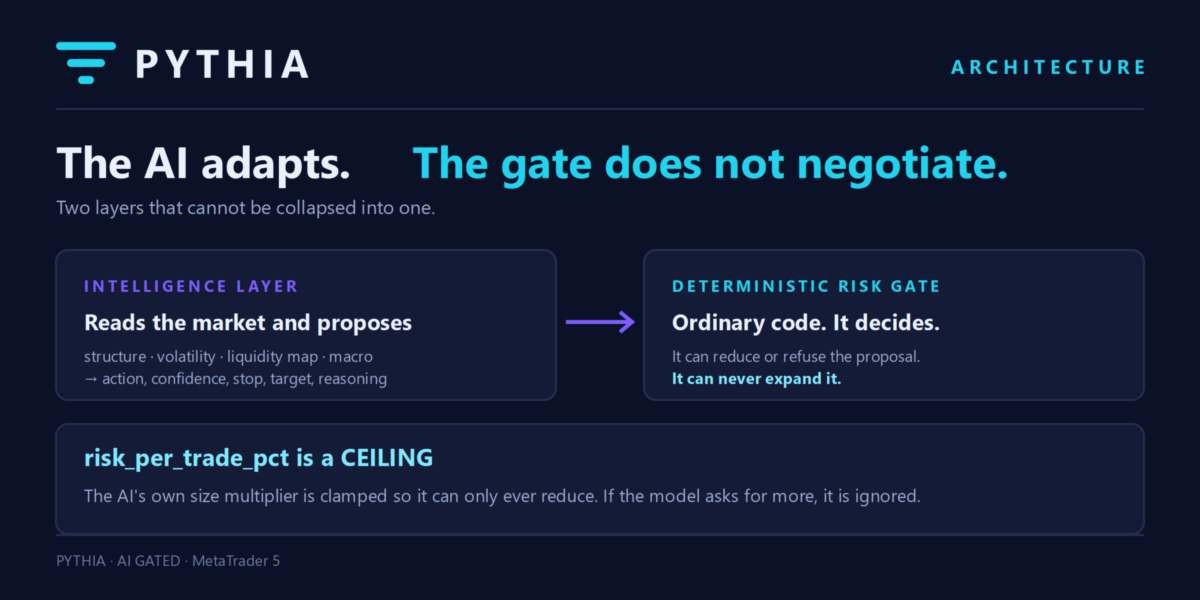
The Intelligence Layer reads and proposes. A language model receives a complete telemetry snapshot — structure, volatility regime, multi-timeframe bias, Fibonacci zones, the liquidity map, spread conditions, macro calendar, open exposure, and this symbol's own trade memory — and returns a decision with a confidence score and its reasoning.
The Deterministic Risk Gate decides. It is ordinary code, not a model. It can reduce or refuse what the AI proposes. It can never expand it.
That asymmetry is the whole design. The AI adapts. The gate does not negotiate.
Risk per trade is a ceiling. The AI's own size multiplier is clamped so it can only ever reduce. If the model asks for more, it is ignored.
The liquidity map — and an honest word about it
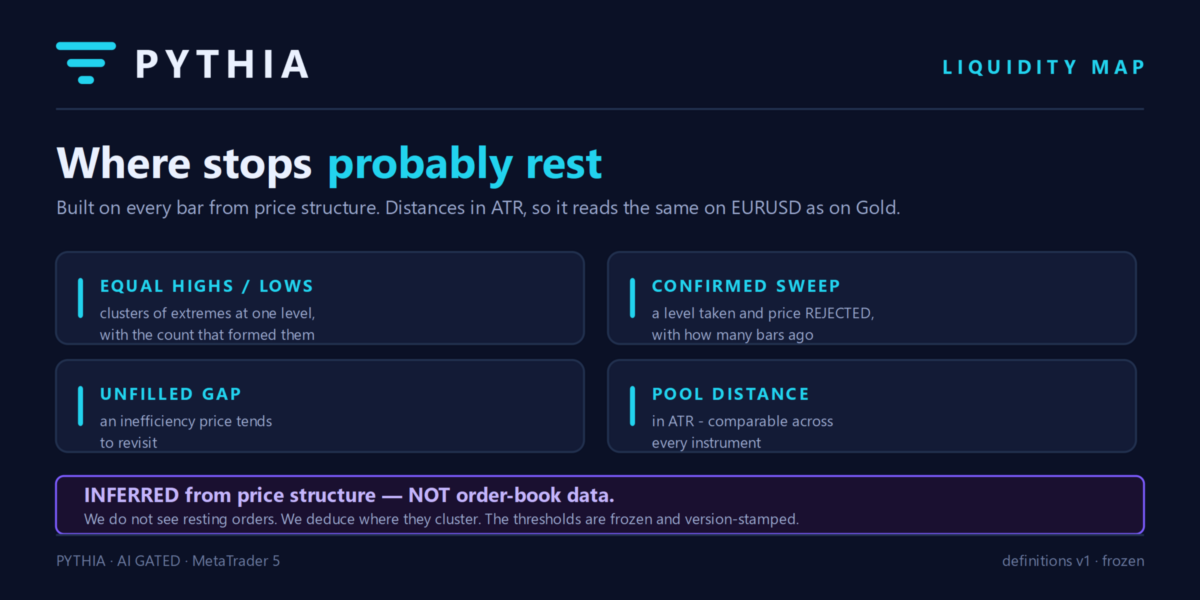
PYTHIA builds a structural liquidity map on every bar:
- Clusters of equal highs and lows where stops accumulate, with the count of extremes forming each cluster.
- Confirmed sweeps — a level taken and price rejected — with how many bars ago it happened.
- Unfilled inefficiencies above and below price.
- Distance to the nearest pool measured in ATR, so it reads the same on EURUSD as on Gold.
The model sees all of it. Optionally it also moves your stops and targets: a stop sitting just short of a pool is the one that gets swept on the way there, and a target sitting just past a pool is the one that never fills.
Now the honest part.
This is inferred from price structure. It is not order-book data.
We do not see resting orders — we deduce where they cluster from where price left extremes untaken. The line the AI receives says exactly that, in those words.
You will not find "footprint", "real delta", "POC" or "Value Area" anywhere in this product. Retail MT5 does not have that data. Anyone claiming otherwise is describing something they cannot measure.
The thresholds defining a cluster, a sweep and a gap are frozen and version-stamped. Every trade records which definition version produced it, so two populations never get silently mixed. That is how you stop "refining the model" from quietly becoming curve-fitting.
Macro data it actually reads
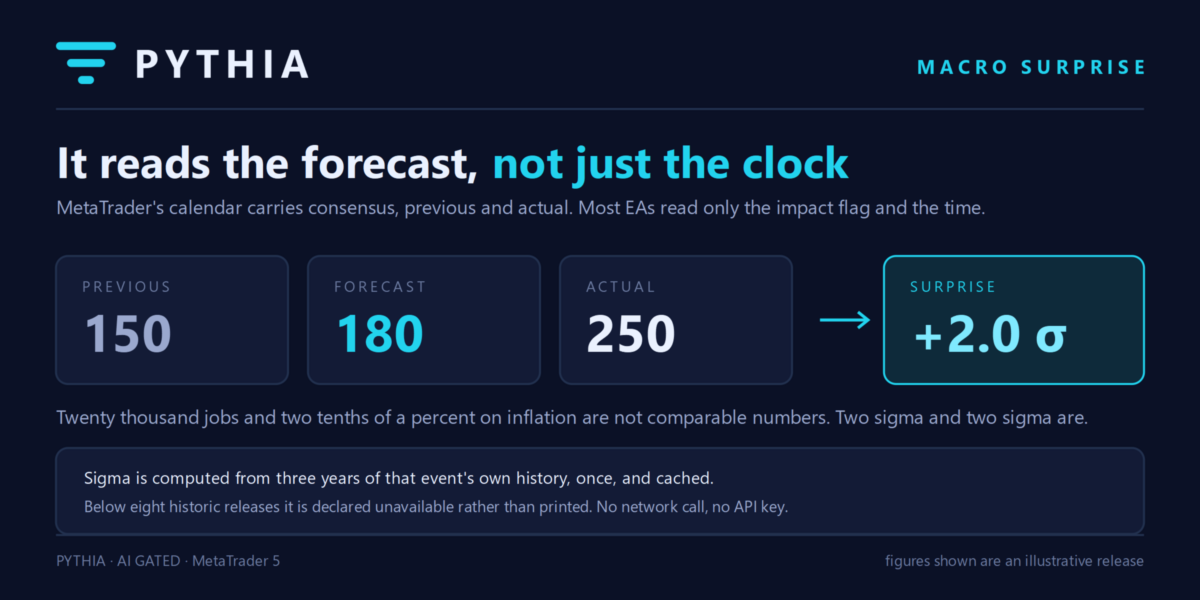
MetaTrader's calendar carries the consensus forecast, the previous figure and the actual release. Most EAs read only "high impact at 14:30" and discard the rest.
PYTHIA reads all of it, and computes the surprise in standard deviations of that specific event's own history.
Twenty thousand jobs and two tenths of a percent on inflation are not comparable numbers. Two sigma and two sigma are.
The AI is told what the market expects before the release, and how badly the market was wrong after it.
No network call. No API key. No third-party feed. It is local data — and because MetaTrader keeps calendar history, it is reconstructable for testing.
The research journal — your data, not ours
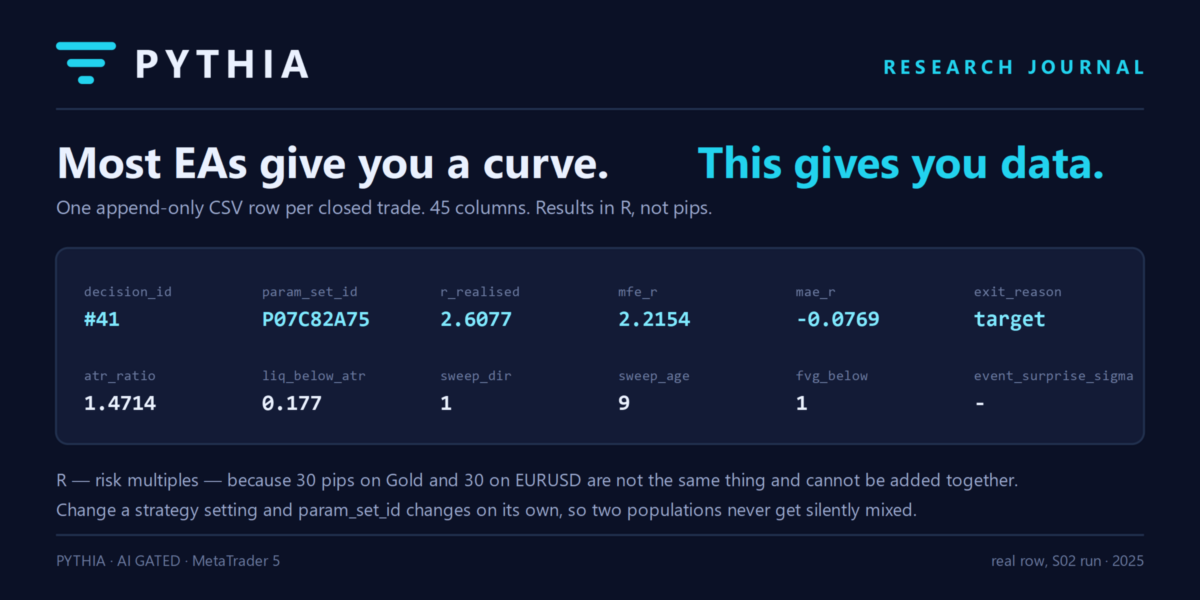
Every closed trade writes one row to an append-only CSV. Forty-five columns.
Not just profit and loss. The state of the market at the moment the decision was made:
- Volatility relative to its own average, trend efficiency, multi-timeframe alignment.
- Distance to liquidity in ATR, whether a sweep had just occurred and how long ago.
- Whether an unfilled gap sat between entry and target.
- Minutes to the next macro release, and its surprise in sigma.
Results are recorded in R — risk multiples — not pips, because thirty pips on Gold and thirty on EURUSD are not the same thing and cannot be added together.
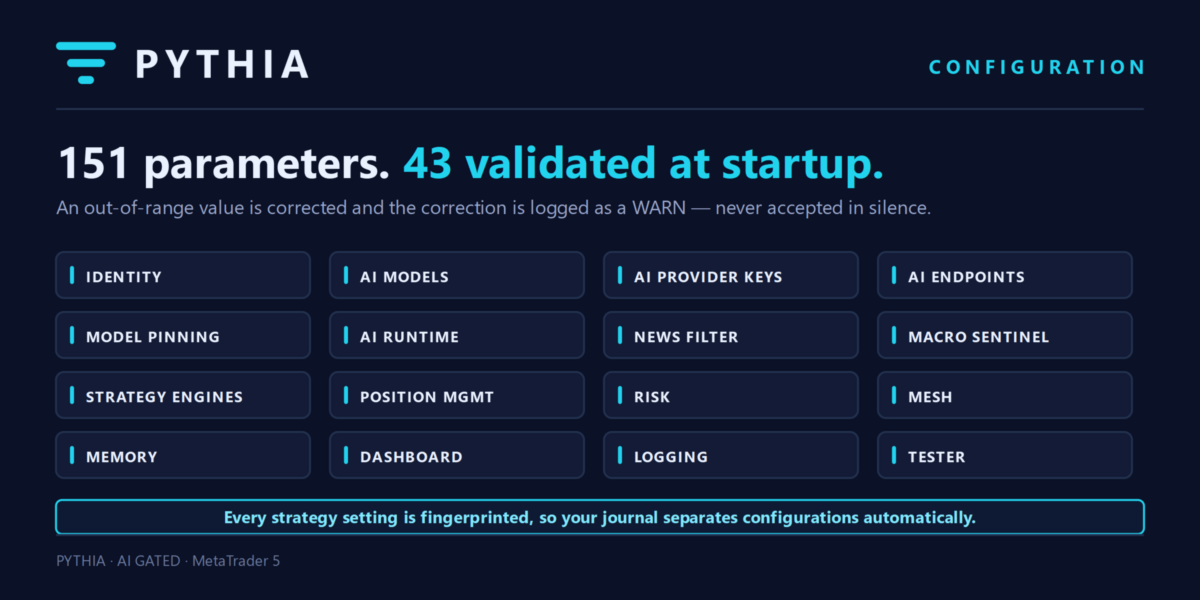
And every row carries a parameter-set fingerprint. Change a strategy setting and the fingerprint changes on its own, so your journal separates the two populations automatically without you having to remember.
This is the file that lets you eventually answer questions like "do trades taken after a swept low actually perform better?" — with your own data, from your own account.
Most EAs give you a balance curve. PYTHIA gives you a dataset.
Multi-symbol from one chart
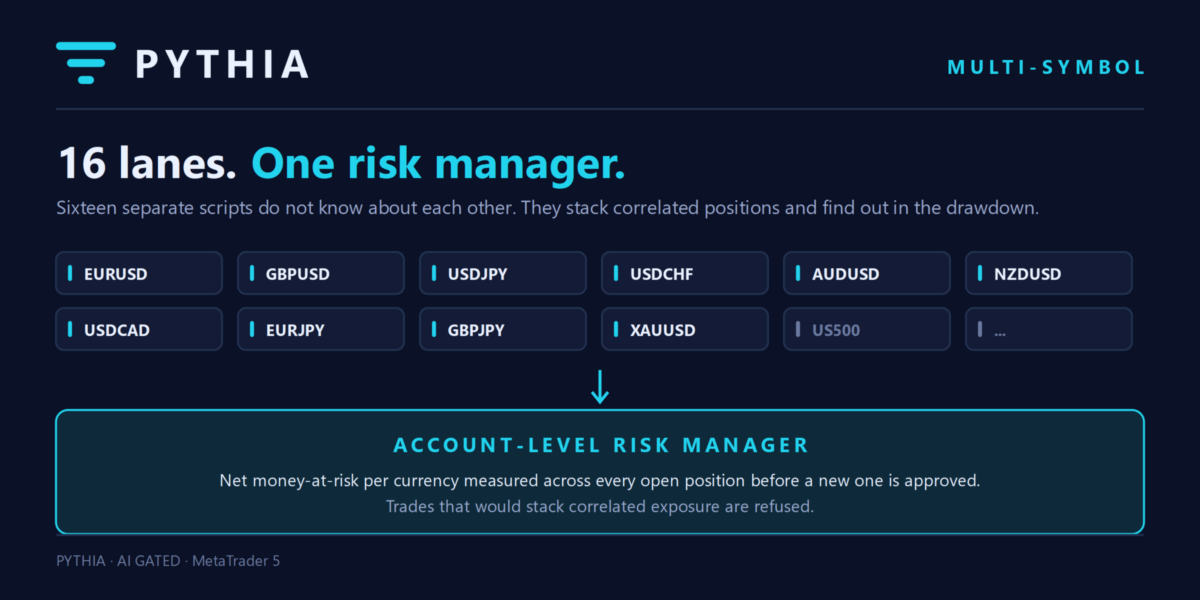
One instance drives up to 16 symbols as independent parallel lanes — each with its own indicators, memory and AI cache — while a single account-level risk manager supervises all of them.
This is what isolated single-symbol EAs structurally cannot do. Sixteen separate scripts do not know about each other. They will happily stack sixteen correlated positions and discover the concentration only in the drawdown.
PYTHIA measures net money-at-risk per currency across every open position before approving a new one, and refuses trades that would stack correlated exposure.
Every log line carries its symbol, so a ten-symbol basket produces a readable log instead of one indistinguishable stream.
Risk governance
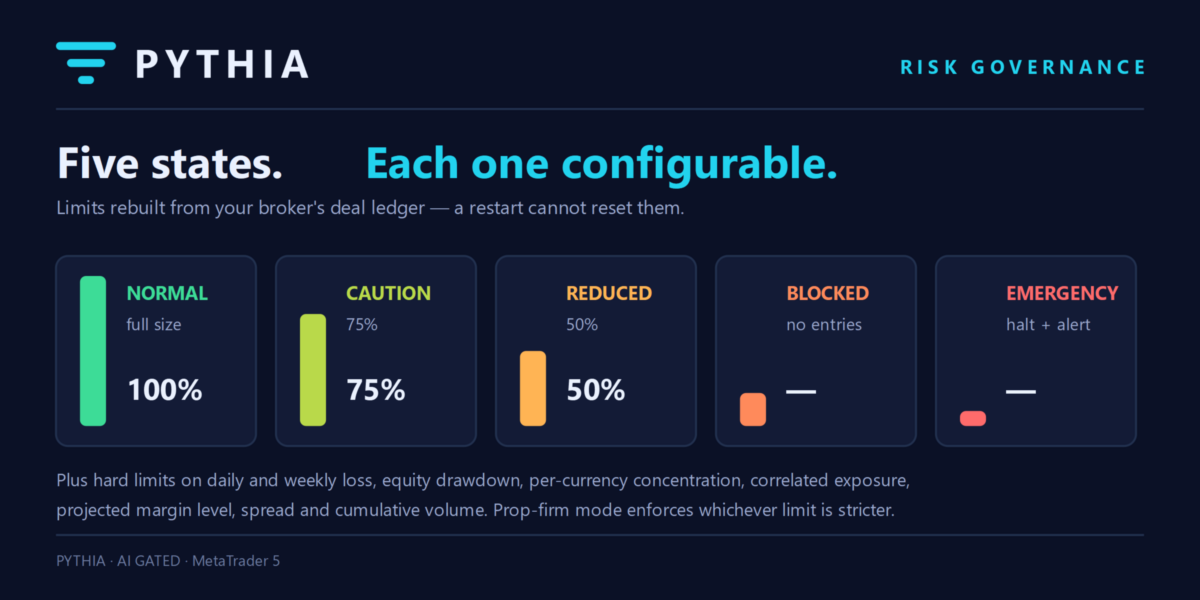
A five-state ladder, each threshold configurable and validated at startup:
- NORMAL — full configured size
- CAUTION — 75%
- REDUCED — 50%
- BLOCKED — no new entries
- EMERGENCY — no new entries, alert raised
Plus hard limits on per-trade risk, daily and weekly loss, equity drawdown, per-currency concentration, correlated exposure, projected margin level, spread and cumulative volume.
Daily and weekly limits are reconstructed from your broker's own deal ledger, not from a local file. Restarting the EA does not reset them. Deleting a file does not reset them. This closes the oldest loophole in retail risk management: the counter that forgets after a bad morning.
Prop-firm mode enforces whichever limit is stricter — yours or the firm's.
And when the emergency path runs with closing enabled, if a close fails PYTHIA says so: "POSITIONS REMAIN OPEN. Manual action required." It never reports as closed something that is still open.
AI engine
- 35 model entries across 6 providers wired directly — OpenAI, Anthropic, Google, xAI, DeepSeek, OpenRouter — plus anything reachable through OpenRouter's catalogue.
- Consensus mode: a second model confirms borderline calls.
- Automatic failover when a provider is unavailable.
- Pin exact model versions, or point any provider at Azure, a proxy, or a self-hosted endpoint for reproducible inference.
- Cost control: response caching with configurable TTL and a per-key minimum call interval. The cache is keyed on symbol, timeframe, purpose, position and prompt version, so a cached answer can never leak from one symbol to another.
- Retry discipline: transient failures retry with exponential backoff and jitter. Permanent failures — a bad key, a wrong endpoint — do not retry, because hammering a provider with an invalid credential is how accounts get blocked.
Keys never reach a log. Redaction happens at the call site and again inside the logger as a catch-all, and a scanner verifies it across every source file, fixture and log in the installation.
Where a backtest helps, and where it lies
We will not sell you an optimised historical curve, and we will tell you exactly why.
In the Strategy Tester the AI is switched off.
Live inference needs network calls the tester cannot make. A backtest exercises PYTHIA's deterministic fallback engine — useful for validating risk logic, execution and stop handling.
It is not a test of the AI, and we will not present it as one.
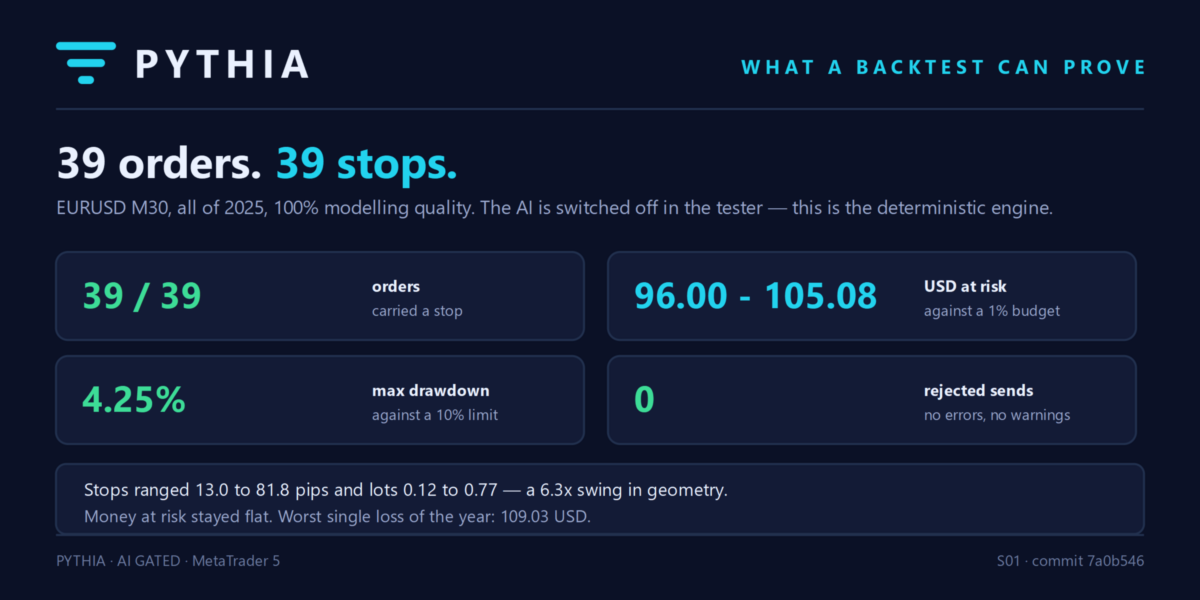
What we did instead: run the deterministic engine over a full year of EURUSD M30 at 100% modelling quality, and verify what a backtest can honestly prove.
- Every one of 39 opening orders carried a stop. Not most. All.
- Across stops from 13.0 to 81.8 pips and lots from 0.12 to 0.77 — a 6.3x swing in geometry — money at risk stayed between 96.00 and 105.08 USD against a 1% budget, averaging 101.03. The worst single loss of the year was 109.03 USD.
- Zero rejected sends. Zero errors. Zero warnings. Maximum drawdown 4.25% against a 10% limit.
That is what a backtest is good for: proving the machinery is sound. For whether it makes money, there is only one honest answer — forward test it.
Multi-asset, including 24/7 markets
FX majors and crosses, metals, indices — and with all four sessions plus weekend days enabled, crypto and other continuous markets. You define the trading windows. PYTHIA respects them.
Session handling works in UTC with the broker's offset deduced automatically, and overlapping sessions are treated as set membership rather than a first-match chain, so London and New York overlapping never silently drops one of them.
Optional distributed mesh
Run PYTHIA across several MT5 terminals as SOLO, MASTER or AGENT. Nodes synchronise through file-based messaging and the master can issue global directives — close-all, reduce-size, halt-entries — across the network.
Disabled by default, and we recommend leaving it that way until you have run a single node in production. It is implemented, but it is the least exercised part of the system, and we would rather say so than let you discover it with capital on the line.
Who this is for
PYTHIA suits traders who want to understand an automated system, not just switch one on:
- You want to know why a trade happened, and be able to check.
- You want risk limits that survive a restart, not ones that quietly reset.
- You want one instance supervising a basket with real account-level exposure control.
- You want to accumulate your own dataset and reach your own conclusions.
- You would rather read an honest limitations page than an optimised backtest.
It is not for you if you want a set-and-forget black box, or a historical curve to justify the purchase. We do not have one to give you, and we are not going to manufacture one.
Quick facts
- Platform: MetaTrader 5
- Markets: FX, metals, indices, crypto, any broker-supported symbol
- Symbols per instance: up to 16 parallel lanes, one account-level risk manager
- AI: 35 model entries, 6 providers, consensus and failover
- Fallback: deterministic engines when AI is unavailable, labelled in every log line
- Risk: 5-state ladder, per-currency and correlated exposure, prop-firm mode
- Persistence: limits reconstructed from the broker's deal ledger, restart-proof
- Auditability: decision ID in log and order comment, 45-column research journal
- Verification: 459 automated assertions, published limitations, secret scanner
- Deployment: one chart; optional multi-terminal mesh
What you get
- The compiled PYTHIA Expert Advisor for MetaTrader 5.
- A complete operating manual in English and Italian, covering every parameter, the mesh, and full configuration.
- Direct developer support and setup guidance.
- Free updates within the version line.
Setup
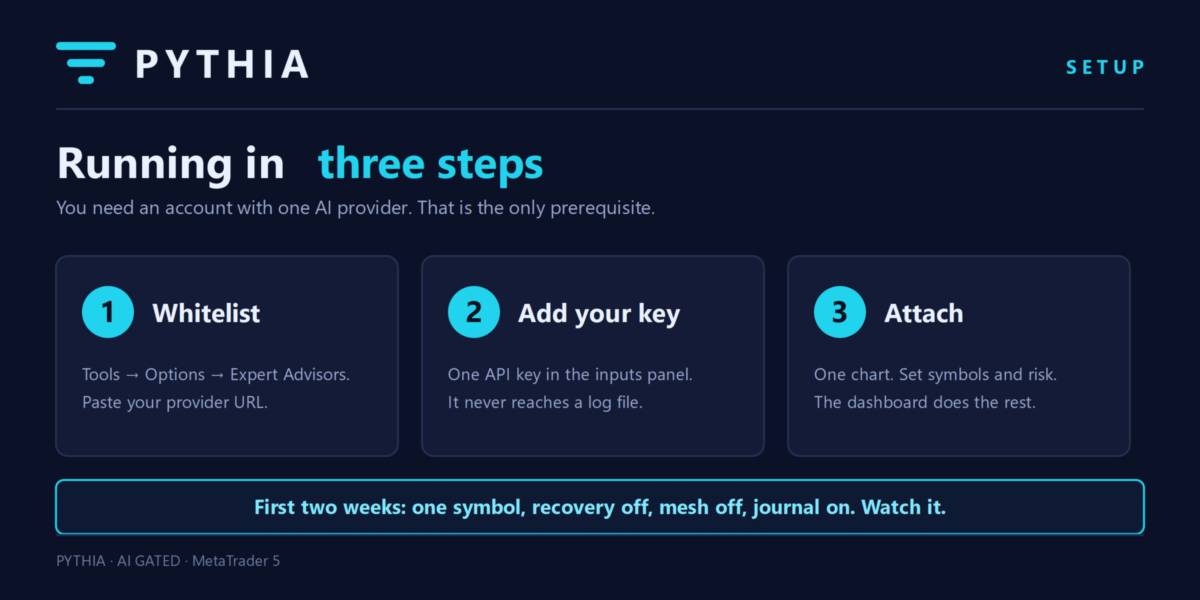
- Whitelist your AI provider URLs in Tools > Options > Expert Advisors.
- Enter your provider API key.
- Attach PYTHIA to one chart. Configure symbols, sessions and risk.
For the first two weeks we recommend: one symbol, recovery off, mesh off, emergency-close off, alerts on, journal on. Watch it. Read the log. Then widen.
Requirements
- MetaTrader 5.
- An account with at least one supported AI provider, for AI-driven operation.
- Stable internet connection; a VPS is recommended for continuous operation.
- Broker-supported symbols and trading permissions.
Launch pricing
PYTHIA is released in tiers. The price rises with the number of licences sold, not by announcement.
- Tier 1 — first 10 licences: 197 USD
- Tier 2 — licences 11 to 25: 397 USD
- Tier 3 — licences 26 to 50: 597 USD
- Standard price from licence 51: 897 USD
Every tier receives the same product and the same lifetime updates within the version line.
Risk disclosure
Trading leveraged products carries substantial risk and can result in the loss of your entire deposit.
- PYTHIA is execution infrastructure, not financial advice. All configuration and risk decisions are yours.
- No performance representation is made. Past or simulated results do not indicate future outcomes.
- AI inference, liquidity inference, exposure controls and drawdown limits do not prevent losses. They constrain behaviour; they do not predict markets.
- The structural liquidity map is inferred from price structure, not observed order flow, and may not correspond to real resting orders.
- Test on a demo account before deploying capital, and trade only what you can afford to lose.
Prove it yourself
Open a closed trade. Find the decision ID in the comment. Match it to the log line where the reasoning was written.
Then decide whether you trust it.
That is the only sales argument we are willing to make.