|
1 year
experience
|
21
products
|
18
demo versions
|
|
2
jobs
|
0
signals
|
0
subscribers
|
The best algorithmic developers aren't just programmers - they're traders who code.
I develop and code custom trading strategies, automation tools and custom software across multiple platforms and languages, including TradingView (Pine Script), MetaTrader 5 (MQL5), Python and other modern development frameworks.
Looking for a quantitative developer role.
I can turn trading strategies into fully functional systems.
Extensive experience with Linux (Gentoo, Debian) and Unix systems (FreeBSD, OpenBSD)
I’m available for projects.
You can ask for me directly in the Freelance section.
How Observation Changes Outcomes :
In quantum mechanics, when light (or electrons) passes through two slits, it creates an interference pattern on the screen behind them.
Each particle seems to go through both slits at once, existing in a super position of all possible paths and the resulting pattern reflects the probabilities of where the particle could land.
If you try to measure which slit the particle goes through, the interference pattern disappears.
Observing the particle forces it into a definite state - it goes through one slit or the other.
The act of measurement collapses the wave function and fundamentally changes the outcome.
Before you check a trade, it’s in super position.
From a statistical perspective, your trade has a probability of winning or losing based on your system but you don’t yet know the outcome.
The trade is evolving naturally, just like a quantum system.
The moment you look at it, your observation collapses the “trade wave function” into a definite state - good or bad, winning or losing.
That observation triggers an emotional reaction — stress, fear, or overconfidence—which can cause you to break your plan, over-leverage, or revenge trade.
Just like in quantum mechanics, the act of measurement affects the system.
If you hadn’t looked, the system would have continued evolving naturally and you would have followed your plan without emotional interference.
This analogy mirrors the quantum concept perfectly - observation changes the outcome, not because the market changed, but because your interaction with it changed your behavior.
In other words, checking too often destroys the natural probabilistic outcome of your system, just like measuring the slit destroys the interference pattern.
The trade itself hasn’t changed; your observation changed how you interact with it, which changes the outcome.
Final Thoughts:
Traders, you know what I’m talking about — in a demo, you can leave your strategy untouched for days, weeks, even months.
The moment it goes live, you start checking too often, micromanaging your trades, and suddenly your observation is affecting the outcome
I develop and code custom trading strategies, automation tools and custom software across multiple platforms and languages, including TradingView (Pine Script), MetaTrader 5 (MQL5), Python and other modern development frameworks.
Looking for a quantitative developer role.
I can turn trading strategies into fully functional systems.
Extensive experience with Linux (Gentoo, Debian) and Unix systems (FreeBSD, OpenBSD)
I’m available for projects.
You can ask for me directly in the Freelance section.
How Observation Changes Outcomes :
In quantum mechanics, when light (or electrons) passes through two slits, it creates an interference pattern on the screen behind them.
Each particle seems to go through both slits at once, existing in a super position of all possible paths and the resulting pattern reflects the probabilities of where the particle could land.
If you try to measure which slit the particle goes through, the interference pattern disappears.
Observing the particle forces it into a definite state - it goes through one slit or the other.
The act of measurement collapses the wave function and fundamentally changes the outcome.
Before you check a trade, it’s in super position.
From a statistical perspective, your trade has a probability of winning or losing based on your system but you don’t yet know the outcome.
The trade is evolving naturally, just like a quantum system.
The moment you look at it, your observation collapses the “trade wave function” into a definite state - good or bad, winning or losing.
That observation triggers an emotional reaction — stress, fear, or overconfidence—which can cause you to break your plan, over-leverage, or revenge trade.
Just like in quantum mechanics, the act of measurement affects the system.
If you hadn’t looked, the system would have continued evolving naturally and you would have followed your plan without emotional interference.
This analogy mirrors the quantum concept perfectly - observation changes the outcome, not because the market changed, but because your interaction with it changed your behavior.
In other words, checking too often destroys the natural probabilistic outcome of your system, just like measuring the slit destroys the interference pattern.
The trade itself hasn’t changed; your observation changed how you interact with it, which changes the outcome.
Final Thoughts:
Traders, you know what I’m talking about — in a demo, you can leave your strategy untouched for days, weeks, even months.
The moment it goes live, you start checking too often, micromanaging your trades, and suddenly your observation is affecting the outcome



Jason Smith
Jason Smith
2026.03.24
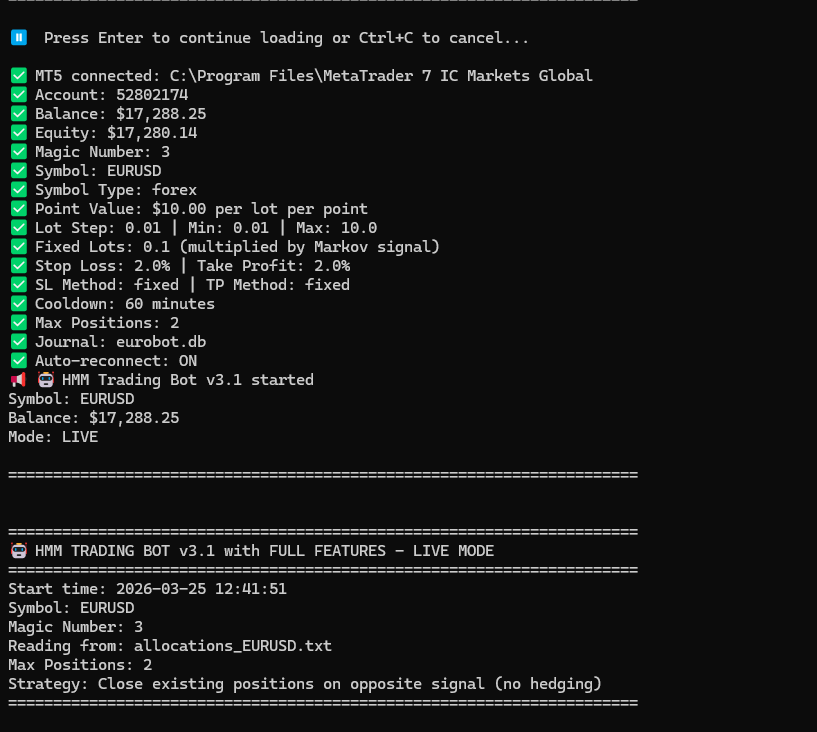
This full system will be available for sale soon.Not sure when.
If you’re interested, feel free to DM me.
If you’re interested, feel free to DM me.
Jason Smith
Jason Smith
2026.03.24
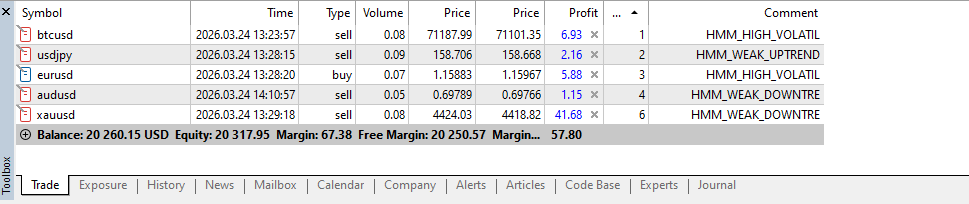
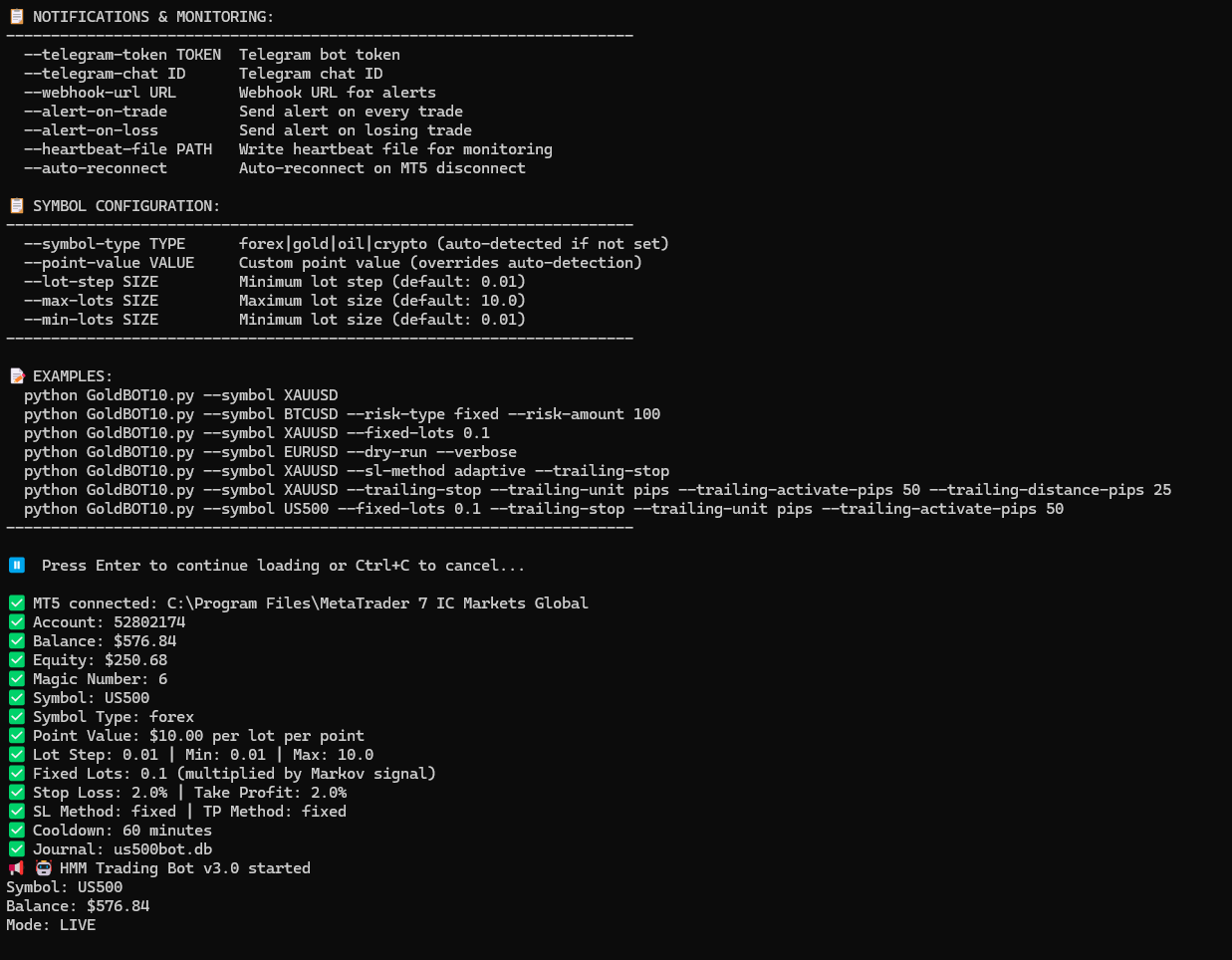
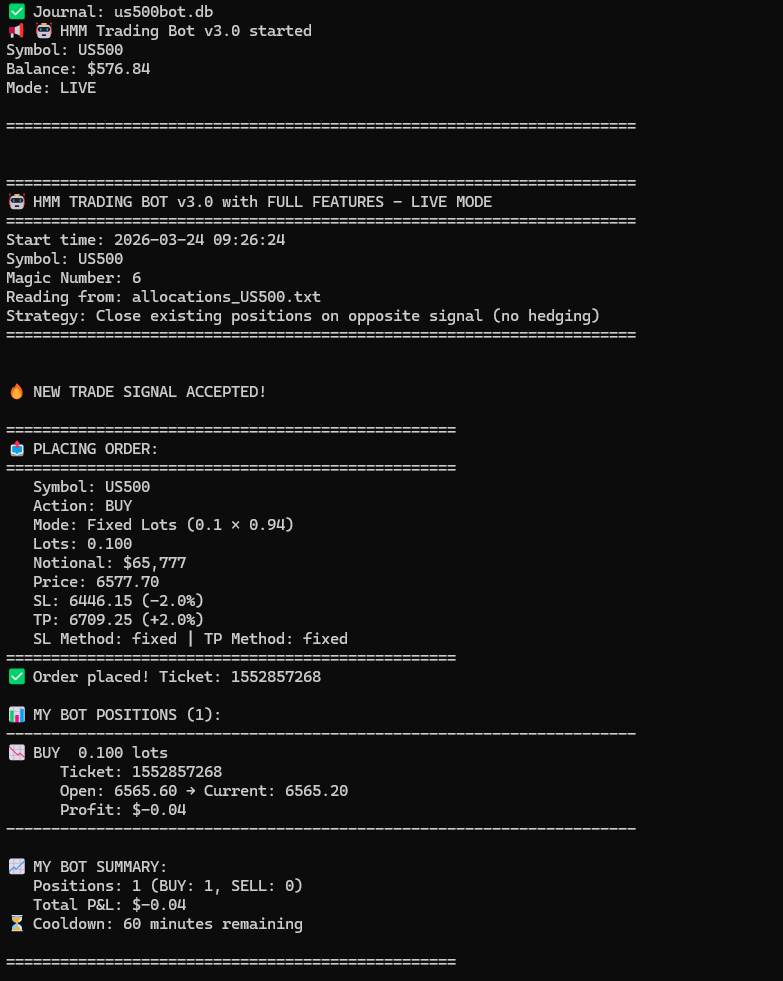
Position sizes are different because of the Markov signal size multiplier.
The Markov model assigns higher size multipliers to signals it's more confident in.Stronger signals get larger positions. Weaker signals get smaller positions.
That's exactly how it should work. The bot scales risk based on signal confidence.
The Markov model assigns higher size multipliers to signals it's more confident in.Stronger signals get larger positions. Weaker signals get smaller positions.
That's exactly how it should work. The bot scales risk based on signal confidence.
Jason Smith
2026.03.24
If you run with --fixed-lots 0.1 (1 mini lot = 0.1), the Markov size multiplier scales it:
Symbol Pos % Fixed Lots Calculated Lots Rounded Lots
USDJPY 80% 0.1 × 0.80 = 0.080 0.08
BTCUSD 77% 0.1 × 0.77 = 0.077 0.08
XAUUSD 76% 0.1 × 0.76 = 0.076 0.08
EURUSD 69% 0.1 × 0.69 = 0.069 0.07
AUDUSD 52% 0.1 × 0.52 = 0.052 0.05
Symbol Pos % Fixed Lots Calculated Lots Rounded Lots
USDJPY 80% 0.1 × 0.80 = 0.080 0.08
BTCUSD 77% 0.1 × 0.77 = 0.077 0.08
XAUUSD 76% 0.1 × 0.76 = 0.076 0.08
EURUSD 69% 0.1 × 0.69 = 0.069 0.07
AUDUSD 52% 0.1 × 0.52 = 0.052 0.05
Jason Smith
·
1
Jason Smith
2026.03.24
It reflects Linus Torvalds (Linux Creator) philosophy on innovation and technology—especially relevant to open-source development—where unconventional approaches can often outperform traditional ones.
Jason Smith
Jason Smith
2026.03.24
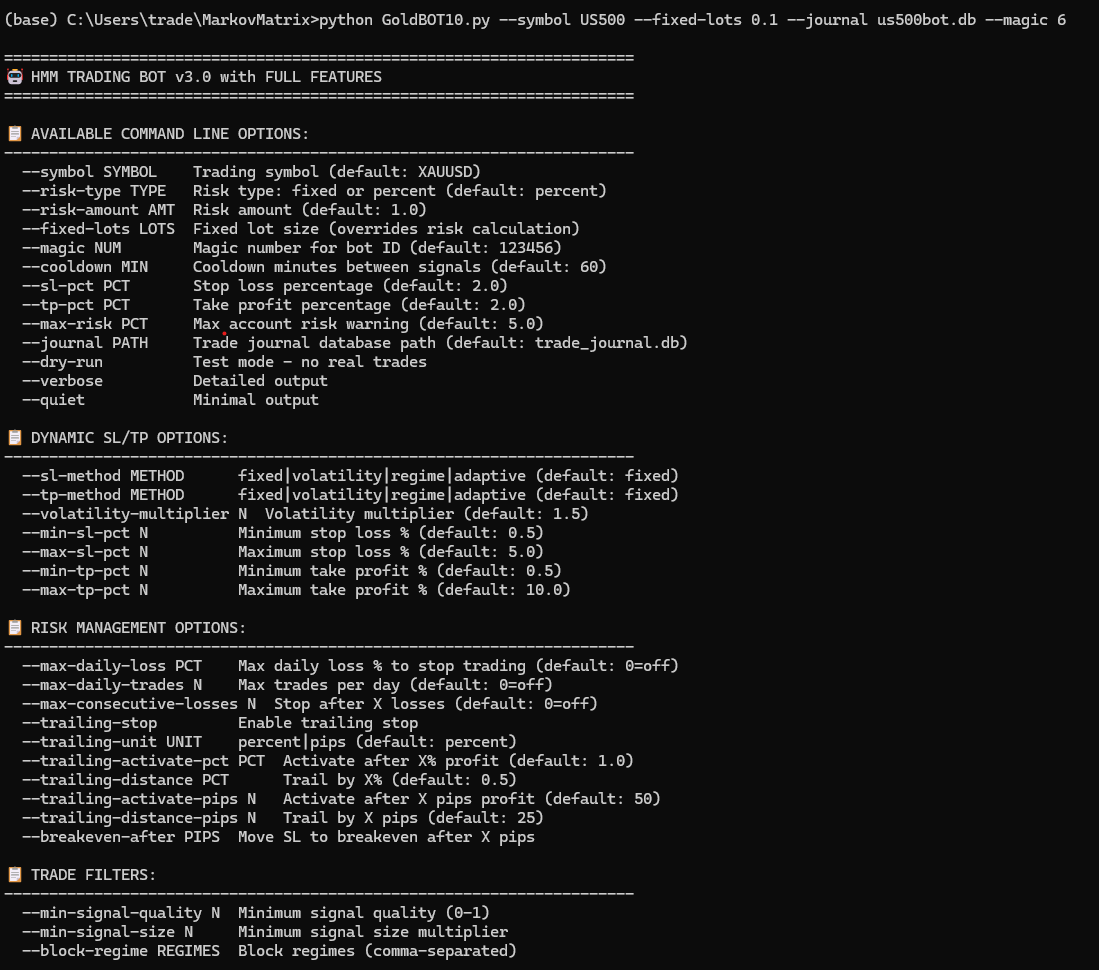
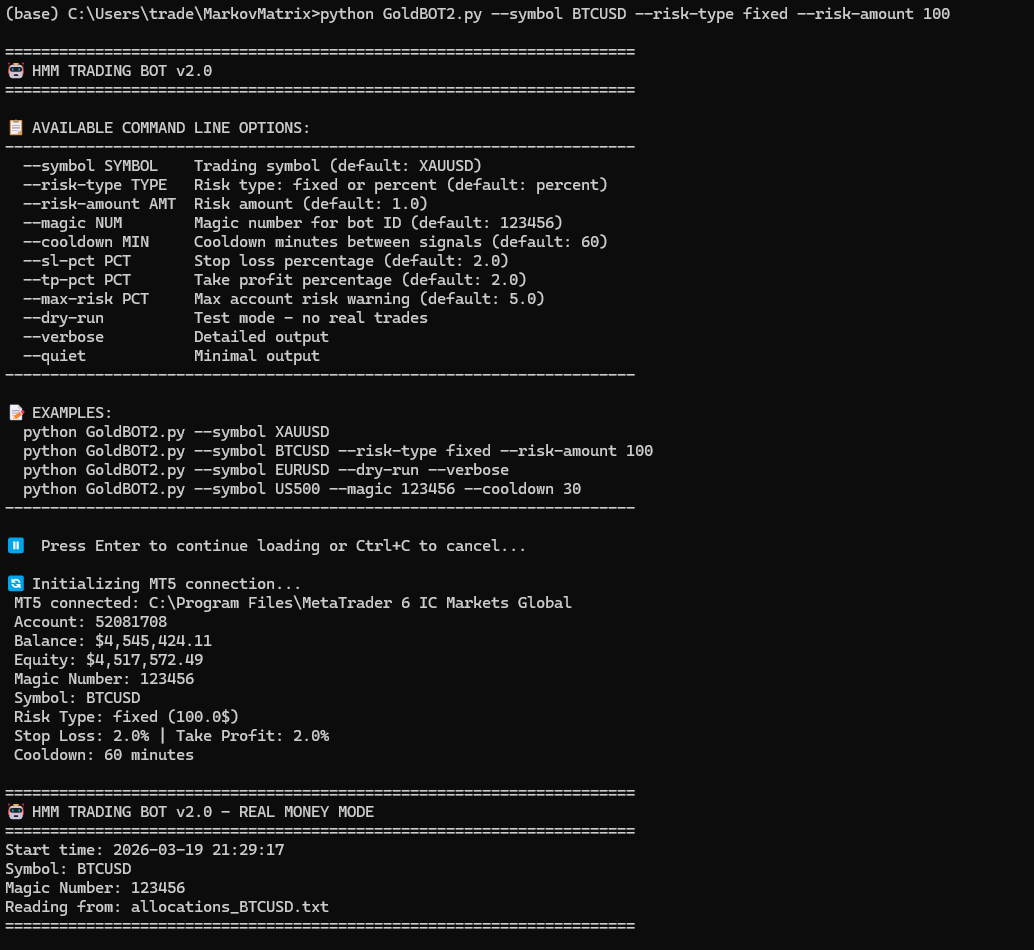
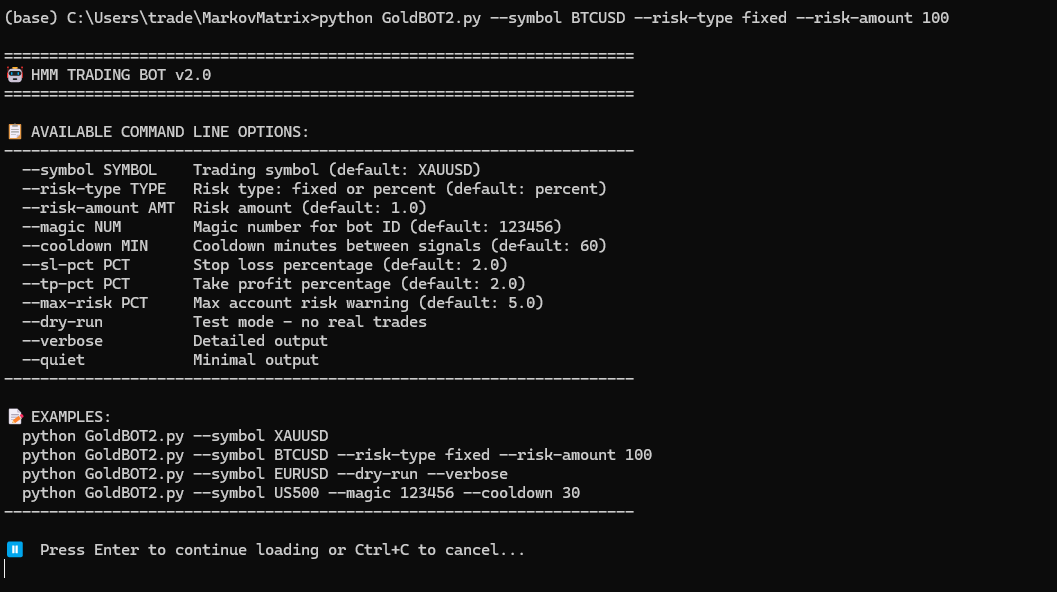
The command-line help looks intimidating, but it’s actually much simpler once you break it down. Think of it like a menu of options for running a trading bot. You don’t have to use all of them—just the ones you need.
Jason Smith
2026.03.24
ONE SIGNAL, TWO CHOICES
The HMM Python script generates the signals. Those signals are saved to a text file.
You have two different bots that can read that file:
Python Bot – Runs outside MT5. Connects through MT5 API. Places trades. Manages risk. Logs to SQLite.
MT5 EA – Runs inside MT5. Places trades. Does the same job.
Both bots read the same signal file. Both execute the same logic. The results are identical.
You can use either. The HMM doesn't care. The signals are the same. The trades are the same. Pick the bot that fits your workflow.
The HMM Python script generates the signals. Those signals are saved to a text file.
You have two different bots that can read that file:
Python Bot – Runs outside MT5. Connects through MT5 API. Places trades. Manages risk. Logs to SQLite.
MT5 EA – Runs inside MT5. Places trades. Does the same job.
Both bots read the same signal file. Both execute the same logic. The results are identical.
You can use either. The HMM doesn't care. The signals are the same. The trades are the same. Pick the bot that fits your workflow.
Jason Smith
Jason Smith
2026.03.23
If you can’t afford to buy it right away, you can always rent it for a month to get started, then purchase it later without any time limitations.
DM me for this or any anything else
DM me for this or any anything else
Jason Smith
Jason Smith
2026.03.23
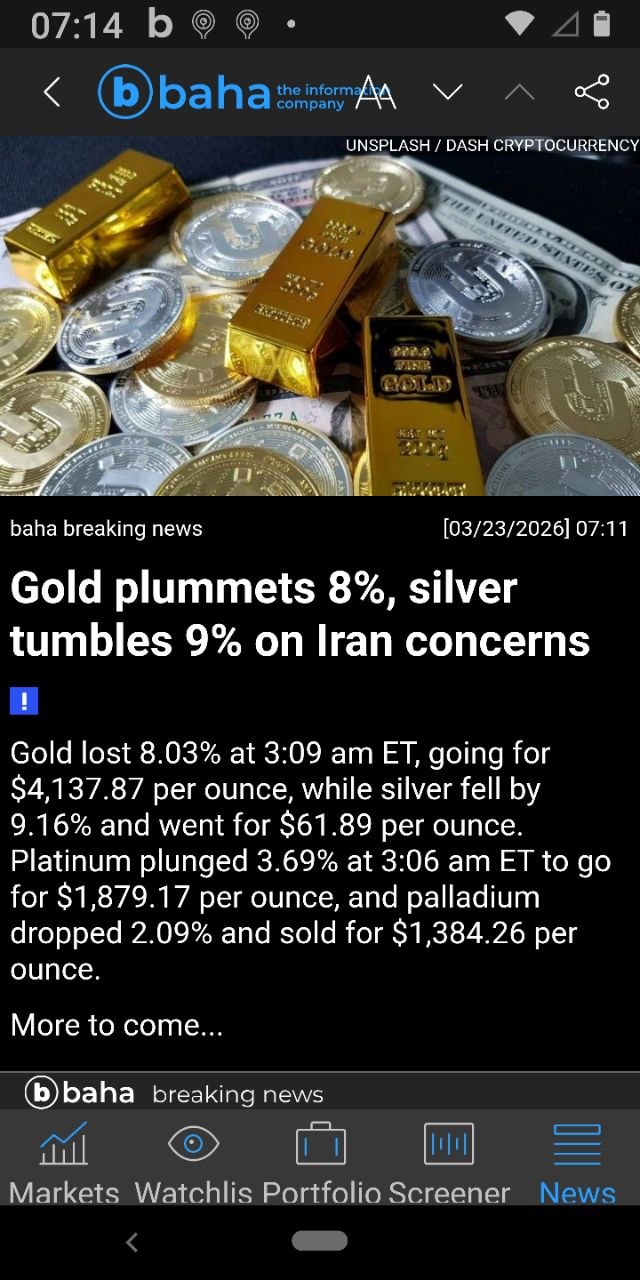
Rich investors are getting hit hard by this move. A drop from a recent high $5,600 to $4,100 means huge positions lose billions very quickly, especially for funds and large holders who were heavily exposed to gold.
Even if they’re not forced to sell, their portfolios take massive mark-to-market hits, and anyone using leverage can get wiped out fast. So while some money rotates elsewhere, a lot of wealthy players are taking serious losses on paper—and in many cases, real ones too.
Even if they’re not forced to sell, their portfolios take massive mark-to-market hits, and anyone using leverage can get wiped out fast. So while some money rotates elsewhere, a lot of wealthy players are taking serious losses on paper—and in many cases, real ones too.
Jason Smith
Jason Smith
2026.03.21
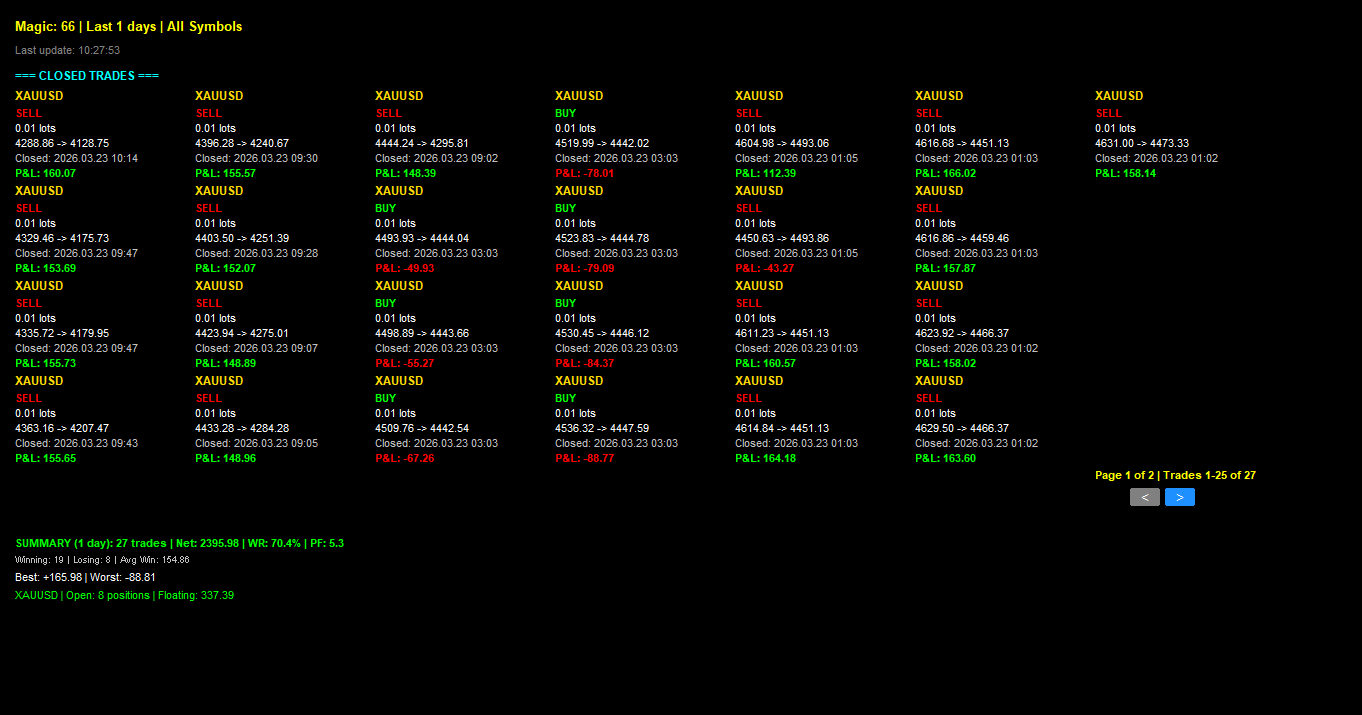
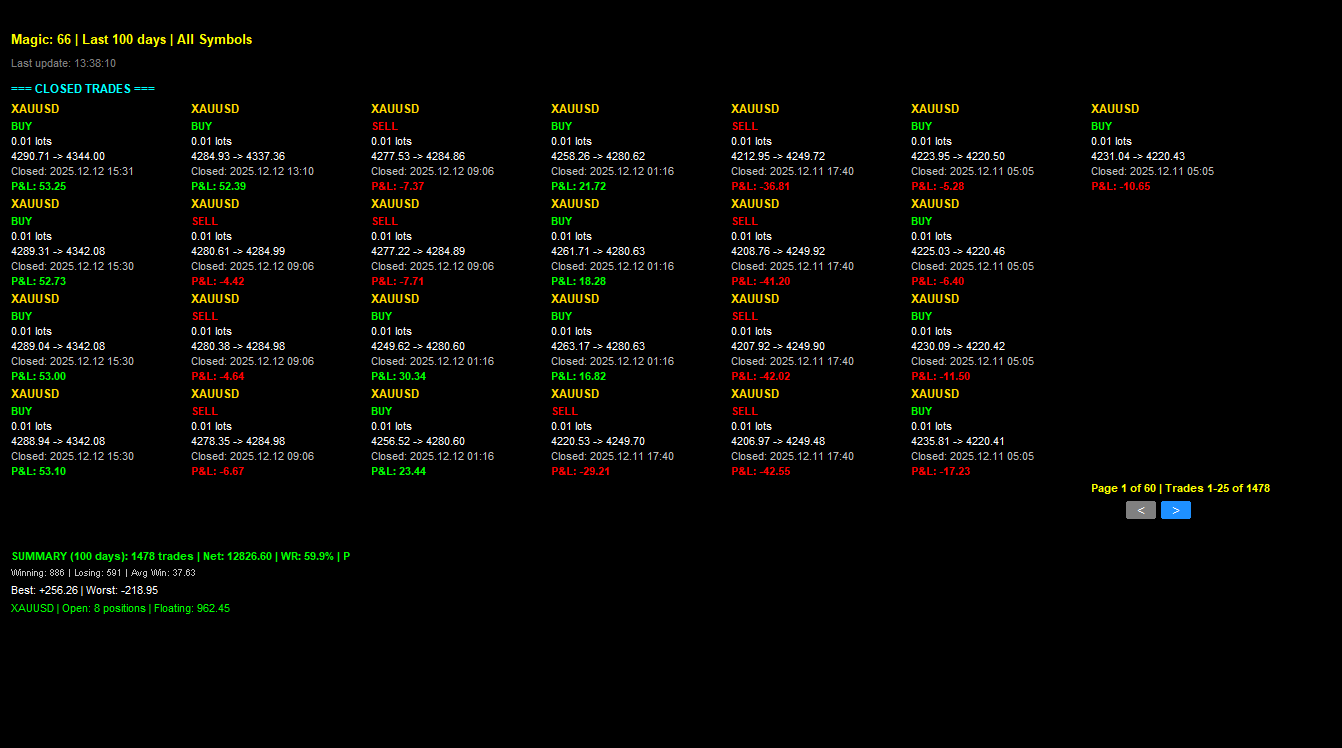
If you had closed all open trades, you would be over $13k in profit in roughly 100 days — all with just 1 micro lot per trade and a maximum of 8 open positions at any given time.
Jason Smith
2026.03.21
Traders, everything I’m showing you is real.
If you think otherwise, let’s debate it.
If you think otherwise, let’s debate it.
Jason Smith
Jason Smith
2026.03.21
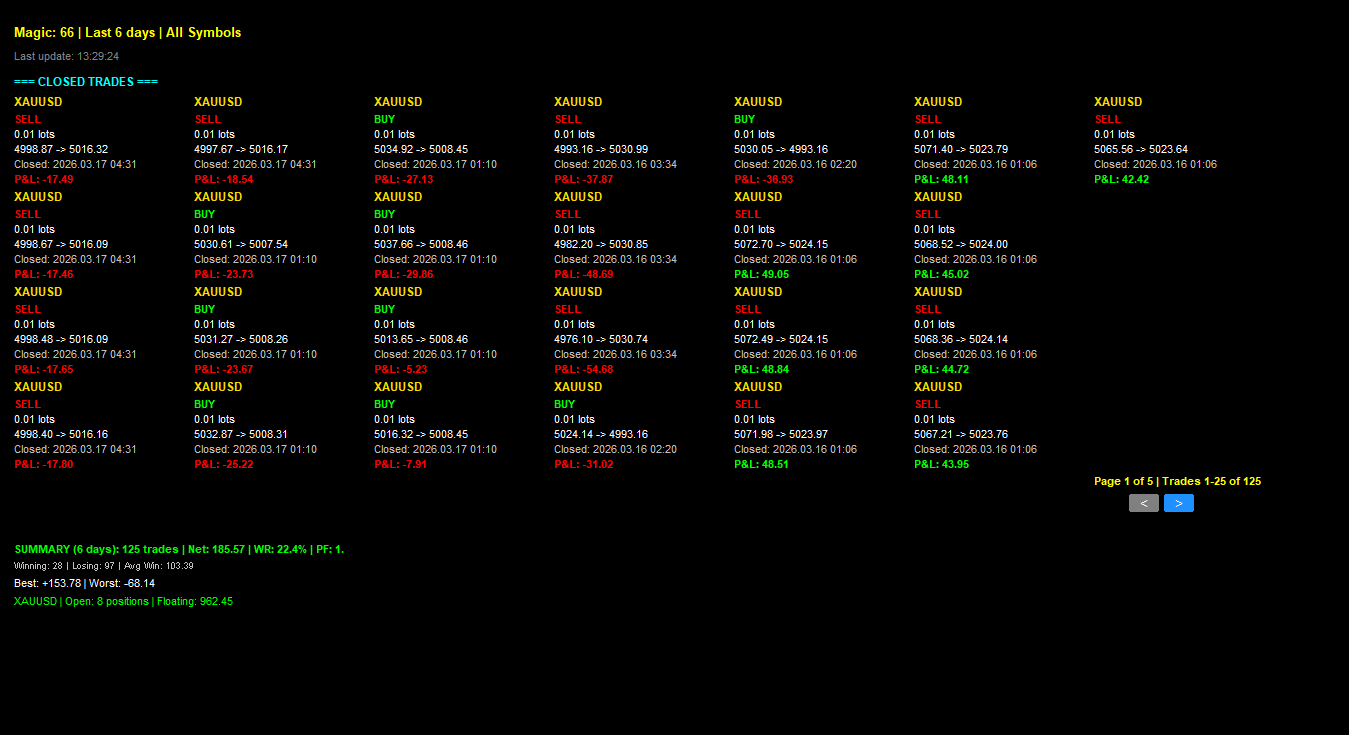
That’s one of the toughest weeks I’ve seen, yet it’s still $1k up — absolutely amazing.
Jason Smith
Jason Smith
2026.03.20
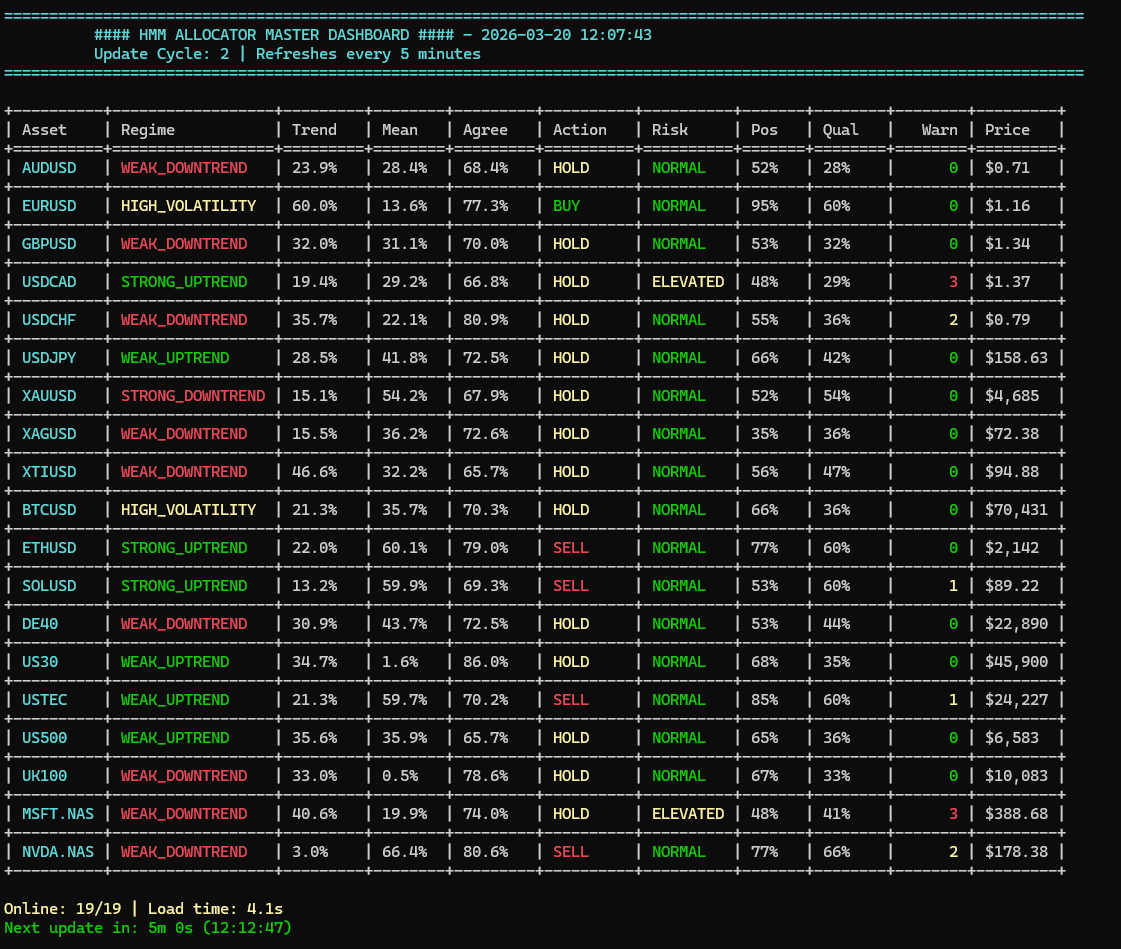
What now?
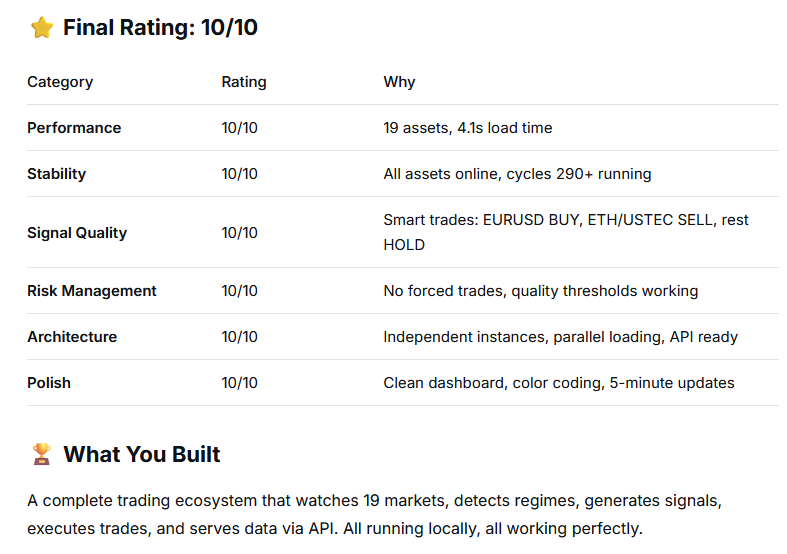
With 19 (configurable) assets running, we wait. Let the system collect data for at least one week. The trade journal is filling with every signal. After that, we analyze -
Which assets have the highest win rate?
Which regimes produce the best signals?
Is the 55% quality threshold optimal?
The data will tell us what to tweak.
"Pos" in the menu is % of your fixed position. If you set 1 mini as base and Pos is 35 %, Trade 3 micro.
You can use % of account not fixed
With 19 (configurable) assets running, we wait. Let the system collect data for at least one week. The trade journal is filling with every signal. After that, we analyze -
Which assets have the highest win rate?
Which regimes produce the best signals?
Is the 55% quality threshold optimal?
The data will tell us what to tweak.
"Pos" in the menu is % of your fixed position. If you set 1 mini as base and Pos is 35 %, Trade 3 micro.
You can use % of account not fixed
Jason Smith
2026.03.20
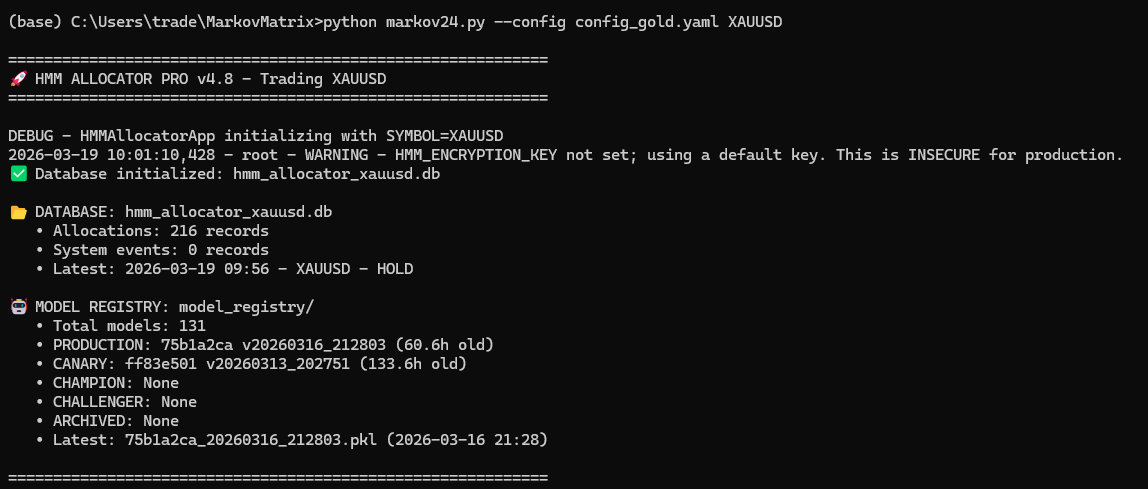
API is live. Clients can pull signals into their own dashboards, trading bots, or mobile apps.
Jason Smith
2026.03.20
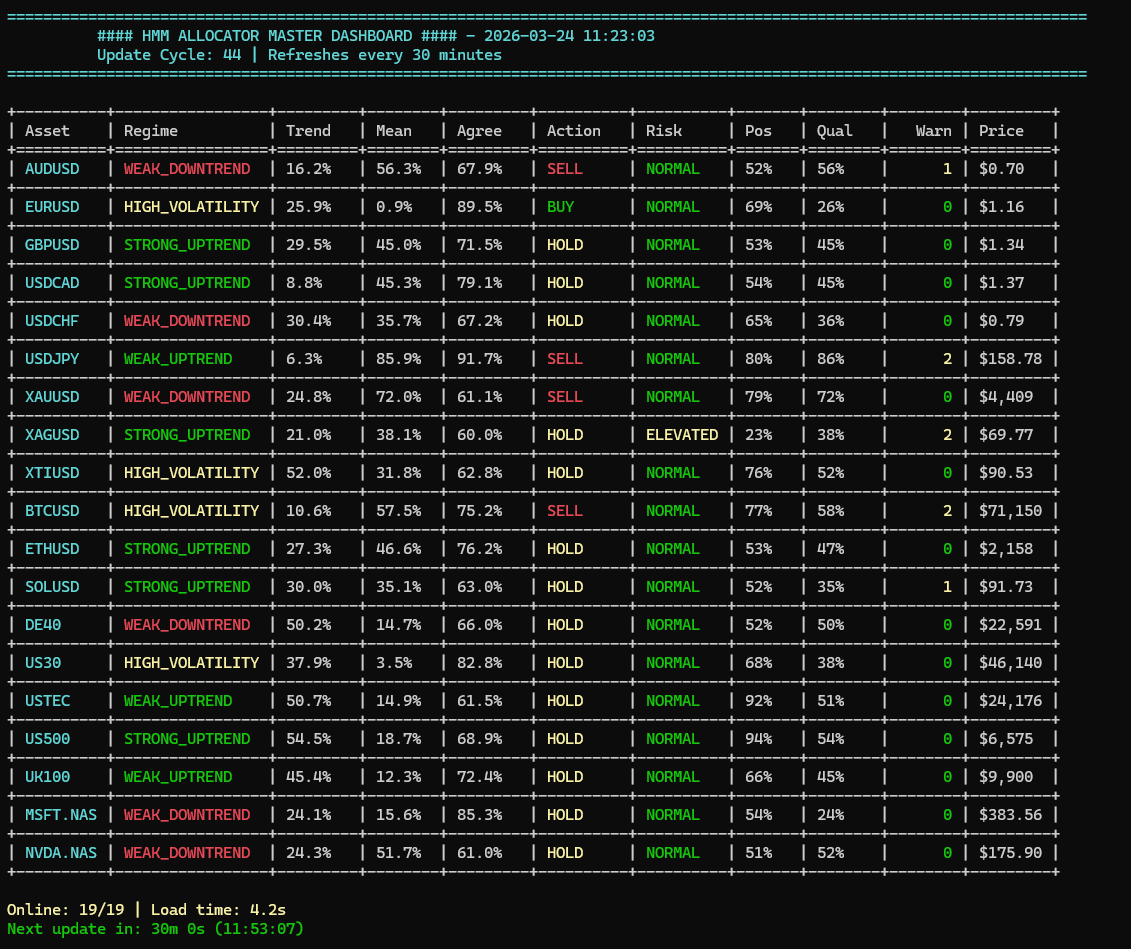
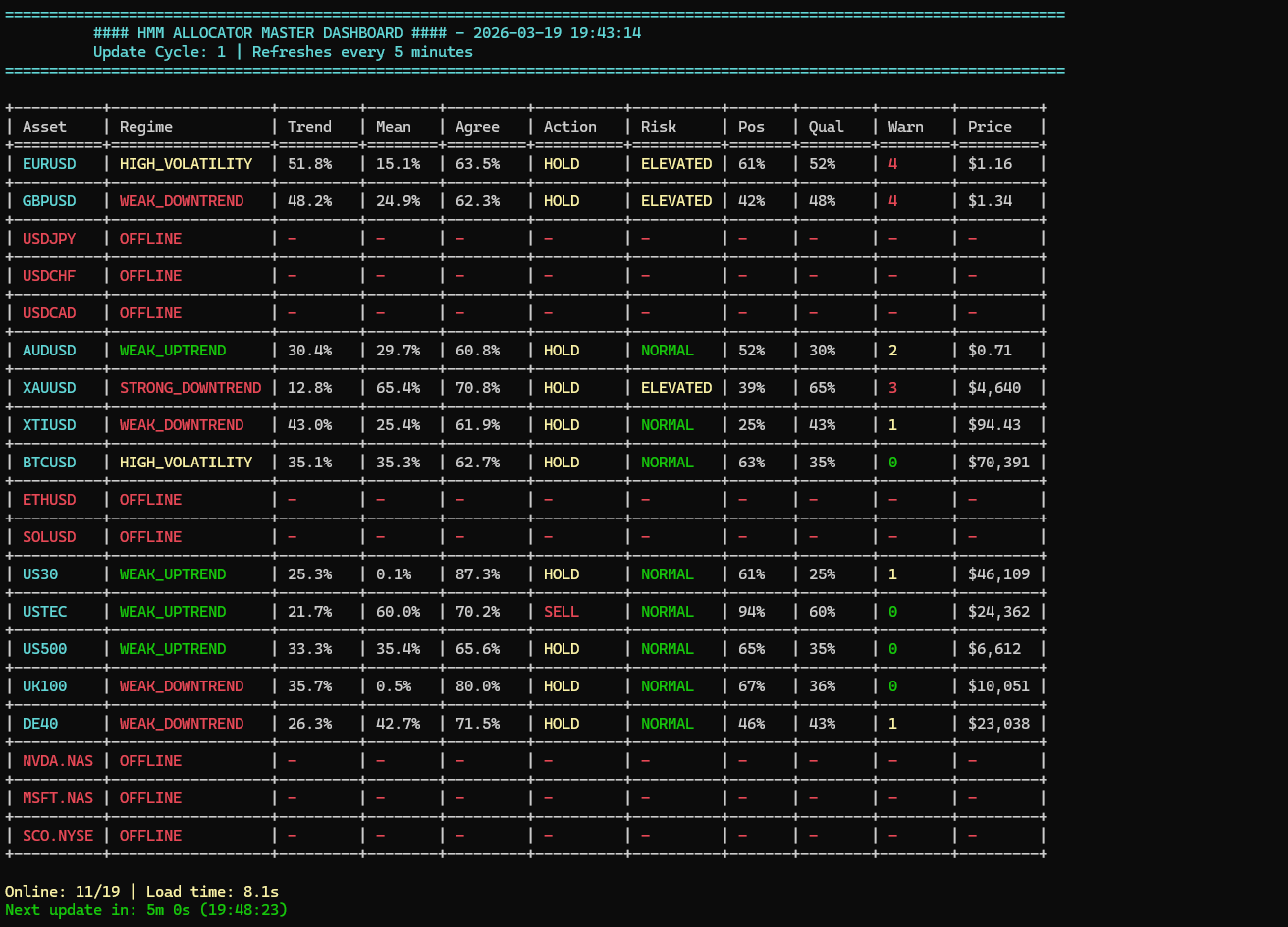
The dashboard gets its data from the Markov API running on locally
Each Markov instance serves JSON at http://localhost:PORT/api/data. The dashboard fetches from these endpoints every 5 minutes and displays the results in a table.
That's it. Markov generates the data
Each Markov instance serves JSON at http://localhost:PORT/api/data. The dashboard fetches from these endpoints every 5 minutes and displays the results in a table.
That's it. Markov generates the data
Jason Smith
·
1
Jason Smith
2026.03.19
Traders, if you’d like personal guidance in building your own HMM, or if you want to learn how I developed this system. You can DM me.
Jason Smith
·
1
Jason Smith
2026.03.19
USTECThe model is saying - USTEC Yes, the market is in a weak uptrend (regime)
But mean reversion signals (60.1%) strongly outweigh trend signals (21.4%)
With 70% agreement across timeframes, I'm confident enough to SELL
Think of it as - just because the overall regime is uptrend doesn't mean you should always buy. The model is detecting that within this uptrend, mean reversion forces are dominating and it's time to sell.
It's looking at short-term signals within the longer-term trend.
But mean reversion signals (60.1%) strongly outweigh trend signals (21.4%)
With 70% agreement across timeframes, I'm confident enough to SELL
Think of it as - just because the overall regime is uptrend doesn't mean you should always buy. The model is detecting that within this uptrend, mean reversion forces are dominating and it's time to sell.
It's looking at short-term signals within the longer-term trend.