Discussing the article: "Neural networks made easy (Part 42): Model procrastination, reasons and solutions"
Hello, Dimitri. Thank you for the new work. I was also trying to get a straight line on the graph. Now I understand why. Can you please tell me what Study2 results can be considered acceptable? Test does not show any meaningful actions yet, it opened a buy and fills on every bar.
By the way, the NeuroNet_DNG folder had to be dragged from the last EA. If you made changes to it, I am beating my head against the wall.
Hello, Dimitri. Thank you for the new work. I was also trying to get a straight line on the graph. Now I understand why. Can you please tell me what Study2 results can be considered acceptable? Test does not show any meaningful action yet, it opened a buy and fills on every bar.
By the way, the NeuroNet_DNG folder had to be dragged from the last EA. If you made changes to it, I am beating my head against the wall.
The latest versions of the files are in the attachment
Dmitry hello. Can you tell me how much you have trained this Expert Advisor so that it started to make at least some meaningful trades, even in minus. I just have it either does not try to trade at all, or opens a bunch of trades and can not pass the whole period of 4 months. At the same time the balance stands still and equity is floating. It uses one or two agents, the rest are zeros. The initial sample tried different.
-from 50$ for example 30-40 examples at the beginning and then after each pass of Stady2 (100000 by default), and then added 1-2 examples in a cycle.
-from $35 for example 130-150 examples at the beginning and then after each pass of Stady2 (100000 by default), and then added 1-2 examples in a loop.
- From 50$ with 15 examples at the beginning and did not add anything to train Stady2 in 500000 and 2000000 .
With all variants the result is the same - does not work, does not learn. Moreover, after 2-3 million iterations, for example, it may well show nothing again - just do not trade.
How much (in figures) it should be trained to start opening and closing trades at all?
Hello Dmitry! You were a great teacher and mentor!
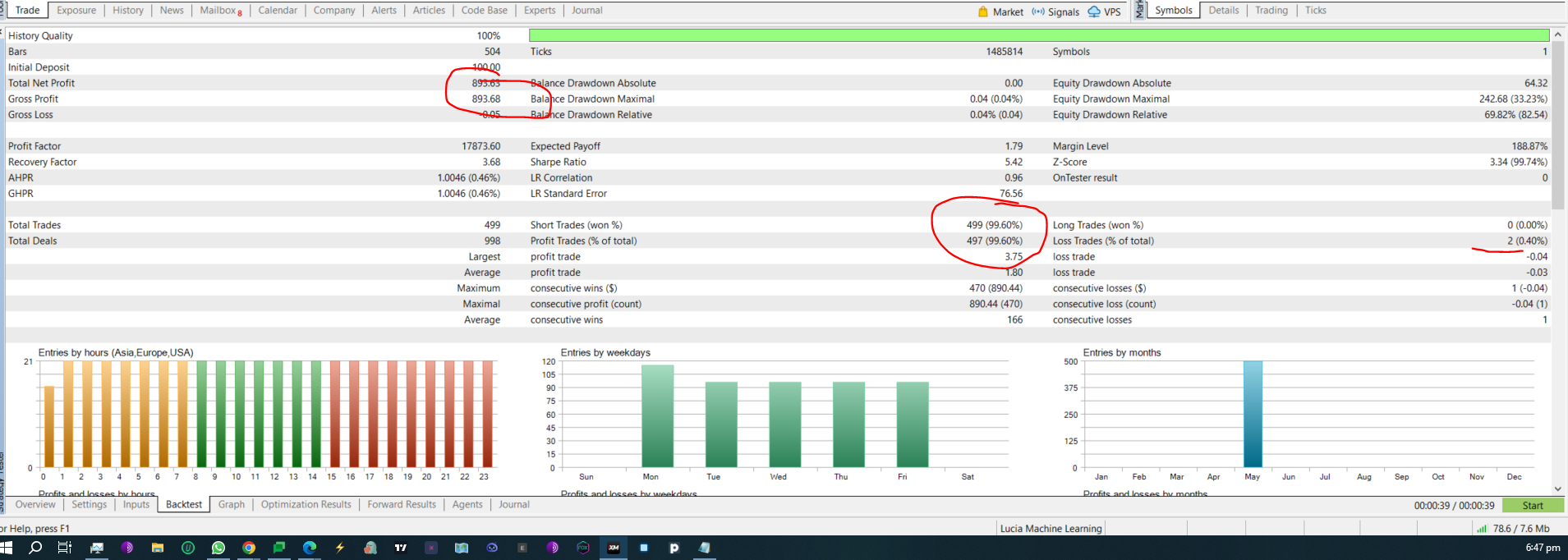
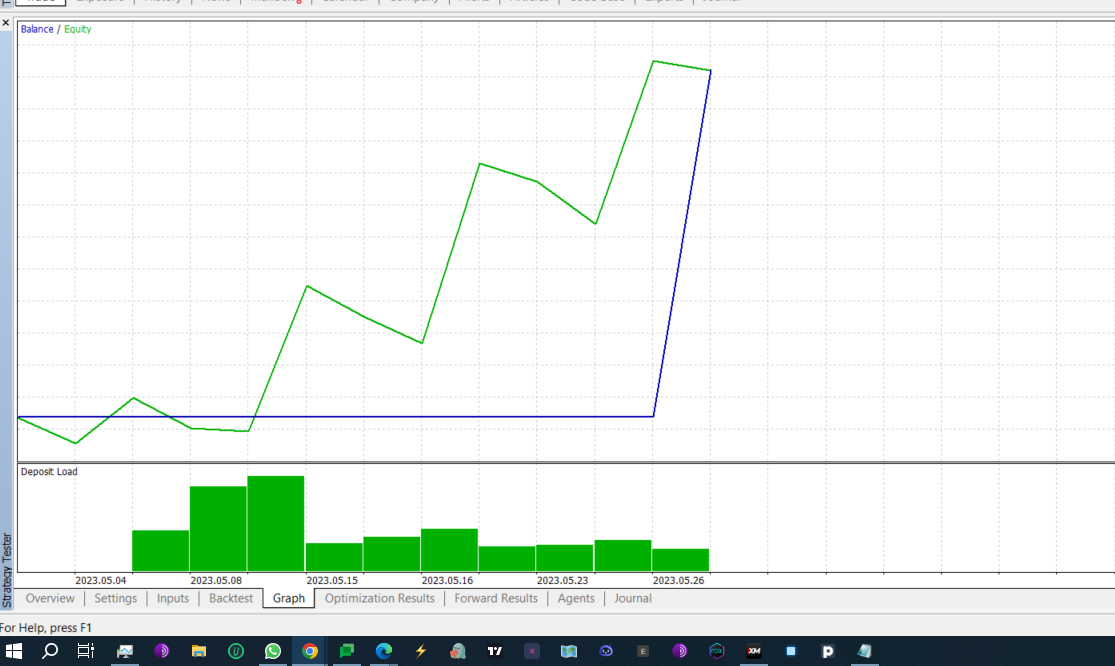
After some successful training, I was able to achieve a 99% win rate. However, it only sold trades. no buy trades
Here's a screenshot:
350733414_605596475011106_6366687350579423076_n.png (1909×682) (fbcdn.net)

Dmitriy,
I am following your articles to learn as much as possible as your knowledge and expertise is way beyond me. After reading the article, it occurred to me that while the final model presented is excellent at identifying short trades and totally unsuccessful at identifying long trades, it could be part of a two tier trading solution. A long trade model is needed to complement the short trades. Do you think the long model could be developed by reversing some of the assumptions or is a wholly new model required, such as toe Go Explore in article #39?
Cheers on your current efforts and support for your future endeavors

- Free trading apps
- Over 8,000 signals for copying
- Economic news for exploring financial markets
You agree to website policy and terms of use
Check out the new article: Neural networks made easy (Part 42): Model procrastination, reasons and solutions.
In the context of reinforcement learning, model procrastination can be caused by several reasons. The article considers some of the possible causes of model procrastination and methods for overcoming them.
One of the main reasons for model procrastination is an insufficient training environment. The model may encounter limited access to training data or insufficient resources. Solving this problem involves creating or updating the dataset, increasing the diversity of training examples and applying additional training resources, such as computing power or pre-trained models for transfer training.
Another reason for model procrastination may be the complexity of the task it should solve or using a training algorithm that requires a lot of computing resources. In this case, the solution may be to simplify the problem or algorithm, optimize computational processes and use more efficient algorithms or distributed learning.
A model may procrastinate if it lacks motivation to achieve its goals. Setting clear and relevant goals for the model, designing a reward function that incentivizes the achievement of these goals and using reinforcement techniques, such as rewards and penalties, can help solve this problem.
If the model does not receive feedback or is not updated based on new data, it may procrastinate in its development. The solution is to establish regular model update cycles based on new data and feedback, and to develop mechanisms to control and monitor learning progress.
It is important to regularly evaluate the model's progress and learning outcomes. This will help you see progress made and identify possible problems or bottlenecks. Regular assessments will allow timely adjustments to be made to the training process to avoid delays.
Author: Dmitriy Gizlyk