Discussion of article "Developing a self-adapting algorithm (Part II): Improving efficiency" - page 9

You are missing trading opportunities:
- Free trading apps
- Over 8,000 signals for copying
- Economic news for exploring financial markets
Registration
Log in
You agree to website policy and terms of use
If you do not have an account, please register
Hello, this is a great contribution, thank you very much!
In order to achieve the portfolio performance across 28 pairs (last graph in your article), can I use the set file (labelled 26set) and run the EA on 1H? Of course understanding that the results might no be replicated in real trading, but the stability and drawdowns look very appealing. Thanks for your advice!
Hello, this is a great contribution, thank you very much!
In order to achieve the portfolio performance across 28 pairs (last graph in your article), can I use the set file (labelled 26set) and run the EA on 1H? Of course understanding that the results might no be replicated in real trading, but the stability and drawdowns look very appealing. Thanks for your advice!
Good afternoon, Maxim!
Thanks for the great work and analysis.
Very interesting approach. But of course the problem remains with entries on peaks (on reversals). Probably it is not
I wrote some programmes for different platforms including MT5, Tslab.
Ready to participate in volunteer work. I have time. Now I am studying the code Max_50per_V2_final_test4.
Started your code in trading on centovik. I will see the results. But the first (daily) result is a little bit tense. Positive result. That's great. But there were no serious reversals yet. Let's see how the averaging will go. I have some thoughts on adapting this process.
For now, I will observe the work and read your next articles to tighten up.
Once again respect.
For stocks, creating an averaging robot would be ideal. I have them on TSLaB. But due to the costliness of connectors with small deposits does not pay off. And the fact that buying shares excludes margin trading, which means you need a large deposit.
Ideal option. Small account for speculation > profit > shares (bonds) dividends dividends coupons.
Looking forward to more work.
I'm testing on a centovik. Here is the situation when averaging has already passed the set. It is necessary to introduce zones of averaging levels and not to allow the position to be over-set in this level. Otherwise, the rule of martingale and fan 1 2 4 8 16 32 in these examples has already passed the limit. Now the situation is 1 (5).There might be a pullback. That's what you're predicting. It's bound to happen sometime. But it's very risky.
Good afternoon, Maxim!
Thank you for the great work and analysis.
Very interesting approach. But of course the problem remains with entries on peaks (on reversals). Probably it is not
I wrote some programmes for different platforms including MT5, Tslab.
Ready to participate in volunteer work. I have time. Now I am studying the code Max_50per_V2_final_test4.
Started your code in trading on centovik. I will see the results. But the first (daily) result is a little bit tense. Positive result. That's great. But there were no serious reversals yet. Let's see how the averaging will go. There are some thoughts on adaptation of this process.
For the time being I will observe the work and read your next articles to get better.
Once again respect.
For stocks, creating an averaging robot would be ideal. I have them on TSLaB. But due to the costliness of connectors with small deposits it doesn't pay off. And the fact that buying shares excludes margin trading, which means that you need a large deposit.
Ideal option. Small account for speculation > profit > shares (bonds) dividends dividends coupons.
Looking forward to more work.
On stocks this robot will not work very well most likely. I tested it on stocks, but I don't remember the result. I think something can be adjusted to make it work stably, but it was a long time ago, I don't remember.
I'm testing on a centovik. Here is the situation when averaging has already passed the set. It is necessary to introduce zones of averaging levels and not to allow the position to be over-set in this level. Otherwise, the rule of martingale and fan 1 2 4 8 16 32 in these examples has already passed the limit. Now the situation is 1 (5).There might be a pullback. That's what you're predicting. It's bound to happen sometime. But it's very risky.
There the maximum loss can be limited at any level for each instrument individually and for all together. As a rule, I used to set $3000. That is, I optimised on a long history (at least 10 years), chose parameters with drawdowns not more than 2000-2500 and made a reserve up to 3000. This is a protective stop loss. The idea was that most likely the drawdown will not reach this value. But if it does, the losses are limited.
there the maximum loss can be limited at any level for each instrument individually and for all together. As a rule, I used to set $3000. That is, I optimised on a long history (at least 10 years), chose parameters with drawdowns not more than 2000-2500 and made a reserve up to 3000. This is a protective stop loss. The idea was that most likely the drawdown will not reach this value. But if it does, the losses are limited.
In any case, the drawdown is limited by the deposit. It is also a stop loss in averaging algorithms. We sit until the last one.
But here the question is different. Now I will look into the code to limit the opening of additional positions in a certain buffer zone () well, maybe on the discrete ATR. At the moment, in very quiet flatness, many positions can be opened actually at the same price. Once again, I will attach the figure to make it clear.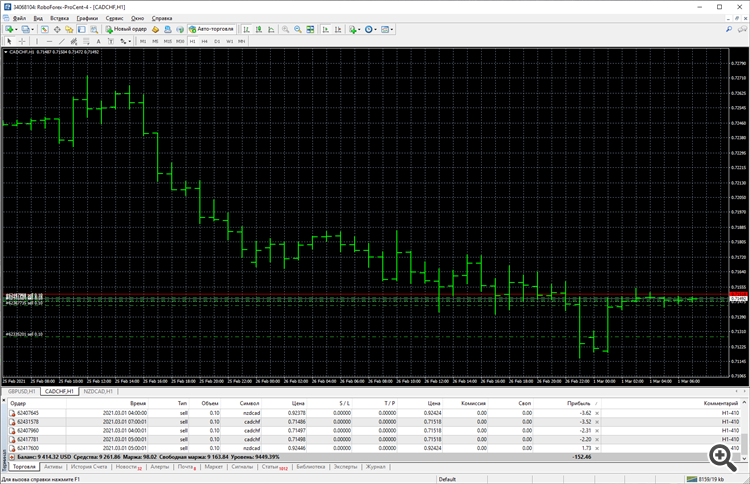
This robot will probably not work very well on stocks. I tested it on stocks, but I don't remember the result. I think something can be adjusted to make it work stably, but it was a long time ago, I don't remember.
If you leave only longs and increase the entry discretes, it will be just right.
If you leave only longs and increase the input discretes it will be just right.
then the input discretisation should be floating and depend on something. I didn't have to figure out how to realise it and started developing an improved algorithm. The fact that it opens trades at the same level is done on purpose, the pattern of time discretisation is used here. I had an idea to use pairs of shares, such as GAZP/SBER, for trading and redesign the algorithm accordingly. Read the next 2 articles, the algorithm described there was developed with consideration of trading on shares, and the 4th article even has tests on shares. It is significantly different from this one.