Kalman Filter
I'm looking for someone that feels the have developed a good working Kalman Filter Model to use in the fx market?
- Forex Books
- Discussion of article "Using the Kalman Filter for price direction prediction"
- implementing Kalman filter
catsally1: I'm looking for someone that feels the have developed a good working Kalman Filter Model to use in the fx market?
How about letting your fingers do the walking with the "Search" facility: https://www.mql5.com/en/search#!keyword=Kalman%20Filter

Search - MQL5.community
- www.mql5.com
Searching is based on morphology and is insensitive to case. All letters, no matter of their case, will be processed as lowercase. By default, our search engine shows pages, that...
- Non-Linear Kalman Filter indicator - the post
- KalmanBands indicator - the post
- Kalman filter - indicator for MetaTrader 4
- Nonlinear Kalman filter - indicator for MetaTrader 5
- Kalman_Filter - indicator for MetaTrader 5
Forum on trading, automated trading systems and testing trading strategies
Sergey Golubev, 2025.02.27 16:49
The Kalman Filter for Forex Mean-Reversion Strategies

The Kalman filter is a recursive algorithm used in algorithmic trading to estimate the true state of a financial time series by filtering out noise from price movements. It dynamically updates predictions based on new market data, making it valuable for adaptive strategies like mean reversion. This article first introduces the Kalman filter, covering its calculation and implementation. Next, we apply the filter to a classic mean-reversion forex strategy as an example. Finally, we conduct various statistical analyses by comparing the filter with a moving average across different forex pairs.

This article presents that practical solution: a scalar state‑space Kalman smoother whose blending weight is the optimally computed Kalman Gain and whose process and measurement noise variances are estimated online from rolling windows of returns and price deviations.

A Practical Kalman Filter Price Smoother in MQL5: Adaptive Noise Estimation Without External Libraries
- 2026.06.22
- www.mql5.com
Fixed-weight moving averages introduce regime-insensitive lag. This work presents an adaptive scalar Kalman filter indicator in native MQL5 that estimates process noise Q from rolling return variance and measurement noise R from rolling price variance, with floor clamps for stability, and recomputes the Kalman Gain on every bar. The chart-overlay output is benchmarked against a 20-period EMA using MAE, RMSE, lag, and smoothness metrics to quantify tracking and noise suppression.
The Kalman Filter for Price Smoothing: An Exact Implementation in MQL5
The Kalman Filter, developed by Rudolf Kalman in 1960 and famously used for spacecraft navigation on the Apollo program, approaches this differently. Rather than a fixed weighting scheme, it maintains an explicit estimate of its own uncertainty at every step, and uses that uncertainty to calculate, mathematically, exactly how much weight a new observation deserves. When the filter is confident in its current estimate, it leans on that. When a new observation is more informative than what came before, it leans on that instead. This weighting — the Kalman gain — is not a value entered directly; it is computed deterministically from the noise parameters Q and R that are chosen by hand, and it converges toward a steady-state value set by their ratio. The gain formula itself involves no manual tuning, but the Q and R inputs that drive it are still a user choice.

The Kalman Filter for Price Smoothing: An Exact Implementation in MQL5
- 2026.10.20
- www.mql5.com
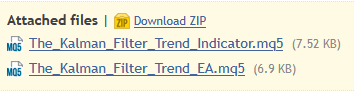
This article implements the scalar Kalman Filter for price smoothing in MQL5 using the standard local-level model and the exact prediction–update equations. It explains how process and measurement noise (Q, R) shape the Kalman gain, builds two independently configured filters into a fast/slow crossover, and provides a complete indicator and Expert Advisor that trade a stability-confirmed signal via iCustom, giving a reproducible baseline for testing and tuning.

You are missing trading opportunities:
- Free trading apps
- Over 8,000 signals for copying
- Economic news for exploring financial markets
Registration
Log in
You agree to website policy and terms of use
If you do not have an account, please register