Technical Analysis (October 6, 2014). The EURUSD tumbled to support
after better than expected Non-Farm Payroll. Will the trend continue in
trading this week?
The Euro may be readying a rebound against the US Dollar
after prices put in a bullish Piercing Line candlestick pattern. A
daily close above support-turned-resistance at 1.2703, the November 2012
bottom, exposes the March 2013 floor at 1.2777. Alternatively, a drop
below the 23.6% Fib expansion at 1.2500 clears the way for a challenge
of the 38.2% level at 1.2377.
EUR/USD Scope For Recovery May Be Limited In Spite Of A Piercing Line(based on dailyfx article)
EUR/USD Technical Strategy: Sidelines Preferred
Piercing Line Pattern Awaits Confirmation Near 2014 Low
Dojis On H4 Suggested Fading Downside Momentum
EUR/USD’s recent rebound has yielded a Piercing Line formation,
yet some skepticism over a recovery is warranted. The pattern requires a
successive up-day in order to be validated and to suggest a base may
have formed. This may prove a difficult feat given the sustained
presence of a downtrend and the sellers still sitting nearby at the
1.2700 handle. Further, the Euro’s path lower over recent months has
been littered with reversal signals that have failed to catalyze a
recovery.
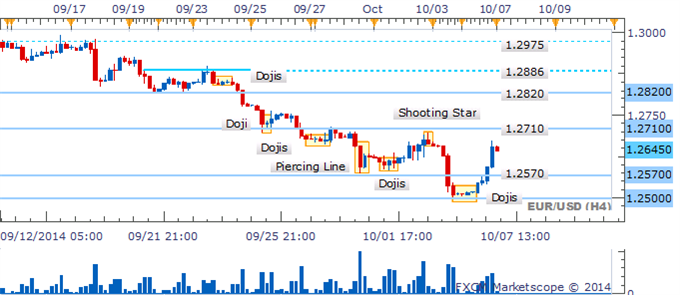
EUR/USD’s intraday recovery was preceded by a parade of Doji formations.
The candlesticks suggested hesitation by the bears to lead the pair
lower at the critical 1.2500 barrier. While an absence of reversal
signals leaves some doubt over a correction, the context on the daily
warns that scope for further gains may be limited.
Normally, the media and market participants are hyping the risk of
reversal or volatility. It seems they under-appreciate it today. Both
the US Dollar
and equity indexes are standing on the edge of important technical
levels - a break from the greenbacks three-month trend and the floor of a
S&P 500
channel that stretches back to the beginning of 2013. Symbolic breaks
for either of these two can tip large fundamental imbalances to trigger
deeper trends. What is the potential this pressure represents? Which
faces the larger unwind? Why does the USDJPY appeal through more
scenarios while the medium-term EURUSD outlook is bearish even if the
greenback slips? We discuss these topics in today's Trading Video.
EUR/USD Technical Analysis: Profits Booked on Short Position(based on dailyfx article)
The Euro recovered against US Dollar as expected
after putting in a bullish Piercing Line candlestick pattern. A daily
close above support-turned-resistance at 1.2777, the March 2013 bottom,
exposes the 38.2% Fibonacci retracement at 1.2848. Alternatively, a turn
below the 1.2703-15 area marked by the November 2012 floor and the
23.6% Fib clears the way for a challenge of trend line
resistance-turned-support at 1.2673.
if actual > forecast (or actual data) = good for currency (for EUR in our case)
[EUR - French Trade Balance] = Difference in value between imported and exported goods during the reported month. Export demand and currency demand are directly linked because foreigners
must buy the domestic currency to pay for the nation's exports. Export
demand also impacts production and prices at domestic manufacturers.
Trading the News: Canada Net Change in Employment (based on dailyfx article)
Canada Employment to Increase for Fifth Month in 2014.
Jobless Rate to Hold at Annualized 7.0% for Third Consecutive Month.
The USD/CAD may face a larger pullback going into the end of the week
should Canada’s Employment report show a meaningful rebound in job
growth and fuel interest rate expectations.
What’s Expected:
Why Is This Event Important:
An upbeat employment print may put increased pressure on the Bank of
Canada (BoC) to further normalize monetary policy, but we would need to
see a material shift in the forward-guidance to adopt a bullish outlook
for the Canadian dollar as Governor Stephen Poloz continues to endorse a
period of interest rate stability.
Easing input costs along with the pickup in private sector activity may
generate a strong pickup in job growth, and a positive print may
threaten the opening monthly range in the USD/CAD as it boosts interest
rate expectations.
However, weakening demand at home and abroad may drag on employment, and
a dismal development may heighten the bullish sentiment surrounding the
USD/CAD as it gives the BoC greater scope to retain its current policy
for an extended period of time.
How To Trade This Event Risk
Bullish CAD Trade: Canada Adds 20.0K or More Jobs
Need red, five-minute candle following the report for a potential short USD/CAD trade
If market reaction favors a long loonie trade, sell USD/CAD with two separate position
Set stop at the near-by swing high/reasonable distance from entry; look for at least 1:1 risk-to-reward
Move stop to breakeven on remaining position once initial target is met, set reasonable limit
Bearish CAD Trade: Employment Report Disappoints
Need green, five-minute candle to consider a long USD/CAD position
Carry out the same setup as the bullish Canadian dollar trade, just in the opposite direction
Will favor topside targets as inverse head-and-shoulders remains in play & RSI retains bullish momentum
Interim Resistance: 1.1300 pivot to 1.1320 (61.8% expansion)
Interim Support: 1.1050 (61.8% expansion) to 1.1065 (23.6% expansion)
Impact that Canada Employment Change has had on CAD during the last release
Period
Data Released
Estimate
Actual
Pips Change
(1 Hour post event )
Pips Change
(End of Day post event)
AUG 2014
09/05/2014 12:30 GMT
10.0K
-11.0K
+12
+8
The Canada employment report disappointed, with the region shedding
11.0K jobs in August after adding 41.7K the month prior. Despite a
downtick in the participation rate to 66.0% from 66.1%, the unemployment
rate held steady at an annualized 7.0% for the second consecutive
month. As a result, it seems as though the Bank of Canada will retain
its neutral tone for monetary policy and keep the benchmark interest
rate at 1.00% throughout the remainder of the year in an effort to
encourage a more robust recovery. The reaction to the dismal reading was
short-lived as the USD/CAD chopped around the 1.0880 level during the
North America trade, with the pair closing at 1.0879.
UK inflation data, Mario Draghi and Janet Yellen’s speeches, US
Retail sales, Unemployment and manufacturing data are the major
events on our calendar for this week. Here is an outlook on the main
market movers coming our way.
Last week, despite continuous positive US data, the FOMC minutes
defied expectations for a possible rate hike in the near future,
sending the dollar down. The minutes revealed a debate on the necessary
normalization period, which the hawks considered too long. Fed minutes
also showed that some policymakers feared a stronger dollar will
generate downward pressure on inflation and that global economic growth
is on a downward trend. Will the dollar continue to decline?
UK inflation data: Tuesday,
8:30. The annual inflation rate in the UK declined from 1.6% to 1.5%
in August, amid lower prices of petrol, food and non-alcoholics drinks.
Meanwhile, core inflation, excluding food, alcohol, tobacco and
energy, edged up1.9%. However the low inflation bides well with
consumer’s purchasing power due to a slow wage growth. UK inflation is
expected to decline to 1.4% this time.
Eurozone German ZEW Economic Sentiment:
Tuesday, 9:00. German investor confidence declined to a 21 month low
of 6.9 in September following a 8.6 reading in August amid stronger
political tensions in Europe. Analysts expected an even lower figure of
5.2. This was the lowest reading since December 2012. German economy
slowed down in the third quarter which may weaken growth in the second
half of the year. German investor confidence s expected to plunge to
0.2.
UK Employment data: Wednesday, 8:30. U.K.
unemployment rate fell to the lowest level in six years, indicating
continued strength in the labor market. Likewise, U.K. jobless claims
dropped 37,200, far better than the 30,000 decline estimated by
economists. That pushed the total below 1 million for the first time
since September 2008. The number of workers rose by 74,000 to 30.6
million. Despite the slow growth in wages, Bank of England Governor Mark
Carney is confident that job market growth will eventually boost
salaries. U.K. jobless claims are expected to decline further by 34,200
now.
Mario Draghi speaks: Wednesday, 7:00,
18:00. ECB President Mario Draghi will speak in Frankfurt at two
occasions. He may talk about the ECB’s efforts to raise inflation to
normal levels and the planned QE. Market volatility is expected.
US retail sales:
Tuesday, 12:30. U.S. retail sales gained 0.6% in August amid a buying
spree of automobiles and a range of other goods. Economists expected a
0.3% increase as in July. Meanwhile core sales expanded 0.3%
exceeding expectations for a 0.2% rise. Consumer sentiment also
soared, hitting a 14-month high in September. However lack of real
wage growth may weigh on retail sales in the future but the third
quarter looks promising. Retail sales are expected to decline by 0.1% ,
while core sales are predicted to rise 0.2%.
US PPI:
Tuesday, 12:30. Wholesale prices in the U.S. remained changed in
August from the previous month, held back by a plunge in energy costs
as well as indicating low inflation in the production pipeline. In the
last 12 months, wholesale prices increased 1.8%. The PPI excluding
food and energy inched 0.1% from the prior month. Producer prices are
predicted to gain 0.1% this time.
US Unemployment Claims: Thursday,
12:30. Fewer Americans filed claims for unemployment benefits last
week, reducing the average number of applications to the lowest level
in eight years reaching 287,750. Applications declined 1,000 to
287,000 last week, suggesting employers keep their workers, expecting
continued economic growth including expansion in hiring. The number of
people receiving benefits has also fallen steadily to just 2.38
million in the week ended Sept. 27. Jobless claims are expected to
reach 286,000 this week.
US Philly Fed Manufacturing Index:
Thursday, 14:00. Manufacturing activity in the Philadelphia area
declined in September to 22.5 from 28 in August which was the highest
since March 2011. Economists expected a slightly higher reading of
22.8. Despite the fall in September, the survey reflects continued
growth in the region’s manufacturing sector as many indicators for
future manufacturing conditions reflect general optimism about growth
in activity and employment over the next six months. Manufacturing
activity in the Philadelphia area is anticipated to decline further to
19.9.
US Building Permits: Friday, 12:30. The
number of permits issued for privately-owned housing units reached a
seasonally adjusted annual rate of 998,000 in August following the
revised July rate of 1,057,000. Economists expected a total of
1,040,000. Single-family permits in August reached 626,000, 0.8% below
the revised July figure of 631,000. Authorizations of units in
buildings with five units or more were at a rate of 343,000 in August.
The number of permits is expected to grow to 1.04 million.
Janet Yellen speaks: Friday,
12:30. Federal Reserve Chair Janet Yellen is scheduled to speak in
Boston. Yellen may shed more light on the FOMC minutes released last
week and the gloomy growth outlook despite positive US economic data.
Market volatility is expected.
US Prelim UoM Consumer Sentiment:
Friday, 13:55. The preliminary September reading of University of
Michigan’s consumer sentiment soared to 84.6, the highest since July
2013, following 82.5 in the final August reading. Despite consumers’
fears of a slowdown in employment growth, anticipations were high on
wage expansion. Consumer expectations jumped to 75.6 from the 71.3
reading last month and above a forecast of 73.0. Consumer sentiment s
expected to reach 84.3 this time.
The Japanese Yen surged versus all major counterparts as the US S&P
500 saw its worst weekly decline in over two years. There’s little
economic event risk out of Japan in the week ahead, but we think big
things stand on the horizon for JPY pairs.
Traders pushed the Japanese Yen to fresh multi-year lows versus the US
Dollar as broader financial markets soared, but a clear flight to
safety warns that the JPY may soon regain favor. Typically we would
favor the traditional safe-haven in the US Dollar through times of
market turmoil.
Yet the clear fact is that speculators remain extremely short the Yen
and long the dollar (long USDJPY). This in turn suggests that the
Greenback could actually do poorly if we see further stock market
tumbles and a broader deleveraging across leveraged assets.
A virtually empty Japanese economic calendar in the week ahead suggests
that few expect major JPY moves. Our Senior Technical Strategist
nonetheless warns that the USDJPY may be nearing a significant breakdown.
And indeed we say this: don’t fall asleep on the Yen. It could very
well be that this is a minor S&P 500 correction within a much larger
bull trend. Yet we can’t rule out a larger pullback, and we believe
the JPY could surge if this is indeed the start of a larger market
correction.
GBPAUD Outside Reversal Favors Long Scalps- 1.8440 Resistance
British Pound May Turn Lower as BOE Policy Standstill Continues
The GBP/USD may continue to carve lower-highs & lows in the week
ahead should the fundamental developments coming out of the U.K.
economy further dampen interest rate expectations.
The U.K. Consumer Price Index (CPI) may mark the lowest print since
2009 as the headline reading is expected to slow to an annualized 1.4%,
and the diminishing threat for inflation may heighten the bearish
sentiment surrounding the British Pound as the Bank of England (BoE)
remains in no rush to normalize monetary policy. It seems as though we
will continue to see a 7-2 split within the Monetary Policy Committee
(MPC) amid the limited headlines surrounding the October 9 interest
rate decision, and we may see Martin Weale and Ian McCafferty continue
to serve as the minority throughout 2014 as wage pressures remain
largely subdued.
However, the September Jobless Claims report may generate a greater
rift within the BoE as Average Weekly Earnings are projected to uptick
for the first time since March, and a strong rebound in wage growth may
renew bets for higher borrowing costs as the central bank continues to
take note of the stronger-than-expected recovery in the labor market.
With that said, the inflation outlook is likely to heavily impact the
British Pound next week as BoE Governor Mark Carney retains a rather
balanced tone for monetary policy, and the central bank may have little
choice but to pay closer attention to the recent wave of U.S. dollar
strength as the depreciation in the exchange rate raise the risk for
imported inflation.
As a result, the GBP/USD remains vulnerable to a further decline,
especially as the Relative Strength Index (RSI) retains the bearish
momentum carried over from back in July, with the next key downside
objective coming in around the 1.5900, the 50.0% Fibonacci expansion
from the 2009 lows.
Will the EURUSD continue to fall?
Technical Analysis (October 6, 2014). The EURUSD tumbled to support after better than expected Non-Farm Payroll. Will the trend continue in trading this week?
EUR/USD Technical Analysis: Floor Set at 1.25 Threshold?
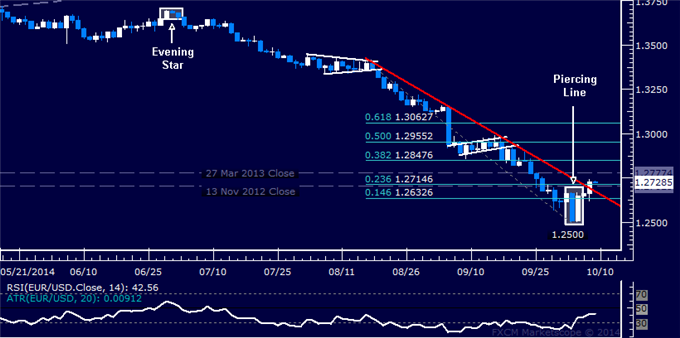
The Euro may be readying a rebound against the US Dollar after prices put in a bullish Piercing Line candlestick pattern. A daily close above support-turned-resistance at 1.2703, the November 2012 bottom, exposes the March 2013 floor at 1.2777. Alternatively, a drop below the 23.6% Fib expansion at 1.2500 clears the way for a challenge of the 38.2% level at 1.2377.
EUR/USD Scope For Recovery May Be Limited In Spite Of A Piercing Line (based on dailyfx article)
EUR/USD’s recent rebound has yielded a Piercing Line formation, yet some skepticism over a recovery is warranted. The pattern requires a successive up-day in order to be validated and to suggest a base may have formed. This may prove a difficult feat given the sustained presence of a downtrend and the sellers still sitting nearby at the 1.2700 handle. Further, the Euro’s path lower over recent months has been littered with reversal signals that have failed to catalyze a recovery.
EUR/USD’s intraday recovery was preceded by a parade of Doji formations. The candlesticks suggested hesitation by the bears to lead the pair lower at the critical 1.2500 barrier. While an absence of reversal signals leaves some doubt over a correction, the context on the daily warns that scope for further gains may be limited.
Forum on trading, automated trading systems and testing trading strategies
Something Interesting in Financial Video October 2014
newdigital, 2014.10.08 06:57
EURUSD and USDJPY - One Risks Correction, The Other Reversal
Normally, the media and market participants are hyping the risk of reversal or volatility. It seems they under-appreciate it today. Both the US Dollar and equity indexes are standing on the edge of important technical levels - a break from the greenbacks three-month trend and the floor of a S&P 500 channel that stretches back to the beginning of 2013. Symbolic breaks for either of these two can tip large fundamental imbalances to trigger deeper trends. What is the potential this pressure represents? Which faces the larger unwind? Why does the USDJPY appeal through more scenarios while the medium-term EURUSD outlook is bearish even if the greenback slips? We discuss these topics in today's Trading Video.
EUR/USD Technical Analysis: Profits Booked on Short Position (based on dailyfx article)
The Euro recovered against US Dollar as expected after putting in a bullish Piercing Line candlestick pattern. A daily close above support-turned-resistance at 1.2777, the March 2013 bottom, exposes the 38.2% Fibonacci retracement at 1.2848. Alternatively, a turn below the 1.2703-15 area marked by the November 2012 floor and the 23.6% Fib clears the way for a challenge of trend line resistance-turned-support at 1.2673.
if actual > forecast (or actual data) = good for currency (for EUR in our case)
[EUR - French Trade Balance] = Difference in value between imported and exported goods during the reported month. Export demand and currency demand are directly linked because foreigners must buy the domestic currency to pay for the nation's exports. Export demand also impacts production and prices at domestic manufacturers.
==========
Trading the News: Canada Net Change in Employment (based on dailyfx article)
The USD/CAD may face a larger pullback going into the end of the week should Canada’s Employment report show a meaningful rebound in job growth and fuel interest rate expectations.
What’s Expected:
Why Is This Event Important:
An upbeat employment print may put increased pressure on the Bank of Canada (BoC) to further normalize monetary policy, but we would need to see a material shift in the forward-guidance to adopt a bullish outlook for the Canadian dollar as Governor Stephen Poloz continues to endorse a period of interest rate stability.
Easing input costs along with the pickup in private sector activity may generate a strong pickup in job growth, and a positive print may threaten the opening monthly range in the USD/CAD as it boosts interest rate expectations.
However, weakening demand at home and abroad may drag on employment, and a dismal development may heighten the bullish sentiment surrounding the USD/CAD as it gives the BoC greater scope to retain its current policy for an extended period of time.
How To Trade This Event Risk
Bullish CAD Trade: Canada Adds 20.0K or More Jobs
- Need red, five-minute candle following the report for a potential short USD/CAD trade
- If market reaction favors a long loonie trade, sell USD/CAD with two separate position
- Set stop at the near-by swing high/reasonable distance from entry; look for at least 1:1 risk-to-reward
- Move stop to breakeven on remaining position once initial target is met, set reasonable limit
Bearish CAD Trade: Employment Report Disappoints- Will favor topside targets as inverse head-and-shoulders remains in play & RSI retains bullish momentum
- Interim Resistance: 1.1300 pivot to 1.1320 (61.8% expansion)
- Interim Support: 1.1050 (61.8% expansion) to 1.1065 (23.6% expansion)
Impact that Canada Employment Change has had on CAD during the last release(1 Hour post event )
(End of Day post event)
The Canada employment report disappointed, with the region shedding 11.0K jobs in August after adding 41.7K the month prior. Despite a downtick in the participation rate to 66.0% from 66.1%, the unemployment rate held steady at an annualized 7.0% for the second consecutive month. As a result, it seems as though the Bank of Canada will retain its neutral tone for monetary policy and keep the benchmark interest rate at 1.00% throughout the remainder of the year in an effort to encourage a more robust recovery. The reaction to the dismal reading was short-lived as the USD/CAD chopped around the 1.0880 level during the North America trade, with the pair closing at 1.0879.
MetaTrader Trading Platform Screenshots
USDCAD, M5, 2014.10.10
MetaQuotes Software Corp., MetaTrader 5, Demo
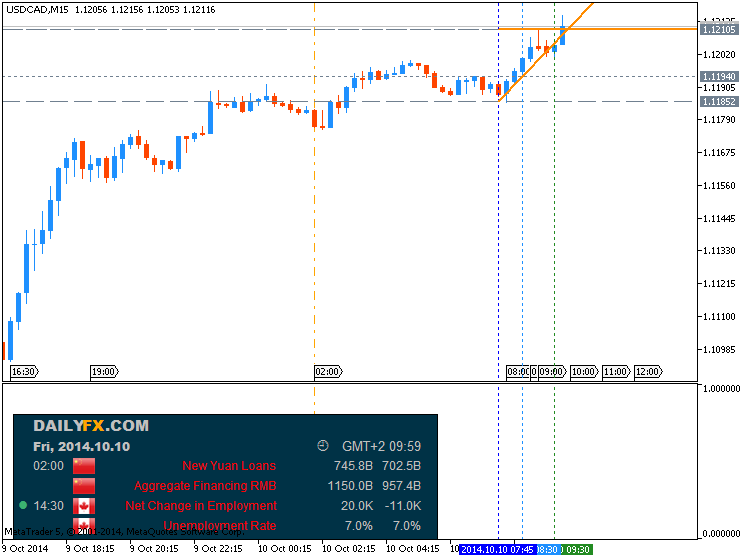
USDCAD M5 : 59 pips range price movement by CAD - Employment Change news event
UK inflation data, Mario Draghi and Janet Yellen’s speeches, US Retail sales, Unemployment and manufacturing data are the major events on our calendar for this week. Here is an outlook on the main market movers coming our way.
Last week, despite continuous positive US data, the FOMC minutes defied expectations for a possible rate hike in the near future, sending the dollar down. The minutes revealed a debate on the necessary normalization period, which the hawks considered too long. Fed minutes also showed that some policymakers feared a stronger dollar will generate downward pressure on inflation and that global economic growth is on a downward trend. Will the dollar continue to decline?
USDJPY Fundamentals (based on dailyfx article)
Fundamental Forecast for Pound: Neutral
The Japanese Yen surged versus all major counterparts as the US S&P 500 saw its worst weekly decline in over two years. There’s little economic event risk out of Japan in the week ahead, but we think big things stand on the horizon for JPY pairs.
Traders pushed the Japanese Yen to fresh multi-year lows versus the US Dollar as broader financial markets soared, but a clear flight to safety warns that the JPY may soon regain favor. Typically we would favor the traditional safe-haven in the US Dollar through times of market turmoil.
Yet the clear fact is that speculators remain extremely short the Yen and long the dollar (long USDJPY). This in turn suggests that the Greenback could actually do poorly if we see further stock market tumbles and a broader deleveraging across leveraged assets.
A virtually empty Japanese economic calendar in the week ahead suggests that few expect major JPY moves. Our Senior Technical Strategist nonetheless warns that the USDJPY may be nearing a significant breakdown. And indeed we say this: don’t fall asleep on the Yen. It could very well be that this is a minor S&P 500 correction within a much larger bull trend. Yet we can’t rule out a larger pullback, and we believe the JPY could surge if this is indeed the start of a larger market correction.
GBPUSD Fundamentals (based on dailyfx article)
Fundamental Forecast for Pound: NeutralBritish Pound May Turn Lower as BOE Policy Standstill Continues
The GBP/USD may continue to carve lower-highs & lows in the week ahead should the fundamental developments coming out of the U.K. economy further dampen interest rate expectations.
The U.K. Consumer Price Index (CPI) may mark the lowest print since 2009 as the headline reading is expected to slow to an annualized 1.4%, and the diminishing threat for inflation may heighten the bearish sentiment surrounding the British Pound as the Bank of England (BoE) remains in no rush to normalize monetary policy. It seems as though we will continue to see a 7-2 split within the Monetary Policy Committee (MPC) amid the limited headlines surrounding the October 9 interest rate decision, and we may see Martin Weale and Ian McCafferty continue to serve as the minority throughout 2014 as wage pressures remain largely subdued.
However, the September Jobless Claims report may generate a greater rift within the BoE as Average Weekly Earnings are projected to uptick for the first time since March, and a strong rebound in wage growth may renew bets for higher borrowing costs as the central bank continues to take note of the stronger-than-expected recovery in the labor market. With that said, the inflation outlook is likely to heavily impact the British Pound next week as BoE Governor Mark Carney retains a rather balanced tone for monetary policy, and the central bank may have little choice but to pay closer attention to the recent wave of U.S. dollar strength as the depreciation in the exchange rate raise the risk for imported inflation.
As a result, the GBP/USD remains vulnerable to a further decline, especially as the Relative Strength Index (RSI) retains the bearish momentum carried over from back in July, with the next key downside objective coming in around the 1.5900, the 50.0% Fibonacci expansion from the 2009 lows.