Paulo Henrique Sanches Bonanni / Notícias
- Informações
|
1 ano
experiência
|
4
produtos
|
2
versão demo
|
|
0
trabalhos
|
0
sinais
|
0
assinantes
|
PHSB Elliott EA Automated Trading Based on Elliott Wave Market Structure Trade the structure. Let the system manage the operation. O PHSB Elliott EA é um Expert Advisor desenvolvido para o MetaTrader 5 com foco na identificação automática de estruturas compatíveis com as Ondas de Elliott , buscando oportunidades especialmente durante a formação de movimentos de impulso. Em vez de depender de uma simples combinação de indicadores tradicionais, o EA trabalha com a estrutura de preço

PHSB Market Vision Uma nova forma de enxergar o mercado. O mercado está sempre falando. A questão é saber interpretar o que o preço está mostrando. O PHSB Market Vision foi desenvolvido para proporcionar uma visão mais ampla e organizada do comportamento do mercado, reunindo em uma única ferramenta diferentes referências de preço, tendência, volatilidade e volume . Em vez de acompanhar diversos indicadores separadamente, o Market Vision coloca essas informações em uma estrutura visual integrada


PHSB Elliott Wave — Indicador de Ondas de Elliott para MT5 Identifique a estrutura do mercado através das Ondas de Elliott O PHSB Elliott Wave é um indicador desenvolvido para o MetaTrader 5 com o objetivo de auxiliar na identificação e acompanhamento das Ondas de Elliott diretamente no gráfico. A proposta do indicador é transformar uma teoria que muitas vezes parece subjetiva em uma leitura mais objetiva, visual e organizada da estrutura do preço . Em vez de simplesmente procurar padrões


Gold FVG Finder EA Gold FVG Finder EA is a selective Expert Advisor for MetaTrader 5, designed for trading gold on XAUUSD M15 . The strategy is built around Fair Value Gap retests, ATR regime filtering, liquidity sweep confirmation, market structure and controlled risk management. This EA is not a grid system and it does not use martingale. The main idea is not to open trades every day at any cost. The EA waits for a specific gold market structure where an FVG continuation setup
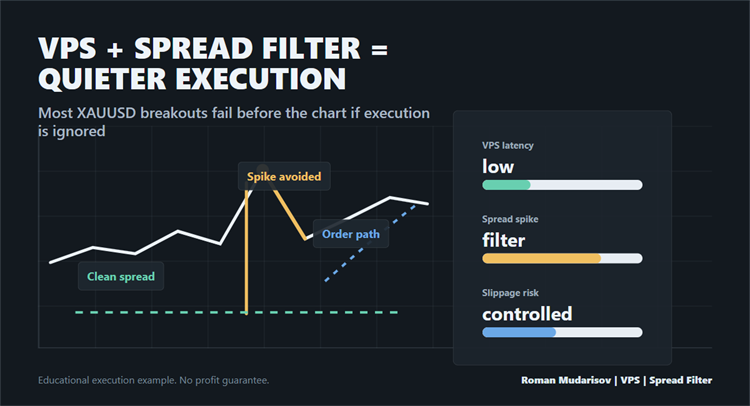
A London breakout can look clean on M15, while real results are changed by spread spikes, slow VPS, slippage, or wrong broker server time.
Before changing inputs, I check:
- Maximum spread at entry time.
- VPS latency to the broker server.
- Slippage during volatile minutes.
- Broker time and session window.
- Stop level and execution rules.
If two brokers show different results, the EA is not always the problem. Sometimes the environment is different.
What VPS or broker setup gives you the most stable XAUUSD execution?
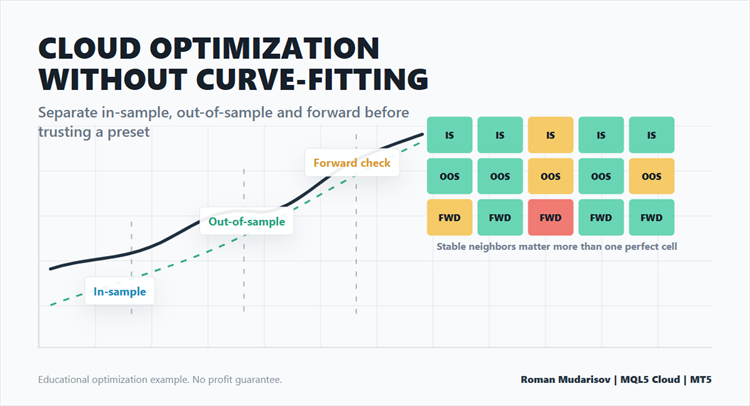
MQL5 Cloud Network helps test thousands of combinations fast, but speed does not replace validation.
For every XAUUSD preset I want to see:
- In-sample logic that still makes sense.
- Out-of-sample behavior that does not collapse.
- Forward or demo results close to the test expectations.
- Stable neighbors, not one magic parameter cell.
A strong preset should be boring: reasonable trade count, controlled drawdown, no single perfect week, and similar behavior across nearby inputs.
How do you separate optimization from curve-fitting?
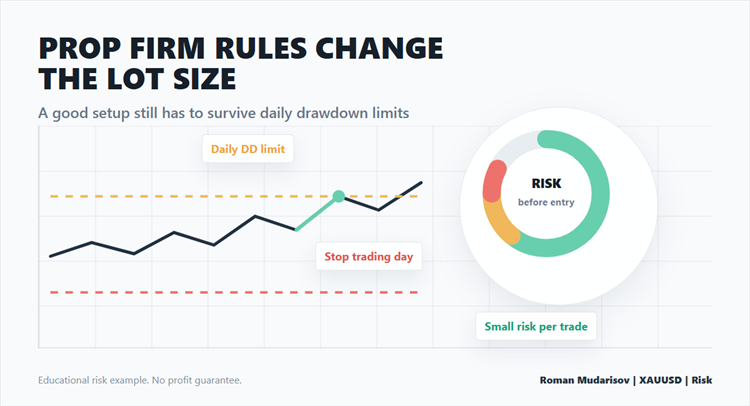
A profitable XAUUSD backtest is not enough if it can violate daily drawdown, max drawdown, or trade limits.
Before I run an EA on a challenge, I check:
- Daily DD limit and maximum drawdown.
- Risk per trade after a losing streak.
- Maximum trades per session and stop-trading rules.
- News and spread filters for volatile periods.
- Broker time and session alignment.
Small risk settings look boring, but they often keep the account alive long enough for the edge to work.
What is your strictest prop-firm rule?
In MetaTrader 5, ONNX models are useful as a confirmation layer, especially for regime detection, volatility context, or breakout quality scoring.
For a breakout robot, I prefer this order:
- Logic first: range, breakout, stop, and risk.
- Filter second: trend, volatility, and session context.
- AI last: confirmation, not a blind entry signal.
If the base idea loses before AI, the model can hide the weakness during optimization. A simple rule should survive out-of-sample before any machine learning is added.
What do you trust more: simple rules or AI filters?
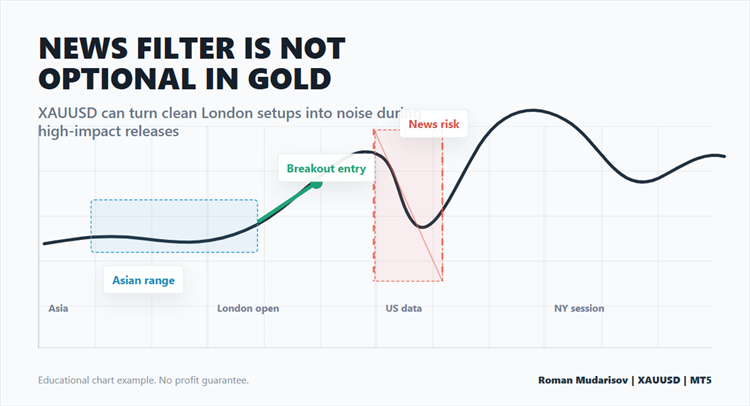
For XAUUSD, a breakout setup can be technically correct and still be a bad trade if the first impulse is news-driven.
My basic news filter is simple:
- Avoid high-impact windows before and after the release.
- Wait for spread to normalize before new entries.
- Let London confirm a real breakout after the noise.
The goal is not to catch every move. The goal is to skip conditions where execution and volatility are out of control.
Do you disable gold robots around high-impact news?
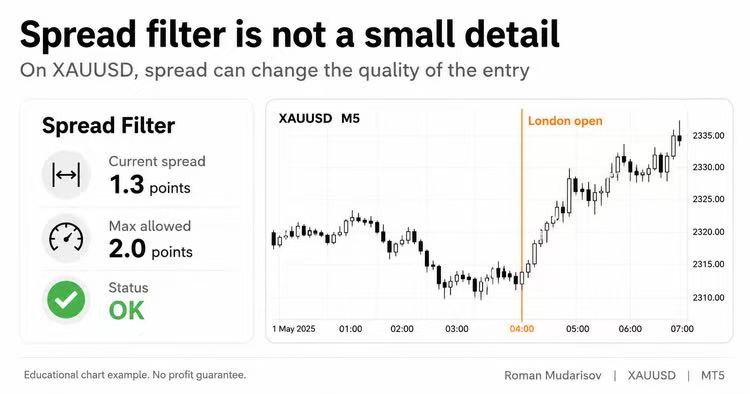
On XAUUSD, a few extra points of spread at the wrong moment can turn a normal breakout entry into a bad one.
This is especially important around London open, when volatility grows fast and liquidity can change quickly.
I prefer simple filters that protect the entry before the trade is opened.
Session range, breakout level, spread filter, risk limit, one trade per day.
Not complicated, but clear.
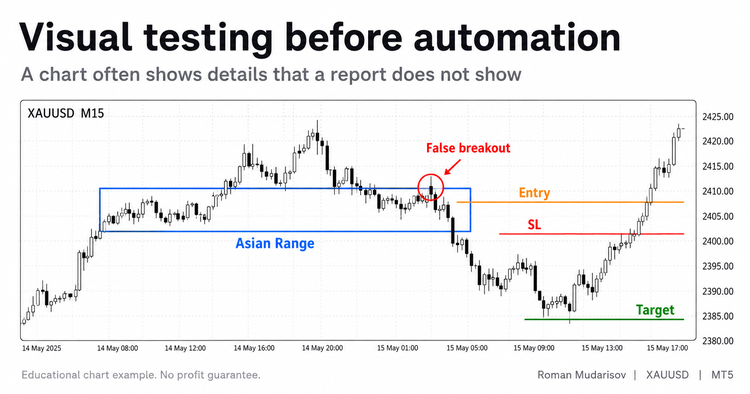
This is why I like visual testing. You can quickly notice things that are easy to miss in a clean backtest report.
Wrong session time, wide range, bad spread, false breakout, entry too close to news.
A breakout EA should not only open trades. It should also know when market conditions are not good enough.
Simple logic is easier to control.
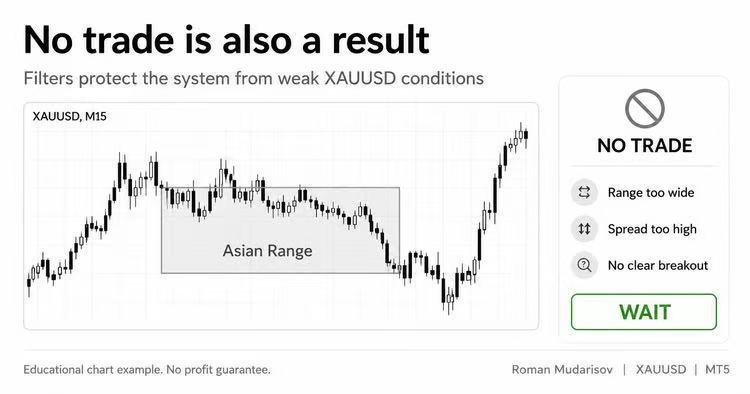
A lot of traders expect an EA to open positions every day. I do not think this is a healthy way to trade gold.
Some days the Asian range is too wide. Some days the spread is not good. Some days the breakout already happened before the trading window.
In these situations, skipping the day is better than forcing a weak entry.
For XAUUSD, discipline is often more important than frequency.