Zhuo Kai Chen
Zhuo Kai Chen
  • Informações
1 ano
experiência
0
produtos
0
versão demo
1
trabalhos
0
sinais
0
assinantes
Expert em Algorithmic Trading
Computer Science Bachelor in CUHK(SZ)
Quant Researcher with 3+ years of trading experience
Currently managing 5+ trading systems
Specializes in CTA strategy development
Github: https://github.com/CodyOutcast
Zhuo Kai Chen
Zhuo Kai Chen
I have just published my first research paper on SSRN!
It's about LLM integration in intraday trading.
Keep in mind that I'm still a noob at research, but I would say this is a good first step.
Link: https://papers.ssrn.com/sol3/papers.cfm?abstract_id=5246516
Ahmad Chaanani
Ahmad Chaanani 2025.06.17
good luck !
Zhuo Kai Chen
Zhuo Kai Chen
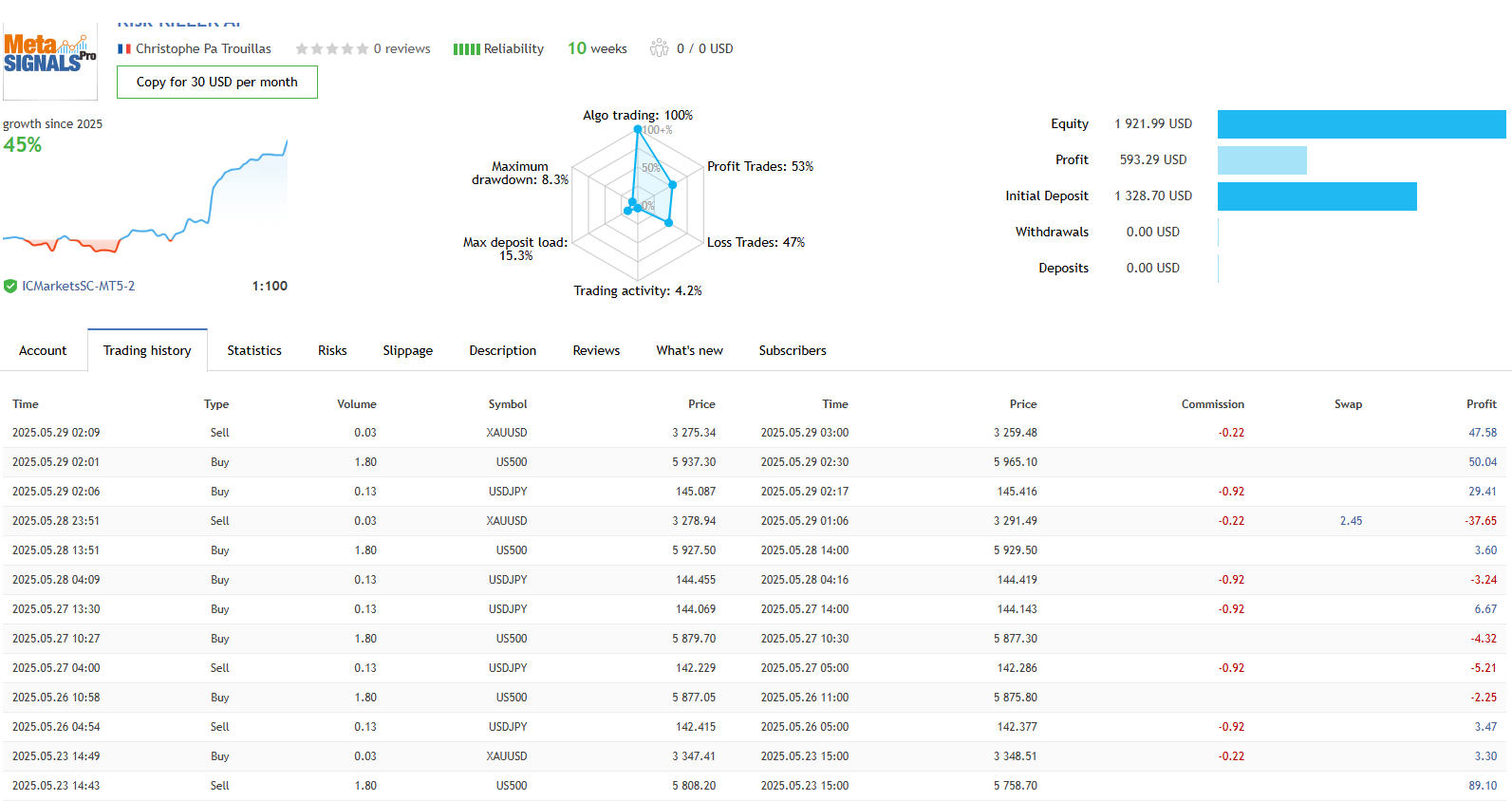
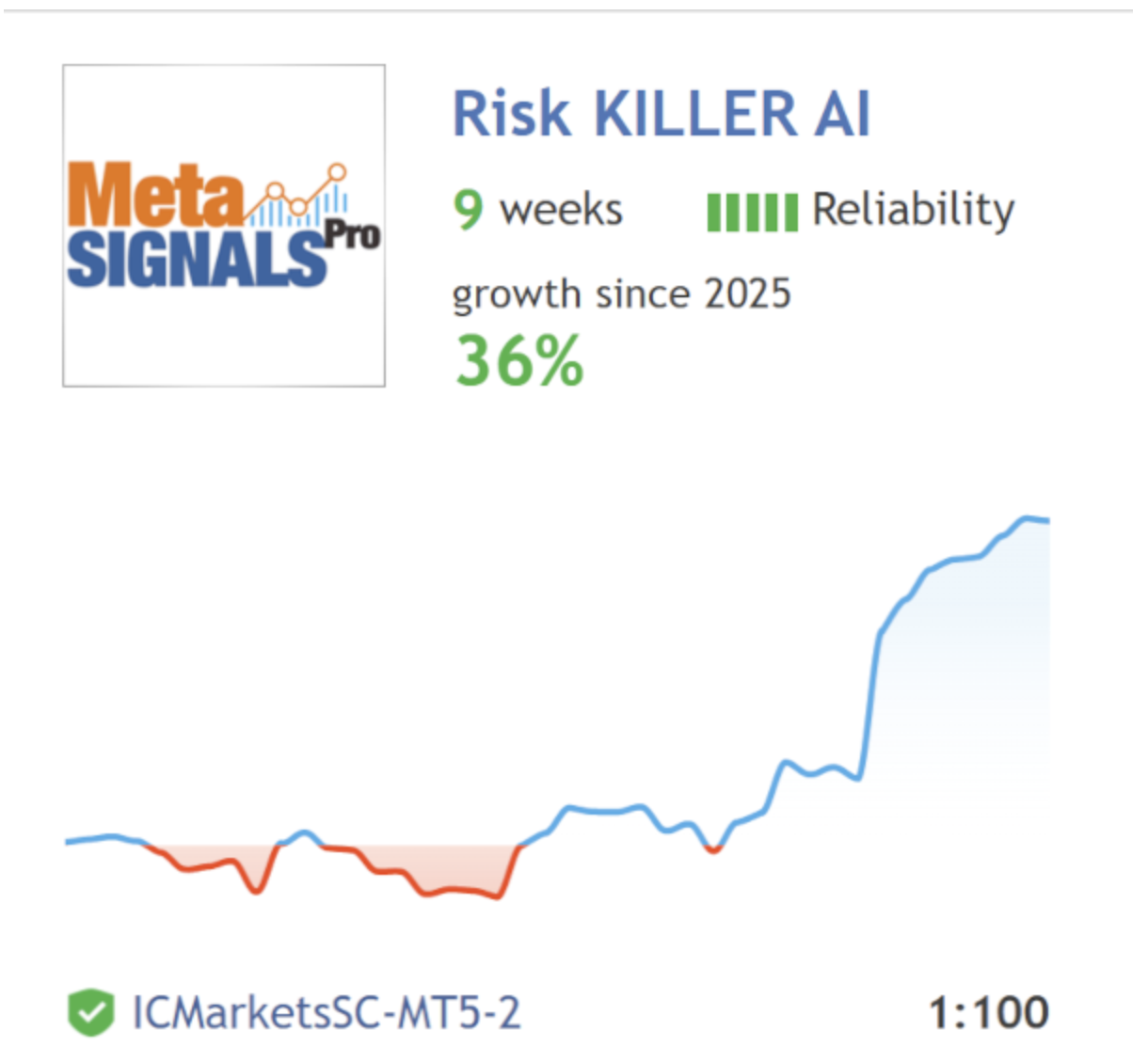
The verified signal has reached a new all-time high. Our EA is now outperforming its historical results in the current market regime. Don't miss this opportunity to capitalize on its success!
Download the demo and test it yourself: https://www.mql5.com/en/market/product/139184
Zhuo Kai Chen
Zhuo Kai Chen
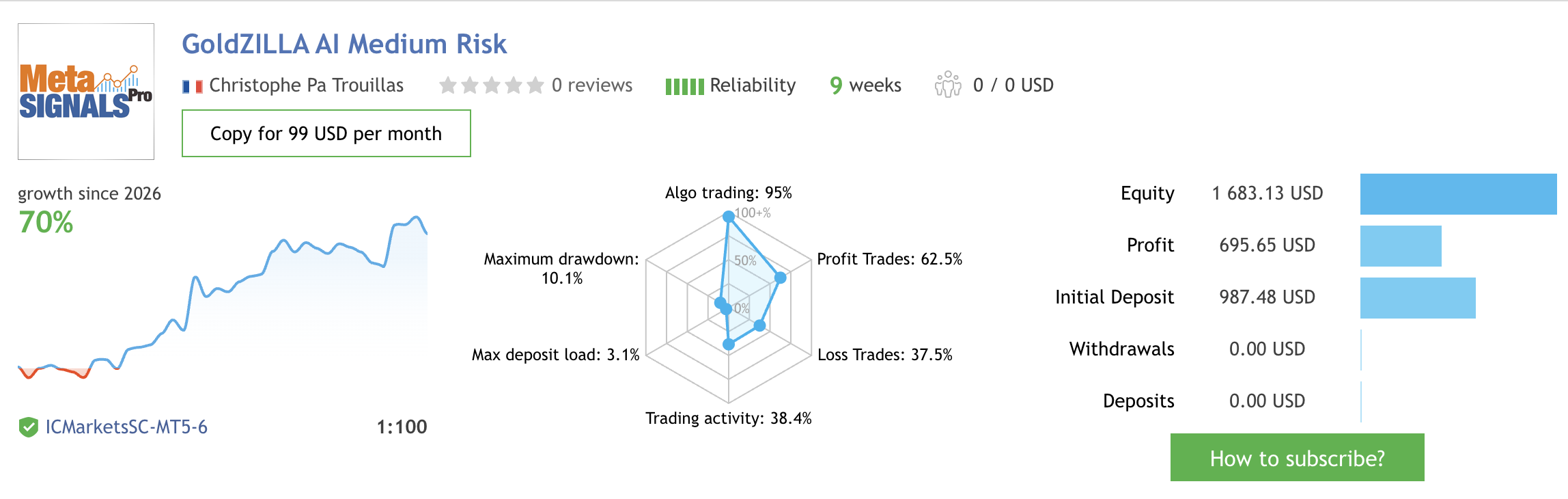
🚀 RiskKILLER AI: The ultimate scalping EA! Powered by AI, it pinpoints high-volatility breakouts with precision & optimizes risk-reward. Be the first to join our prelaunch for exclusive early bird deals! 👉 https://www.mql5.com/en/blogs/post/762546
Zhuo Kai Chen
Feedback deixado para o cliente no serviço Improve Indicators and Experts
Zhuo Kai Chen
Publicado o artigo Decoding Opening Range Breakout Intraday Trading Strategies
Decoding Opening Range Breakout Intraday Trading Strategies

Opening Range Breakout (ORB) strategies are built on the idea that the initial trading range established shortly after the market opens reflects significant price levels where buyers and sellers agree on value. By identifying breakouts above or below a certain range, traders can capitalize on the momentum that often follows as the market direction becomes clearer. In this article, we will explore three ORB strategies adapted from the Concretum Group.

3
Zhuo Kai Chen
Publicado o artigo Day Trading Larry Connors RSI2 Mean-Reversion Strategies
Day Trading Larry Connors RSI2 Mean-Reversion Strategies

Larry Connors is a renowned trader and author, best known for his work in quantitative trading and strategies like the 2-period RSI (RSI2), which helps identify short-term overbought and oversold market conditions. In this article, we’ll first explain the motivation behind our research, then recreate three of Connors’ most famous strategies in MQL5 and apply them to intraday trading of the S&P 500 index CFD.

1
Zhuo Kai Chen
Publicado o artigo Exploring Advanced Machine Learning Techniques on the Darvas Box Breakout Strategy
Exploring Advanced Machine Learning Techniques on the Darvas Box Breakout Strategy

The Darvas Box Breakout Strategy, created by Nicolas Darvas, is a technical trading approach that spots potential buy signals when a stock’s price rises above a set "box" range, suggesting strong upward momentum. In this article, we will apply this strategy concept as an example to explore three advanced machine learning techniques. These include using a machine learning model to generate signals rather than to filter trades, employing continuous signals rather than discrete ones, and using models trained on different timeframes to confirm trades.

1
Zhuo Kai Chen
Publicado o artigo The Kalman Filter for Forex Mean-Reversion Strategies
The Kalman Filter for Forex Mean-Reversion Strategies

The Kalman filter is a recursive algorithm used in algorithmic trading to estimate the true state of a financial time series by filtering out noise from price movements. It dynamically updates predictions based on new market data, making it valuable for adaptive strategies like mean reversion. This article first introduces the Kalman filter, covering its calculation and implementation. Next, we apply the filter to a classic mean-reversion forex strategy as an example. Finally, we conduct various statistical analyses by comparing the filter with a moving average across different forex pairs.

1
Zhuo Kai Chen
Publicado o artigo Robustness Testing on Expert Advisors
Robustness Testing on Expert Advisors

In strategy development, there are many intricate details to consider, many of which are not highlighted for beginner traders. As a result, many traders, myself included, have had to learn these lessons the hard way. This article is based on my observations of common pitfalls that most beginner traders encounter when developing strategies on MQL5. It will offer a range of tips, tricks, and examples to help identify the disqualification of an EA and test the robustness of our own EAs in an easy-to-implement way. The goal is to educate readers, helping them avoid future scams when purchasing EAs as well as preventing mistakes in their own strategy development.

2
Zhuo Kai Chen
Publicado o artigo Trend Prediction with LSTM for Trend-Following Strategies
Trend Prediction with LSTM for Trend-Following Strategies

Long Short-Term Memory (LSTM) is a type of recurrent neural network (RNN) designed to model sequential data by effectively capturing long-term dependencies and addressing the vanishing gradient problem. In this article, we will explore how to utilize LSTM to predict future trends, enhancing the performance of trend-following strategies. The article will cover the introduction of key concepts and the motivation behind development, fetching data from MetaTrader 5, using that data to train the model in Python, integrating the machine learning model into MQL5, and reflecting on the results and future aspirations based on statistical backtesting.

1
Zhuo Kai Chen
Publicado o artigo The Inverse Fair Value Gap Trading Strategy
The Inverse Fair Value Gap Trading Strategy

An inverse fair value gap(IFVG) occurs when price returns to a previously identified fair value gap and, instead of showing the expected supportive or resistive reaction, fails to respect it. This failure can signal a potential shift in market direction and offer a contrarian trading edge. In this article, I'm going to introduce my self-developed approach to quantifying and utilizing inverse fair value gap as a strategy for MetaTrader 5 expert advisors.

2
Zhuo Kai Chen
Zhuo Kai Chen
Machine learning mean-reversion strategy recent performance.
Dominic Michael Frehner
Dominic Michael Frehner 2025.01.26
Perfect for prop firm trading👍🏼
Zhuo Kai Chen
Zhuo Kai Chen
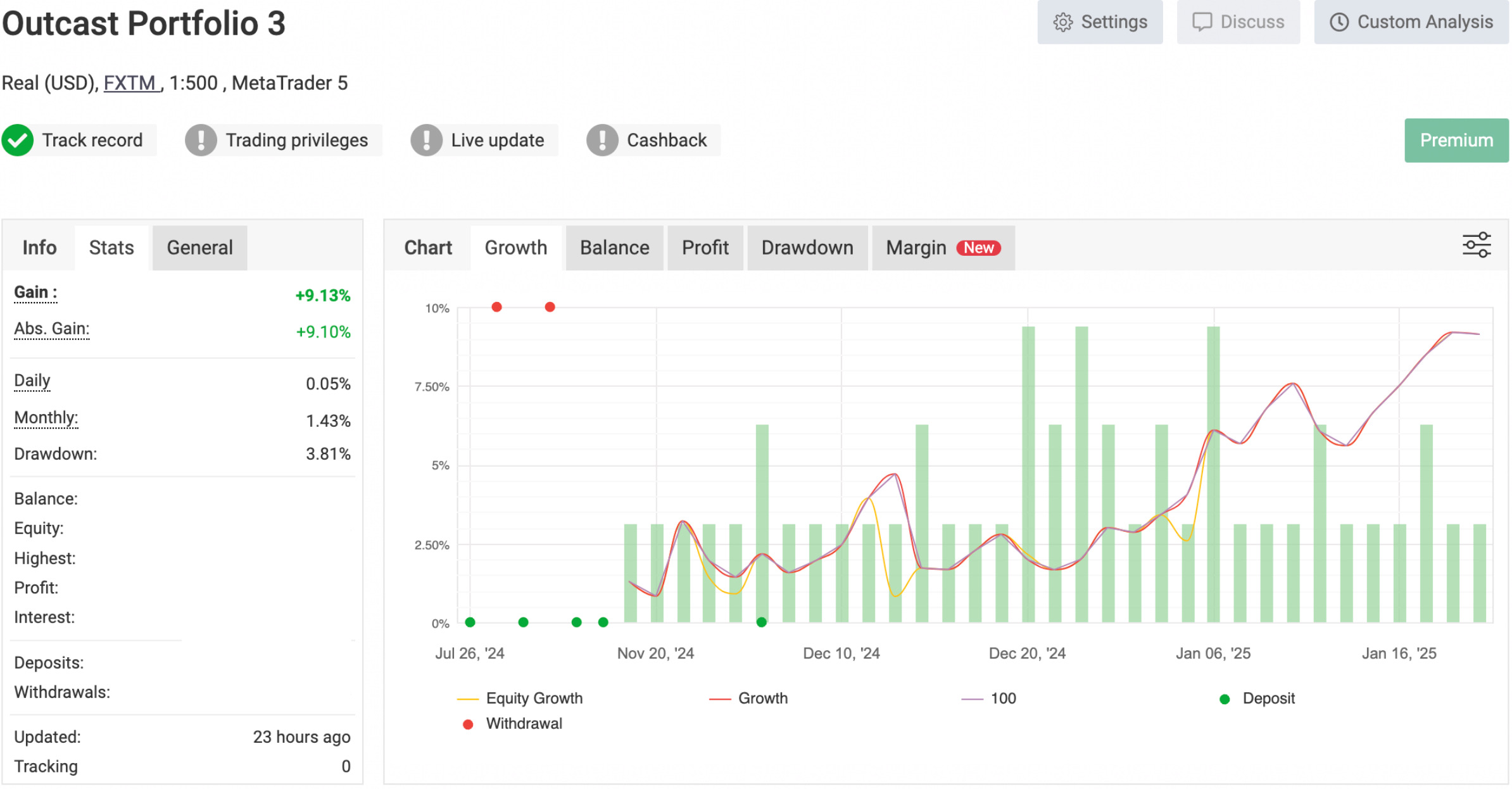
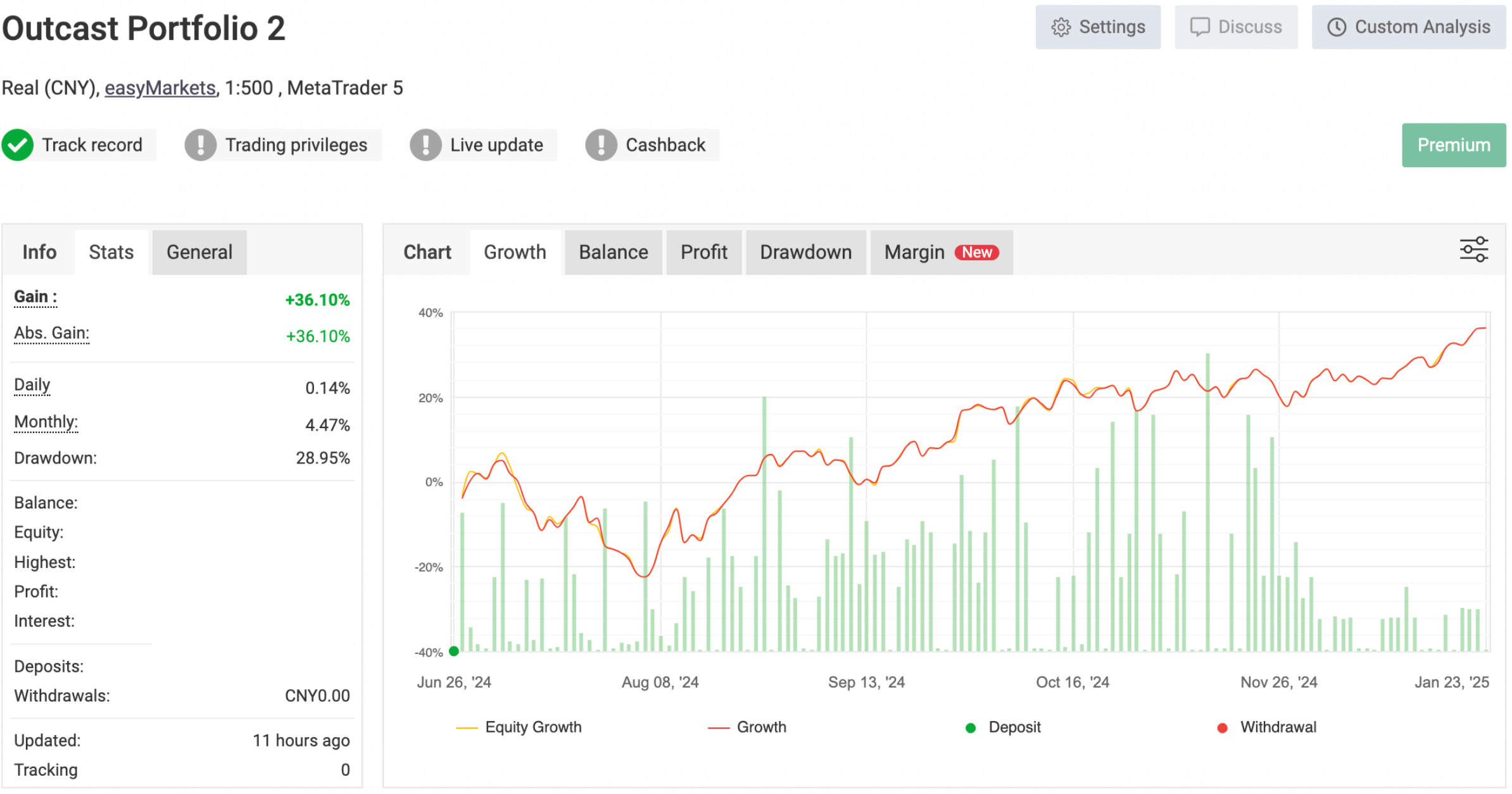
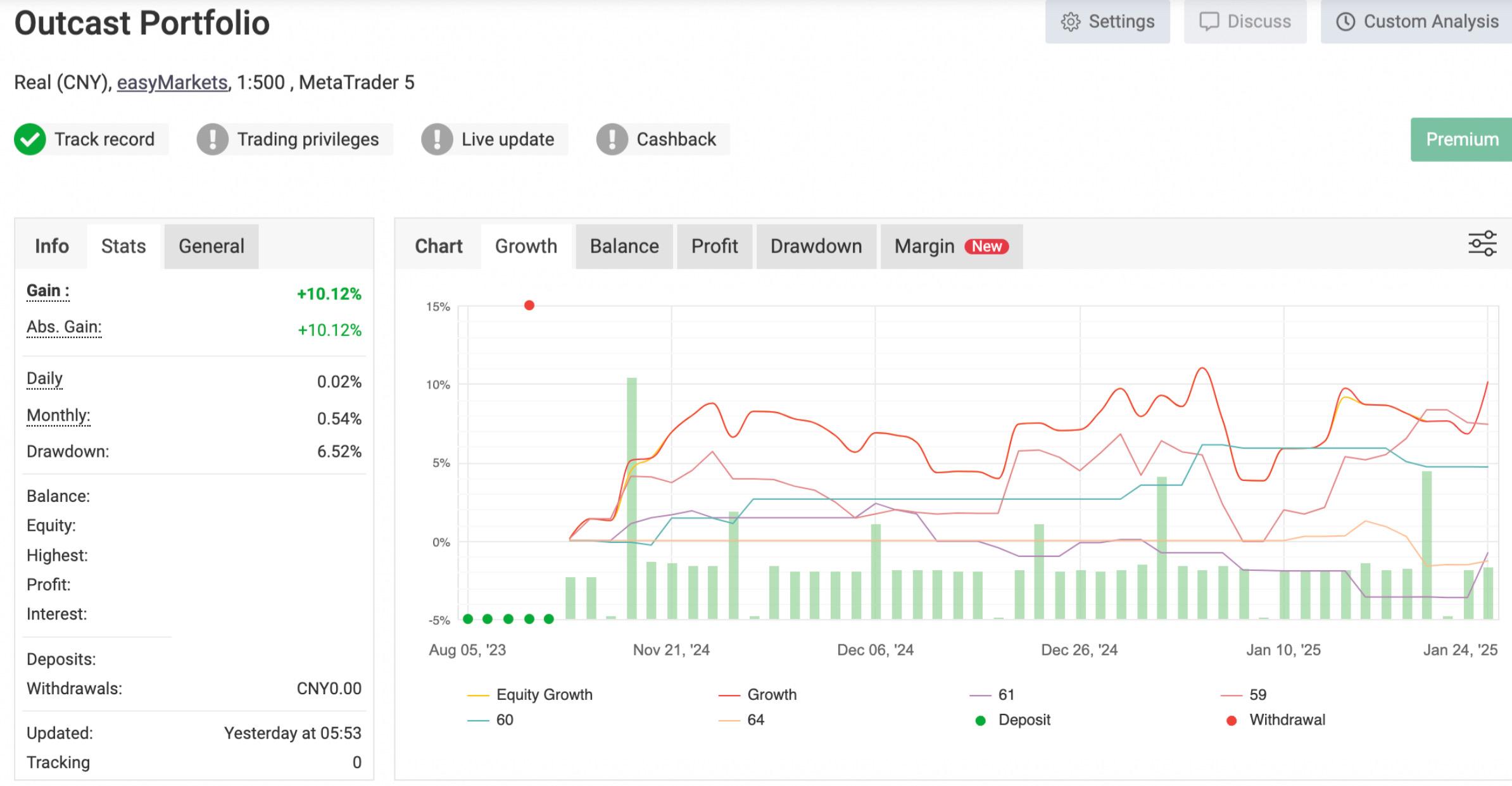
Mean-reversion and trend-following mixed strategy portfolio.
Zhuo Kai Chen
Zhuo Kai Chen
Breakout trading system recent performance.
Zhuo Kai Chen
Publicado o artigo Desenvolvendo um Expert Advisor de Breakout Baseado em Eventos de Notícias do Calendário em MQL5
Desenvolvendo um Expert Advisor de Breakout Baseado em Eventos de Notícias do Calendário em MQL5

A volatilidade tende a atingir picos em torno de eventos de notícias de alto impacto, criando oportunidades significativas de breakout. Neste artigo, iremos delinear o processo de implementação de uma estratégia de breakout baseada em calendário. Abordaremos tudo, desde a criação de uma classe para interpretar e armazenar dados do calendário, o desenvolvimento de backtests realistas utilizando esses dados e, por fim, a implementação do código de execução para negociação ao vivo.

Zhuo Kai Chen
Publicado o artigo Estratégia de trading "Captura de Liquidez" (Liquidity Grab)
Estratégia de trading "Captura de Liquidez" (Liquidity Grab)

A estratégia de captura de liquidez é um componente-chave do Smart Money Concepts (SMC), que visa identificar e aproveitar as ações dos participantes institucionais no mercado. Ela envolve mirar áreas de alta liquidez, como zonas de suporte ou resistência, onde ordens de grande volume podem provocar um movimento de preço antes que o mercado retome sua tendência. Este artigo explica em detalhes o conceito de captura de liquidez e descreve o processo de desenvolvimento de um EA para a estratégia de captura de liquidez em MQL5.

Zhuo Kai Chen
Publicado o artigo Modelos ocultos de Markov para previsão de volatilidade com consideração de tendência
Modelos ocultos de Markov para previsão de volatilidade com consideração de tendência

Os modelos ocultos de Markov (HMM) são uma poderosa ferramenta estatística que permite identificar estados ocultos do mercado com base na análise de movimentos observáveis dos preços. No trading, os HMM permitem melhorar a previsão da volatilidade e são aplicados no desenvolvimento de estratégias de tendência, modelando as mudanças nos regimes de mercado. Neste artigo, apresentaremos um processo passo a passo para o desenvolvimento de uma estratégia de seguimento de tendência que utiliza HMM como filtro para previsão de volatilidade.

Zhuo Kai Chen
Publicado o artigo Portfolio Risk Model using Kelly Criterion and Monte Carlo Simulation
Portfolio Risk Model using Kelly Criterion and Monte Carlo Simulation

Por décadas, traders vêm utilizando a fórmula do Critério de Kelly para determinar a proporção ideal de capital a ser alocada em um investimento ou aposta, a fim de maximizar o crescimento de longo prazo enquanto minimiza o risco de ruína. No entanto, seguir cegamente o Critério de Kelly utilizando o resultado de um único backtest costuma ser perigoso para traders individuais, pois, na negociação ao vivo, a vantagem de trading diminui com o tempo, e o desempenho passado não é garantia de resultado futuro. Neste artigo, apresentarei uma abordagem realista para aplicar o Critério de Kelly para alocação de risco de um ou mais EAs no MetaTrader 5, incorporando resultados de simulação de Monte Carlo provenientes do Python.

Zhuo Kai Chen
Zhuo Kai Chen
I personally have some critical thoughts about developing machine learning models as filters for trend-following strategies. We all know that trend-following strategies primarily profit from a few outlier trades that offset most of the losses. This characteristic of profit distribution is difficult to capture with a binary classifier. While we can attempt to minimize this issue by assigning greater weight to the higher profit class, it remains challenging. Intuitively, predicting long-term profits is akin to forecasting prices, which academia often regards as a mystery. Dr. Ernest P. Chan, the author of "Quantitative Trading", stated that using tree models to predict short-term prices is much easier than predicting long-term prices—similar to how forecasting the weather for the next minute is easier than predicting it for tomorrow. I strongly agree and have found success using such models to predict short-term mean reversion strategies.

Recently, a fund manager from Man Group gave a lecture about CTAs (Commodity Trading Advisors) at my university. He mentioned that they rarely use machine learning in their CTA bots, which baffled me. Literally, one of the most successful firms in the world prefers simple rules and intuitive algorithms over sophisticated methods. I asked him why, and he explained:

1. They tried using machine learning to mine alphas but failed miserably.
2. They attempted to use it as a filter, similar to what we discussed in this article, but it barely worked, achieving only 80% correlation. This means it provided almost no additional edge compared to the original strategy.
3. They found success in using machine learning to select the best strategy for a given market.

Regarding the third point, I wondered why they didn’t simply test each strategy for every market and compare the results. However, I assume they find it more efficient to cluster markets for certain strategies, especially since they trade over 6,000 assets. They believe the aforementioned theory explains their obstacles, as they primarily use trend-following strategies for their CTA bots.
Zhuo Kai Chen
Publicado o artigo Utilizando o modelo de Machine Learning CatBoost como Filtro para Estratégias de Seguimento de Tendência
Utilizando o modelo de Machine Learning CatBoost como Filtro para Estratégias de Seguimento de Tendência

CatBoost é um poderoso modelo de machine learning baseado em árvores que se especializa em tomada de decisão com base em features estacionárias. Outros modelos baseados em árvores como XGBoost e Random Forest compartilham características semelhantes em termos de robustez, capacidade de lidar com padrões complexos e interpretabilidade. Esses modelos têm uma ampla gama de usos, desde análise de features até gestão de risco. Neste artigo, vamos percorrer o procedimento de utilização de um modelo CatBoost treinado como filtro para uma estratégia clássica de seguimento de tendência com cruzamento de médias móveis.

12