Hassila Quant Trio
- Experts
- 버전: 1.0

Hassila Trio Quant runs three separate trading engines inside one Expert Advisor. Each engine has its own pair, its own entry rule, its own trading hours and its own stop and target. You attach the EA to any single chart and it reads and trades GBPUSD, USDJPY and EURUSD from there, all on the M15 timeframe.
The GBPUSD engine looks for Williams %R(50) extremes during the European afternoon and the New York session, and it only trades when volatility is below its recent average. It uses a short target and a wider stop, so it wins often and each win is small. In the simulation the typical trade lasted about an hour and a half.
The USDJPY engine works during the Tokyo hours. When price closes far from its 50 period EMA, measured in ATR, and volatility is above its average, it trades in the direction of that move with a target twice the size of the stop. Roughly half of its trades were winners in the simulation.
The EURUSD engine trades pullbacks inside the trend defined by the 50 and 200 period EMAs, using a fast RSI to time the entry, and it only takes the trade when the last daily candle closed against it. Its target is three times the stop, so it loses more often than it wins and relies on fewer, larger winners. In the five year simulation it once had 13 losses in a row, and a streak of that length should be expected again at some point.
The three engines were chosen because they behave differently and their monthly results showed little correlation. They share one account and one risk budget. Risk per trade is a percentage of equity and adapts to recent results, growing after a win and shrinking after a loss within limits you set. After a losing trade the engine waits a few bars, and after a long losing streak it pauses and returns to its base risk. Total open risk across the three engines never goes above the cap in the inputs, and a new trade only receives the room that is left.
There is no grid, no martingale, no averaging down and no hedging. Each engine holds at most one position, every order is sent with its stop loss and take profit already on the server, and a trade that reaches its maximum number of bars is closed.
The news filter uses the MetaTrader 5 economic calendar to block new entries before and after high impact releases for the currencies involved, and it can optionally close an open trade before the release. The calendar is not available in the Strategy Tester, so the filter only works on a live or demo chart. The EA also skips a signal when the spread is too wide or when the bar opened too long ago, keeps a daily trade limit per engine, and saves its state so a terminal restart does not reset the risk multiplier or the counters.
The on-chart panel shows the state of each engine, its current signal values, its session, open risk and the last action taken. It can be shown with a translucent, solid or transparent background, and it can be minimized with one click.
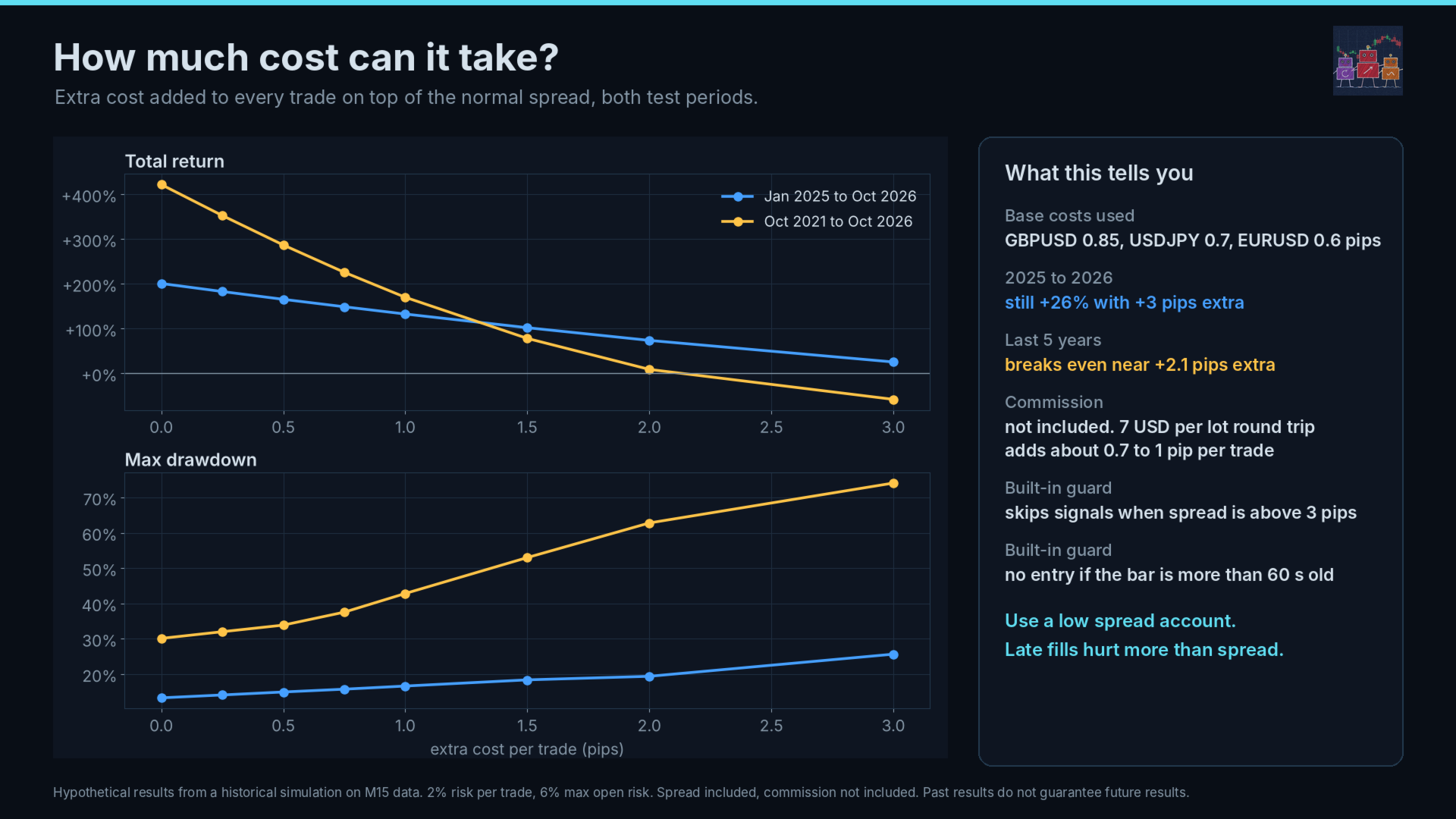
Before using it on a real account, please read the following. Session hours are defined in UTC, so set the server GMT offsets for summer and winter to match your broker. If your broker adds a suffix to symbol names, enter the full names in the inputs and make sure the three symbols are in Market Watch. The default risk of 2 percent per trade with a multiplier that can reach three times that value is aggressive, and most traders will be more comfortable with a lower base risk. Trades can stay open overnight and over weekends, so swap and weekend gaps apply. Results depend heavily on trading costs and on execution speed, so a low spread account and a stable connection or VPS are recommended. Run your own test with your broker's data and commission, and then use a demo account before going live.
Results shown in the screenshots come from a historical simulation. They include spread but not commission, and past results do not guarantee future results. Losing periods will happen, including some that last several months.