UT Bot Trend Multi Pair Timeframe Scan Dashboard
- インディケータ
- バージョン: 1.0
- アクティベーション: 5

UT Bot Trend Multi Pair Timeframe Scan Dashboard
Overview
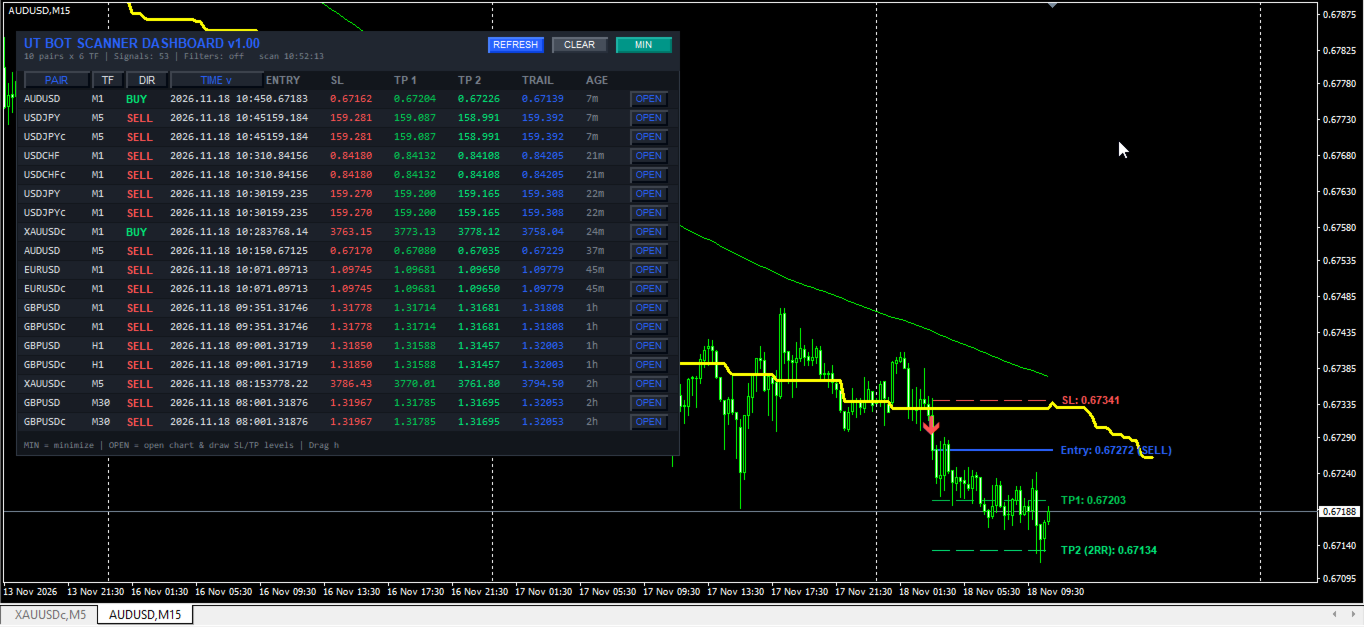
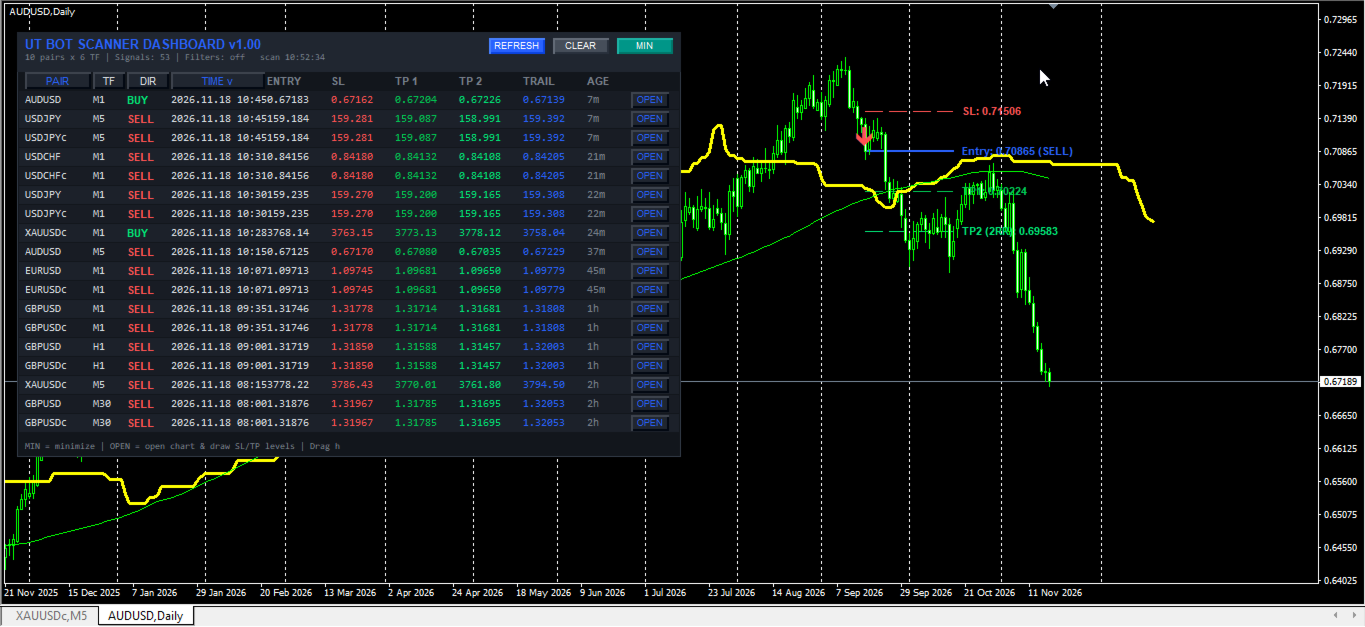
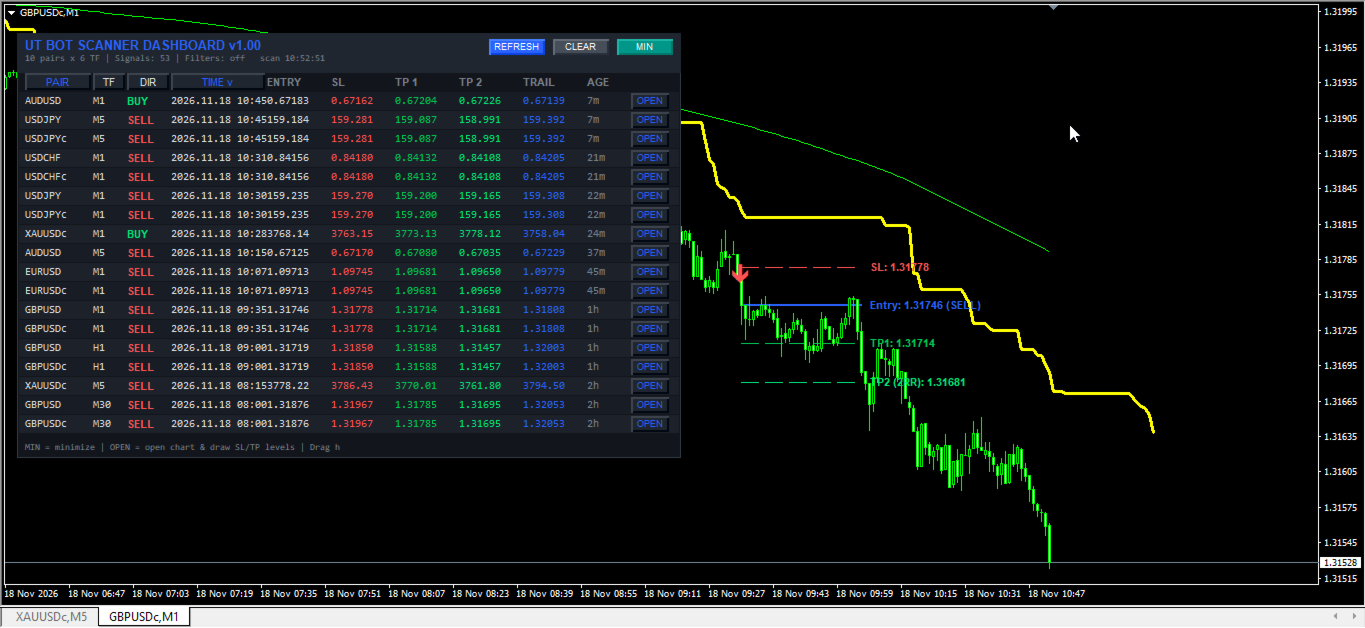
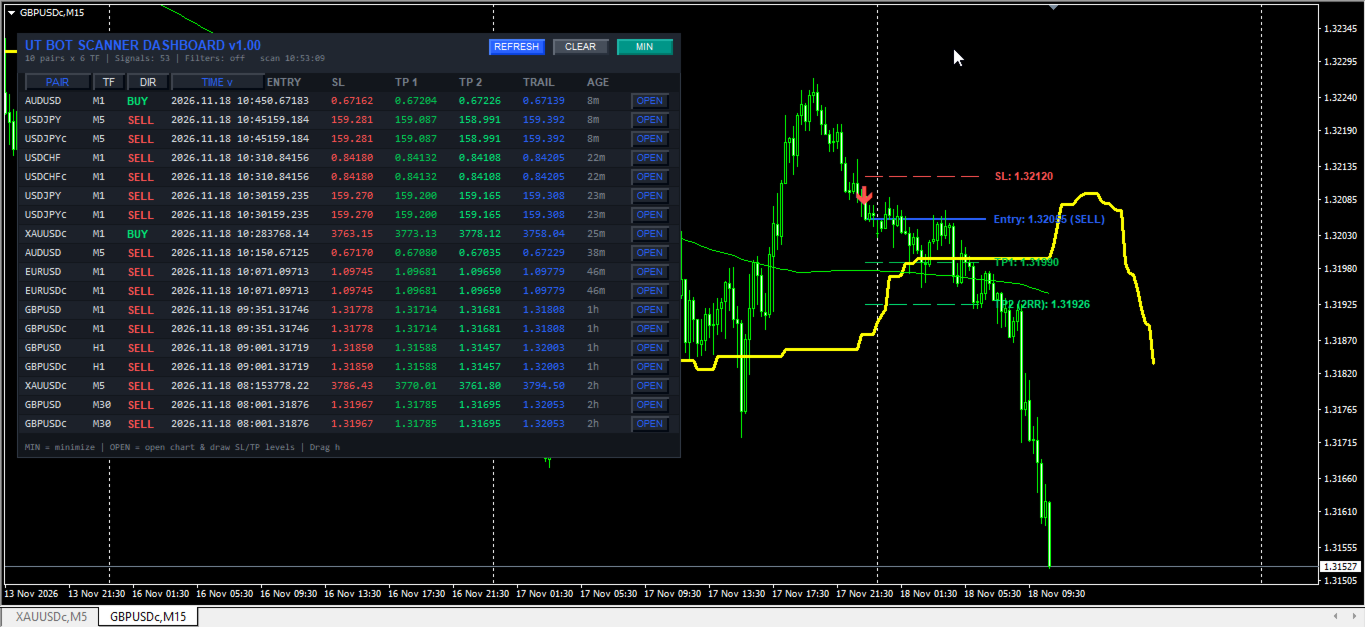
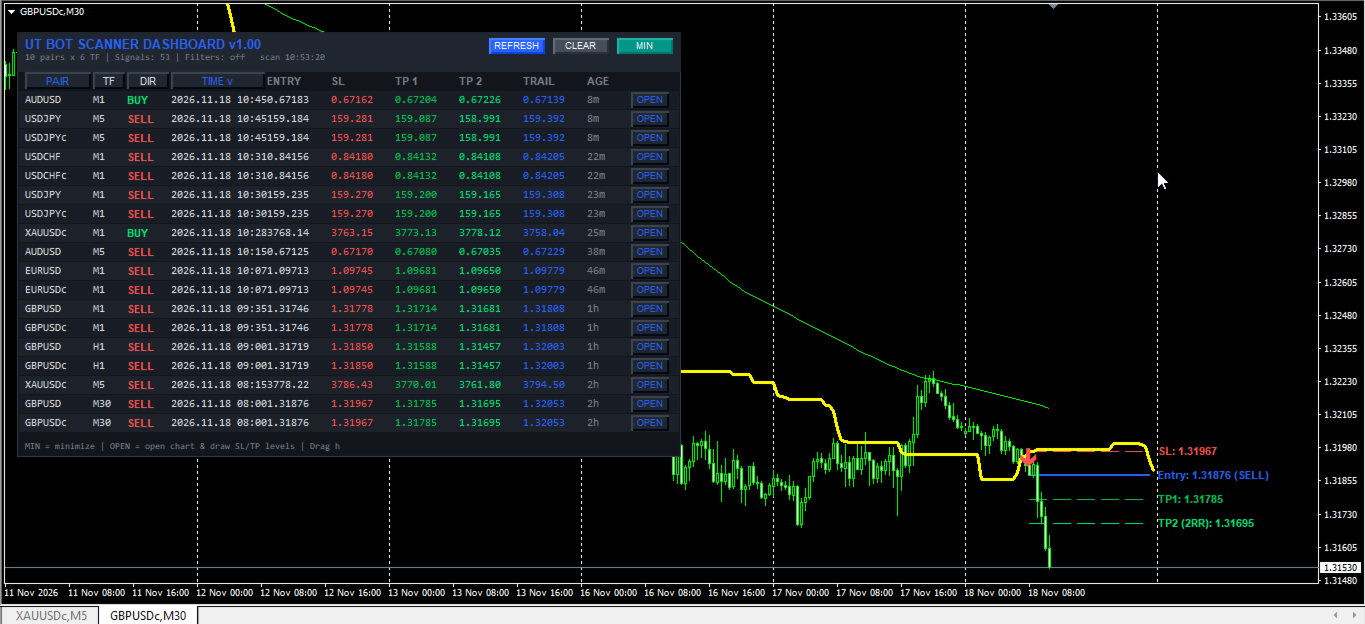
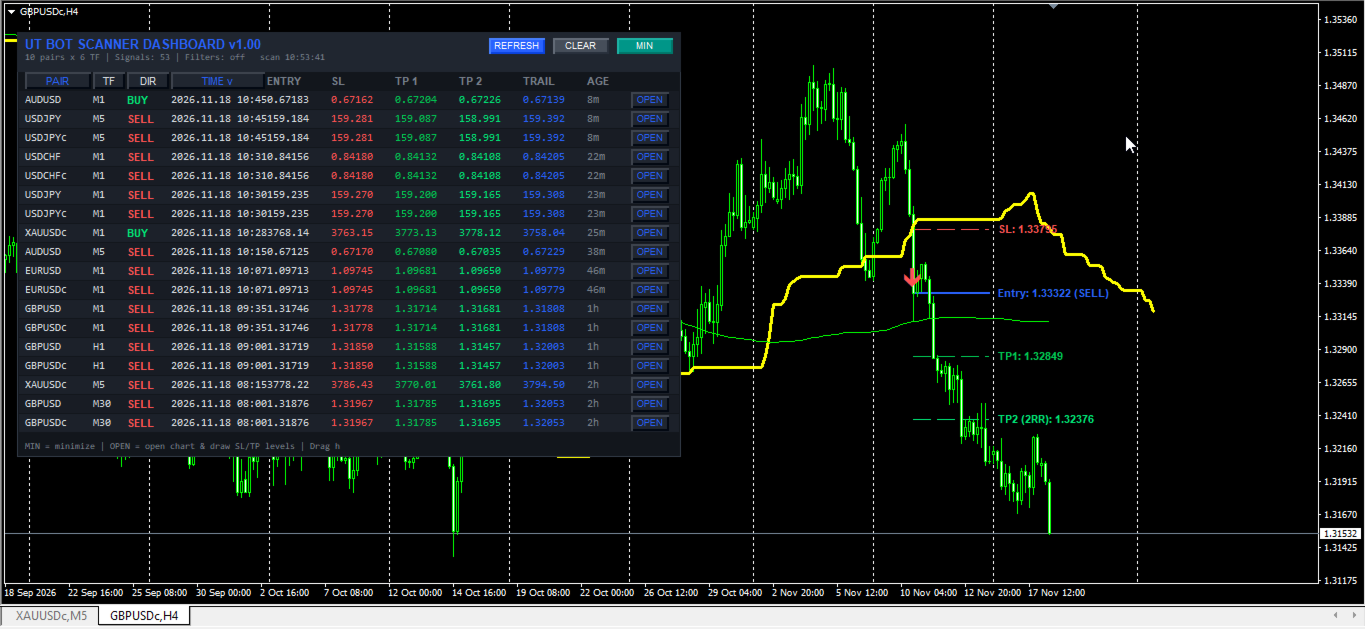
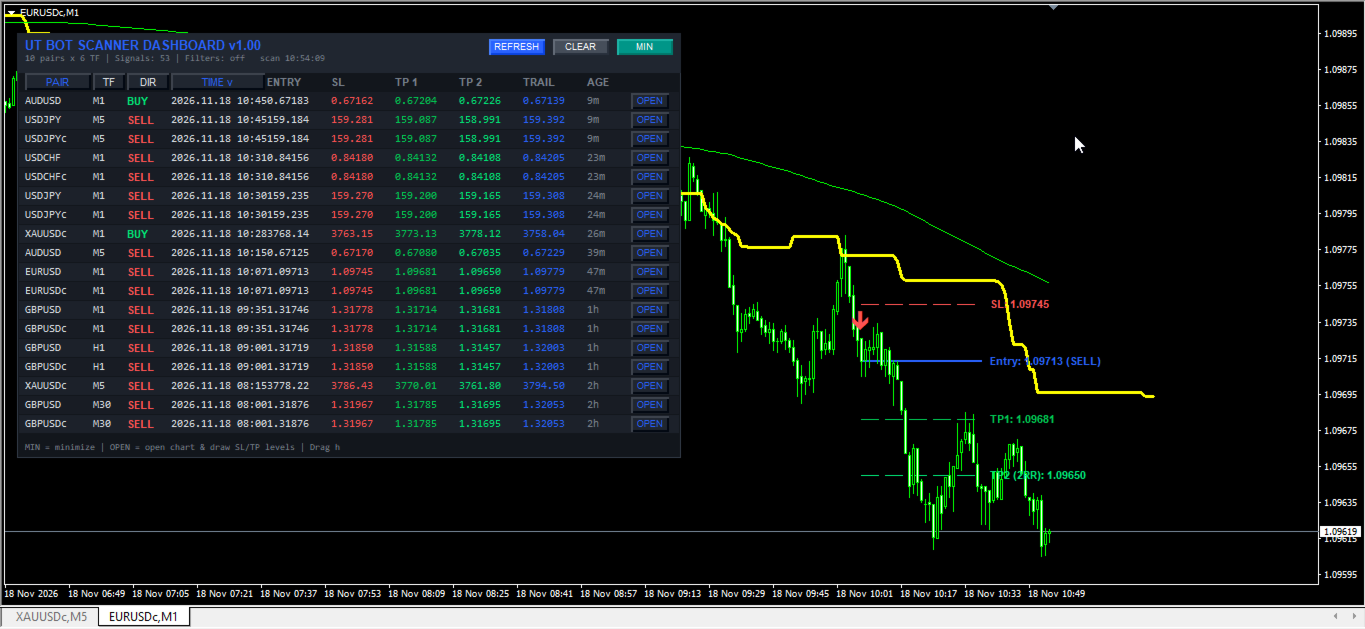
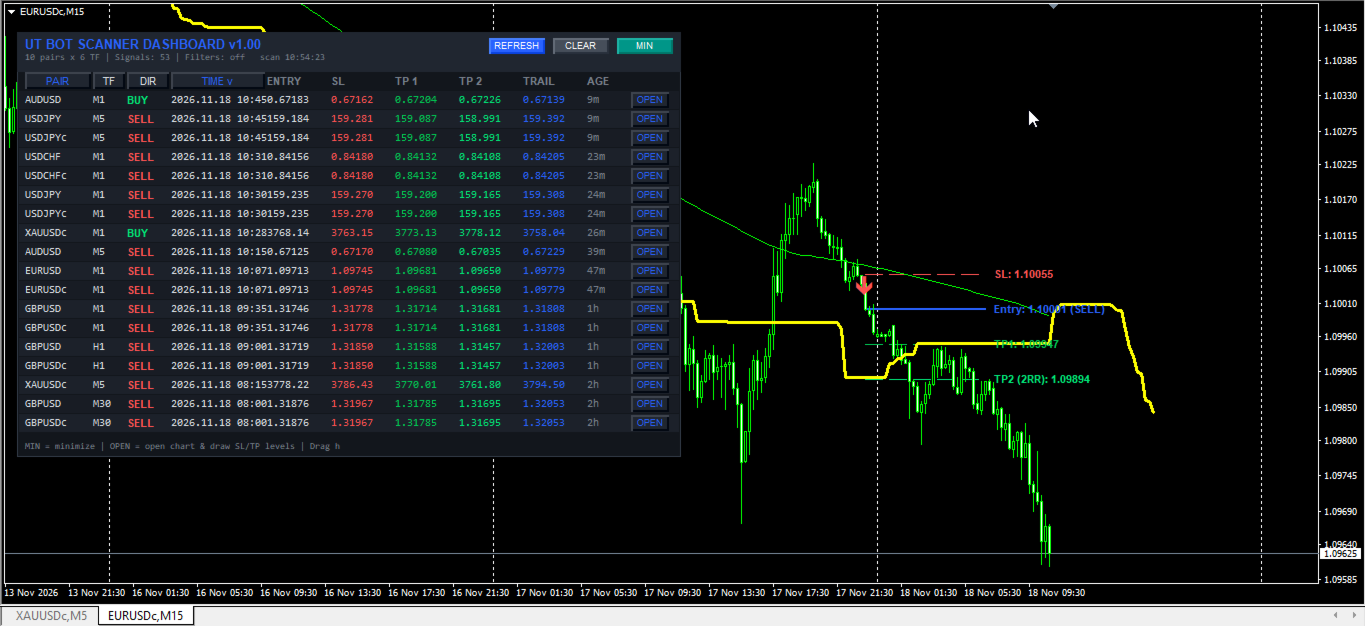
UT Bot Scanner Dashboard is a multi-pair and multi-timeframe technical indicator and market scanner developed natively for MetaTrader 4 (MT4). It continuously monitors selected Forex pairs, precious metals, indices, or active Market Watch symbols across multiple timeframes simultaneously to detect dynamic Average True Range (ATR) volatility trailing stop crossovers. Instead of manually cycling through dozens of individual charts to monitor trend transitions, traders receive a centralized, interactive on-chart matrix displaying active BUY and SELL setups, exact signal timestamps, entry prices, volatility-calibrated Stop Loss (SL) and dual Take Profit (TP 1 and TP 2) levels, active trailing stop values, elapsed signal age, and one-click chart switching. A modular 15-filter confirmation suite enables traders to require technical confluence from momentum oscillators, trend baselines, or price-action zones before a signal is validated and dispatched.
Operating Principle and Signal Logic
The scanner executes a deterministic, multi-stage evaluation workflow designed for transparency while keeping proprietary source-level state calculations encapsulated:
- Core Volatility Trailing Engine: For every configured symbol and timeframe slot, the indicator computes an adaptive ATR volatility trailing threshold controlled by sensitivity multiplier InpKeyValue and lookback length InpATRPeriod. During bullish phases, the trailing threshold ratchets upward beneath price action; during bearish phases, it steps downward above price action while remaining flat during minor counter-trend consolidations.
- Bullish BUY Signal Condition: A BUY setup triggers when a completed candle closes above the dynamic ATR trailing threshold immediately following a prior candle that closed below it, provided direction settings permit bullish signals and every enabled confirmation filter aligns on that signal bar.
- Bearish SELL Signal Condition: A SELL setup triggers when a completed candle closes below the dynamic ATR trailing threshold immediately following a prior candle that closed above it, provided direction settings permit bearish signals and every enabled confirmation filter aligns on that signal bar.
- Most-Recent Crossover Gatekeeping: Within each symbol-timeframe slot, the scanner searches backward from the first closed bar (shift 1) up to InpLookback bars. When it locates the most recent UT Bot crossover, it evaluates all active filters on that specific bar; if the crossover fails any enabled filter condition, the slot is marked inactive rather than falling back to older, outdated signals.
- Closed-Bar Evaluation and Non-Repainting Behavior: All signal detection and filter checks operate exclusively on completed historical candles starting at shift 1, ignoring the unclosed live candle (shift 0). Once a bar closes and a signal is confirmed, its direction, timestamp, entry price, and SL/TP levels remain fixed and do not repaint, shift, or disappear on subsequent ticks. When the optional Fibonacci filter is enabled, swing highs and lows are identified strictly from closed historical bars preceding the signal bar.
- ATR Risk and Reward Projections: For every validated setup, local market volatility is measured via InpSLTP_ATRPeriod multiplied by InpATRMultSL to establish the Stop Loss distance from the signal close price, while TP 1 and TP 2 levels are projected at InpTP1_RR and InpTP2_RR Risk-to-Reward multiples.
- Modular 15-Filter Confluence Layer: All 15 auxiliary filters default to false so the dashboard operates out of the box on pure UT Bot volatility crossovers. When one or more filters are enabled, they operate as strict logical AND gates requiring simultaneous confirmation on the signal candle.
Key Features and Dashboard Interface
- Multi-Symbol and Multi-Timeframe Matrix: Scans up to InpMaxSymbols instruments across any combination of M1, M5, M15, M30, H1, H4, D1, W1, and MN1 on a configurable background timer interval (InpScanSec).
- Market Watch and Broker Suffix Compatibility: Automatically imports visible instruments from the MT4 Market Watch window (including broker-specific prefixes or suffixes) when InpUseWatch is true, or parses a custom delimiter-separated symbol list from InpSymbols.
- Interactive Sortable Table: Renders up to InpMaxRows active setups across 11 structured columns: PAIR (instrument symbol), TF (timeframe), DIR (BUY or SELL), TIME (signal bar timestamp), ENTRY (signal close price), SL (ATR Stop Loss), TP 1 (first R:R target), TP 2 (second R:R target), TRAIL (active ATR trailing stop value), AGE (elapsed duration in s, m, h, or d), and OPEN (instant chart launch button). Clicking PAIR, TF, DIR, or TIME column headers toggles ascending or descending sorting (^ or v).
- One-Click Chart Switching and Visual Overlay: Clicking OPEN switches the current chart to the selected symbol and timeframe in candlestick mode, plots directional Wingdings signal arrows, and draws horizontal Entry, SL, TP 1, and TP 2 trendlines with price labels extending rightward by InpExtendBars. When InpDrawOnChart is active, the indicator also automatically draws and updates the latest valid signal on whichever chart it is attached to.
- GUI Color Coding and Panel Controls: Green (InpColBull) highlights bullish BUY text and upward arrows; coral red (InpColBear) highlights bearish SELL text and downward arrows; blue (InpColEntry) marks Entry lines; red (InpColSL) marks Stop Loss values; green shades (InpColTP1, InpColTP2) mark Take Profit targets. Header buttons provide REFRESH (reloads symbol/timeframe lists and forces an immediate rescan), CLEAR (removes dashboard panel objects from the chart), and MIN/MAX (collapses the table into a compact status header bar). Panel coordinates and minimized state persist across chart timeframe changes via MT4 Global Variables, the header bar supports mouse drag repositioning, and InpScale scales all UI dimensions from 70% to 180%.
- Multi-Channel Alert System with Deduplication: Supports native MT4 pop-up windows (InpAlertPopup), separate BUY and SELL WAV sound files (InpAlertSound), mobile push notifications via MetaQuotes ID (InpAlertPush), and SMTP email alerts (InpAlertEmail). Per-slot timestamp memory prevents duplicate alerts on repeated timer scans, with optional strict new-bar filtering via InpAlertOnlyNew.
- Terminal Resource and CPU Efficiency: Uses timer-driven scanning (minimum 2-second interval), bounded bar copying (InpBarsCopy), and symbol caps (InpMaxSymbols) rather than recalculating all symbols on every incoming tick. Keep InpMaxSymbols within 10 to 20 instruments on standard desktop hardware and avoid running multiple heavy dashboard instances on separate charts simultaneously.
Trading and Operational Recommendations
- Supported Instruments: Compatible with liquid Forex major and minor pairs (such as EURUSD, GBPUSD, USDJPY, AUDUSD, USDCAD, USDCHF, NZDUSD, EURJPY, GBPJPY), spot metals (XAUUSD), indices, and CFDs enabled in Market Watch. Ensure at least 35 to 100 historical bars are loaded in the MT4 History Center for every scanned symbol and timeframe.
- Recommended Timeframes: Adaptable to intraday scalping (M1, M5), day trading (M15, M30, H1), and swing analysis (H4, D1). Timeframes from M15 to H4 generally exhibit smoother ATR trailing stop behavior during low-liquidity session transitions compared to M1.
- Broker and Account Environment: Works on both Hedging and Netting MT4 account types across standard or ECN/raw-spread brokers. Standard broadband connectivity is sufficient for closed-bar signal monitoring, while a reliable VPS is recommended if 24/5 mobile push or email notifications are required.
Complete Input Parameters Reference
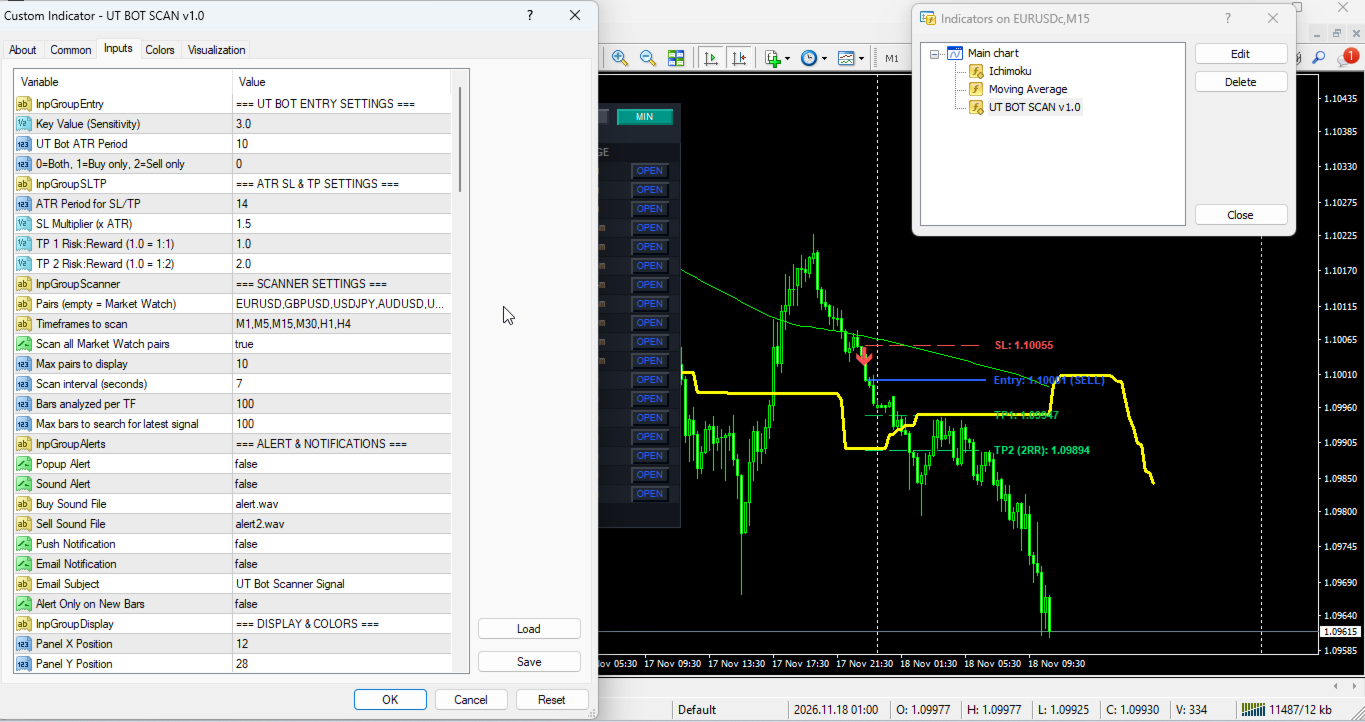
UT Bot Entry Settings
- InpKeyValue (Default: 1.0) -> Sensitivity multiplier applied to ATR distance to determine dynamic volatility trailing stop width.
- InpATRPeriod (Default: 1) -> Lookback period (bars) for ATR calculation inside the core UT Bot trailing stop engine.
- InpDirection (Default: 0) -> Signal direction filter: 0 scans both BUY and SELL, 1 scans BUY signals only, 2 scans SELL signals only.
ATR SL and TP Settings
- InpSLTP_ATRPeriod (Default: 14) -> Lookback period (bars) for the ATR baseline used to calculate Stop Loss and Take Profit projections.
- InpATRMultSL (Default: 1.5) -> Volatility multiplier (x ATR) defining Stop Loss distance from the entry close price.
- InpTP1_RR (Default: 1.0) -> Risk-to-Reward ratio multiplier for Take Profit 1 relative to Stop Loss distance (1.0 = 1:1 R:R).
- InpTP2_RR (Default: 2.0) -> Risk-to-Reward ratio multiplier for Take Profit 2 relative to Stop Loss distance (2.0 = 1:2 R:R).
Scanner Settings
- InpSymbols (Default: "EURUSD,GBPUSD,USDJPY,AUDUSD,USDCAD,USDCHF,NZDUSD,EURJPY,GBPJPY,XAUUSD") -> Delimiter-separated list of instrument symbols scanned when InpUseWatch is false.
- InpTimeframes (Default: "M1,M5,M15,M30,H1,H4") -> Delimiter-separated list of timeframes scanned per instrument (supports M1, M5, M15, M30, H1, H4, D1, W1, MN1).
- InpUseWatch (Default: true) -> Automatically imports active symbols from the MT4 Market Watch window instead of InpSymbols when true.
- InpMaxSymbols (Default: 10) -> Maximum number of instruments scanned and processed to control CPU and RAM usage.
- InpScanSec (Default: 7) -> Automatic background scan timer interval (seconds); enforced minimum is 2 seconds.
- InpBarsCopy (Default: 100) -> Number of historical bars copied per symbol and timeframe for UT Bot and filter evaluation buffers.
- InpLookback (Default: 100) -> Maximum number of closed bars searched backward from bar 1 to locate the latest valid signal.
Alert and Notifications
- InpAlertPopup (Default: false) -> Enables native MT4 pop-up alert dialogs when a new valid signal is detected.
- InpAlertSound (Default: false) -> Enables WAV audio playback upon signal detection.
- InpSoundFileBuy (Default: "alert.wav") -> Audio filename inside the terminal Sounds directory played for BUY signals.
- InpSoundFileSell (Default: "alert2.wav") -> Audio filename inside the terminal Sounds directory played for SELL signals.
- InpAlertPush (Default: false) -> Enables push notifications to the MetaTrader mobile app via configured MetaQuotes ID.
- InpAlertEmail (Default: false) -> Enables email notifications via configured MT4 terminal SMTP settings.
- InpEmailSubject (Default: "UT Bot Scanner Signal") -> Subject line prefix used for outgoing signal emails.
- InpAlertOnlyNew (Default: false) -> Triggers alerts strictly when a signal timestamp is newer than the previously alerted bar in that slot.
Display and Colors
- InpX (Default: 12) -> Initial horizontal X coordinate offset (pixels) from the upper-left corner of the chart.
- InpY (Default: 28) -> Initial vertical Y coordinate offset (pixels) from the upper-left corner of the chart.
- InpScale (Default: 100) -> Dashboard UI scaling percentage (clamped between 70 and 180) for proportional text, row, and column sizing.
- InpRowH (Default: 19) -> Base row height (pixels) for each signal entry in the table.
- InpFont (Default: 8) -> Base font size (points) for dashboard labels and values.
- InpPadX (Default: 8) -> Horizontal inner left and right padding (pixels) inside the panel frame.
- InpWPair (Default: 68) -> Base width (pixels) of the PAIR column.
- InpWTF (Default: 34) -> Base width (pixels) of the TF (timeframe) column.
- InpWArah (Default: 44) -> Base width (pixels) of the DIR (direction) column.
- InpWTime (Default: 96) -> Base width (pixels) of the TIME column.
- InpWEntry (Default: 64) -> Base width (pixels) of the ENTRY price column.
- InpWSL (Default: 64) -> Base width (pixels) of the SL (Stop Loss) column.
- InpWTP1 (Default: 64) -> Base width (pixels) of the TP 1 column.
- InpWTP2 (Default: 64) -> Base width (pixels) of the TP 2 column.
- InpWTrail (Default: 64) -> Base width (pixels) of the TRAIL (trailing stop) column.
- InpWUmur (Default: 42) -> Base width (pixels) of the AGE column.
- InpWOpen (Default: 44) -> Base width (pixels) of the OPEN action button column.
- InpShowEmpty (Default: false) -> Displays symbol/timeframe rows without an active valid signal when set to true.
- InpMaxRows (Default: 18) -> Maximum number of signal rows displayed simultaneously in the dashboard table.
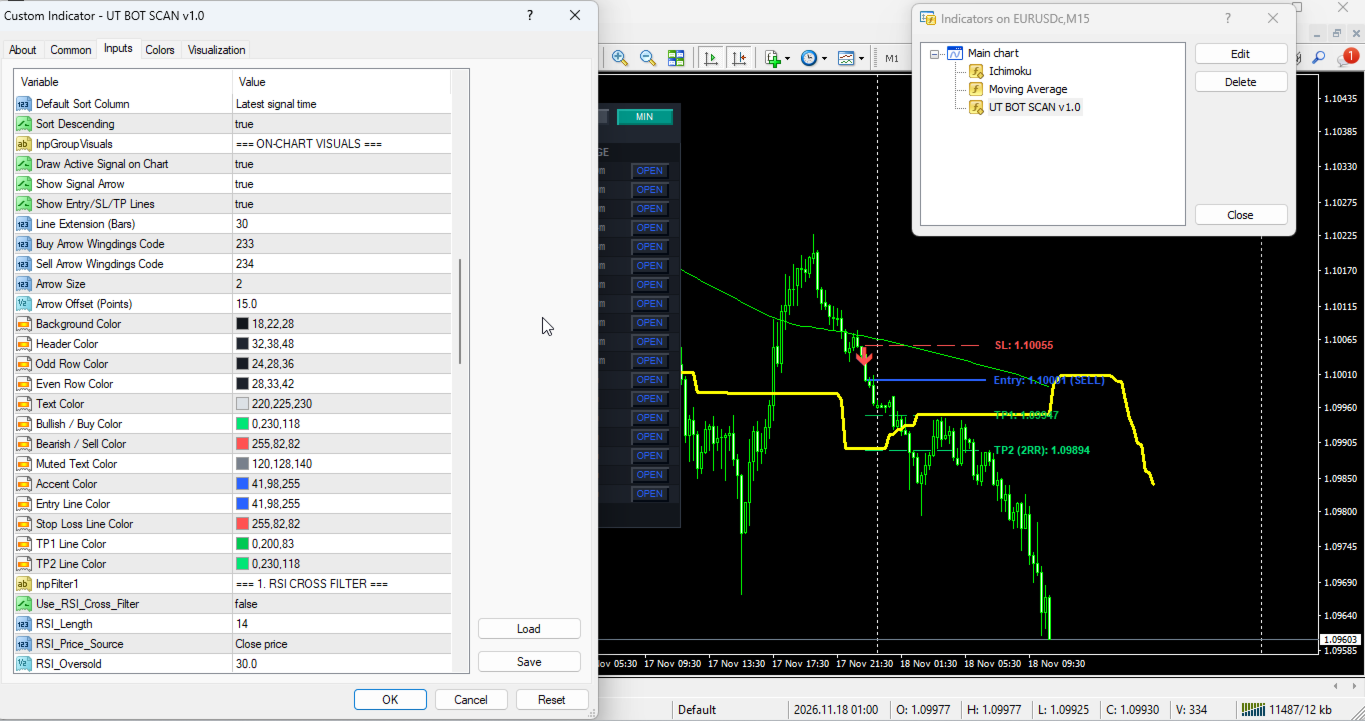
- InpSortBy (Default: SORT_TIME) -> Default table sorting criterion (SORT_TIME, SORT_PAIR, SORT_TF, or SORT_DIR).
- InpSortNewest (Default: true) -> Default sort direction: true for descending (newest first), false for ascending.
On-Chart Visuals and Color Settings
- InpDrawOnChart (Default: true) -> Plots the active chart symbol and timeframe signal arrow and SL/TP levels when true.
- InpShowArrow (Default: true) -> Displays directional Wingdings signal arrows at the signal candle.
- InpShowLevels (Default: true) -> Draws horizontal Entry, SL, TP 1, and TP 2 lines with descriptive price labels on the chart.
- InpExtendBars (Default: 30) -> Number of bar periods to the right that Entry, SL, and TP lines extend from the signal bar.
- InpArrowCodeBuy (Default: 233) -> Wingdings symbol code used for bullish BUY arrows.
- InpArrowCodeSell (Default: 234) -> Wingdings symbol code used for bearish SELL arrows.
- InpArrowSize (Default: 2) -> Visual thickness size of plotted signal arrows.
- InpArrowDistance (Default: 15) -> Vertical distance offset (points) between the signal close price and the plotted arrow.
- InpColBg (Default: C'18,22,28') -> Main background fill color of the dashboard panel.
- InpColHead (Default: C'32,38,48') -> Background fill color of the title bar and sortable column headers.
- InpColRow (Default: C'24,28,36') -> Background fill color for odd-numbered table rows.
- InpColRow2 (Default: C'28,33,42') -> Background fill color for even-numbered table rows.
- InpColText (Default: C'220,225,230') -> Primary text color for pairs, timeframes, timestamps, and entry values.
- InpColBull (Default: C'0,230,118') -> Color for bullish BUY labels and upward chart arrows.
- InpColBear (Default: C'255,82,82') -> Color for bearish SELL labels and downward chart arrows.
- InpColMute (Default: C'120,128,140') -> Muted text color for status metadata, inactive cells, and footer hints.
- InpColAccent (Default: C'41,98,255') -> Accent highlight color for title text, active sort markers, trailing values, and OPEN buttons.
- InpColEntry (Default: C'41,98,255') -> Color for on-chart Entry trendline and text label.
- InpColSL (Default: C'255,82,82') -> Color for Stop Loss (SL) table values, chart line, and text label.
- InpColTP1 (Default: C'0,200,83') -> Color for Take Profit 1 (TP 1) table values, chart line, and text label.
- InpColTP2 (Default: C'0,230,118') -> Color for Take Profit 2 (TP 2) table values, chart line, and text label.
Filter 1: RSI Cross Filter
- Use_RSI_Cross_Filter (Default: false) -> Enables RSI oversold/overbought threshold crossover confirmation on the signal bar.
- RSI_Length (Default: 14) -> Averaging period (bars) for the RSI crossover filter.
- RSI_Price_Source (Default: PRICE_CLOSE) -> Applied price type for RSI calculation.
- RSI_Oversold (Default: 30.0) -> Lower RSI threshold level that BUY signals must cross upward through.
- RSI_Overbought (Default: 70.0) -> Upper RSI threshold level that SELL signals must cross downward through.
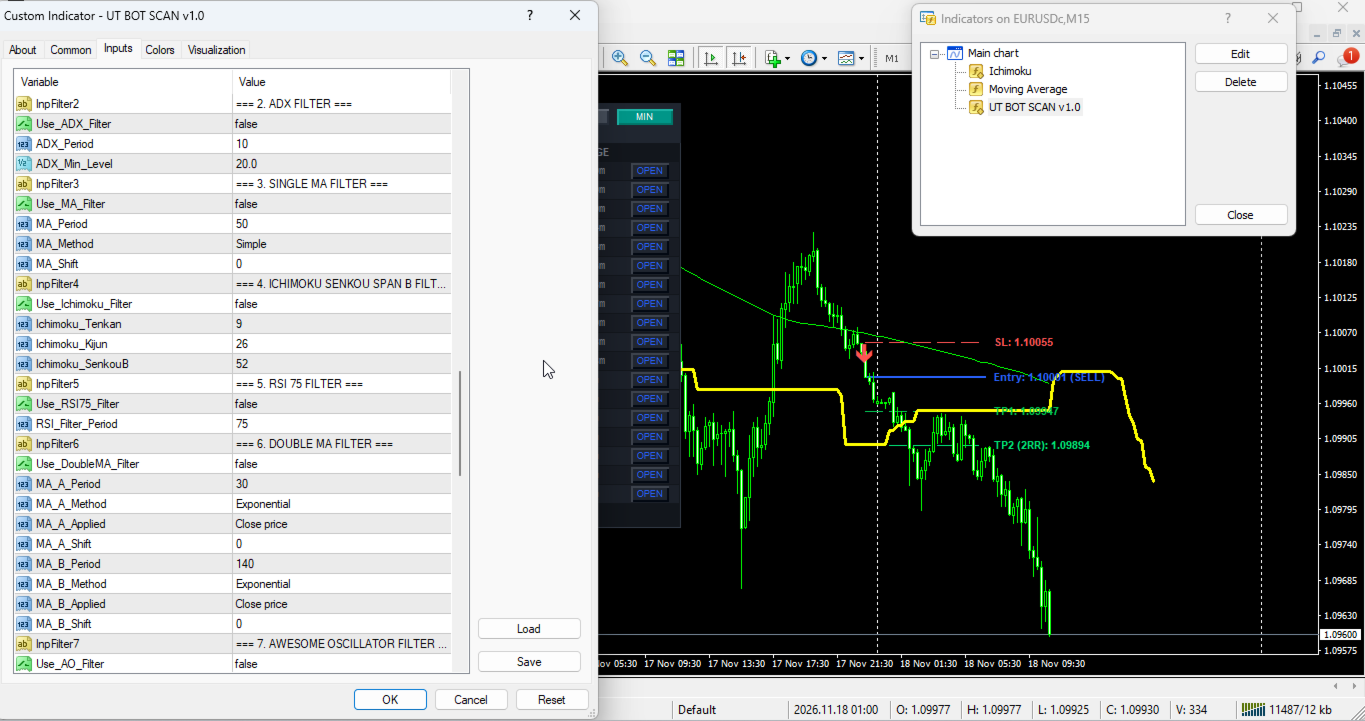
Filter 2: ADX Trend Strength Filter
- Use_ADX_Filter (Default: false) -> Enables ADX minimum trend strength validation.
- ADX_Period (Default: 10) -> Calculation period (bars) for the ADX indicator.
- ADX_Min_Level (Default: 20.0) -> Minimum ADX main-line value required to confirm directional trend momentum.
Filter 3: Single Moving Average Filter
- Use_MA_Filter (Default: false) -> Enables trend direction filtering based on signal close relative to a single Moving Average.
- MA_Period (Default: 50) -> Averaging period (bars) for the Moving Average baseline.
- MA_Method (Default: MODE_SMA) -> Smoothing algorithm (MODE_SMA, MODE_EMA, MODE_SMMA, or MODE_LWMA).
- MA_Shift (Default: 0) -> Horizontal bar shift applied to the Moving Average.
Filter 4: Ichimoku Senkou Span B Filter
- Use_Ichimoku_Filter (Default: false) -> Enables trend bias filtering based on signal close relative to Ichimoku Senkou Span B.
- Ichimoku_Tenkan (Default: 9) -> Tenkan-sen (Conversion Line) calculation period in bars.
- Ichimoku_Kijun (Default: 26) -> Kijun-sen (Base Line) calculation period in bars.
- Ichimoku_SenkouB (Default: 52) -> Senkou Span B (Leading Span B) calculation period in bars.
Filter 5: Long-Period RSI Midline Filter
- Use_RSI75_Filter (Default: false) -> Enables macro momentum bias filtering around the 50.0 midline using a long-period RSI.
- RSI_Filter_Period (Default: 75) -> Calculation period (bars) for the midline RSI filter.
Filter 6: Double Moving Average Filter
- Use_DoubleMA_Filter (Default: false) -> Enables dual Moving Average alignment check (MA A above MA B for BUY; MA A below MA B for SELL).
- MA_A_Period (Default: 30) -> Averaging period (bars) for fast Moving Average MA A.
- MA_A_Method (Default: MODE_EMA) -> Smoothing mode for MA A.
- MA_A_Applied (Default: PRICE_CLOSE) -> Applied price source for MA A.
- MA_A_Shift (Default: 0) -> Horizontal bar shift for MA A.
- MA_B_Period (Default: 140) -> Averaging period (bars) for slow Moving Average MA B.
- MA_B_Method (Default: MODE_EMA) -> Smoothing mode for MA B.
- MA_B_Applied (Default: PRICE_CLOSE) -> Applied price source for MA B.
- MA_B_Shift (Default: 0) -> Horizontal bar shift for MA B.
Filter 7: Awesome Oscillator Filter
- Use_AO_Filter (Default: false) -> Enables Bill Williams Awesome Oscillator (AO) momentum confirmation.
- Use_AO_Volume_Filter (Default: false) -> Requires AO histogram amplitude to exceed minimum positive or negative thresholds.
- AO_Buy_Min (Default: 4.0) -> Minimum positive AO histogram value required for BUY confirmation when amplitude check is enabled.
- AO_Sell_Max (Default: -4.0) -> Maximum negative AO histogram value required for SELL confirmation when amplitude check is enabled.
- Use_AO_Color_Filter (Default: false) -> Requires AO bar slope to rise for BUY signals and fall for SELL signals.
- Use_AO_Zero_Filter (Default: false) -> Requires AO to slope in the signal direction while positioned above zero for BUY or below zero for SELL.
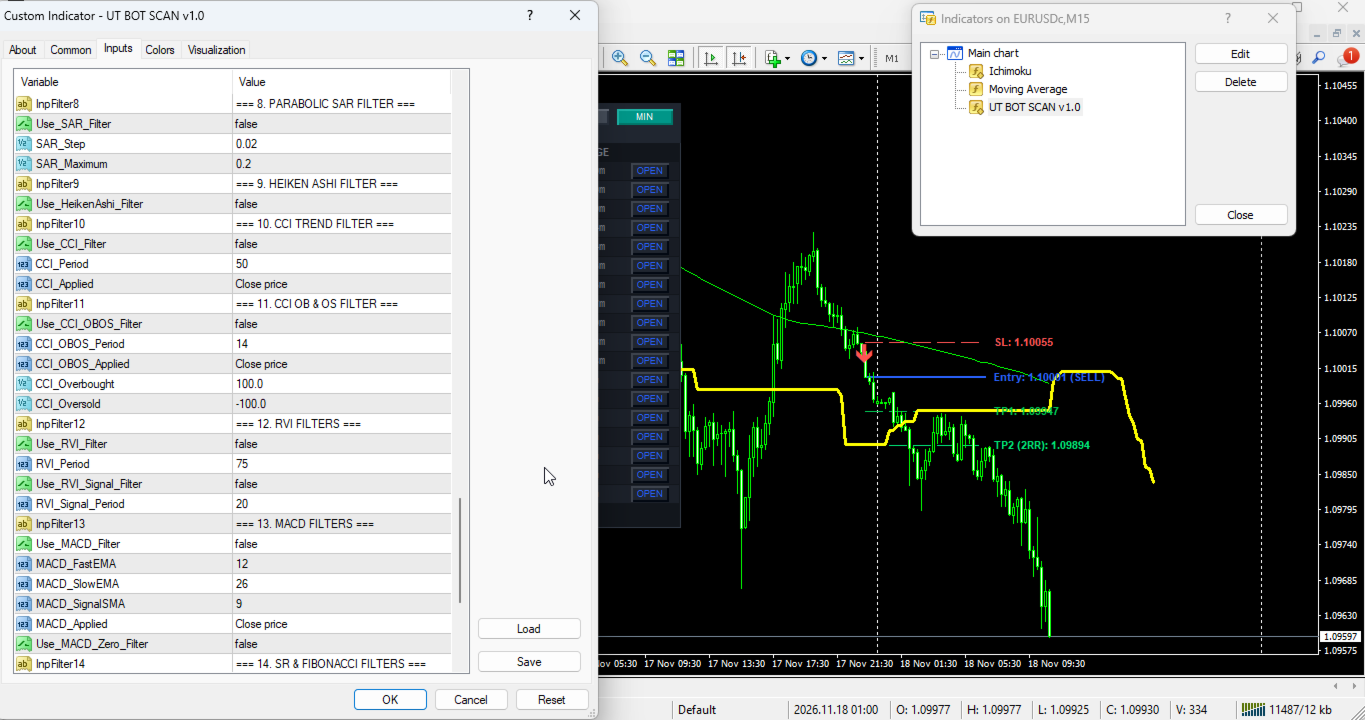
Filter 8: Parabolic SAR Filter
- Use_SAR_Filter (Default: false) -> Enables Parabolic SAR dot position check relative to the signal close price.
- SAR_Step (Default: 0.02) -> Acceleration step increment for Parabolic SAR.
- SAR_Maximum (Default: 0.2) -> Maximum acceleration limit for Parabolic SAR.
Filter 9: Heiken Ashi Filter
- Use_HeikenAshi_Filter (Default: false) -> Enables smoothed Heiken Ashi candle body polarity check (bullish close above open for BUY; bearish close below open for SELL).
Filter 10: CCI Trend Filter
- Use_CCI_Filter (Default: false) -> Enables Commodity Channel Index zero-line bias confirmation (positive for BUY; negative for SELL).
- CCI_Period (Default: 50) -> Lookback period (bars) for the trend CCI filter.
- CCI_Applied (Default: PRICE_CLOSE) -> Applied price source for the trend CCI filter.
Filter 11: CCI Overbought and Oversold Filter
- Use_CCI_OBOS_Filter (Default: false) -> Enables momentum breakout confirmation beyond upper or lower CCI threshold bands.
- CCI_OBOS_Period (Default: 14) -> Lookback period (bars) for the OB/OS CCI filter.
- CCI_OBOS_Applied (Default: PRICE_CLOSE) -> Applied price source for the OB/OS CCI filter.
- CCI_Overbought (Default: 100.0) -> Upper CCI threshold level for bullish breakout confirmation.
- CCI_Oversold (Default: -100.0) -> Lower CCI threshold level for bearish breakout confirmation.
Filter 12: RVI Trend and Signal Filters
- Use_RVI_Filter (Default: false) -> Enables long-period Relative Vigor Index zero-line directional check.
- RVI_Period (Default: 75) -> Lookback period (bars) for the RVI zero-line filter.
- Use_RVI_Signal_Filter (Default: false) -> Enables RVI main-line versus signal-line crossover confirmation.
- RVI_Signal_Period (Default: 20) -> Lookback period (bars) for the RVI main/signal crossover filter.
Filter 13: MACD Histogram and Zero Filters
- Use_MACD_Filter (Default: false) -> Enables MACD histogram polarity check (main line above signal line for BUY; below for SELL).
- MACD_FastEMA (Default: 12) -> Fast EMA period (bars) for MACD calculation.
- MACD_SlowEMA (Default: 26) -> Slow EMA period (bars) for MACD calculation.
- MACD_SignalSMA (Default: 9) -> Signal line SMA period (bars) for MACD calculation.
- MACD_Applied (Default: PRICE_CLOSE) -> Applied price source for MACD calculation.
- Use_MACD_Zero_Filter (Default: false) -> Enables MACD main-line zero-axis check (above 0.0 for BUY; below 0.0 for SELL).
Filter 14: Support/Resistance and Fibonacci Filters
- Use_SR_Filter (Default: false) -> Enables price-action proximity verification near recent swing support or resistance zones.
- SR_Period (Default: 50) -> Lookback window (bars) used to identify recent support lows and resistance highs.
- SR_Zone_Points (Default: 80) -> Proximity tolerance buffer (points) around detected support or resistance levels.
- Use_Fib_Filter (Default: false) -> Enables swing-based Fibonacci retracement pullback zone confirmation.
- Fib_Level_1 (Default: 0.382) -> First Fibonacci retracement ratio defining the pullback zone boundary.
- Fib_Level_2 (Default: 0.618) -> Second Fibonacci retracement ratio defining the pullback zone boundary.
- ZigZag_Depth (Default: 12) -> Minimum bar depth used to locate historical swing highs and lows.
- ZigZag_Deviation (Default: 5) -> Minimum price deviation (points) required to register a swing point.
- ZigZag_Backstep (Default: 3) -> Minimum bar separation between consecutive swing highs or swing lows.
Filter 15: Supertrend Filter
- Use_Supertrend_Filter (Default: false) -> Enables ATR-based Supertrend directional alignment check on the signal bar.
- ST_AtrPeriod (Default: 10) -> ATR lookback length (bars) for Supertrend volatility bands.
- ST_Factor (Default: 3.0) -> ATR multiplier factor controlling Supertrend band width.
Risk Disclaimer
Trading foreign exchange, commodities, indices, and other financial instruments on margin carries a high level of risk and may not be suitable for all investors. Past performance does not guarantee future results. This software is an analytical and technical market-scanning utility designed to assist traders in objective chart monitoring; it does not provide investment advice or guarantee financial profit. Always test the indicator thoroughly on a demo account to understand its operational behavior and terminal resource usage before deploying it in live trading environments.