ElasticGate
- エキスパート
-
Ahmed Aangour
 Based in France. I am a trader first: I run my own accounts on MT4 and MT5, and I develop my own trading robots from that experience, built only on strategies that have proven solid in the market.
- バージョン: 1.50
- アクティベーション: 10
Launch price: 99 USD. Next price: 199 USD after the first 10 copies, then +100 USD after every 10 copies.
A smart grid for gold: it waits for confirmation before trading, adapts its spacing to volatility, and comes with a protective stop loss switched on by default. Fixed lot on every level, no martingale.
ElasticGate is part of the Gate series, a set of rule-based MetaTrader 5 experts, each built around one clearly explained mechanism.
When gold stretches too far, too fast, it often snaps back.
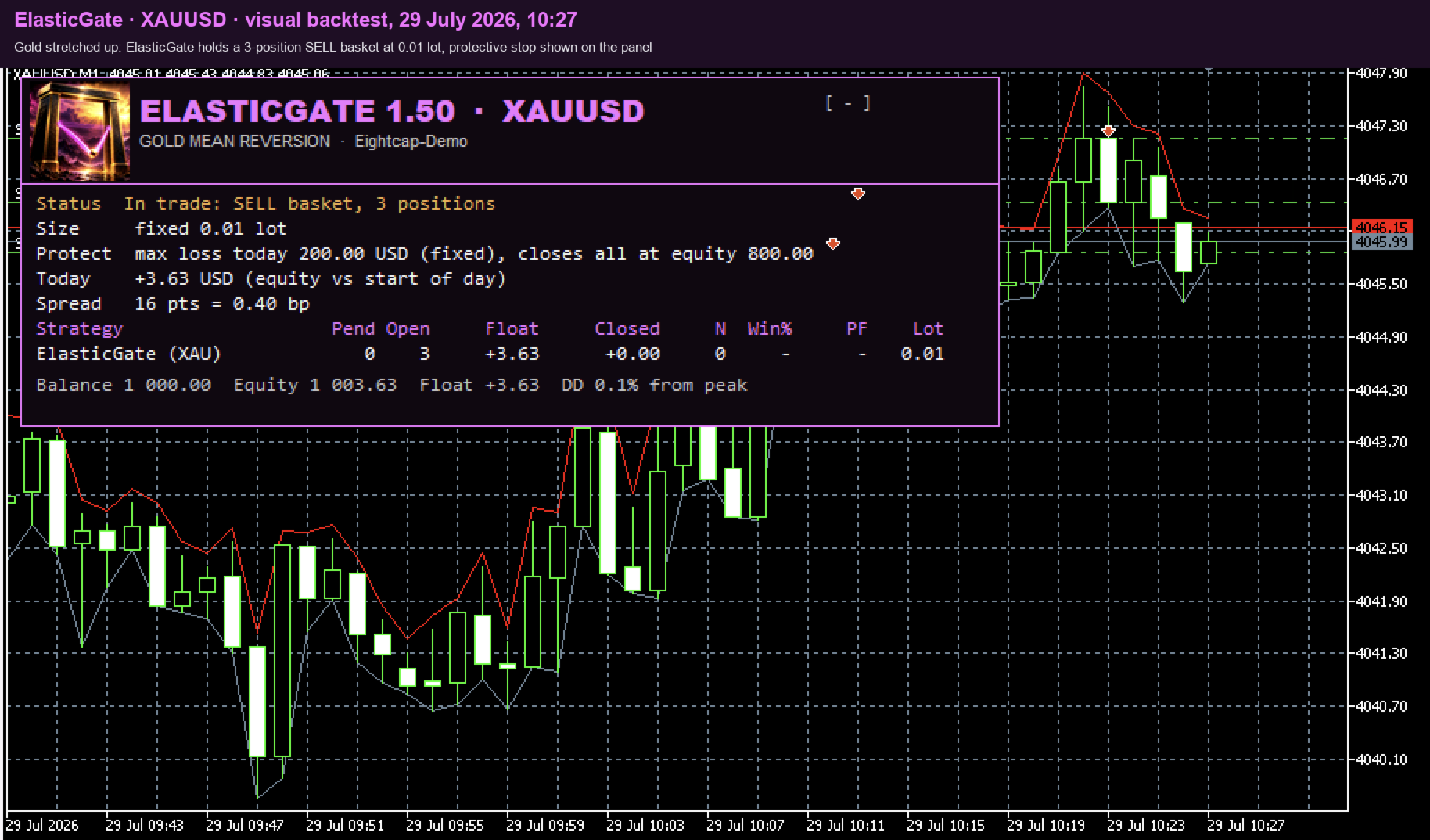
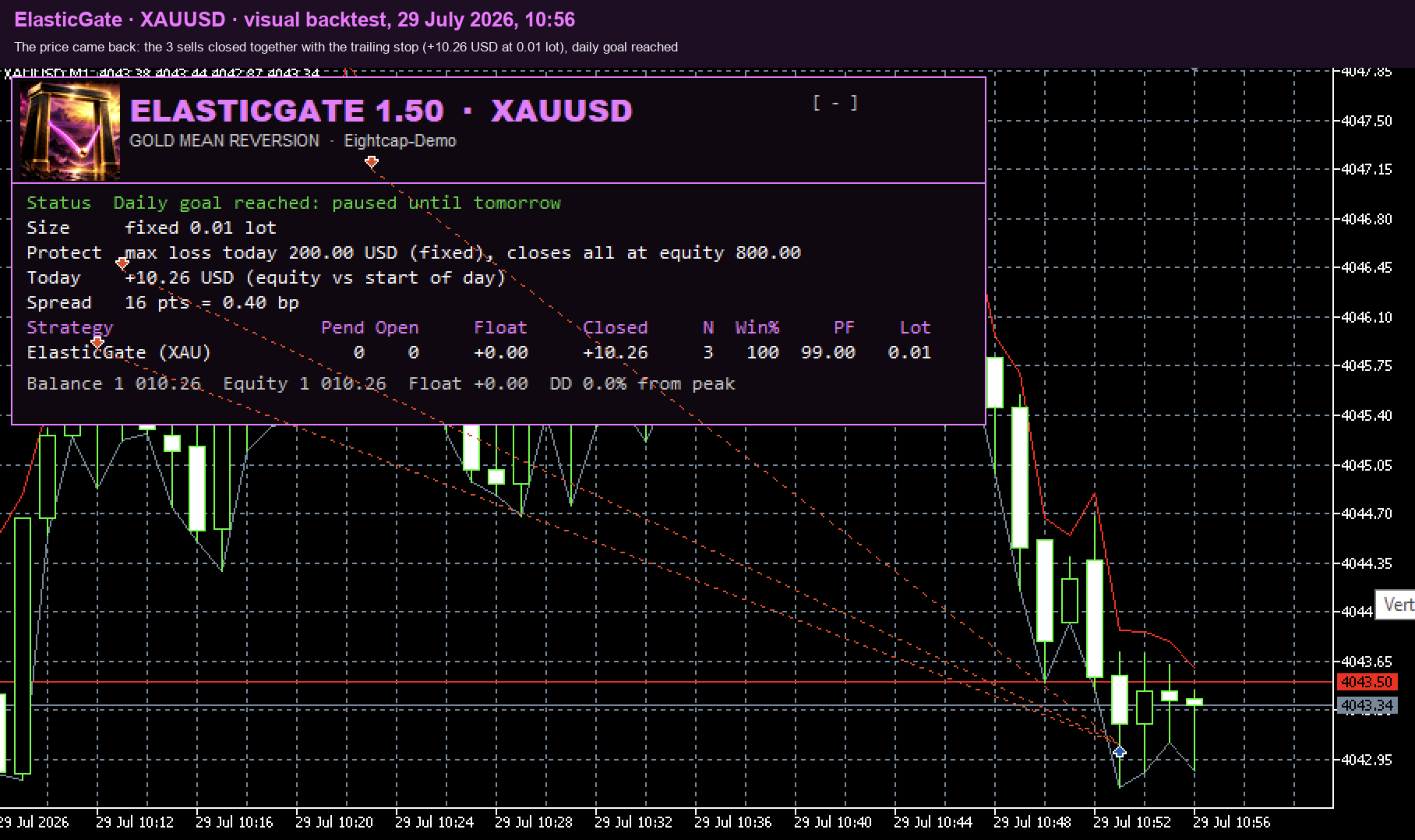
On short time frames, gold regularly overshoots: a fast push away from its recent average, then a quick return. ElasticGate waits for such an overextension, trades the return with a small basket of positions, and closes the whole basket together as soon as the price comes back in its favour. Each basket usually lasts minutes, rarely hours.
A smart grid, not a plain grid: three measured choices
A grid that opens at the first sign of excess and adds at fixed distances eventually meets a trending day it cannot survive. ElasticGate is built on three choices that were tested, not guessed:
- Confirmation before the first order. The robot first follows the overextension without risking anything and opens only once it has clearly extended. In our tests this step cut the size of the largest baskets by about five times (for example from 87 to 18 positions in 2021).
- Spacing that follows volatility. Grid spacing, trailing distances and the emergency take profit all scale with gold's recent daily range. When gold becomes wild, the grid widens on its own. The same engine with fixed distances lost money on 2009-2018 data; with adaptive spacing it was profitable on the same data.
- Selected sessions only. It opens new baskets only during selected sessions from Monday to Thursday. Trading all hours with the same engine turned 2019-2026 into a loss in our tests.
Key features
- Protective stop loss on by default: a daily equity stop (200 USD per 0.01 lot by default, fixed amount or % of the balance) closes every position when the day's loss reaches it, then the robot waits for the next day. You can adjust it, and it stays on whatever the size of the basket.
- One market: Gold (XAUUSD), any symbol suffix (XAUUSD.i, XAUUSDm, GOLD…), any chart timeframe.
- One basket at a time, never buys and sells together. The same lot on every level: no martingale, no lot increase after a loss.
- Basket exit by a shared trailing stop, plus an emergency take profit on every position.
- Daily goal: once the day has earned about 10 USD per 0.01 lot, the robot stops until the next day.
- Lot: fixed, or a lot per balance amount (compounding). The protection in % follows the balance too.
- On-chart panel: status, lot, protection level, result of the day, spread, statistics.
What a grid means for your account
- Most baskets close with a small profit: 99 % of the 1 213 baskets in the 2019-2026 real-tick backtest.
- The losses come from a few strong trend days, when the daily protection closes everything: 7 such days in 2019-2026, about 200 USD each per 0.01 lot with the default protection.
- The protective stop works on the whole account for the day rather than on each position: keep it on, and size it with your lot (about 200 USD per 0.01 lot, as tested).
Requirements and recommendations
- MetaTrader 5, hedging account required (several positions at once).
- Broker server time GMT+2 in winter / GMT+3 in summer (most MT5 brokers). The sessions are defined in server time.
- Low-cost account (raw spread + commission, or a tight standard spread): each position earns a small amount, so the cost per trade matters.
- Balance: for a lower risk, 0.01 lot per 2 000 to 3 000 USD. 0.01 lot per 1 000 USD is the minimum: it held in the 2019-2026 real-tick backtest (largest drawdown 59 % of 1 000 USD), but on the 2009-2018 data a start at the worst moment (late 2015) would have lost the whole account.
- Leverage 1:100 or more. A VPS (the robot only trades while MetaTrader 5 is running).
- Not designed for prop-firm challenges: a grid can take several days to recover from a protection day.
Quick start
- Open a gold chart (XAUUSD or your broker's name for it), any timeframe.
- Attach ElasticGate, set the lot (0.01 per 2 000 to 3 000 USD for a lower risk) and keep the protective stop (about 200 USD per 0.01 lot), enable Algo Trading.
- Check the panel: the first line shows the status (waiting, in trade, paused until tomorrow).
- Leave it running on a VPS. Several days without a trade are normal.
Settings
- Lot: fixed / per balance amount (compounding). Lot size: the fixed lot, or the lot per balance amount. Balance amount for that lot size: e.g. 0.01 lot per 2 000 USD.
- Equity protection (the protective stop, on by default): fixed amount / % of balance. Equity protection value: in account currency or in % of the balance at the start of the day.
- Magic number, Order comment, display settings (Show the panel on the chart, Panel corner, Panel font size).
- The daily goal follows the lot automatically (about 10 USD per 0.01 lot).
Good to know
- Quiet days: ElasticGate waits for clear overextensions. Some days bring several baskets, some none. It does not trade on Fridays.
- Volatile periods: when gold is very agitated, the wider spacing makes the robot more selective; it takes fewer, larger moves.
- Restart: a basket already open is found again by its magic number after a restart or a timeframe change.
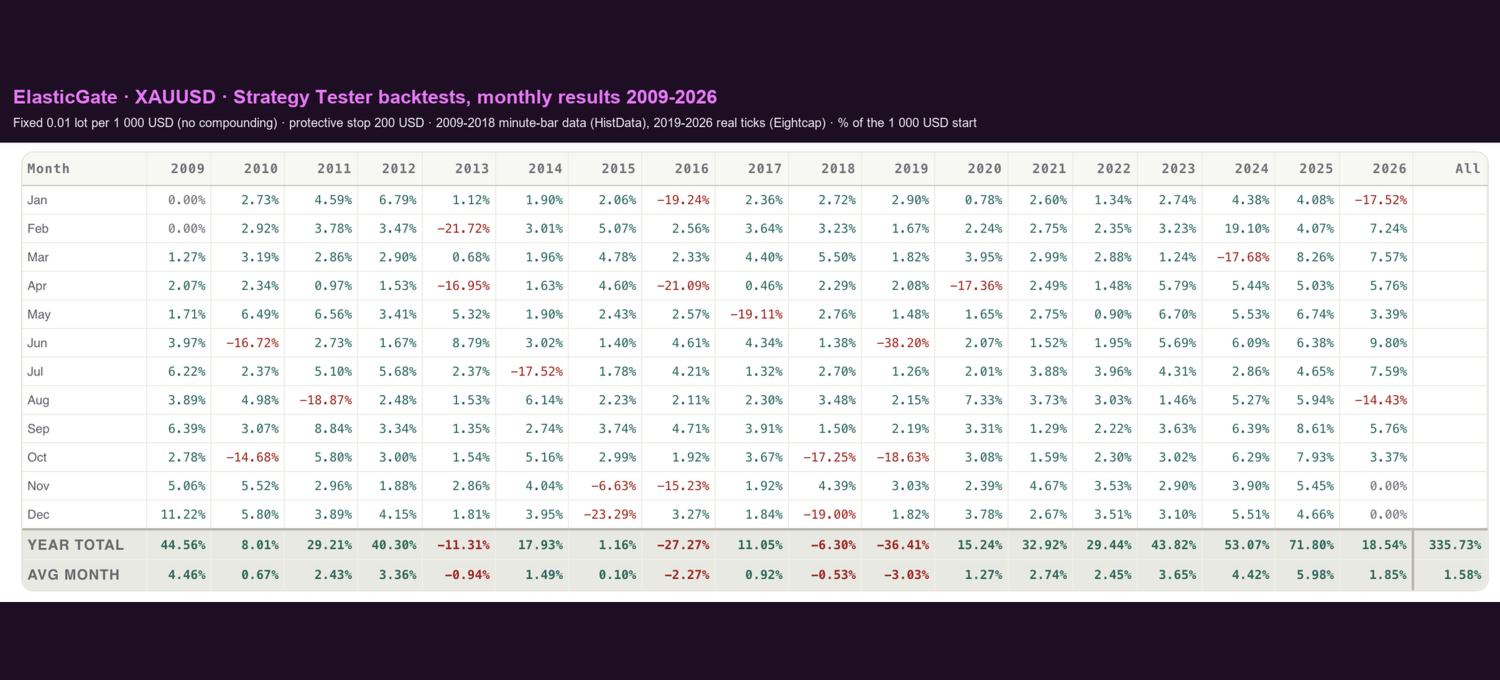
- Weak years exist: 2019 lost in the real-tick backtest (−364 USD per 0.01 lot), and 2013-2019 were flat to slightly negative on the older data.
Backtests (Strategy Tester, not live results)
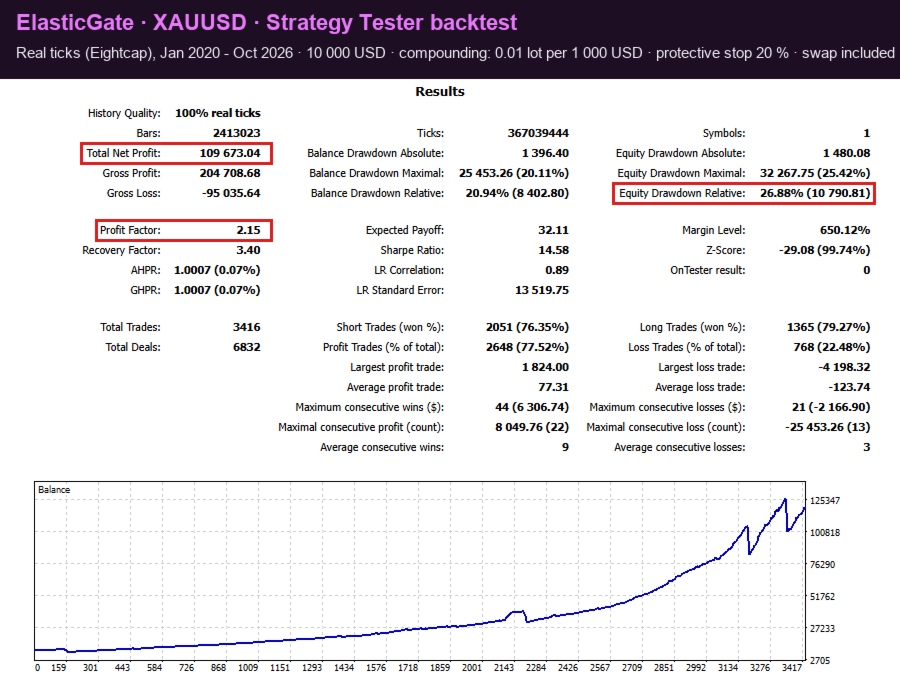
Real ticks, January 2020 to October 2026 (screenshots), spread included, no commission, fixed 0.01 lot, equity protection 200 USD:
- Per 0.01 lot: about +390 USD per year, largest drawdown 215 USD.
- On 3 000 USD: average gain +13.0 % per year, largest drawdown 7.2 % of the starting balance.
- Compounding (screenshots), 0.01 lot per 1 000 USD of balance, protective stop 20 % of the balance, 10 000 USD, January 2020 to October 2026, swap included: 10 000 → 119 673 USD (+44 % per year compounded), largest drawdown 26.9 % of the equity peak, lowest equity 8 597 USD (−14 % of the deposit, in 2020). Year by year: 2020 +11 %, 2021 +37 %, 2022 +33 %, 2023 +53 %, 2024 +62 %, 2025 +104 %, 2026 (to 23 October) +16 %.
- Year by year (per 0.01 lot): 2020 +152, 2021 +329, 2022 +294, 2023 +438, 2024 +531, 2025 +718, 2026 (to 13 October) +185 USD.
Longer history, same settings:
- 2019 was a losing year (real ticks, −364 USD per 0.01 lot). From January 2019: about +293 USD per year per 0.01 lot, largest drawdown 588 USD (19.6 % of a 3 000 USD balance), profit factor 1.95, 4 091 positions in 1 213 baskets.
- Independent test on 2009-2018 data (minute bars, less precise than real ticks): +110 USD per year per 0.01 lot, profit factor 1.23, with losing years in 2013, 2016 and 2018.
- Over the whole 2009-2026 history, the largest drawdown was 1 013 USD per 0.01 lot (October 2015 to April 2020), or 34 % of a 3 000 USD balance.
Drawdowns are a % of the starting balance. The results were much stronger from 2020 onwards, a period of high gold volatility, than in 2013-2019. Simulated results have limits and do not reflect real execution, slippage or future market conditions.
Risk warning
Trading gold on margin carries a high level of risk and may not be suitable for every investor. A grid strategy holds several positions against the price until the basket recovers or the daily protection closes it. You can lose part or all of your capital. Past performance, real or simulated, does not guarantee future results.