Enrique Enguix
Enrique Enguix
4.5 (665)
  • Información
5+ años
experiencia
2
productos
8095
versiones demo
0
trabajos
0
señales
0
suscriptores
Automatizo estrategias de trading en MetaTrader 5 (MQL5).
Mi trabajo consiste en usar algoritmos para generar y validar enfoques que son robustos y rentables, pero que a menudo no son evidentes para otros.

| Todos nuestros Asesores Expertos: https://www.mql5.com/es/users/envex/seller
| Nuevo Grupo MQL5: https://www.mql5.com/es/messages/01c72081307dda01
| Canal de Telegram: https://t.me/+Jwdm825813I1Nzk0
Enrique Enguix
Enrique Enguix
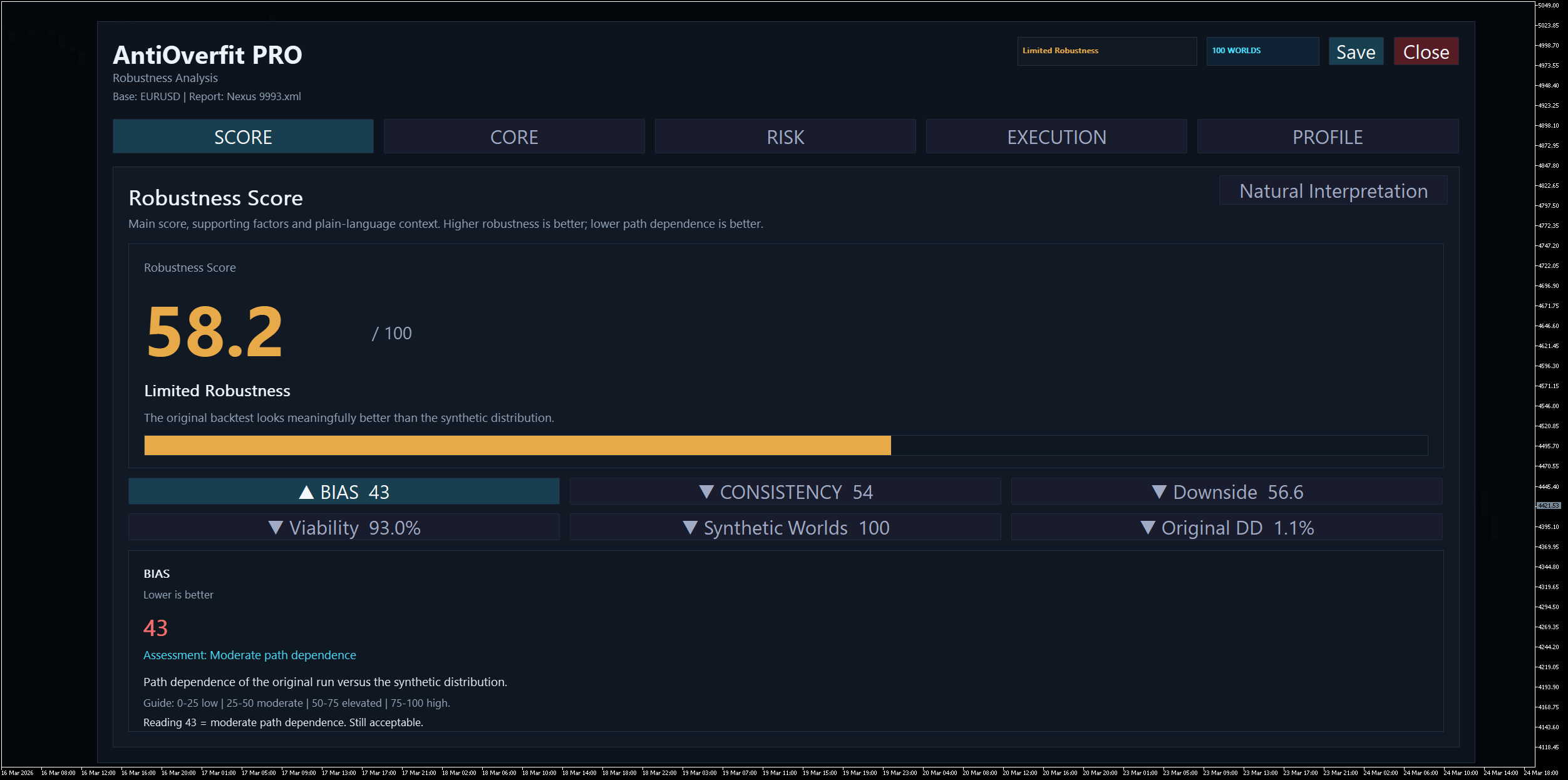
I didn’t want to fall into the contradiction of analyzing other products while avoiding testing my own expert advisor, Nexus.

After evaluating it with this methodology, it obtained a score of 58.2. The interpretation is fairly clear: the results remain reasonably mixed under synthetic variation, but the original backtest still appears stronger than the synthetic distribution, which suggests some degree of path dependence. This is not a confirmation of failure, but rather a useful warning signal.

There is also an important context here. When Nexus was originally designed, I did not yet have this tool or this analytical framework available. Because of that, I don’t see this result as something negative, but rather as a turning point in my own work.

From this point forward, this methodology will not only serve to evaluate third-party systems or study potential EA portfolios, but also to continuously review and improve Nexus itself. Both its internal logic and its parameter sets will gradually evolve to adapt to this more demanding robustness framework.

https://www.mql5.com/en/market/product/90877
Enrique Enguix
Enrique Enguix
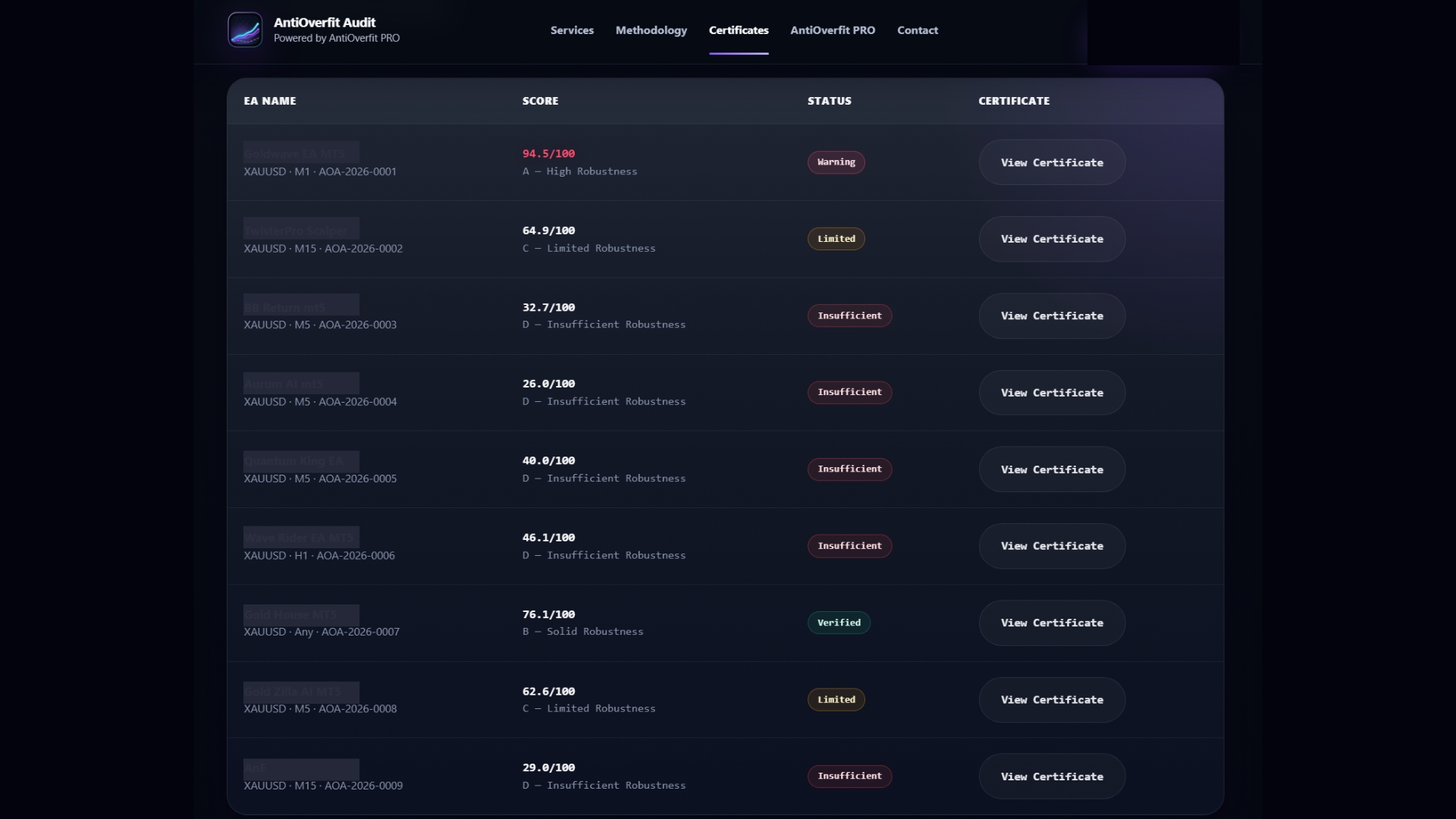
I analyzed a well-known Expert Advisor from the Market, and the results point to very low robustness.

The comparison between the original backtest and the behavior of the same setup on synthetic worlds shows a very clear divergence: the original historical result is significantly higher than the synthetic distribution.

This is usually a sign of dependence on the market path and possible over-optimization based on the specific past for which it was calibrated. When the market path changes, the setup shows fragility.

I'm not saying it will necessarily fail in the future, but the data certainly suggests interpreting it with great caution.

The score obtained, 16.9, is far below what I've seen in some other Expert Advisors, including even some free products that have shown a much more robust response in this type of analysis.

For me, this result suggests a fragile setup, with insufficient robustness and excessive sensitivity to the specific market movement.

This type of configuration should be treated with extreme caution.
Enrique Enguix
Enrique Enguix
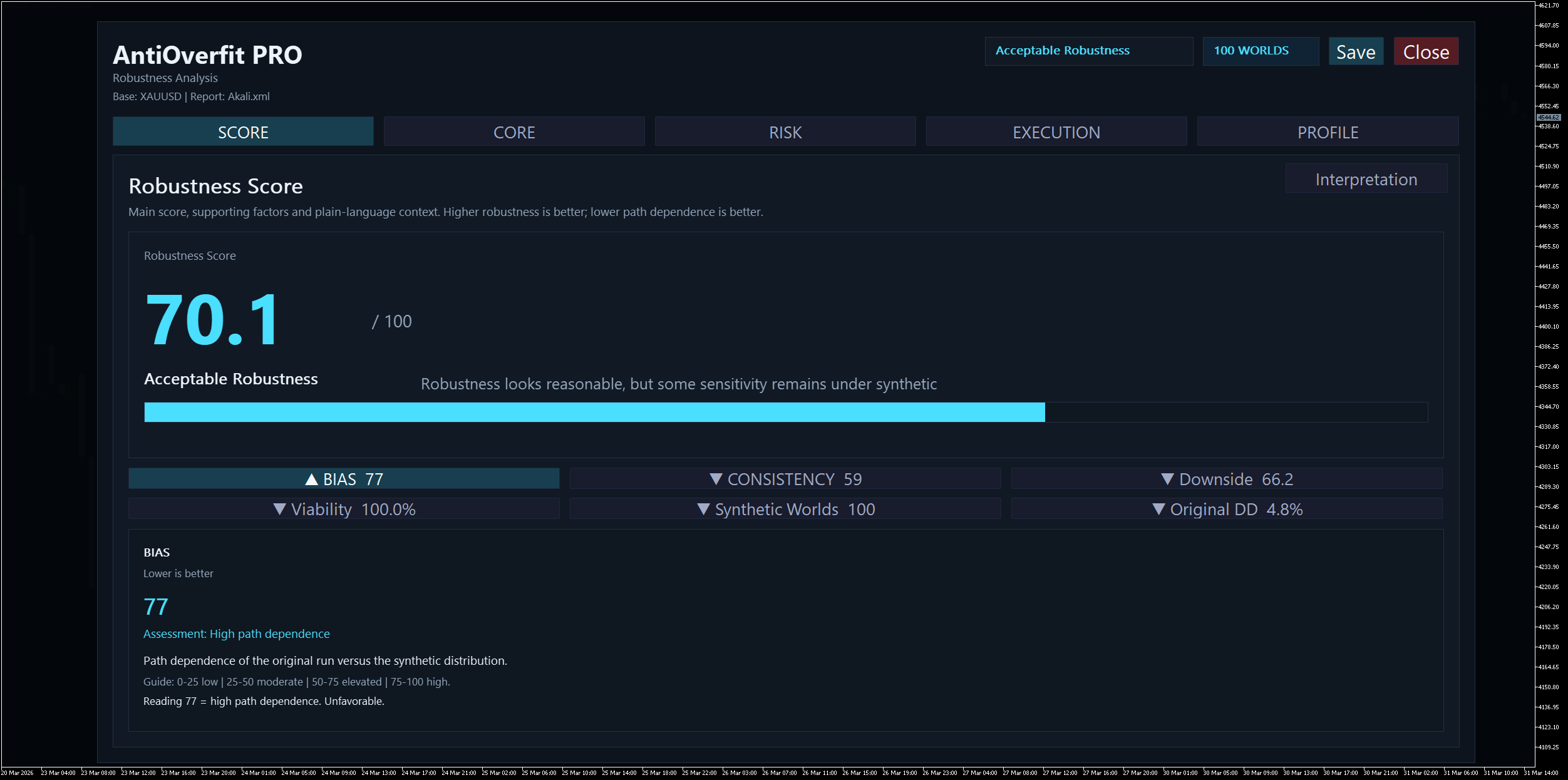
I’ve just found a hidden gem in the Market using AntiOverfit PRO: a free product that has clearly outperformed several EAs ranked among the top paid products.

It scored 59/100, which is far from common under such a demanding evaluation. What matters is not just the score itself, but what it suggests: this does not look like a product built to fit one specific historical path, but rather a system with genuine adaptive capacity.
Enrique Enguix
Enrique Enguix hace 37 minutos
There's a small error in this image; the DD is 12.91%. The image is from a beta version, and there was an error reading the file.
Enrique Enguix
Enrique Enguix
Many users have asked me about the new tool and compared it to traditional Monte Carlo testing, so here is a simple explanation:

Monte Carlo, when understood as a permutation of a strategy’s returns, is still working with the same underlying path, only rearranged. The problem is that many strategies are path dependent, meaning that not only the final result matters, but also the exact path the market took to get there.

The tool I use does not simply permute returns: it generates fully synthetic market histories.

A clear analogy would be this:

Monte Carlo is like taking apart the same road and rebuilding it by rearranging its sections.
Synthetic histories are like building thousands of different roads from scratch.

And for a trading strategy, that changes everything, because surviving variations of a single path is not the same as being exposed to genuinely different plausible paths.

That is the key difference: the goal is not just to see how a system behaves under small rearrangements of the past, but how it holds up across many different plausible market realities.

https://www.mql5.com/en/market/product/168279
Enrique Enguix
Enrique Enguix
📢 NEW! NEXUS Trial Version Available on the HUB

A trial version of NEXUS is now available, designed for easy and risk-free testing.

👉 It comes pre-loaded with a set very similar to the classic version, ideal for testing how the system works without the need for advanced configurations.

🔹 Instrument: EURUSD (automatic prefix/suffix detection)
🔹 First order: fixed at 0.01 lots
🔹 Grid: normal configuration (no changes)
🔹 Valid until: December 31, 2025 (server time)

⚙️ You can download it directly from the HUB, in the downloads section. It's available now!
| NEXUS HUB | Guide, Sets, FAQ & Support: https://www.mql5.com/en/blogs/post/764411
Enrique Enguix
Enrique Enguix
Nexus opened two trades, but no new ones are appearing even though the grid distance has been exceeded. That’s intentional. Nexus is not random — it uses controlled mechanisms, not roulette logic.

In this conservative set, the grid only activates after **four trades** have been opened by standard entry conditions (the base strategies). Until then, grid averaging is disabled.

Right now, either the price must rise, or additional valid entries must appear to complete the initial four trades. Only then will the grid logic engage to average profit.

It’s a conservative setup. I don’t mind if profits take a few days — what matters is preserving the account.
Enrique Enguix
Enrique Enguix
Following up on yesterday’s explanation, I ran an optimization of the “My Favourite” set — a process I’ll be applying to the other sets as well.

The original Take Profit was relatively low, and a significant portion of profit was being lost to swaps and commissions. It was set at 25% of the ATR. To refine it, I ran a 3D optimization (since 2D didn’t show the relationships clearly).

X-axis: Take Profit from 25% to 200% ATR.
Y-axis: backtest start delay from 0 to 2000 days, in 50-day increments (50 different start dates).

The most robust area emerged around 100% ATR. I’ll be testing this configuration to confirm its consistency.

Development is ongoing — every day brings small improvements. It will never be perfect, but the goal is to make it consistently good enough.

If this change turns out to be a real step forward, it will be uploaded
Enrique Enguix
Enrique Enguix
“I won’t lie to you — I was expecting solid results.
But what’s happening with the Gold Set… it’s honestly blowing me away.”

When I built this setup for NEXUS, I spent hours fine-tuning every detail.
Backtests over several years.
Thousands of trades.
And the stats were clear:

91.37% win rate on shorts

93.13% on longs

Fast trades, low exposure, sniper-like entries.

So yeah, I knew it was strong.
But seeing real users report 100% winning trades week after week…
That still hit different.

What’s wild is: it’s not just one user.
It's happening across different accounts, brokers, setups — and the consistency is insane.

This isn’t magic.
It’s not a “holy grail.”
But it’s a system built to enter where it matters and exit before things go sideways.

Will it lose someday?
Of course.
This is trading — not a fairy tale.

But seeing the community validate it like this…
It reminds me why I built NEXUS in the first place:
To deliver a real tool for real traders.
Without hype. Without shortcuts. Without BS.

Just precision.
And results.

https://www.mql5.com/en/market/product/90877