M5 prints a sell divergence while M30 prints a buy — what would you do?

 
Hi everyone, I've been trading RSI divergences for a while, and there's still one situation that confuses me. Curious how more experienced guys handle it.
  • On my screenshot (H1 gold), at the same moment I have:
  • M5  -> sell divergence, 13 bars old
  • M15 -> buy divergence
  • M30 -> fresh buy divergence, 2 bars old
  • H1 and above -> nothing

So half of the screen shouts "buy" and the other half shouts "sell". 

My usual reaction is to wait for the higher timeframe to join in, or just skip the trade - but honestly I keep feeling I throw away decent setups.

So for those of you who actually trade this stuff:
When timeframes conflict like this, do you trust the higher TF, go with the majority, or just stand aside? How much weight does a divergence even carry in your decisions - main trigger, or just a confirmation? And how
long do you keep a divergence "alive"? I expire mine after about 15 candles, not sure if that's too strict.
Real experience only please! Thank you so much!


Mixed RSI Divergence signal  
 

Forum on trading, automated trading systems and testing trading strategies

GOLD, Gold and XAUUSD

Vitaly Muzichenko, 2026.08.16 20:00

That’s how you should trade

As soon as the final confirmation appears as a red square, go short
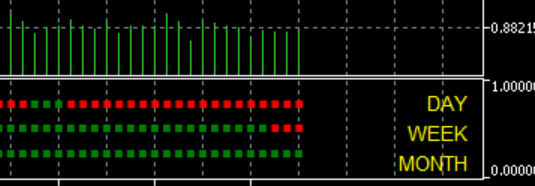
Basically, when all the indicators align and the trend has ‘run its course’ – that’s when you enter; this way, it won’t be like reading tea leaves 😁


Ryan L Johnson #:

Thanks Ryan! So the idea is: don't fight the conflict, just wait for full alignment on the higher TFs and treat that as the only green light.
Do you still use divergences at all in that setup, or purely the day/week/month alignment?
 
Le Uyen Phuong Nguyen #:
Thanks Ryan! So the idea is: don't fight the conflict, just wait for full alignment on the higher TFs and treat that as the only green light.
Do you still use divergences at all in that setup, or purely the day/week/month alignment?

That is a pocket post referring you to Vitaly Muzichenko who is a consistent MTF gold trader. There's relevant information posted by him in many pages of that thread. Check it out.

(Personally, I trade my own gold scalping EA on a single custom chart structure).

 
Ryan L Johnson #:

That is a pocket post referring you to Vitaly Muzichenko who is a consistent MTF gold trader. There's relevant information posted by him in many pages of that thread. Check it out.

(Personally, I trade my own gold scalping EA on a single custom chart structure).

Thanks Ryan! I’ll dive into Vitaly’s posts and study the alignment concept on my own.
I appreciate you taking the time to help me out. Have a great trading week!
 
My honest advice is to stick with only one time frame.
 
Daniel-gheorghe Muresan #:
My honest advice is to stick with only one time frame.

Hello, thank you so much for the advice! You're right! I've noticed that during the US session, when liquidity is high, even a divergence on M1 or M5 can trigger a strong price reaction. However, at times like the start of the London session, when the market hasn't clearly established a direction, I often see divergences across different timeframes not aligning. That makes me unsure whether to prioritize higher‑timeframe divergences or lower‑timeframe ones.

I've been thinking: maybe the key is to look for divergences only when price is near a strong support/resistance level, and then watch price action around that zone? Sometimes it works, sometimes not. Or should we simply treat divergences as a minor warning signal rather than a primary entry trigger?

 
I would not count divergences like votes, because M5 and M30 describe different swings. Use the higher timeframe only for directional context, then require lower-timeframe price structure to confirm the actual entry. I would also expire a divergence when price invalidates its swing, not after a fixed number of candles, because 15 quiet candles and 15 news candles are very different. Have you tested the same rules separately for trend, range and high-volatility periods?
 
Both M5 and M30 show inducement zones and liquidity corrections and make you think there's a new trend (when there isn't a new trend). You need to look in a timeframe which ignores those, which would be H1. So compare both M5 and M30 with H1, and it's also good to see the H4 trend.
 
Fxrobustix #:
I would not count divergences like votes, because M5 and M30 describe different swings. Use the higher timeframe only for directional context, then require lower-timeframe price structure to confirm the actual entry. I would also expire a divergence when price invalidates its swing, not after a fixed number of candles, because 15 quiet candles and 15 news candles are very different. Have you tested the same rules separately for trend, range and high-volatility periods?
Yes, I have also tried it – when the market is highly volatile, even a divergence on M1 or M5 can cause a strong reversal reaction in price. However, during a deep sell-off, a bearish divergence on M30 or H1, even if it appears on the 10th candle, cannot be overridden by any bullish divergence on lower timeframes – price continues to drop. And in a ranging market, it is indeed very difficult to identify. I think I still need to learn, observe, and backtest extensively to determine when multi-timeframe divergence works effectively.
 
Conor Mcnamara #:
Both M5 and M30 show inducement zones and liquidity corrections and make you think there's a new trend (when there isn't a new trend). You need to look in a timeframe which ignores those, which would be H1. So compare both M5 and M30 with H1, and it's also good to see the H4 trend.
Yes, thank you. I will pay more attention to the higher timeframes as you suggested. H4 is indeed very important. From my observation of many instances, for example, when H4 gives a bearish divergence signal, price will still continue to push higher at that exact moment. But when the bearish divergence on H4 reaches the 2nd or 3rd candle, price starts to drop extremely deeply – for example, the recent drop in Gold from 4670 to 4450 last Friday.