Discussion of article "Graphical Interfaces XI: Rendered controls (build 14.2)"
Cool, is this the final version or will there be some more improvements? So that if I switch from the standard panel to yours, then I don't have to redo a lot of things in case of updates.
Cool, is this the final version or will there be some more improvements? So that if I switch from the standard panel to yours, I don't have to redo a lot of things in case of updates.
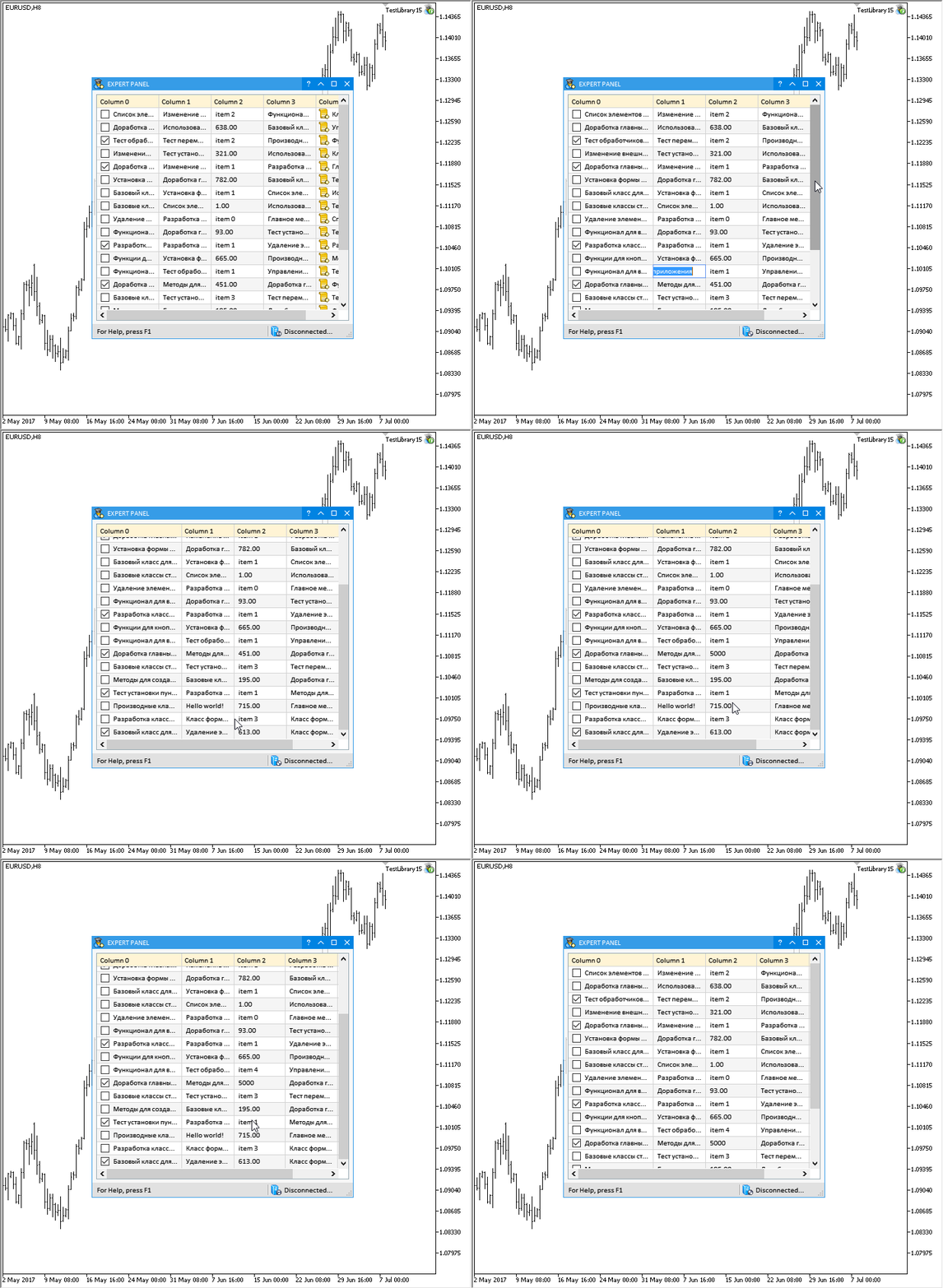
Now there is already one more article for publication with some additions. Input fields and combo boxes will be added to the table cells.
As an announcement I can show you how it will look like:
//---
And there are plans to integrate a graphical standard library, which is described in this article: Visualise it! Graphical library in MQL5 as an analogue of plot from R
After that, I will take a break. Finally. )
I don't really understand pointers and I also don't understand the method of working with methods.
When you create for example a background, intellens shows a lot of methods that do not apply to the background.
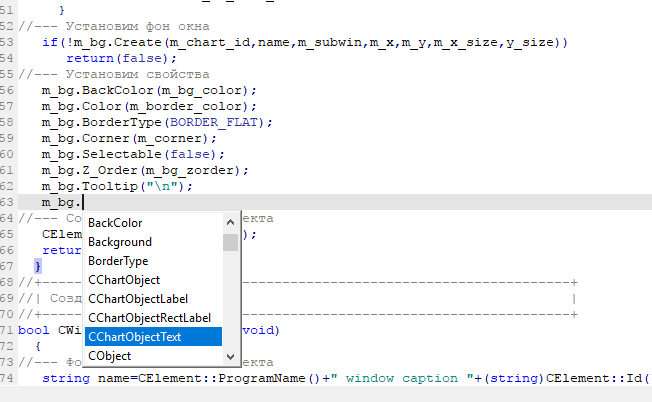
This causes a lot of confusion...
Is it possible to create objects so that only the methods applicable to it are visible?
here is an example
class test

{
int met_1();
int met_2();
int met_3();
int met_4();
int met_5();
};

class TEST2: public test
{
}
How to make it so that only 3 4 methods are visible in the descendant class and the rest are not ?
...
How to make it so that only 3 4 methods are visible in the descendant class and the rest are not ?
Define access specifiers.
MQL5 Reference Guide > Language Basics > Variables > Access Specifiers section
The following specifiers are used to access members of structures and classes:
- public - allows unrestricted access to a variable or method of a class;
- protected - allows access from the methods of this class, as well as from the methods of publicly inherited classes. Other access is impossible;
- private - allows access to variables and methods of the class only from the methods of this class.
- virtual - applies only to class methods (but not to structure methods) and informs the compiler that this method should be placed in the table of virtual functions of the class.
Denote access specifiers.
MQL5 Reference Guide > Language Fundamentals > Variables > Access Specifiers section
I've read it and watched video lessons, but I don't get it....
Can you give me a simple example?
I've read it and watched the video lessons, but I'm not getting it....
Can you give me a simple example?
At least read this article: Fundamentals of object-oriented programming >>>. Everything is very clear and there are examples in it.
Or open a thread with questions on object-oriented programming.
At least read this article: Fundamentals of object-oriented programming >>>. Everything is very clear and there are examples in it.
Or open a thread with questions on object-oriented programming.
I read it all, the problem is that to you as a programmer it seems perfect or correct, you are in the subject.
But for me as a person who is not in the subject, it is not clear..... Although I've been writing in procedural style for a long time, and I'm trying to master objects....
I don't really understand pointers and I also don't understand the method of working with methods.
When you create for example a background, intellens shows a lot of methods that do not apply to the background.
This causes a lot of confusion...
Is it possible to create objects so that only the methods applicable to it are visible?
here is an example
class test { int met_1(); int met_2(); int met_3(); int met_4(); int met_5(); }; class TEST2: public test { }
How can I make it so that in a descendant class only 3 4 methods are visible and the rest are not ?
Are they not applicable? The methods of parent objects must be shown. In this case documentation can help. In the standard library we have added special blocks that show inherited methods. For example, for CWndObj:
The methods inherited from CObject are. |
Create, Destroy, OnMouseEvent, Name, ControlsTotal, Control, ControlFind, Rect, Left, Left, Top, Top, Right, Right, Bottom, Bottom, Width, Width, Height, Height, Size, Size, Size, Size, Size, Move, Move, Shift, Contains, Contains, Alignment, Align, Id, Id, Id, IsEnabled, Enable, Disable, IsVisible, Visible, Show, Hide, IsActive, Activate, Deactivate, StateFlags, StateFlags, StateFlagsSet, StateFlagsReset, PropFlags, PropFlags, PropFlagsSet, PropFlagsReset, MouseX, MouseX, MouseY, MouseY, MouseFlags, MouseFlags, MouseFocusKill, BringToTop |
I read it all, the problem is that it seems perfect or correct to you as a programmer, you are in the subject.
But for me, as a person who is not in the subject, it is not clear..... Although I've been writing in procedural style for a long time, and I'm trying to master objects...
So try reading it again. There is a clear answer to your question. It couldn't be clearer.
Ask questions there or in any other thread where OOP is discussed. Here we are discussing a library for creating graphical interfaces.
Hi. Tol, I didn't find something in the examples how I can draw a dividing line in the window now.
What does index mean?
bool CSeparateLine::CreateSeparateLine(const int index,const int x_gap,const int y_gap,const int x_size,const int y_size)
What index parameter, index of what, should be passed there?
And another question at the same time: when drawing a text label (CTextLabel) on the background of a window that has some transparency, the labels are drawn on their opaque background, which does not respond to the Alpha() method, and it does not look good .... Is it possible to make the background of labels with transparency as well?

- Free trading apps
- Over 8,000 signals for copying
- Economic news for exploring financial markets
You agree to website policy and terms of use
New article Graphical Interfaces XI: Rendered controls (build 14.2) has been published:
In the new version of the library, all controls will be drawn on separate graphical objects of the OBJ_BITMAP_LABEL type. We will also continue to describe the optimization of code: changes in the core classes of the library will be discussed.
Below is the appearance of the different types of buttons:
Fig. 9. Demonstration of the appearance of several button types.
Author: Anatoli Kazharski