Fitch Ratings maintained China's sovereign ratings and 'stable' outlook
on Friday, citing strong external balance sheet and the less volatile
economic growth.
Fitch affirmed China's long-term foreign and local currency Issuer
Default Ratings at 'A+'. The 'stable' outlook reflects Fitch's view that
upside and downside risks to the rating are balanced.
The sovereign external balance sheet is China's core sovereign credit
strength. China's foreign reserves rose to $3.82 trillion at end-2013.
This was equal to 19.2 months of current external payments.
China's growth model faces tightening constraints from the rapidly
increasing burden of leverage in the economy and from the deteriorating
ability of the economy to absorb additional investment profitably.
According to Fitch, China's GDP growth would remain less volatile out to
2015 than the 'A' range median in Fitch's projections. However, the
re-balancing process entails some risk of sharply higher volatility if
things go less smoothly than Fitch expects.
Further, Fitch estimates the level of aggregate financing in China's
economy at 217 percent of GDP at end-2013, up from 198 percent at
end-2012. The authorities acted more aggressively to contain risks to
financial stability since mid-2013.
However, fundamental credit weaknesses, including low average incomes
and weak scores for governance, weigh on the credit profile relative to
'A' range peers.
Traditionally, the value of gold fluctuates with market sentiment. In
times of military or geopolitical unrest, traders and investors buy gold
and sell the more risky currencies to seek refuge in the safe haven
asset. Conversely, when all is well in the markets and traders' and
investors' perception of a nation's economic outlook is positive, gold
generally depreciates versus the more risky assets.
The yellow metal has gained strength for the majority of the year,
sustaining a considerable uptrend, likely fuelled by the ongoing
situation in Crimea, gold topped out at 1,392.00 on March 17. Since
then, the XAUUSD has traded to two month lows at 1.277.26, and now sits
slightly higher at 1,299.44. A number of fundamental factors will likely
decide the medium term outlook for the price of the precious metal.
The first is the aforementioned situation in Crimea. The tension looks
to have reduced, as Putin withdrew troops from the Ukrainian border, and
the markets look to have responded accordingly. However, the sanctions
on Putin's Russia remain, and are set to be tightened for as long as
Russia lays claim to Ukraine. At some point, one or the other parties
will have to compromise, something that, at present, neither seems
willing to do.
The second is the potential for a slowdown in China. As disappointing
economic data continues to pour out of the Asian superpower, global
markets become increasingly concerned of the ripple effect such a
slowdown might create. China has large levels of foreign investment
across a huge number of industries worldwide, and a slowdown would stem
capital flow to these investments. This could switch sentiment, and
drive up the price of gold.
Finally, Janet Yellen recently hinted at an interest rate hike. This
would, in the medium term at least, afford US dollar safe haven status.
Such an event would likely redirect the capital of risk averse investors
from gold to the US dollar, and in turn, drive down the price of the
precious metal.
The Chinese foreign exchange regulator announced on Friday that the
nation’s current account will most likely remain in surplus in 2014;
while it expects more capital outflows and inflows into the economy as
Beijing moves in to implement its exchange rate reforms.
China’s current account, its widest gauge of trade with its partners
such as U.S., hit a surplus totalling $182.8 billion in 2013, a decline
of 15 percent from a year ago, according to the State Administration of
Foreign Exchange in a statement posted on its website.
The surplus equals 2 percent of the country’s gross domestic product, a
decline of 0.6 percent from a year ago, reported SAFE, according to Wall Street Journal.
The surplus in 2014 will likely be a major contributor, while surplus as
a proportion of the GDP will remain at low levels, said SAFE. China’s
trade surplus measured $259.8 billion in 2013.
SAFE announced that it will shift its focus towards minimizing risks
from cross-border capital movements this year, and two-way capital flows
will possibly rise as the yuan rate slowly edges towards the
government considers an equilibrium level.
The financial and capital account, which incorporates investment, reached a surplus of $326.2 billion in 2013.
A separate statement issued on Friday showed that the regulator had
revised slightly upwards the forecasts of the China’s current account
surplus in the fourth quarter of 2013 to 44.0 billion from a surplus of
$40.4 billion.
In the fourth quarter the revised forecast of financial account and
capital totalled a surplus of $127.0 billion, up from a prediction of
$81.0 billion.
BEIJING—China's foreign-exchange regulator said on Friday that the country's current account will likely still be in surplus this year, while it sees more capital flowing in and...
The European Central Bank’s (ECB) patience with the region’s lackluster recovery may be running out, if one is to believe the rhetoric deployed by President Mario Draghi at the April press conference. Although the ECB held its main refinancing rate on hold at 0.25%, a record low, it was clear that the downturn in economic data over the past...
Gold prices are firmer on the week with the precious metal rallying 0.5% to trade at $1302 ahead of the New York close on Friday. The move snaps a two week losing streak that saw prices plummet more than 8.2% off the highs and although the rebound may yet have further upside, the magnitude to the rally is likely to remain limited. took...
The British pound offered up an unflattering performance this past week. While the currency was unable to mount a meaningful advance, neither would it loose substantial ground against most counterparts. Stability in exchange rates is sought by central bankers but not currency traders. Looking out over the coming week, the question is whether...
The US dollar gained against most currencies and the euro was on the
back foot in a busy week. And now, rate decisions in Japan and the UK,
Australian employment data and the FOMC meeting minutes of Yellen’s
first decision are the highlights of this week. Here is an outlook on
the main market-movers ahead.
The all-important US Non-Farm Payrolls, slightly disappointed with a
192,000 jobs gain in March. The expectations were high since the winter
storms were over and a strong rebound was anticipated. Nevertheless,
the release still indicates recovery and consists of encouraging
details. The taper train remains on track. Mario Draghi sent the euro
lower on more dovish rhetoric and despite a lack of action. Is the ECB
serious about QE? In the UK, PMIs weighed on the pound, and the loonie
finally staged a recovery after a great Canadian jobs report. More
volatility ahead? Let’s start:
Japan rate decision: Tuesday.
The Bank of Japan maintained its accommodative monetary policy for the
sixth consecutive month, to help the ongoing growth trend in Japan’s
economy. Deflation fears have subsided while the BOJ strives to achieve
a 2% inflation rate. The bank also upgraded its assessment on capital
investment amid a pick-up in business activity. This is the first
decision of the BOJ after the sales tax hike and it comes in the one
year anniversary of Kuroda’s monetary blitz.
US JOLTS Job Openings:
Tuesday, 14:00. The US economy increased its Job openings to 3.974
million in January from December’s revised print of 3.914 million.
However the reading was below market forecast of 4.015 million. The
hiring rate and separation rate remained nearly unchanged at 3.3% and
3.2%, respectively. The Federal Reserve’s new chair Janet Yellen highly
regards JOLTS Report as a good indicator for hiring in the US economy.
Jobs openings in February are expected to reach 3.99 million.
FOMC Meeting Minutes:
Wednesday, 18:00. These are the meeting minutes of Yellen’s first
decision, in which a third taper of QE to $55 billion was announced and
forward guidance was dropped. More importantly, markets will look for
hints about the timing of a rate hike, something that was conveyed by
Yellen in the press conference with the 6 months comment and ignited a
dollar rally.
Australian employment data:
Thursday, 1:30. The Australian economy increased its labor force by
47,300 jobs in February, following 18,000 climb in January. The reading
topped market forecast of 15,300 job addition. However the
unemployment rate remained unchanged at a decade high of 6%. Full-time
employment edged up by a staggering 80,500 but was offset by a drop in
part-time workers. Despite a positive reading, both the RBA and the
Treasury believe the unemployment rate will rise in the coming months
as the economy struggles to transition from a fading mining investment
boom to broader based growth. Australian economy is expected to add
14,300 jobs while the unemployment rate is predicted to remain 6%.
UK rate decision:
Thursday, 11:00. The BoE maintained its rate at a five –year low of
0.5%, in March. The Monetary Policy Committee decided to reinvest 8.1
billion pounds of proceeds from government bonds the Bank bought
through its quantitative easing program and which are due to mature in
March. The pick-up in recovery witnessed in recent months forced the
central bank to reinvent its forward guidance policy. BoE last month
broadened the focus of the guidance towards a wider assessment of spare
capacity, or slack in the economy, to refrain from raising rates or
tightening monetary conditions and also indicated that the first rate
hike could come in the second quarter of 2015. No change in rates is
expected.
US Unemployment Claims: Thursday,
12:30. The number of Americans filing initial claims for unemployment
benefits edged up more than expected last week, reaching 326,000,
however the general trend indicates the Us labor market is continuing
to improve. The 16,000 addition compared to the previous week increased
the four-week moving average to 319,500. Despite this relapse, the
number of claims has been generally stable in March suggesting
acceleration in the US job market. Claims are expected to decline to
314,000.
G20 Meetings: Thu-Fri. G20 meetings
taking place in Washington DC are attended by finance ministers and
central bankers from 20 industrialized nations including the G7 nations
– Canada, Italy, France, Germany, Japan, the UK, and the US. The
discussions are closed to the press but officials usually give
statements to reporters after the meetings have been concluded.
US Federal Budget Balance:
Thursday, 18:00. The federal expenses generally increased in
February, but this year the increase was 32% lower than last year.
February’s budget deficit reached $193.5 billion compared to the $203.5
billion posted in February 2013. In the five months of the
government’s fiscal year, the total is up to $377.5 billion, 24%
smaller than last year. The good news is that the deficit has improved
to where it’s running at about 3% of GDP, the normal 40-year average.
US Federal budget deficit is expected to improve to -$127.5 billion.
US PPI
: Friday, 12:30. Prices of finished goods fell slightly in February,
down by 0.1%, following a 0.2% rise in the previous month. Analysts
expected a 0.2% increase. On a yearly base, producer prices rose 0.9%,
the smallest 12-month increase since last May. The recent drop
suggests, inflation remains low. However, Fed officials have expressed
concern about the persistence of low inflation. If it remains below
target, the Fed may stop scaling back its stimulus measures. A rise of
0.1% is expected this time.
US UoM Consumer Sentiment:
Friday, 13:55. U.S. consumer sentiment declined in March to 79.9 from
81.6 in the prior month, the lowest level since November 2013.
Economists expected the index to rise to 81.9. Meanwhile, Conference
Board consumer confidence report edged up to 82.3, the highest since
2008 but relied mostly on consumers’ expectations. Consumer sentiment is
expected to rise to 81.2.
Allow the use of cookies to log in to the MQL5.com website.
Please enable the necessary setting in your browser, otherwise you will not be able to log in.
You are signed in. Two-factor authentication has been disabled. Set it up again and scan a new QR code, or continue with two-factor authentication disabled.
Fitch Retains China's 'A+' Rating
Fitch Ratings maintained China's sovereign ratings and 'stable' outlook on Friday, citing strong external balance sheet and the less volatile economic growth.
Fitch affirmed China's long-term foreign and local currency Issuer Default Ratings at 'A+'. The 'stable' outlook reflects Fitch's view that upside and downside risks to the rating are balanced.
The sovereign external balance sheet is China's core sovereign credit strength. China's foreign reserves rose to $3.82 trillion at end-2013. This was equal to 19.2 months of current external payments.
China's growth model faces tightening constraints from the rapidly increasing burden of leverage in the economy and from the deteriorating ability of the economy to absorb additional investment profitably.
According to Fitch, China's GDP growth would remain less volatile out to 2015 than the 'A' range median in Fitch's projections. However, the re-balancing process entails some risk of sharply higher volatility if things go less smoothly than Fitch expects.
Further, Fitch estimates the level of aggregate financing in China's economy at 217 percent of GDP at end-2013, up from 198 percent at end-2012. The authorities acted more aggressively to contain risks to financial stability since mid-2013.
However, fundamental credit weaknesses, including low average incomes and weak scores for governance, weigh on the credit profile relative to 'A' range peers.
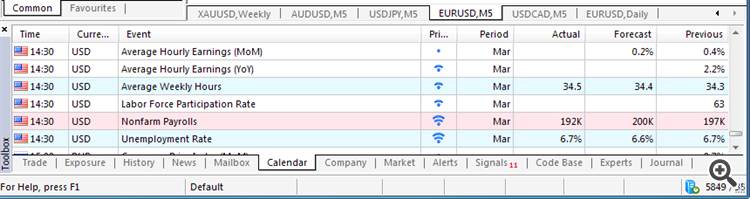
2014-04-04 12:30 GMT (or 14:30 MQ MT5 time) | [USD - Non-Farm Employment Change]
if actual > forecast = good for currency (for USD in our case)
==========
2014-04-04 12:30 GMT (or 14:30 MQ MT5 time) | [CAD - Employment Change]
if actual > forecast = good for currency (for CAD in our case)
==========
What Does The Future Hold For Gold? (based on forexminute article)
Traditionally, the value of gold fluctuates with market sentiment. In times of military or geopolitical unrest, traders and investors buy gold and sell the more risky currencies to seek refuge in the safe haven asset. Conversely, when all is well in the markets and traders' and investors' perception of a nation's economic outlook is positive, gold generally depreciates versus the more risky assets.
The yellow metal has gained strength for the majority of the year, sustaining a considerable uptrend, likely fuelled by the ongoing situation in Crimea, gold topped out at 1,392.00 on March 17. Since then, the XAUUSD has traded to two month lows at 1.277.26, and now sits slightly higher at 1,299.44. A number of fundamental factors will likely decide the medium term outlook for the price of the precious metal.
The first is the aforementioned situation in Crimea. The tension looks to have reduced, as Putin withdrew troops from the Ukrainian border, and the markets look to have responded accordingly. However, the sanctions on Putin's Russia remain, and are set to be tightened for as long as Russia lays claim to Ukraine. At some point, one or the other parties will have to compromise, something that, at present, neither seems willing to do.
The second is the potential for a slowdown in China. As disappointing economic data continues to pour out of the Asian superpower, global markets become increasingly concerned of the ripple effect such a slowdown might create. China has large levels of foreign investment across a huge number of industries worldwide, and a slowdown would stem capital flow to these investments. This could switch sentiment, and drive up the price of gold.
Finally, Janet Yellen recently hinted at an interest rate hike. This would, in the medium term at least, afford US dollar safe haven status. Such an event would likely redirect the capital of risk averse investors from gold to the US dollar, and in turn, drive down the price of the precious metal.
China’s Foreign Exchange Watchdog Expects Country to Hit Current Account Surplus
The Chinese foreign exchange regulator announced on Friday that the nation’s current account will most likely remain in surplus in 2014; while it expects more capital outflows and inflows into the economy as Beijing moves in to implement its exchange rate reforms.
China’s current account, its widest gauge of trade with its partners such as U.S., hit a surplus totalling $182.8 billion in 2013, a decline of 15 percent from a year ago, according to the State Administration of Foreign Exchange in a statement posted on its website.
The surplus equals 2 percent of the country’s gross domestic product, a decline of 0.6 percent from a year ago, reported SAFE, according to Wall Street Journal.
The surplus in 2014 will likely be a major contributor, while surplus as a proportion of the GDP will remain at low levels, said SAFE. China’s trade surplus measured $259.8 billion in 2013.
SAFE announced that it will shift its focus towards minimizing risks from cross-border capital movements this year, and two-way capital flows will possibly rise as the yuan rate slowly edges towards the government considers an equilibrium level.
The financial and capital account, which incorporates investment, reached a surplus of $326.2 billion in 2013.
A separate statement issued on Friday showed that the regulator had revised slightly upwards the forecasts of the China’s current account surplus in the fourth quarter of 2013 to 44.0 billion from a surplus of $40.4 billion.
In the fourth quarter the revised forecast of financial account and capital totalled a surplus of $127.0 billion, up from a prediction of $81.0 billion.
EURUSD Fundamentals (based on dailyfx article)
Fundamental Forecast for Euro: BearishGOLD Fundamentals (based on dailyfx article)
Fundamental Forecast for Gold: NeutralUSDJPY Fundamentals (based on dailyfx article)
Fundamental Forecast for Japanese Yen: NeutralUSD/JPY at Top of Near Term Channel; Caution Warranted
GBPUSD Fundamentals (based on dailyfx article)
Fundamental Forecast for Pound: NeutralThe US dollar gained against most currencies and the euro was on the back foot in a busy week. And now, rate decisions in Japan and the UK, Australian employment data and the FOMC meeting minutes of Yellen’s first decision are the highlights of this week. Here is an outlook on the main market-movers ahead.
The all-important US Non-Farm Payrolls, slightly disappointed with a 192,000 jobs gain in March. The expectations were high since the winter storms were over and a strong rebound was anticipated. Nevertheless, the release still indicates recovery and consists of encouraging details. The taper train remains on track. Mario Draghi sent the euro lower on more dovish rhetoric and despite a lack of action. Is the ECB serious about QE? In the UK, PMIs weighed on the pound, and the loonie finally staged a recovery after a great Canadian jobs report. More volatility ahead? Let’s start: