USDCAD moves higher in early trade(based on nasdaq article)
The U.S. dollar was higher against its Canadian
counterpart on Tuesday, as the greenback regained some strength
after weakening broadly due to Friday's disappointing report on
U.S. employment.
USD/CAD hit 1.2522 during early U.S. trade, the pair's highest
since April 3; the pair subsequently consolidated at 1.2519,
gaining 0.30%.
The pair was likely to find support at 1.2405, the low of March
26 and resistance at 1.2654, the high of April 2.
The dollar came under broad selling pressure on Friday after the Labor Department reported that the U.S. economy added 126,000 new jobs in March, less than half of February's gain and the smallest increase since December 2013.
The U.S. dollar dropped to one-month lows against its Canadian
counterpart on Wednesday, as demand for the greenback weakened broadly
before the highly-anticipated minutes of the Federal Reserve's latest
policy meeting.
USDCAD
hit 1.2388 during early U.S. trade, the pair's lowest since February
25; the pair subsequently consolidated at 1.2421, declining 0.68%.
The pair was likely to find support at 1.2309, the low of January 22 and resistance at 1.2524, Tuesday's high.
Market participants were eyeing the Fed's upcoming meeting minutes
for indications on the central bank's next policy moves after Friday's
downbeat jobs data fuelled uncertainty over the timing of a rate hike.
The Labor Department reported Friday that the U.S. economy added
126,000 new jobs in March, less than half of February’s gain and the
smallest increase since December 2013.
The loonie was higher against the euro, with EURCAD shedding 0.28% to 1.3486.
Also Wednesday, data showed that retail sales in the euro zone fell
0.2% in February, in line with market expectations. On a year-over-year
basis, retail sales rose 3.0% also in line with forecasts.
Dollar extends gains as hawks hear hike in Fed talk(based on reuters article)
Dollar index at one-week highs, euro dips below $1.0800
Canadian dollar hit by slide in oil prices
Fed officials keep rate hike talk alive
New York Fed President William Dudley and Fed Governor
Jerome Powell on Wednesday sketched out scenarios in which the
central bank could make an initial move earlier than many now
expect and then proceed in a slow and gradual manner on further
rate increases.
Yet, minutes of the Fed's March meeting showed there was a
wide divergence of views among policymakers, suggesting no
consensus on the timing of a move.
"The final arbiter will be the data, recent data argued for
delayed rate lift-off. A June 18 rate lift-off is now being
priced as quite a slim chance," said David de Garis, senior
economist at NAB.
Still, the chance of a hike at all this year is a stark
contrast to Europe and Japan where quantitative easing has years
to run. So dollar bulls took heart and bid up the dollar index
to a one-week high of 98.197, further away from Monday's
trough of 96.329. It last stood at 98.063.
The euro slipped to $1.0784 and was now more than 2
percent lower from this week's peak of $1.1036 set on Monday.
The USD/CAD range continues. The exchange rate teased the market again
yesterday as a break of the 1.2830-1.2350 range looked all but
inevitable following the move below the trendline connecting the
February lows around 1.2435. It clearly was not meant to be, however, as
the pair reversed sharply from just above the February lows to trade
back towards the middle of the range this morning. Our view on the rate
remains generally the same as last week. The wide range reversal on some
of the highest volume in years after the FOMC last month is a clear
potential negative, but until or unless we convincingly break the range
lows at 1.2350 there is really little reason to read too much into this
situation and waste precious mental capital. A daily settlement over
1.2830 would obviously turn the outlook much more positive.
if actual > forecast (or previous data) = good for currency (for CNY in our case)
[CNY - CPI]
= Change in the price of goods and services purchased by consumers. Consumer prices account for a majority of overall inflation. Inflation
is important to currency valuation because rising prices lead the
central bank to respond by raising interest rates.
“China kicked off economic reports for the month of March in decent
fashion, as CPI held steady at 1.4% beating consensus by a decimal and
PPI declines stopped accelerating for the first time in 8 months.”
“Sequentially,
CPI fell 0.5% after rising 1.2% in Feb, but YTD CPI edged up to 1.2%
from 1.1%. Non-food component was unchanged at 0.9%.”
“Analysts
are split on the implications of the latest inflation data - some see
the report as beginning of stabilization that would diminish the need
for PBoC to ease aggressively, while others do not see the release
sufficiently significant to alter the increasingly more regular easing
path.”
“Investors will monitor lending, M2 money supply, and Trade figures expected over the next few trading sessions.”
AUDIO - How To Capitalize On A Market Drop with Josip Causic(based on fxstreet article)
Spurred by a listener question about how to short the S&P 500, Merlin Rothfeld and Josip Causic
break down the various methods to achieve the same goal. The duo breaks
down the pros and cons of 4 different approaches to making money should
the markets drop. They also talk about current market conditions and
volatility.
AUDIO - Buy or Hold?! Housing Markets with Diana Hill(based on fxstreet article)
The residential market is heating up, leading to some bidding wars in
various parts of the country. This has led many to inquire about selling
their homes too! Is it the right choice? Tune in and listen to real
estate expert, Diana Hill offer her thoughts on inventories, interest rates, and market data.
The US dollar managed to stage a recovery after the previous blows,
especially against the majors. A busy week awaits traders with US
inflation and consumer data as well as rate decisions in Canada and the
euro-zone among other events. Here is an outlook on the highlights of
this week.
US data began recovering and the dollar followed. The ISM
Non-Manufacturing PMI was OK and JOLTs beat expectations. But it was the
meeting minutes that provided the greenback with the biggest push: they
revealed that in March, some members talked about hiking in June.
Despite the known fact about the existence of hawks and the timing of
the meeting before the weak NFP, the greenback soared. It probably
remains the cleanest shirt in the dirty pile. Elsewhere, Greek worries
weighed on the euro, elections worries hurt the pound and the yen also
slid. The Aussie stood out, enjoying yet another “no change” decision by
the RBA.
UK CPI: Tuesday, 8:30. Inflation
in the UK reached a flat 0% in February, a figure that alarmed many.
Will Britain enter deflation? This could push back any potential rate
hike for even longer and also cast its shadow on the euro-zone. Official
expectations stand on another 0% read y/y.
US Retail Sales:
Tuesday, 12:30. For a third consecutive time, retail sales squeezed and
disappointed. The fall of 0.6% in February will likely be followed by a
bounce in March of 1.1%. Also core sales have followed the same pattern
with a drop of 0.1% in February. Also here, a bounce is on the cards:
+0.7%.
US PPI: Tuesday, 12:30. Producer prices
serve as a warm up to consumer prices. After a drop of 0.5% in both
headline and core figures in February, rises are expected in both, 0.2%
and 0.1% respectively, especially as oil prices have stabilized.
Chinese GDP:
Wednesday, 2:00. The world’s No. 2 economy has grown at a pace of 7.3%
in Q4 2014 and is expected to experience slower growth in Q1. Some say
it is inevitable and others say it is wisely engineered by the
leadership. Growth in China closely impacts Australia but certainly has
implications for the entire world. A slide to 7% y/y is on the cards and
as authorities wish to see.
Euro-zone rate decision:
Wednesday, decision at 11:45, press conference at 12:30. In the last
meeting by the ECB in early March, Draghi showed determination in
implementing the QE program announced in January. Implementation has
begun and it is going well. The Bank made it clear that success of the
euro-zone in general and particularly regarding inflation depends on
full implementation. Will he continue the same determination? If so, the
euro would feel the weight. If optimism rises due to the recent signs
of growth, we could see the common currency rise. The interest rate is
expected to remain unchanged at 0.05% with a negative deposit rate of
0.20%. The latter serves as the lower bar for buying bonds in the QE
program
Canadian rate decision: Wednesday,
14:00. The Bank of Canada left the interest rate unchanged at 0.75% and
is expected to do so once again. After the surprise cut in January,
Poloz and his team seemed more optimistic about the economy and hinted
that this was not the beginning of a new loosening cycle. How will they
sound now? Worries about Q1 growth could be echoed in the statement.
Note that the release is followed by a press conference at 15:15.
Australian employment data:
Thursday, 2:30. Australia enjoyed job growth in February: 15.6K jobs
were added. Also the unemployment rate went in the right direction and
dropped to 6.3%. In the bigger scheme of things, unemployment is still
on the rise and is likely to rise later on in the year. Very similar
number are expected now: a gain of 15.1K jobs and an unemployment rate
of 6.3%.
US housing data: Thursday, 12:30. These
figures went in different directions: building permits rose to a
promising 1.09 million (annualized) in February, while housing starts
stood on 0.90 million. The latter can be blamed on the cold winter
weather, while the former is more forward looking. Building permits are
expected to stand at 1.08 million (annualized) and housing starts to
bounce back to 1.04 million. Note that revisions are quite common here.
US unemployment claims:
Thursday, 12:30. The weekly gauge of jobs did bounce back from the lows
but beat expectations by hitting 281K. Perhaps more importantly the
moving average fell to levels last seen many years ago at 282K. It was
above 300K not too long ago. A small rise to 284K is on the cards.
US Philly Fed Manufacturing Index:
Thursday, 14:00. The regional figure is for the month of April,
providing a fresh insight on the manufacturing situation. 4 consecutive
misses on expectations set the number on 5 points last time. A small
rise is likely: 5.5 points.
UK employment data:
Friday, 8:30. This is the last jobs report before the May elections and
carries more political weight. The claimant count change, aka jobless
claims, continued dropping quickly in February: 31K. A similar number is
probable now – a slide of 28.5K. The unemployment rate is also going in
the right direction, and stood on 5.7% in January. A drop to 5.6% is
expected. This is what the current conservative coalition government is
championing. However, the average earnings index has risen by only 1.8%
y/y in January, and this provides fuel for the opposition Labour. A tick
down to 1.7% is expected now.
US CPI: Friday,
12:30. When looking at the headline number, the US is experiencing
deflation, but this is clearly oil-related. Year over year core
inflation is actually on the rise, reaching 1.7% in February. Both
monthly indicators rose 0.2% last time and could follow suit this time,
with +0.3% in the headline number and +0.2% in the core figure.
US Consumer Confidence:
Friday, 14:00. The Reuters / University of Michigan consumer confidence
survey edged up to 93 points in the final read for March. We now get
the preliminary figure for April and a higher score is expected: 93.8
points.
The British pound was seen trading lower against the Japanese yen, as
the latter one was bid across the board. Plus, the British also
weakened in the short term igniting downside reaction in GBPUSD, GBPJPY.
There are a few major releases lined up in the UK, including the
industrial production data and the manufacturing report. The UK
Industrial Production measuring outputs of the UK factories and mine
will be released by the National Statistics. The forecast is lined up
for an increase of 0.3% in February 2015, compared to the previous
decline of 0.1%. Let us see how the outcome shapes and affects the
British Pound moving ahead.
There was a minor bullish trend line
formed on the hourly chart of the GBPJPY pair, which was broken recently
by sellers. There was a sharp downside reaction after the break and the
pair was seen testing the 177.00 area. The British pound buyers managed
to protect losses around the mentioned area and it is currently
correcting higher. However, it faces the same trend line as resistance,
which is also coinciding with the 23.6% fib retracement level of the
last drop from the 178.05 high to 177.00 low. The hourly RSI is well
below the 50 level signalling more losses in the near term. Moreover,
the 100 and 200 simple moving averages on the way up are also barriers
for the pair.
If the GBPJPY continues to move lower from the current levels, then a break below the recent low could take it towards 176.46
Allow the use of cookies to log in to the MQL5.com website.
Please enable the necessary setting in your browser, otherwise you will not be able to log in.
You are signed in. Two-factor authentication has been disabled. Set it up again and scan a new QR code, or continue with two-factor authentication disabled.
USDCAD moves higher in early trade (based on nasdaq article)
The U.S. dollar was higher against its Canadian counterpart on Tuesday, as the greenback regained some strength after weakening broadly due to Friday's disappointing report on U.S. employment.
USD/CAD hit 1.2522 during early U.S. trade, the pair's highest since April 3; the pair subsequently consolidated at 1.2519, gaining 0.30%.
The pair was likely to find support at 1.2405, the low of March 26 and resistance at 1.2654, the high of April 2.
USDCAD drops to 1-month lows in early trade (based on investing.com article)
The U.S. dollar dropped to one-month lows against its Canadian counterpart on Wednesday, as demand for the greenback weakened broadly before the highly-anticipated minutes of the Federal Reserve's latest policy meeting.
USDCAD hit 1.2388 during early U.S. trade, the pair's lowest since February 25; the pair subsequently consolidated at 1.2421, declining 0.68%.
The pair was likely to find support at 1.2309, the low of January 22 and resistance at 1.2524, Tuesday's high.
Market participants were eyeing the Fed's upcoming meeting minutes for indications on the central bank's next policy moves after Friday's downbeat jobs data fuelled uncertainty over the timing of a rate hike.
The Labor Department reported Friday that the U.S. economy added 126,000 new jobs in March, less than half of February’s gain and the smallest increase since December 2013.
The loonie was higher against the euro, with EURCAD shedding 0.28% to 1.3486.
Also Wednesday, data showed that retail sales in the euro zone fell 0.2% in February, in line with market expectations. On a year-over-year basis, retail sales rose 3.0% also in line with forecasts.
New York Fed President William Dudley and Fed Governor Jerome Powell on Wednesday sketched out scenarios in which the central bank could make an initial move earlier than many now expect and then proceed in a slow and gradual manner on further rate increases.
Yet, minutes of the Fed's March meeting showed there was a wide divergence of views among policymakers, suggesting no consensus on the timing of a move.
"The final arbiter will be the data, recent data argued for delayed rate lift-off. A June 18 rate lift-off is now being priced as quite a slim chance," said David de Garis, senior economist at NAB.
Still, the chance of a hike at all this year is a stark contrast to Europe and Japan where quantitative easing has years to run. So dollar bulls took heart and bid up the dollar index to a one-week high of 98.197, further away from Monday's trough of 96.329. It last stood at 98.063.
The euro slipped to $1.0784 and was now more than 2 percent lower from this week's peak of $1.1036 set on Monday.
USDCAD range break looming? (based on dailyfx article)
The USD/CAD range continues. The exchange rate teased the market again yesterday as a break of the 1.2830-1.2350 range looked all but inevitable following the move below the trendline connecting the February lows around 1.2435. It clearly was not meant to be, however, as the pair reversed sharply from just above the February lows to trade back towards the middle of the range this morning. Our view on the rate remains generally the same as last week. The wide range reversal on some of the highest volume in years after the FOMC last month is a clear potential negative, but until or unless we convincingly break the range lows at 1.2350 there is really little reason to read too much into this situation and waste precious mental capital. A daily settlement over 1.2830 would obviously turn the outlook much more positive.
Forum on trading, automated trading systems and testing trading strategies
Something Interesting in Financial Video April 2015
newdigital, 2015.04.10 08:03
Multi-Month Consolidation Holds Ahead of Key Data (based on forexminute article)
USDCAD is squaring up within a multi-month consolidation range as we approach key fundamental data, especially Friday's Canadian employment data.
if actual > forecast (or previous data) = good for currency (for CNY in our case)
[CNY - CPI] = Change in the price of goods and services purchased by consumers. Consumer prices account for a majority of overall inflation. Inflation is important to currency valuation because rising prices lead the central bank to respond by raising interest rates.
==========
China CPI steadies, but sends mixed signals
“China kicked off economic reports for the month of March in decent fashion, as CPI held steady at 1.4% beating consensus by a decimal and PPI declines stopped accelerating for the first time in 8 months.”
“Sequentially, CPI fell 0.5% after rising 1.2% in Feb, but YTD CPI edged up to 1.2% from 1.1%. Non-food component was unchanged at 0.9%.”
“Analysts are split on the implications of the latest inflation data - some see the report as beginning of stabilization that would diminish the need for PBoC to ease aggressively, while others do not see the release sufficiently significant to alter the increasingly more regular easing path.”
“Investors will monitor lending, M2 money supply, and Trade figures expected over the next few trading sessions.”
AUDIO - How To Capitalize On A Market Drop with Josip Causic (based on fxstreet article)
Spurred by a listener question about how to short the S&P 500, Merlin Rothfeld and Josip Causic break down the various methods to achieve the same goal. The duo breaks down the pros and cons of 4 different approaches to making money should the markets drop. They also talk about current market conditions and volatility.
AUDIO - Buy or Hold?! Housing Markets with Diana Hill (based on fxstreet article)
The residential market is heating up, leading to some bidding wars in various parts of the country. This has led many to inquire about selling their homes too! Is it the right choice? Tune in and listen to real estate expert, Diana Hill offer her thoughts on inventories, interest rates, and market data.
Forex Weekly Outlook Apr. 13-17 (based on forexcrunch article)
The US dollar managed to stage a recovery after the previous blows, especially against the majors. A busy week awaits traders with US inflation and consumer data as well as rate decisions in Canada and the euro-zone among other events. Here is an outlook on the highlights of this week.
US data began recovering and the dollar followed. The ISM Non-Manufacturing PMI was OK and JOLTs beat expectations. But it was the meeting minutes that provided the greenback with the biggest push: they revealed that in March, some members talked about hiking in June. Despite the known fact about the existence of hawks and the timing of the meeting before the weak NFP, the greenback soared. It probably remains the cleanest shirt in the dirty pile. Elsewhere, Greek worries weighed on the euro, elections worries hurt the pound and the yen also slid. The Aussie stood out, enjoying yet another “no change” decision by the RBA.
GBPJPY Crushed As Yen Gains (based on countingpips article)
The British pound was seen trading lower against the Japanese yen, as the latter one was bid across the board. Plus, the British also weakened in the short term igniting downside reaction in GBPUSD, GBPJPY. There are a few major releases lined up in the UK, including the industrial production data and the manufacturing report. The UK Industrial Production measuring outputs of the UK factories and mine will be released by the National Statistics. The forecast is lined up for an increase of 0.3% in February 2015, compared to the previous decline of 0.1%. Let us see how the outcome shapes and affects the British Pound moving ahead.
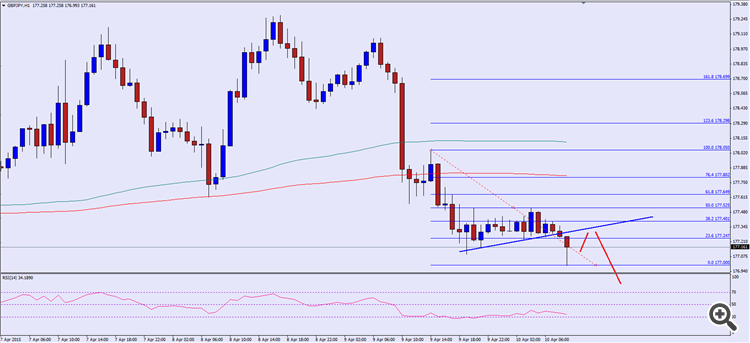
There was a minor bullish trend line formed on the hourly chart of the GBPJPY pair, which was broken recently by sellers. There was a sharp downside reaction after the break and the pair was seen testing the 177.00 area. The British pound buyers managed to protect losses around the mentioned area and it is currently correcting higher. However, it faces the same trend line as resistance, which is also coinciding with the 23.6% fib retracement level of the last drop from the 178.05 high to 177.00 low. The hourly RSI is well below the 50 level signalling more losses in the near term. Moreover, the 100 and 200 simple moving averages on the way up are also barriers for the pair.

If the GBPJPY continues to move lower from the current levels, then a break below the recent low could take it towards 176.46