Bugra Kaan Yildirim / Profil
- Information
|
nein
Erfahrung
|
8
Produkte
|
0
Demoversionen
|
|
0
Jobs
|
0
Signale
|
0
Abonnenten
|
https://www.mql5.com/en/job/new?prefered=bugraky123
https://www.mql5.com/en/channels/trendtower
Engineered by Experience. Built for the Markets.
With more than 20 years of experience in software development and engineering, and over a decade dedicated specifically to algorithmic trading, our team combines deep technical expertise with extensive real-market trading knowledge.
Every Expert Advisor and indicator we develop is engineered with precision, discipline, and attention to detail. From strategy architecture and signal logic to execution, risk management, filtering, and user experience, every component is carefully designed and refined by an experienced development team.
We do not believe in releasing unfinished ideas. Every product goes through extensive development cycles, historical backtesting, forward testing, market-condition analysis, and continuous refinement before being introduced to the MQL5 Market.
Our goal is not simply to automate trading decisions, but to build robust, intelligent, and professionally engineered trading systems capable of adapting to the realities of modern financial markets.
We focus on reliability, execution quality, logical consistency, risk awareness, and long-term usability. Our systems are developed using years of accumulated trading experience, quantitative analysis, and advanced software engineering principles.
We approach every product as a serious engineering project — not as a simple trading script.
Our Expert Advisors and indicators are designed for traders who value technology, transparency, disciplined execution, and sophisticated market logic.
Behind every product is extensive research, countless tests, continuous optimization, and one clear objective:
To create professional-grade algorithmic trading tools that traders can use with confidence.
Because behind every chart, every position, and every decision, there is a trader working toward a goal.
We hope our technology becomes a trusted part of that journey — helping you trade with greater discipline, clarity, and confidence.
May every system we build bring you one step closer to your goals, and may every trade be made with knowledge, patience, and purpose.
From our team to yours — trade wisely, stay disciplined, and may the markets reward your preparation.
An algorithm’s true value lies not only in the trends it captures, but also in how it behaves under challenging conditions.
Testing is an integral part of Trend Tower’s engineering process. Our focus goes beyond historical results to examine decision-making consistency, risk management, and system behavior across different market conditions.
We are developing, testing, and refining the details. Our goal is to deliver a carefully engineered system with clear logic behind every decision.
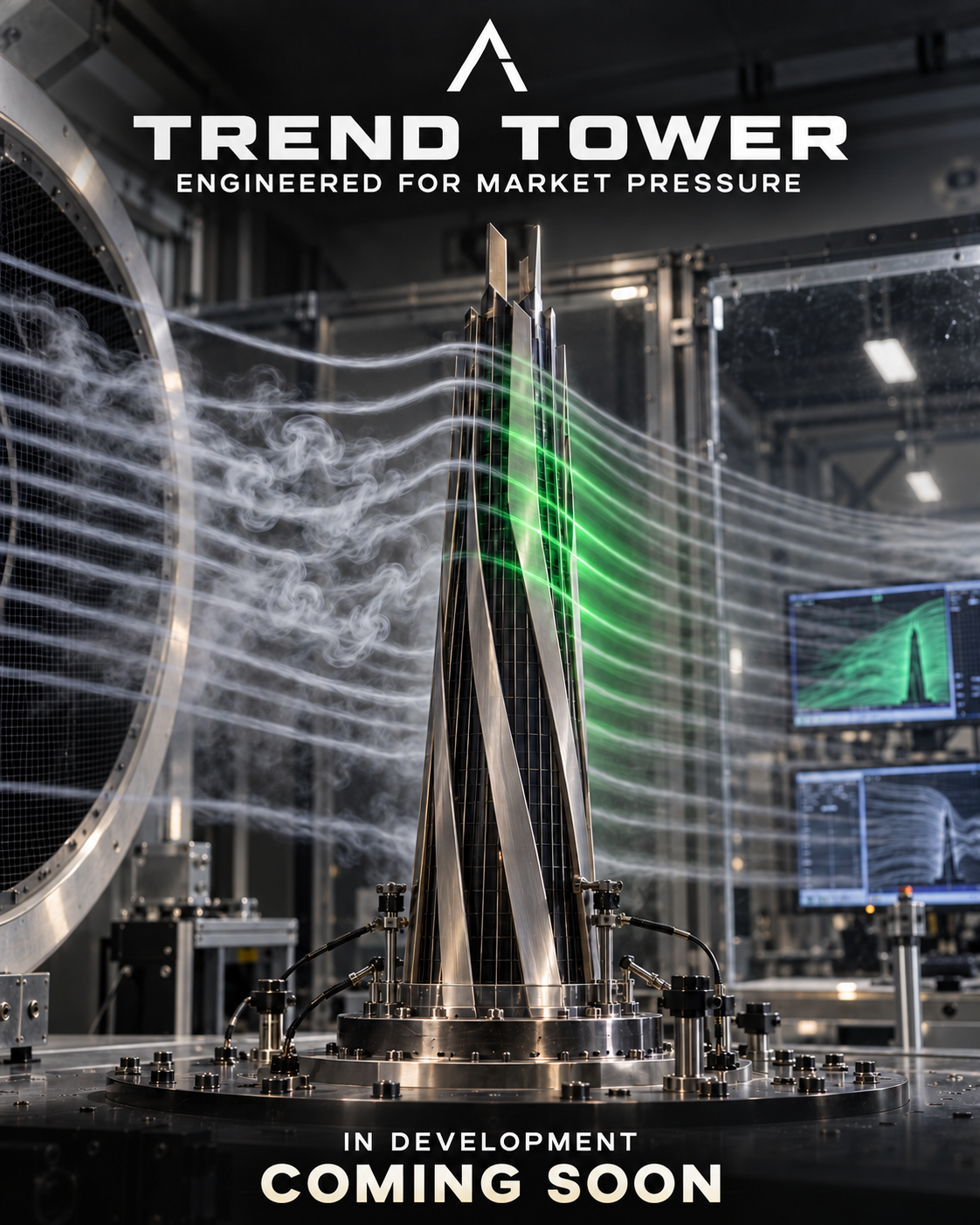
Trend Tower is still in development. We will continue sharing updates from the process here.
Algo Teknik
Quant Key Levels, Version 1.0. Die Referenzniveaus, nach denen ein diskretionärer Trader tatsächlich arbeitet – auf einem Chart und in einer einheitlichen visuellen Sprache. Elf Familien, jede auf einem eigenen Schalter, und nichts auf dem Chart, was nicht durch ein Niveau gerechtfertigt ist. Was dieses Tool von einem Pivot-Paket unterscheidet, ist nicht die Anzahl der Familien. Es ist vielmehr, dass es genau das misst, was die meisten Level-Tools als gegeben voraussetzen. Wie weit die Uhr Ihres
Quant Desk Pro Ein R-nativer Handelsmanager für MetaTrader 5. Er verwaltet die von Ihnen bereits eröffneten Positionen: Er ermittelt das tatsächliche Risiko jeder einzelnen Position, schützt diese, reduziert das Engagement gemäß einem von Ihnen festgelegten Plan, passt die verbleibende Position an und schließt das gesamte Portfolio, wenn der Tag bereits zu schlecht verläuft. Bitte lesen Sie dies zuerst. Quant Desk Pro eröffnet keine Trades und gibt keine Signale aus. Außerdem wird es im Modus
Something new is rising.
For a long time, we have been building, testing and refining what will become the flagship trading system of Algoteknik.
Its name is Trend Tower.
Designed to go beyond simple trend detection, Trend Tower is being developed to evaluate market structure, trend quality and trading conditions as one unified system.
We are not ready to reveal everything yet.
Over the coming weeks, we will share selected development notes, real market examples, testing results and individual layers of the system — step by step.
Trend Tower is coming.
Smart Volatility Squeeze MT5 Smart Volatility Squeeze MT5 ist ein Indikator zur Volatilitätskompression und Momentum-Expansion für MetaTrader 5. Er baut auf John Carters „Volatility Squeeze“-Konzept auf und erweitert den üblichen einstufigen Squeeze auf drei Kompressionsstufen, sodass Sie nicht nur erkennen können, ob der Markt komprimiert ist, sondern auch, wie stark er komprimiert ist, bevor er sich wieder ausdehnt. Der Indikator öffnet sich in einem separaten Fenster und zeichnet zwei
SVS Assistant SVS Assistant ist die Ausführungs-Komponente von Smart Volatility Squeeze MT5. Er führt die Orders aus, die Sie über den 1-Click-Trading-Desk dieses Indikators erteilen, wendet Ihre Risikoregeln darauf an und verwaltet die daraus resultierenden Positionen. Er wird kostenlos zur Verfügung gestellt. Bitte lesen Sie dies vor dem Herunterladen: Er analysiert den Markt nicht und erzeugt keine eigenen Signale. Ohne den auf demselben Chart laufenden „Smart Volatility Squeeze“-Indikator
Smart Exit EA – Den Trend nutzen, Seitwärtsbewegungen vermeiden Der Smart Exit EA folgt einem Trend mithilfe einer adaptiven ATR-Trailing-Linie und bleibt so lange im Trend, bis sich dieser tatsächlich umkehrt. Er wurde entwickelt, um zwei Probleme zu lösen, die jeder Trendtrader kennt: zu früh aus einem guten Trade herausgeschüttelt zu werden und in einem Seitwärtsmarkt in den Schwankungen unterzugehen. Release-Notes, Chartbeispiele und Ankündigungen zu neuen Produkten werden auf dem
OBV verfeinern Refine OBV misst den kumulativen Volumenfluss im Vergleich zu seiner eigenen adaptiven Signallinie mit farbcodierter Streuung und einer Divergenzerkennung ohne Neuberechnung. Das rohe On-Balance-Volume beantwortet eine Frage: Wird das Volumen den Käufern oder den Verkäufern gutgeschrieben? Das rohe OBV ist zwar nützlich, stellt jedoch lediglich eine einzelne, schwankende Linie ohne Bezugspunkt dar. Refine OBV fügt einen adaptiven EMA des Volumenstroms selbst als Referenzlinie
Trix-Trend algoteknik · Handbuch zu den MetaTrader 5-Indikatoren Übersicht Trix Trend ist ein Momentum-Oszillator, der auf dem TRIX basiert – der Änderungsrate eines dreifach geglätteten exponentiellen gleitenden Durchschnitts des Kurses. Durch die dreifache Glättung werden die meisten kurzfristigen Schwankungen herausgefiltert, sodass der Oszillator eher auf das zugrunde liegende Momentum der Kursbewegung reagiert als auf jede kleine Schwankung, dabei aber reaktionsschneller bleibt als ein
Smart Chandelier Exit „Smart Chandelier Exit“ ist ein adaptiver Trailing-Stop und Trendrichtungsindikator. Er zeichnet eine mehrschichtige Ratchet-Stop-Linie, die dem Kurs folgt: grün unterhalb des Kurses in einem Aufwärtstrend, rot oberhalb des Kurses in einem Abwärtstrend. Die Linie verschiebt sich stets nur in Richtung des Trends, niemals entgegen dem Trend, sodass sie sowohl als mechanischer Trailing-Stop als auch als klares Signal für den Trendstatus dient. Was ihn „smart“ macht, ist der
One of the biggest misconceptions in algorithmic trading is believing that a profitable backtest automatically means a profitable trading system.
After spending more than two decades developing trading software and testing countless strategies, we've noticed that many Expert Advisors fail for surprisingly similar reasons.
Here are some of the most common mistakes.
### 1. Over-Optimization
Many EAs are optimized until they perfectly fit historical data.
The result often looks impressive:
* High profit factor
* Smooth equity curve
* Small drawdown
Unfortunately, once market conditions change, these systems frequently collapse because they learned historical noise instead of real market behavior.
---
### 2. Ignoring Different Market Regimes
Markets constantly transition between:
* Trending
* Ranging
* High volatility
* Low volatility
* News-driven periods
An EA that performs exceptionally during one regime may struggle significantly during another.
A robust algorithm should adapt or selectively avoid unfavorable environments rather than forcing trades everywhere.
---
### 3. Drawdown Matters More Than Profit
Many traders focus almost exclusively on annual returns.
In reality, long-term survival depends much more on drawdown.
Would you rather have:
* 60% annual return with 70% drawdown?
or
* 30% annual return with 12% drawdown?
Professional money management almost always favors the second option.
---
### 4. Risk Management Is the Real Strategy
Many developers spend months improving entry signals while dedicating little attention to:
* Position sizing
* Exposure control
* Consecutive loss protection
* Equity protection
* Volatility filters
Ironically, these components often have a greater impact on long-term performance than the entry logic itself.
---
### 5. Transparency Builds Trust
In today's marketplace, traders are becoming more experienced.
Most buyers now prefer to evaluate:
* Long-term backtests
* Forward testing
* Maximum drawdown
* Recovery factor
* Sharpe Ratio
* Profit Factor
instead of simply looking at total profit.
Providing transparent statistics helps users make informed decisions.
---
### Final Thoughts
There is no "perfect" Expert Advisor.
Markets evolve, volatility changes, and no algorithm wins forever.
However, an EA designed with realistic expectations, strong risk management, and disciplined development principles has a much better chance of surviving changing market conditions.
I'm curious to hear other developers' experiences.
**In your opinion, what is the biggest reason most Expert Advisors eventually fail?**
When evaluating an Expert Advisor, many traders immediately look at one number:
**Total Profit.**
While profit is obviously important, experienced developers often pay much closer attention to something else:
**Maximum Drawdown.**
Imagine these two systems.
### EA A
* Total Return: +320%
* Maximum Drawdown: 58%
* Profit Factor: 1.45
### EA B
* Total Return: +180%
* Maximum Drawdown: 14%
* Profit Factor: 2.10
At first glance, EA A appears far more attractive.
But would you really be comfortable watching your account lose more than half its value before recovering?
For many traders, the answer is no.
---
## Drawdown Is More Than a Number
Large drawdowns create psychological pressure.
Many traders stop using an EA precisely when it is about to recover.
Even if the strategy eventually reaches new equity highs, the user may have already abandoned it.
This is one reason why many excellent algorithms never stay in real accounts for very long.
---
## Capital Preservation Comes First
Professional money managers often repeat a simple principle:
**Protect capital first. Generate returns second.**
An EA that survives difficult market conditions has a much greater chance of producing attractive long-term returns.
Once an account experiences a 50% drawdown, it requires a 100% gain just to break even.
That recovery is much harder than many traders realize.
---
## Metrics Should Be Evaluated Together
Rather than focusing only on net profit, I believe an EA should always be evaluated using multiple statistics together.
For example:
* Maximum Drawdown
* Profit Factor
* Sharpe Ratio
* Recovery Factor
* Number of Trades
* Average Trade Duration
* Expected Payoff
* Consecutive Wins and Losses
A strategy with moderate returns but excellent consistency can often outperform a highly aggressive strategy over several years.
---
## Risk Management Is Often the Hidden Edge
In my experience, the difference between an average EA and a professional one is not always the entry signal.
Instead, it is usually found in:
* Position sizing
* Exposure limits
* Volatility filters
* Equity protection
* Session filters
* Trade management
Many developers underestimate how much these components influence long-term performance.
---
## What Do You Think?
If you had to choose only one Expert Advisor for the next five years, which would you prefer?
* Higher returns with larger drawdowns?
* Lower returns with much better capital preservation?
I'd be interested to hear how other developers and traders prioritize risk versus performance.