The Saker
- Uzmanlar
- Sürüm: 1.3
- Etkinleştirmeler: 10

Saker is a gold expert advisor (XAUUSD) built from three independent trend engines on three time scales. Every trade has a hard stop loss at the broker from the moment it opens. No grid, no martingale, no averaging, no recovery trades.
What makes Saker different
One stop per trade, always. Each engine holds at most one position, and that position is sized from its stop distance and your risk per trade. The loss of every trade is known before it opens.
Three engines that rarely lose together. A momentum engine on ten-minute bars (the trend entries of our Harrier EA, as single trades), a breakout engine on hourly channels, and a classic breakout engine on daily bars. Their daily results correlate at about 0.2, so their losing stretches seldom overlap.
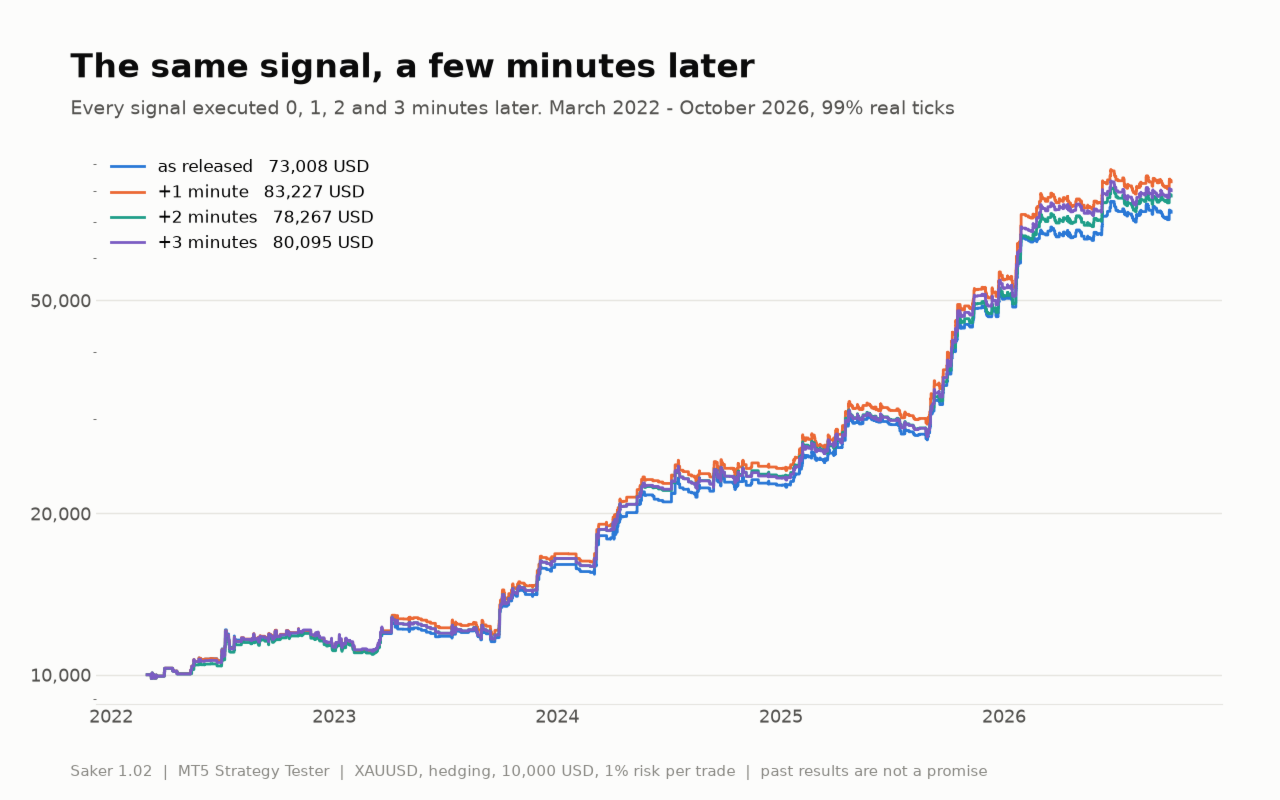
Tested on delayed entries. We run every version four times: once as released and three times with every signal executed one, two and three minutes later. A result that only exists at the exact second of the signal is not a result. The four runs are in the table below.
Tested outside the period it was built on. See "Outside its development period" below.
The three engines
| Engine | Trades | Exit | Risk weight |
| Harrier SL/TP (M10) | Fast moves with the higher-timeframe trend: trend, continuation, session open, second New York wave, COMEX settlement | Stop or target scaled to volatility, or a time limit; stops for the day after two of its own losses | 0.6 × risk |
| Peregrine (H1) | Pending order at the edge of a multi-day channel, only with the long-term trend | Stop scaled to volatility, or a time limit of a few hours | 1.25 × risk |
| Donchian (D1) | Pending orders at the multi-week high and low | Stop scaled to daily volatility, or a target at a multiple of the stop | 1.5 × risk |
You set one number, the risk per trade (default 1% of equity). With all three engines in a position, up to 3.35 times that is at risk at once.
Risk per setting
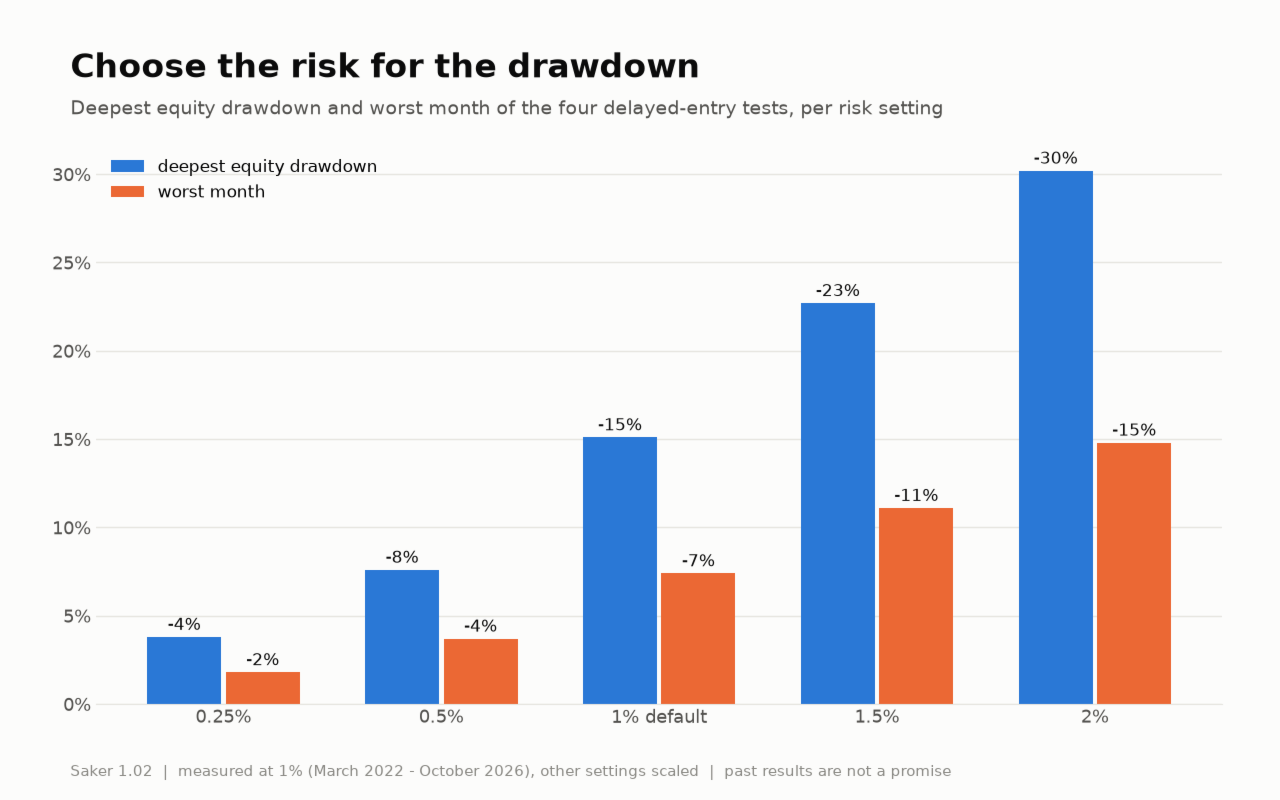
| Risk per trade | All three open | Deepest equity drawdown (4 tests) | Worst month (4 tests) |
| 0.25% | 0.84% | about 4% | about -2% |
| 0.5% | 1.7% | about 7 – 8% | about -3.7% |
| 1.0% (default) | 3.35% | 13.8 – 15.1% | -6.3 to -7.4% |
| 1.5% | 5.0% | about 21 – 23% | about -10 to -11% |
The 1% row is measured on four delayed-entry tests (March 2022 – October 2026); the other rows scale it. About half of all trades end at their stop, so losses come in streaks: in the tests about one month in three closed with a loss. Choose your risk for the drawdown, not for the average month.
Test result (please read the conditions)
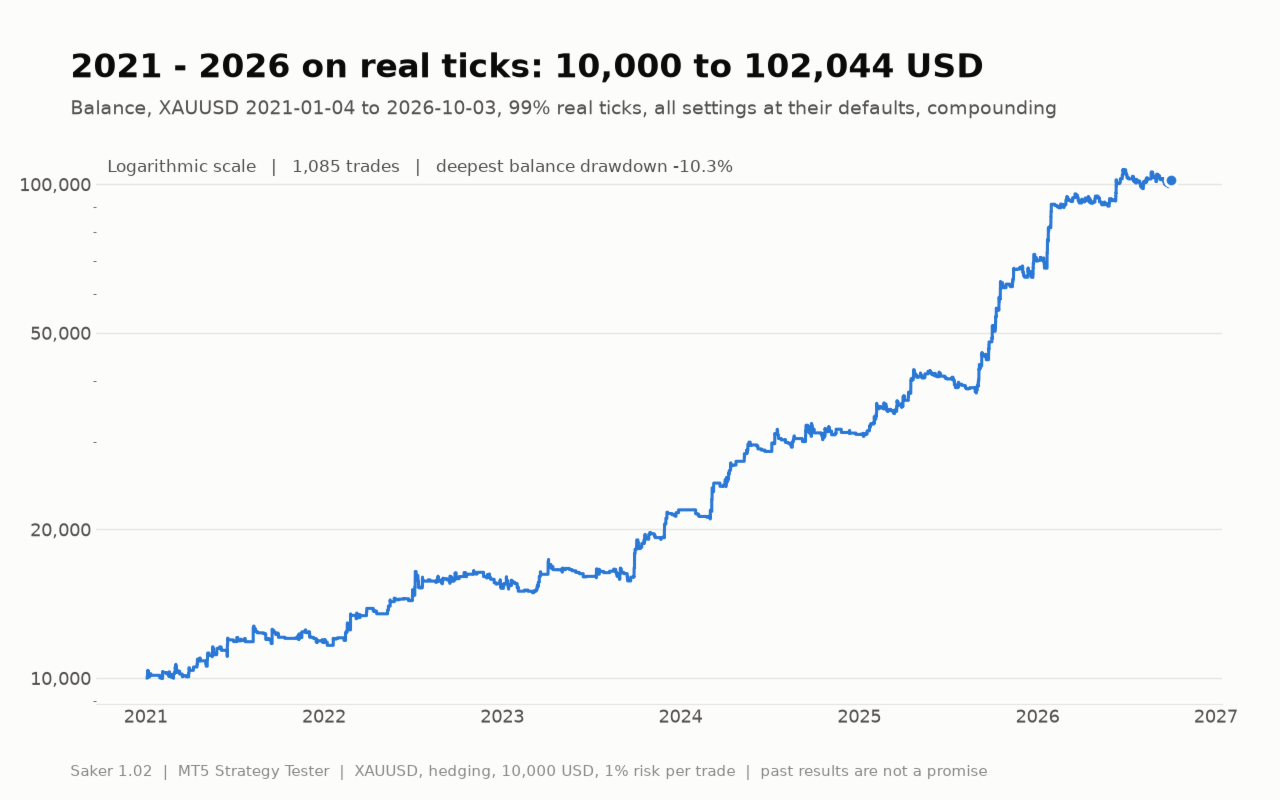
MT5 Strategy Tester, XAUUSD, 4 January 2021 – 3 October 2026, 99% real ticks, hedging account, spread from the tick data, 10,000 USD, all settings at their defaults (1% risk per trade, compounding).
| Net profit | +92,044 USD (10,000 to 102,044) |
| Profit factor | 1.62 |
| Deepest equity drawdown | 14.7% (deepest fall from the equity peak, open trades included) |
| Trades | 1,085 |
| Losing months | 22 of 70 (worst -6.2%) |
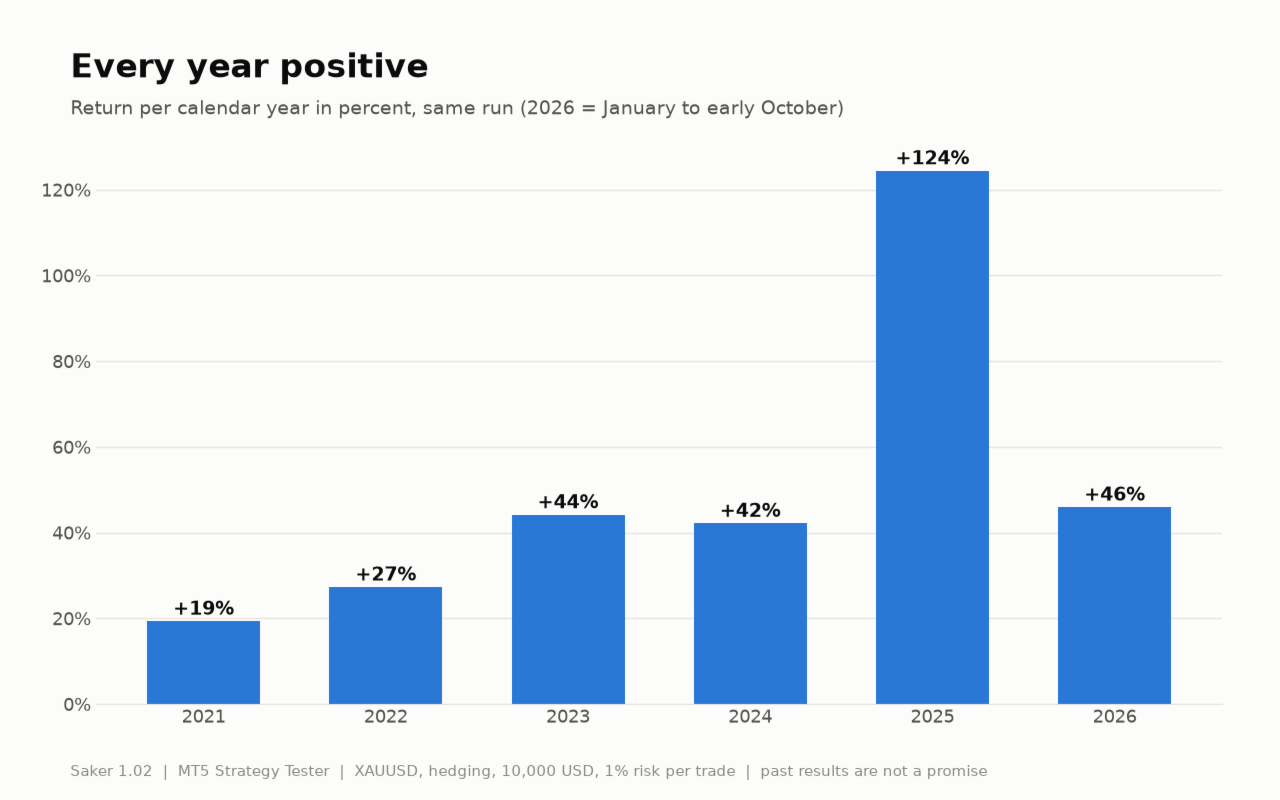
| Return per year | 2021 +19%, 2022 +27%, 2023 +44%, 2024 +42%, 2025 +124%, 2026 (to October) +46% |
The same signal, a few minutes later
| March 2022 – October 2026, 1% risk | Return per year | Deepest equity drawdown | Losing months |
| As released | 54.3% | 14.6% | 18 of 56 |
| Every signal + 1 minute | 58.7% | 13.8% | 19 of 56 |
| Every signal + 2 minutes | 56.6% | 15.1% | 19 of 56 |
| Every signal + 3 minutes | 57.4% | 15.0% | 18 of 56 |
Outside its development period
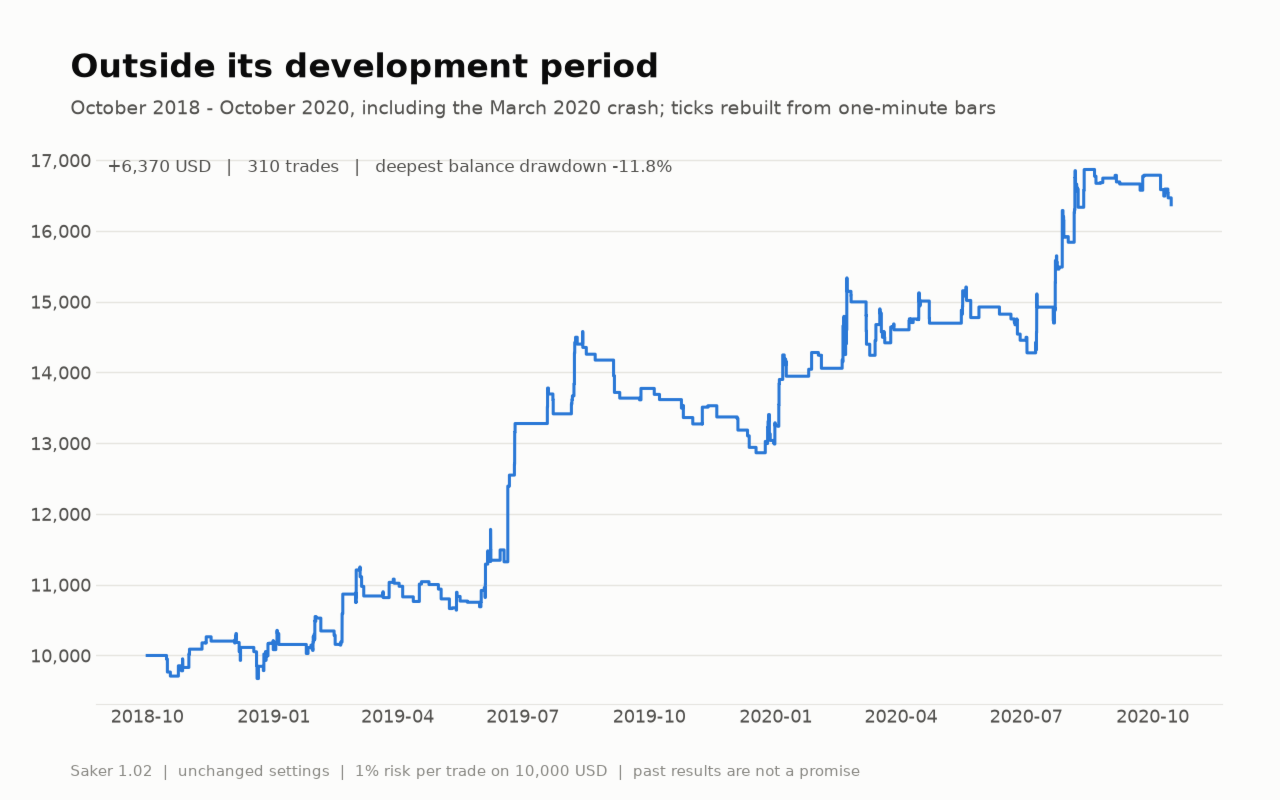
The engines were built on 2021–2026. We ran the unchanged EA on October 2018 – October 2020, including the March 2020 crash, on ticks rebuilt from one-minute bars: +6,370 USD on 10,000, profit factor 1.40, deepest equity drawdown 13.6%, 9 losing months of 25. Gold was half its current price and far calmer; the result is smaller, and it is the honest check of whether the logic holds outside the years it was designed in.
What this does not tell you
The engines were developed on the same period as the main test, so part of the result is in-sample, and a live result below it is the normal outcome. 2025 was an exceptional trend year for gold and carries the largest share. Saker earns when gold moves and keeps moving; it loses when moves reverse before they continue. In September 2026 gold swung about 100 dollars a day in alternating directions for three weeks: the account slid about 4–6% before a strong day at the end of the month, and September closed between +1.4% and +4.1% across the four tests. Expect a stretch like that once or twice a year. Past results are not a promise.
Requirements
- Hedging account. Saker refuses to start on a netting account: the three engines would merge into one position.
- XAUUSD, any suffix. Gold only.
- One chart, any timeframe. Saker refuses a second copy on the same symbol.
- Server time GMT+2/+3 (New York close); Saker warns when your broker differs.
- At the volatility of September 2026, about 4,700 USD at 1% risk for the daily engine's minimum lot (about 2,000 for the other two engines); a cent account removes the limit.
- No DLL, no internet calls, no external files.
Settings and panel
Settings: magic number and trade direction; risk per trade or a fixed lot, a lot cap, an optional daily stop and emergency stop, and the risk weight of each engine; each engine on or off; news filter (FOMC, and which release days take no new momentum trade: FOMC only, FOMC + NFP, + CPI, + PPI); a Friday cut-off; slippage, panel and push notifications. The measured engine values (stops, targets, channels, filters) are fixed in the code. Saker remembers a daily stop through a restart, pauses 60 seconds when the market is closed, and sends a push message on a daily stop or emergency stop.
The panel shows balance, equity and floating result, the realised result per day, month and total, each engine with its pending order, open position or pause reason, its own result and win/loss count, the win rate, current and maximum drawdown, and a status line.
Trading gold with leverage can cost more than you intend. All figures are measured on historical data under the stated conditions; they are not a promise of future results.