
Binary Volume Edge Martingale Stats
- 지표
- 버전: 1.44
- 업데이트됨: 1 5월 2026
- 활성화: 5

Binary Volume Edge – Martingale Stats No Repaint
Every lost deposit in binary options starts with a simple thought: "This signal looks reliable." The problem is not the lack of signals – any indicator generates them. The problem is the lack of a filtering system that can distinguish real market momentum from random fluctuations.
Binary Volume Edge-Martingale Stats solves this problem at a fundamental level. Instead of one or two confirmations, it passes each candle through twelve independent analytical blocks. Each block evaluates a specific aspect of the market situation and makes a decision: to pass the signal or to block it. Instead of just an arrow on the chart, you get the result of a multi-step engineering analysis.
Below, each filter is described and its impact on the quality of the inputs.
**1. The trading session filter**
Allows you to send signals only during the specified trading sessions: Asian, European, American, or any combination of them. Low-liquidity periods with chaotic price movements are completely excluded. You stop receiving signals at the moment of shift change, when the spread is expanded, and tick volumes do not reflect real market interest.
**2. Time filter**
Limits the indicator's operation to a specified time window (for example, from 9:00 a.m. to 7:00 p.m. broker time). It works similarly to the session filter, but with the accuracy of minutes. It allows you to exclude the first minutes after the market opens, when volatility is often impulsive and false.
**3. Tick Volume Filter**
Checks whether there is enough fuel in the current candlestick for directional movement. You set an absolute threshold (MinVolumeAbsolute) or enable a dynamic mode that compares the volume with the average of the previous 20 bars, amplified by a specified percentage. Weak, empty bars are discarded, and signals remain only where there is a real struggle of major players in the market.
**4. Candlestick Body Filter**
It cuts out dojis, tops, and narrow bars where the volatility is insufficient to cover even one pip of payoff. The minimum body size in pips is set. You will not enter a consolidation that ends in a loss due to a lack of movement.
**5. Alligator Trend Filter**
Uses three of Bill Williams' lines to determine the direction of the trend and its absence. If the lines are intertwined (the market is sleeping), the signal is blocked. If the trend is determined, the indicator will only allow entry in the direction of the trend. This eliminates counter-trend attempts, which account for a significant portion of novice losses.
**6. RSI Filter**
Monitors overbought and oversold conditions. For CALL, no signal will be generated if the RSI is above the overbought threshold (default 80). For PUT – if RSI is below oversold threshold (20). Works on advance: you do not buy the top and do not sell the bottom when the market is overheated and ready to roll back.
**7. ADX filter**
Estimates the strength of the trend. The signal is allowed only when ADX exceeds the specified threshold (20 by default). This ensures that you enter a truly trending market, and not a sideways one, where any movement quickly runs out of steam.
**8. +DI/–DI filter**
Works in tandem with ADX and adds a directional component. For CALL, +DI must be higher than –DI (bullish force prevails), for PUT – vice versa. Even if ADX shows the presence of a trend, this filter checks whether the direction has changed on the last bars. Entries are excluded at the moment of reversal, when the trend is still formally there, but the market has already gone the other way.
**9. Price Levels Filter**
Disallows signals if the price is too close to yesterday's high/low, today's opening, or round numbers (adjustable). These levels are often the cause of sharp reversals or false breakouts. By removing entries in close proximity, you reduce the amount of losses from structural reversals.
**10. Push Bar Filter with Price POC - a unique technology**
This is the central element of the system, which has no analogues among indicators for MetaTrader 4. The filter doesn't just look at the volume; it breaks down the candle of the higher timeframe (or the current one, if you're working with M5) into minute bars and builds a price profile of the delta. The entire High-Low range is divided into 20 price levels. Each minute is assigned a delta: if the minute candle closes above the opening, its entire volume is considered a buy, and if it closes below, it's considered a sell.
Then, the indicator finds the POC (Point of Control), which is the price zone with the maximum positive delta (for CALL) or the minimum negative delta (for PUT). The key condition is that the POC should be located near the candlestick extremum, within the zone that you specify as a percentage of the candlestick height (from 2% to 50%). For CALL, the POC should be near the Low, and for PUT, it should be near the High.
Why does this improve the quality of the signal? If a large player enters the market aggressively at the opening of a candle and pushes the price from the extreme itself, the POC will be located there. If the struggle is even, or the peak is shifted to the middle, this is not a push, but a normal market struggle. The filter discards such candles.
Enable the adaptive zone (UseAdaptivePushZone), and the indicator will automatically narrow or expand the search area for the POC, depending on the current volatility (via ATR). In a calm market, the zone expands to avoid missing moderate but reliable impulses. During news events, it narrows to a minimum, allowing only the most aggressive pushes. The AdaptiveSensitivity parameter (0..1) controls the strength of the ATR's influence.
Additionally, the filter can be linked to any higher timeframe (M5, M15, H1), even when trading on a minute chart. You can trade on M1, while the push bar is analyzed based on the closed M5 candlestick. This removes micro-noise and leaves only the movements visible on the higher scale.
**11. Score-Based scoring system**
By default, the indicator works in the classic mode: each enabled filter must be passed, otherwise there is no signal. This is a rigid logic that may be overly categorical for some market conditions. The Score-Based mode changes the approach.
You assign a weight (from 0 to 100) to each of the twelve filters. When a potential signal is formed on a candle, the indicator sums up the scores of those filters that have given a positive conclusion. For example, if the volume threshold is broken, the score is +15, if the RSI is normal, the score is +10, and if the push bar is confirmed, the score is +25. Additionally, a base score is added for meeting the PercentThreshold condition. If the total score reaches the specified MinScore threshold, the signal is confirmed.
This provides incredible flexibility. You can make the push bar decisive (weight 40, MinScore=50), and the other filters auxiliary. Or distribute the weights evenly, creating a system where the decision is made collectively. You don't lose the filters completely, as in the classic "on/off" approach, but rather manage their contribution to the final decision. Score-Based transforms the indicator into a trading strategy builder that can be customized to a specific instrument and timeframe with mathematical precision.
**12. Signal Reversal**
With a single switch, you can invert all signals – CALL turns into PUT, and vice versa. Useful for checking the re-optimization of the strategy or for trading on the fading of the trend, when standard signals are more likely to give a loss.
**Built-in statistics and risk management**
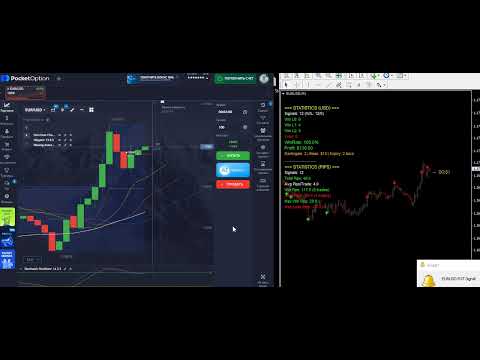
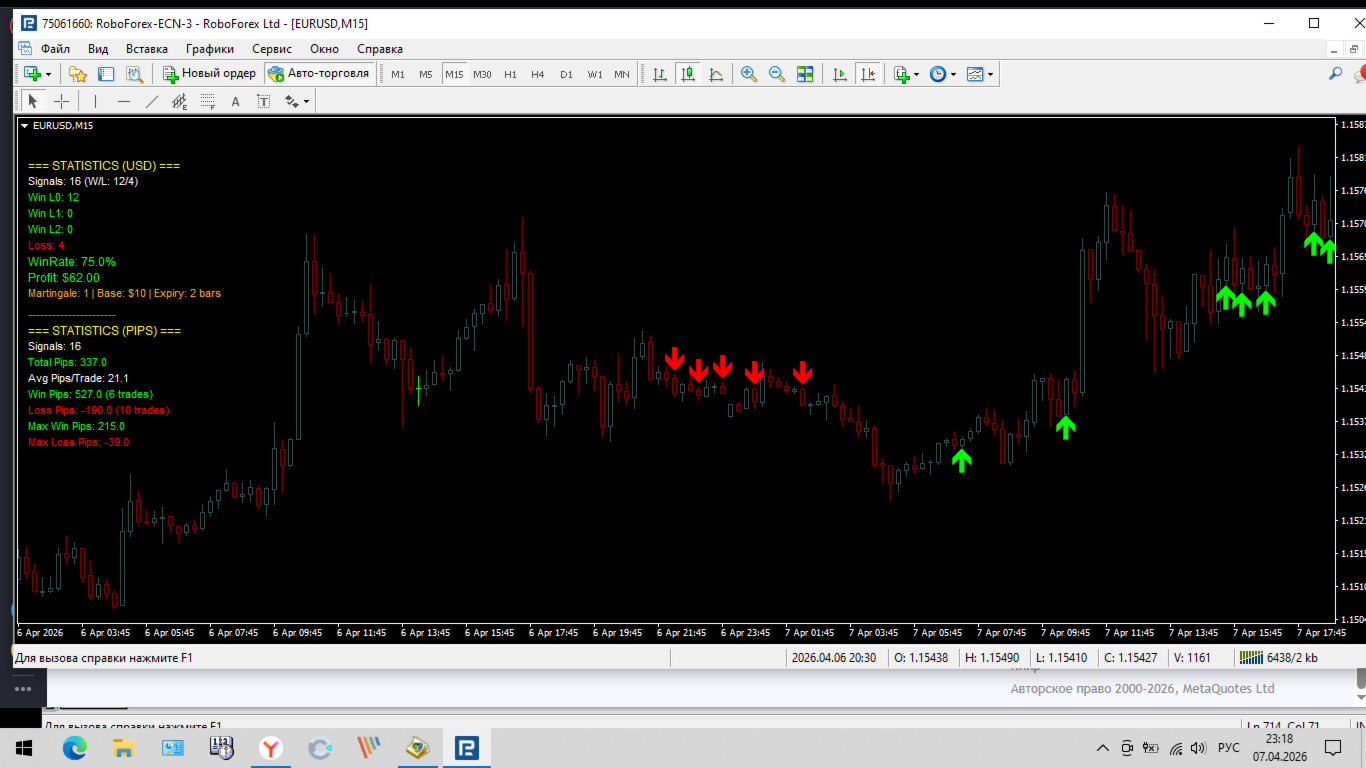
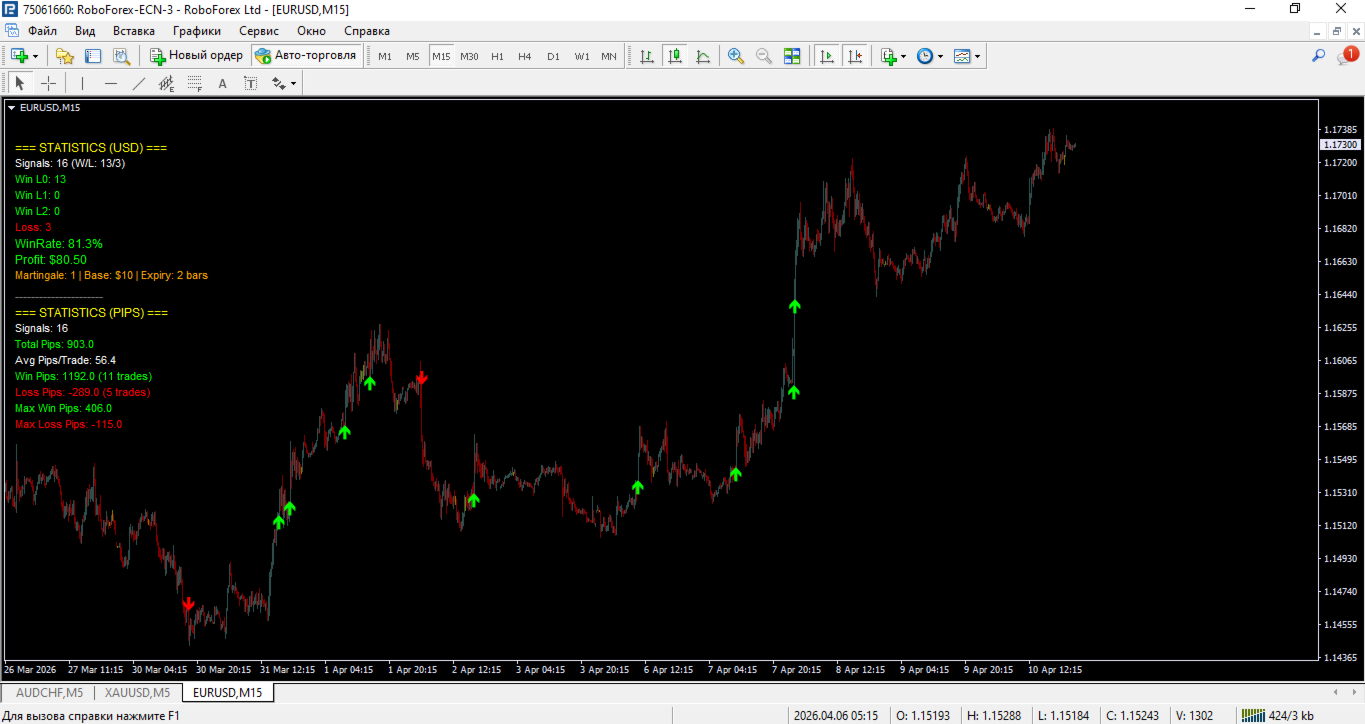
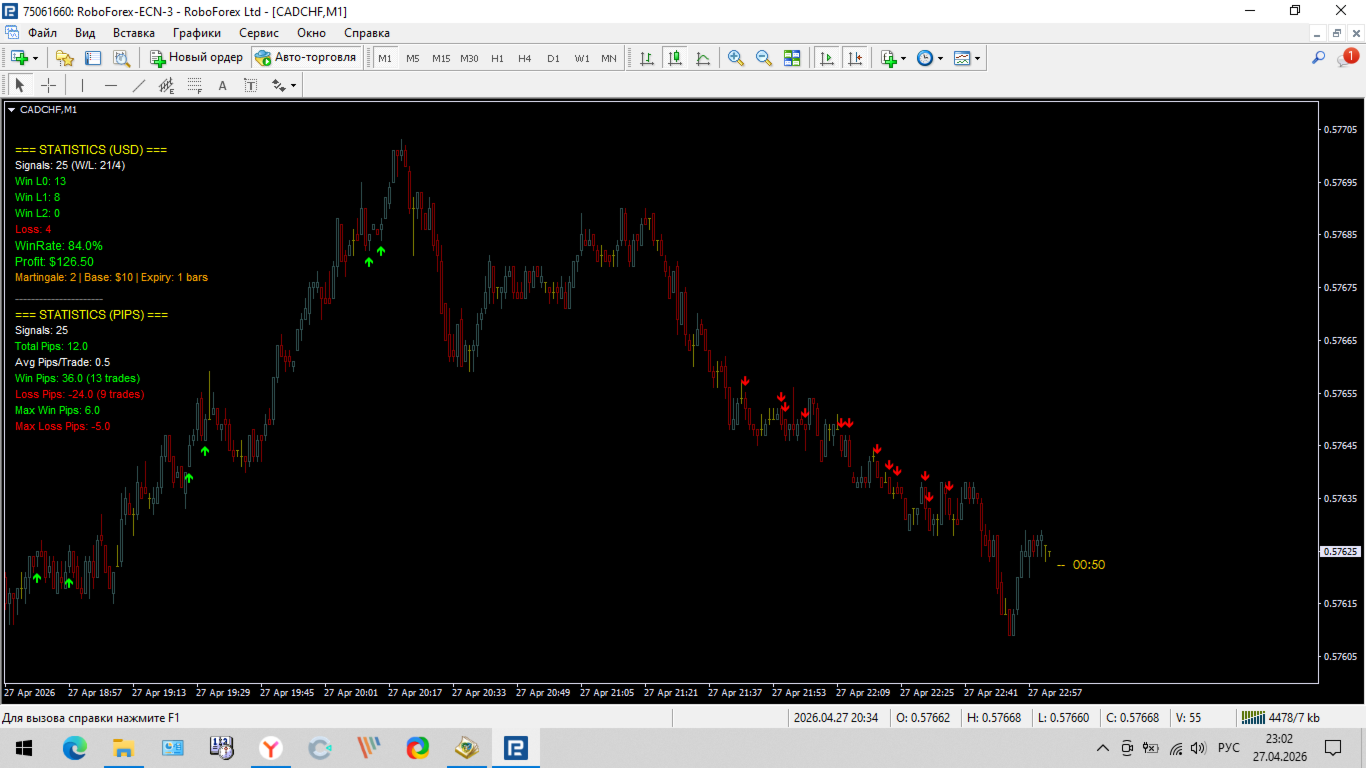
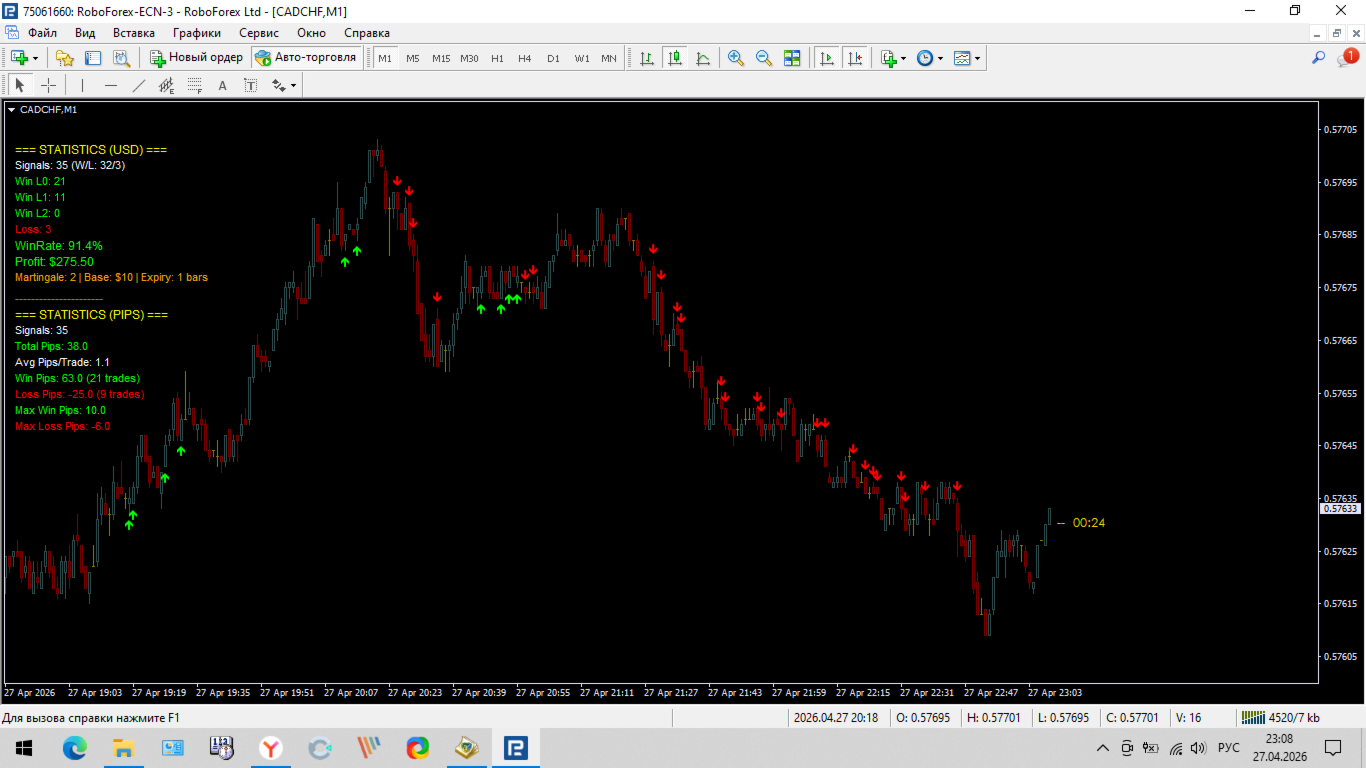
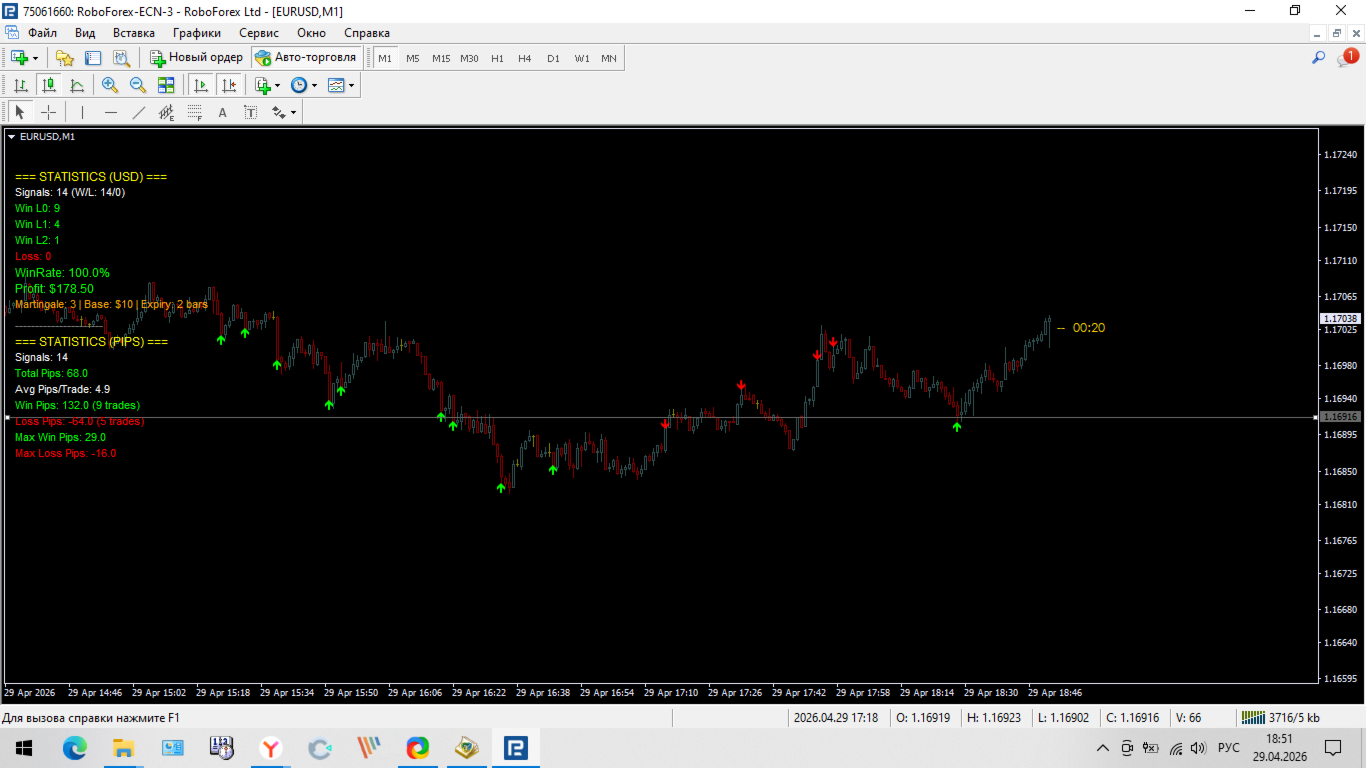
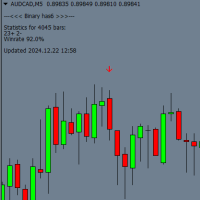
The indicator not only generates signals, but also keeps a detailed record. The chart displays: profit in dollars, taking into account the selected martingale parameters, win rate, distribution of outcomes by levels (L0, L1, L2, losses), full point analytics (total points, average profit per trade, maximum gain and loss). The entire history of signals is available for export to CSV.
You set the base bet, the number of martingale legs, and the payout percentage. The indicator calculates the maximum loss of the full series and visualizes the risk percentage of the deposit. You see the boundary that you can't cross, and you manage your money management not blindly but based on precise numbers.
---
**Bottom line**
Binary Volume Edge is not a generator of arrows. It is an analytical station that combines twelve independent methods of assessing the market situation in one instrument. The push bar filter with price POC gives you access to volume analysis that was previously unavailable in MetaTrader 4 without expensive external software. The Score-Based mode allows you to adapt the system to any trading style without changing the code.
The \$149 price does not reflect the number of arrows, but rather the number of filters that eliminate false signals before you risk your money. The \$39 per month rental allows you to evaluate the system's performance in real market conditions without making a full payment.
Stop guessing. Start filtering. With Binary Volume Edge-Martingale Stats, you only see the candles that are worth your bet.

































Excellent indicator for scalping, thank you Vadim.