News of the day. 27.04.2016
Australia
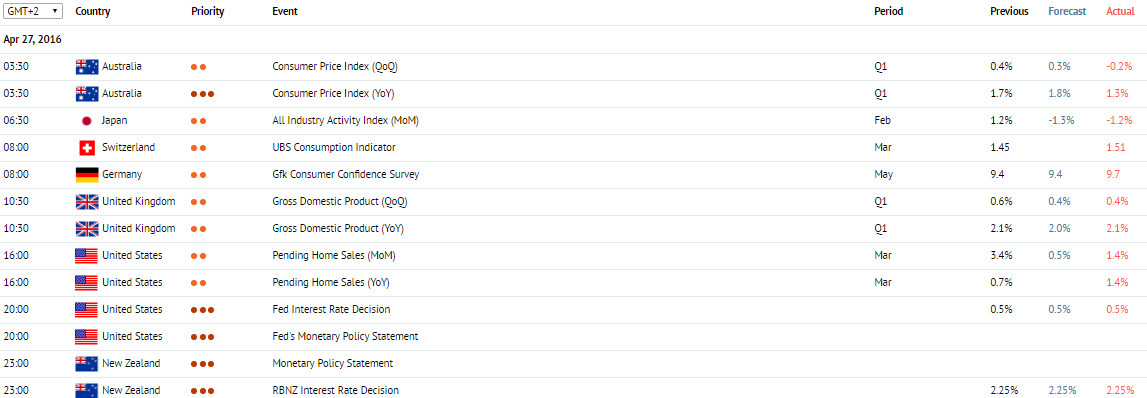
The Consumer Price Index for the first quarter is due in Australia at 3:30 am (GMT+2). On a year-over-year basis, the indicator is expected to grow from 1.7% to 1.8%. The index represents the change in the value of the basket of goods and services. A growth in the indicator strengthens the Australian Dollar. A fall in the indicator weakens the Australian Dollar.
Japan
The All Industry Activity Index for February is due in Japan at 6:30 (GMT+2). On a monthly basis, a fall from -0.9% to -1.3% is expected. The index represents expenditures of large manufacturers in all sectors of the economy excluding the financial one. The data is considered as a leading indicator of productivity growth. Generally, an increase in the index strengthens the Yen, while a fall weakens the Yen.
Switzerland
The UBS Consumption Indicator is due in Switzerland at 8:00 am (GMT+2). The data is based on 5 consumer-related indicators: car sales, consumer confidence, retail sales, the number of domestic overnight hotel stays and credit card transactions volumes.
Germany
The Consumer Confidence Survey is due in Germany at 8:00 am (GMT+2). The indicator is expected to remain unchanged at 9.4 points. The data, released by GfK, is based on survey responses of consumers regarding how confident they fell about the country’s economy. A positive reading suggests a generally optimistic assessment and strengthens the Euro. A negative reading indicates consumers are mainly pessimistic about Germany’s economy that weakens the Euro.
UK
The Gross Domestic Product for the first quarter is due in the UK at 10:30 am (GMT+2). The indicator is expected to decline both in annual and quarterly terms, from 2.1% to 2.0% and from 0.6% to 0.4% respectively. The data measures the value of all goods and services created in the UK and represents the pace of economic growth. A growth in the indicator strengthens the Pound. A fall in the indicator weakens the Pound.
USA
Data on Pending Home Sales is due in the US at 4:00 pm (GMT+2). On a monthly basis, the indicator is expected to decline from 3.5% to 0.5% in March. It is one of the key indicators of the US property market that represents the general state of the national economy. A high reading strengthens the US Dollar. A low reading weakens the US Dollar.
The Federal Reserve releases its decision on interest rates at 8:00 pm (GMT+2). The indicator is expected to remain unchanged at 0.5%. It is an important economic indicator which has an impact on commercial banks’ interest rates and the USD exchange rate. A rate increase strengthens the US Dollar. A rate decrease weakens the US Dollar.
The Federal Reserve releases its Monetary Policy Statement at 8:30 pm (GMT+2). The publication has a significant impact on the market and can either strengthen or weaken the US Dollar.
New Zealand
The Reserve Bank of New Zealand releases its Monetary Policy Statement at 11:00 pm (GMT+2). The publication has a significant impact on the market and can either strengthen or weaken the NZ Dollar.
The Reserve Bank of New Zealand releases its decision on interest rates at 11:00 pm (GMT+2). The indicator is expected to remain unchanged at 2.25%. A rate increase strengthens the NZ Dollar. A rate decrease weakens the NZ Dollar.