What's one thing you look for before trusting an EA with real money?
Des milliers de conseillers experts sont disponibles aujourd'hui, mais seuls quelques-uns parviennent à être intégrés à un compte réel.
Avant de confier de l'argent réel à un EA, que confirmer-vous en premier ?
- Performance en direct à long terme ?
- Baisse maximale ?
- Gestion des risques ?
- Qualité du backtest ?
- Réputation du développeur ?
- Autre choix ?
Pour moi, la régularité et la gestion des risques priment sur quelques mois de rendements élevés. Je préfère un EA qui progresse de façon constante à un autre qui offre des résultats spectaculaires sur une courte période avant de s'effondrer.
Je suis curieux de savoir quels sont les critères prioritaires des autres traders lorsqu'ils pèsent sur un EA.
Fully agree with you on this — consistency and risk management matter way more than spectacular short-term gains. My priority order would be:
- Risk management first — is there a real Stop Loss on every trade, or is the system built on martingale/grid in disguise? This is often what people discover too late, once the account has already blown up. I always look for whether the developer clearly explains their sizing and protection logic, not just "our algorithm optimizes risk" without any detail.
- Maximum drawdown, both in relative value AND duration. A 20% drawdown recovered in 2 weeks doesn't carry the same psychological and financial weight as a 20% drawdown that drags on for 4 months.
- The logic of the strategy itself — do I understand why it works, or is it a black box? I'm wary of EAs that won't explain anything about their approach.
- Only after that do I look at long-term performance and backtest quality — knowing that even a clean backtest never replaces real tracking on a live or demo account over several months.
Fully agree with you on this — consistency and risk management matter way more than spectacular short-term gains. My priority order would be:
- Risk management first — is there a real Stop Loss on every trade, or is the system built on martingale/grid in disguise? This is often what people discover too late, once the account has already blown up. I always look for whether the developer clearly explains their sizing and protection logic, not just "our algorithm optimizes risk" without any detail.
- Maximum drawdown, both in relative value AND duration. A 20% drawdown recovered in 2 weeks doesn't carry the same psychological and financial weight as a 20% drawdown that drags on for 4 months.
- The logic of the strategy itself — do I understand why it works, or is it a black box? I'm wary of EAs that won't explain anything about their approach.
- Only after that do I look at long-term performance and backtest quality — knowing that even a clean backtest never replaces real tracking on a live or demo account over several months.
I agree that hidden risk management is one of the biggest issues with many EAs. A strategy can look profitable for months, but if it relies on uncontrolled recovery methods, the real risk often only becomes visible during unusual market conditions.
I also like your point about drawdown duration. Many traders only focus on the percentage, but being stuck in a long recovery can be just as difficult psychologically.
Out of curiosity, have you found any EA that has consistently met your criteria over a long period, or are you still searching for one?
I agree that hidden risk management is one of the biggest issues with many EAs. A strategy can look profitable for months, but if it relies on uncontrolled recovery methods, the real risk often only becomes visible during unusual market conditions.
I also like your point about drawdown duration. Many traders only focus on the percentage, but being stuck in a long recovery can be just as difficult psychologically.
Out of curiosity, have you found any EA that has consistently met your criteria over a long period, or are you still searching for one?
Honestly, I'd say 90% of EAs here are built on a disguised martingale. Personally, the moment an EA has that kind of logic or doesn't have a Stop Loss on every trade, I drop it right away — I don't even bother testing it, saves me time.
Ideally the seller would also have a live signal in addition to the backtest, and I'd generally avoid strategies pitched as "revolutionary." Looking back, I can tell you the simpler a trading strategy is, the better it holds up over time.
On my end, I've been trading the same strategy for 10 years (Opening Range Breakout on gold), and I finally automated it recently. Automation let me bring in things I simply couldn't replicate properly by hand — especially a staged trailing stop that's ultra-reactive, impossible to follow manually with the same precision over time.
So to answer your question: yes, I ended up with one that checks my boxes — it's my own.
Honestly, I'd say 90% of EAs here are built on a disguised martingale. Personally, the moment an EA has that kind of logic or doesn't have a Stop Loss on every trade, I drop it right away — I don't even bother testing it, saves me time.
Ideally the seller would also have a live signal in addition to the backtest, and I'd generally avoid strategies pitched as "revolutionary." Looking back, I can tell you the simpler a trading strategy is, the better it holds up over time.
On my end, I've been trading the same strategy for 10 years (Opening Range Breakout on gold), and I finally automated it recently. Automation let me bring in things I simply couldn't replicate properly by hand — especially a staged trailing stop that's ultra-reactive, impossible to follow manually with the same precision over time.
So to answer your question: yes, I ended up with one that checks my boxes — it's my own.
That's an impressive journey. I think there's a big difference between automating a strategy you've already traded successfully for years and trying to build a strategy around automation alone.
I also agree that simplicity often survives changing market conditions better than overly complex systems.
Out of curiosity, since you've been running your ORB strategy for so long, has automating it changed the overall performance, or has it mainly improved execution and consistency?
One thing nobody mentioned yet: number of trades. I've seen "2 years of live results" that turn out to be 40 trades total. That's not a track record, that's a small sample. If a system takes one trade a week I want years of it before I believe anything, whereas something that trades daily gives you a usable picture much faster.
The other thing I always do is run it on my own broker for a month or two before any real money goes in. Spreads, commission and execution differ enough between brokers that a good backtest on the seller's data can turn into something very different on your account, especially for anything scalping-ish.
And I'd add one to Jean's list — check the seller's other products. If someone has 15 EAs published and the older ones haven't been updated in two years and the signals are dead, that tells you what happens once the sales dry up.
Agree with everyone on martingale though. No stop loss, instant no.
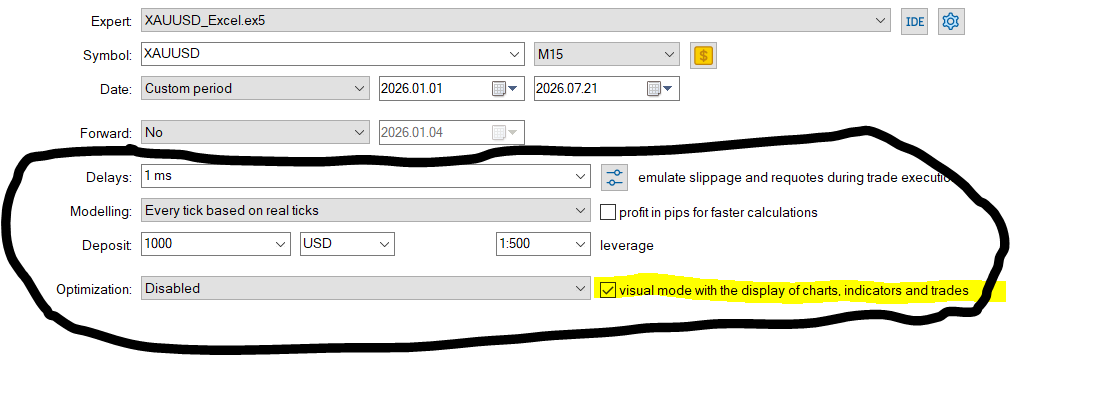
Backtest, forward test, like looking at all the stats very very carefully does like 50% of the work. And plus when you test out the demo version of any EA, I keep these settings like have realistic delay ( my case 1ms, as I totally want to use VPS when I am running any EAs), that modelling is super important... and also check out the visual mode, that way you can clearly see how positions are opened with TP and SL levels, that way at least we can understand how logical the strategy is. Rest I think communicating with the developer and checking out all the works and ideas.... vision, experience and such imo.
A main idea of backtesting, itself, is to test for consistency in different market conditions. If you're not encountering different market conditions in your backtest, then increase the data sample size (length) of your backtest and rerun it. Only then can you meaningfully analyze things like relative drawdown, maximal drawdown, etc.
One thing nobody mentioned yet: number of trades. I've seen "2 years of live results" that turn out to be 40 trades total. That's not a track record, that's a small sample. If a system takes one trade a week I want years of it before I believe anything, whereas something that trades daily gives you a usable picture much faster.
The other thing I always do is run it on my own broker for a month or two before any real money goes in. Spreads, commission and execution differ enough between brokers that a good backtest on the seller's data can turn into something very different on your account, especially for anything scalping-ish.
And I'd add one to Jean's list — check the seller's other products. If someone has 15 EAs published and the older ones haven't been updated in two years and the signals are dead, that tells you what happens once the sales dry up.
Agree with everyone on martingale though. No stop loss, instant no.
You raised some excellent points, especially about sample size. Two years of results with only a handful of trades can definitely be misleading. I also like your suggestion about checking a developer's history and maintaining updates. Consistent support says a lot about the quality of a product. How long do you usually forward-test an EA before you're comfortable using real funds?

- Free trading apps
- Over 8,000 signals for copying
- Economic news for exploring financial markets
You agree to website policy and terms of use
There are thousands of Expert Advisors available today, but only a few ever make it into a live account.
Before you trust an EA with real money, what's the first thing you look for?
For me, consistency and risk management matter more than a few months of high returns. I'd rather have an EA that grows steadily than one that delivers spectacular results for a short period and then falls apart.
I'm interested to hear what other traders prioritize when evaluating an EA.