LiquidityLines
- Indikatoren
- Version: 3.10
- Aktivierungen: 5

1. So funktioniert es
-
Pivot-Quelle („PivotStructured“): ZigZag-Sonderpunkte.
-
Strukturrichtung und Ausbruchlogik (OnCalculate):
-
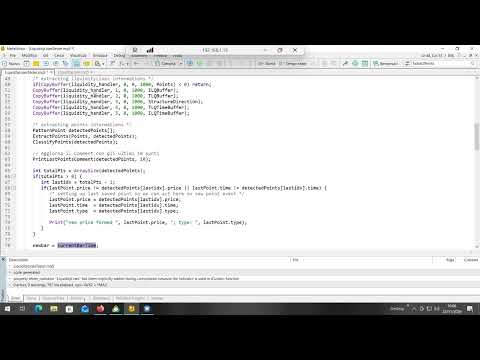
Überträgt ILQBuffer , TLQBuffer , StructureDirection , TLQTimeBuffer und ILQTimeBuffer vom Index [ 2] auf [ 1] , wenn sich ein neuer Balken bildet ( prev_calculated != rates_total ).
-
Bärischer Zustand (StructureDirection[1] < 0): Wenn high [0] > TLQBuffer[1] ist , wird eine Aufwärtsverschiebung der Struktur registriert, ein Markierungspunkt in Points[] gesetzt (Wingdings-Pfeil 159 ), TLQBuffer , ILQBuffer sowie deren Anker-Zeitstempel aktualisiert und StructureDirection [1] = 1 gesetzt . Andernfalls, wenn ArraySize (h) > 1 && h[0].price < lastZZH ist, aktualisiert es ILQBuffer [1] anhand von h [0] und TLQBuffer [1] anhand von h [1] .
-
Bullischer Zustand (StructureDirection[1] >= 0): Symmetrisch dazu registriert das Programm, falls low [0] < TLQBuffer[1] ist, eine Abwärtsverschiebung, setzt einen Markierungspunkt in Points [] , aktualisiert Puffer und Zeitstempel und setzt StructureDirection [1] = -1 . Andernfalls, wenn ArraySize (l) > 1 && l[0].price > lastZZL ist, aktualisiert es ILQBuffer [1] anhand von l [0] und TLQBuffer [1] anhand von l [1] .
-
-
Chart-Objekte und Tester-Optimierung: Verwendet horizontale OBJ_TREND-Segmente ( RAY_RIGHT = false ), denen ILQ_ <TF>_ , TLQ_<TF>_ und BOS_ <TF>_ vorangestellt sind und die bis zum Zeitpunkt time [1] aktualisiert werden . Die Objekterstellung wird bei nicht-visuellen Strategy-Tester-Läufen automatisch deaktiviert ( g_disegna ).
2. Indikatorpuffer
| Puffer | Array | Datenfenster | Zweck |
| 0 | Punkte[] | Sichtbar ( DRAW_ARROW , Code 159 ) | Markierte strukturelle Hoch-/Tief-Kurse (ansonsten EMPTY_VALUE) |
| 1 | ILQBuffer[] | Sichtbar ( DRAW_NONE ) | Aktuelles ILQ-Kursniveau |
| 2 | TLQBuffer[] | Sichtbar ( DRAW_NONE ) | Aktuelles TLQ-Preisniveau |
| 3 | StructureDirection[] | Sichtbar ( DRAW_NONE ) | Status der Strukturrichtung (1: bullischer Durchbruch, -1: bärischer Durchbruch) |
| 4 | TLQTimeBuffer[] | Ausgeblendet ( PLOT_SHOW_DATA = false ) | TLQ-Anker-Datums- und Zeitangabe, in Double umgewandelt |
| 5 | ILQTimeBuffer[] | Ausgeblendet ( PLOT_SHOW_DATA = false ) | ILQ-Anker-Datums-/Zeitangabe, in „double“ umgewandelt |
3. MQL5-Integrations-Snippet
input ENUM_TIMEFRAMES InpPivotTF = PERIOD_CURRENT; // TF-PIVOTS input color InpClrILQ = clrDodgerBlue; input color InpClrTLQ = clrOrangeRed; input color InpClrBOS = clrLime; input int InpLineWidth = 1; int indHandle = INVALID_HANDLE; int OnInit() { indHandle = iCustom(_Symbol, _Period, „liquiditylines“, InpPivotTF, InpClrILQ, InpClrTLQ, InpClrBOS, InpLineWidth); return (indHandle == INVALID_HANDLE) ? INIT_FAILED : INIT_SUCCEEDED; } void OnDeinit(const int reason) { if(indHandle != INVALID_HANDLE) IndicatorRelease(indHandle); } void OnTick() { double ilq[], tlq[], dir[], tlqTime[], ilqTime[]; ArraySetAsSeries(ilq, true); ArraySetAsSeries(tlq, true); ArraySetAsSeries(dir, true); ArraySetAsSeries(tlqTime, true); ArraySetAsSeries(ilqTime, true); // Index 1 (letzter geschlossener Balken) lesen if(CopyBuffer(indHandle, 1, 1, 1, ilq) != 1 || CopyBuffer(indHandle, 2, 1, 1, tlq) != 1 || CopyBuffer(indHandle, 3, 1, 1, dir) != 1 || CopyBuffer(indHandle, 4, 1, 1, tlqTime) != 1 || CopyBuffer(indHandle, 5, 1, 1, ilqTime) != 1) return; double currentILQ = ilq[0]; double currentTLQ = tlq[0]; double structDir = dir[0]; datetime anchorTLQTime = (datetime)tlqTime[0]; datetime anchorILQTime = (datetime)ilqTime[0]; }