Obsidian Pivot Engine
- Uzmanlar
- Sürüm: 1.0
- Etkinleştirmeler: 5

Obsidian Pivot Engine is a multi-symbol and multi-timeframe Expert Advisor for MetaTrader 5, designed to analyze and trade XAUUSD, BTCUSD, and NASDAQ simultaneously.
The product's primary configuration is oriented toward XAUUSD, which is the main instrument considered in the default setup. BTCUSD and NASDAQ are available as additional markets and can be enabled or disabled independently.
Trading Strategy
Obsidian Pivot Engine analyzes recent price structure across multiple timeframes and uses pending orders when the defined conditions for a potential level breakout are met.
The exact criteria used for level detection, signal filtering, and entry management are part of the product's internal design and are not publicly disclosed.
Each managed symbol has independent parameters for spread control, slippage, entry distance, and protection management.
The system can analyze different timeframes simultaneously, allowing each market to be managed according to its own parameters.
Risk Management
Every position opened by Obsidian Pivot Engine includes Stop Loss protection.
When the trading conditions of an instrument do not allow the requested protection to be placed correctly on the server, the system includes a backup mechanism to continue managing the position's protection.
The Expert Advisor does not place a Take Profit by default.
Position volume can be calculated automatically according to a risk level selected by the user or set manually using a fixed volume.
Automatic position sizing can use the account balance or equity as its reference, depending on the selected configuration.
The EA also includes a configurable aggregate risk limit per symbol. When exposure reaches the percentage defined relative to account equity, the system can prevent new positions from being opened until the exposure returns within the configured limit.
Obsidian Pivot Engine does not use martingale, does not average losing positions, does not automatically increase volume after a loss, and does not use a grid trading system.
The account size and risk level should be selected by each user according to their own circumstances and risk tolerance.
Main Features
-
Primary configuration oriented toward XAUUSD, with additional support for BTCUSD and NASDAQ.
-
Breakout engine based on price levels and multi-timeframe analysis.
-
Integrated risk management.
-
Initial Stop Loss and trailing stop.
-
Backup protection mechanism for positions when instrument conditions require it.
-
Duplicate filter to avoid redundant orders at the same level.
-
Configurable limit for positions and pending orders per symbol.
-
Configurable aggregate risk limit based on account equity.
-
Automatic expiration of pending orders on Fridays according to the time defined by the user.
-
Optional position-closing protection during holidays.
-
Cross-market normalization designed to detect potential price deviations during order execution.
-
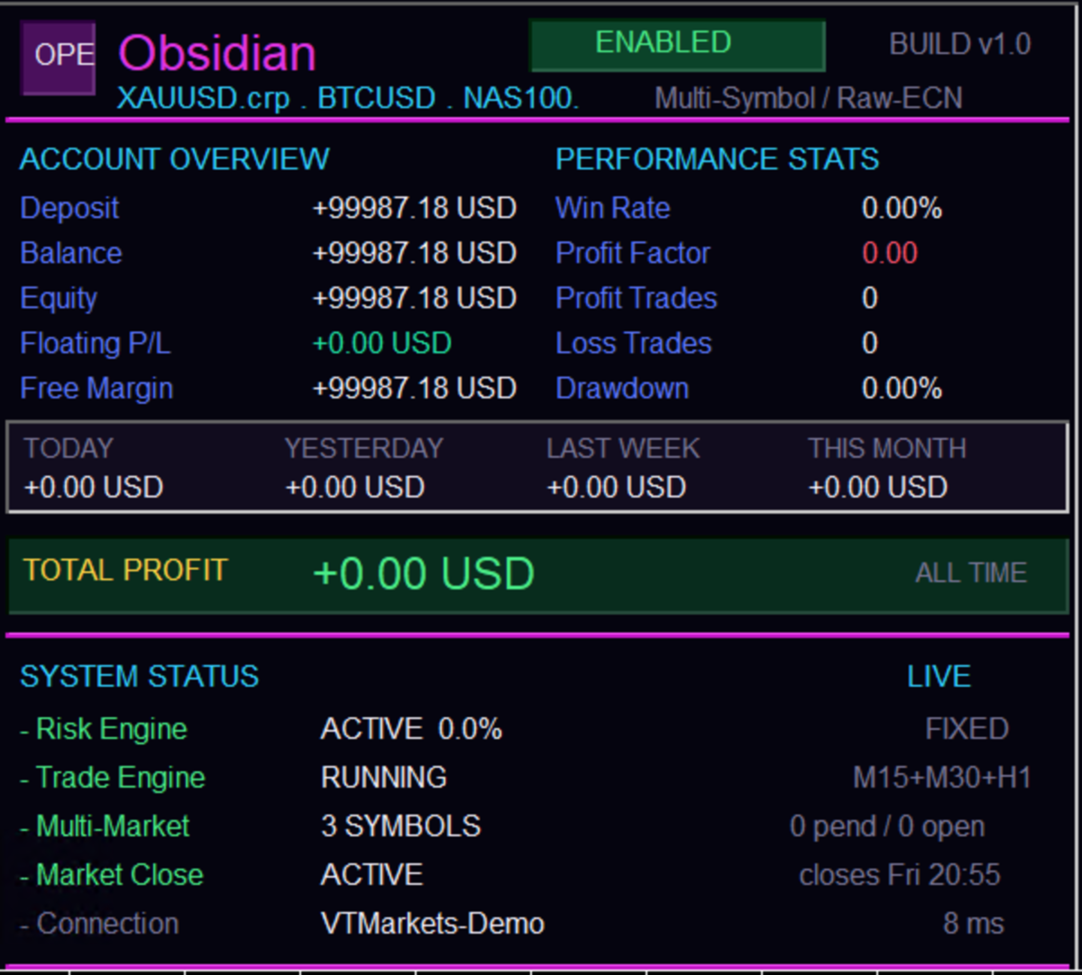
On-screen information panel showing the status of each symbol, spread, pending orders, and active positions.
-
Compatible with the MetaTrader 5 Strategy Tester.
Broker and Execution Conditions
Breakout-based trading can be sensitive to execution conditions.
Factors such as spread, commissions, slippage, latency, liquidity, broker stop-level restrictions, and the specifications of each instrument can affect trade execution and trading results.
Users should select a broker and account type that provide the trading conditions required for the selected instrument.
For continuous operation, a Virtual Private Server (VPS) can be used. This allows MetaTrader 5 to remain running continuously and can reduce interruptions caused by connection problems, power outages, or terminal shutdowns.
Before using the product with real funds, users are advised to verify its operation with the broker, instrument, and account type they intend to use.
Account Type
The product can be used according to the characteristics and capabilities of the trading account provided by the broker.
A hedging account is recommended when independent management of multiple positions on the same instrument is required.
Available trading conditions may differ between hedging and netting accounts.
Before using the product, users should verify the characteristics of their account and the trading conditions available from their broker.
Backtesting
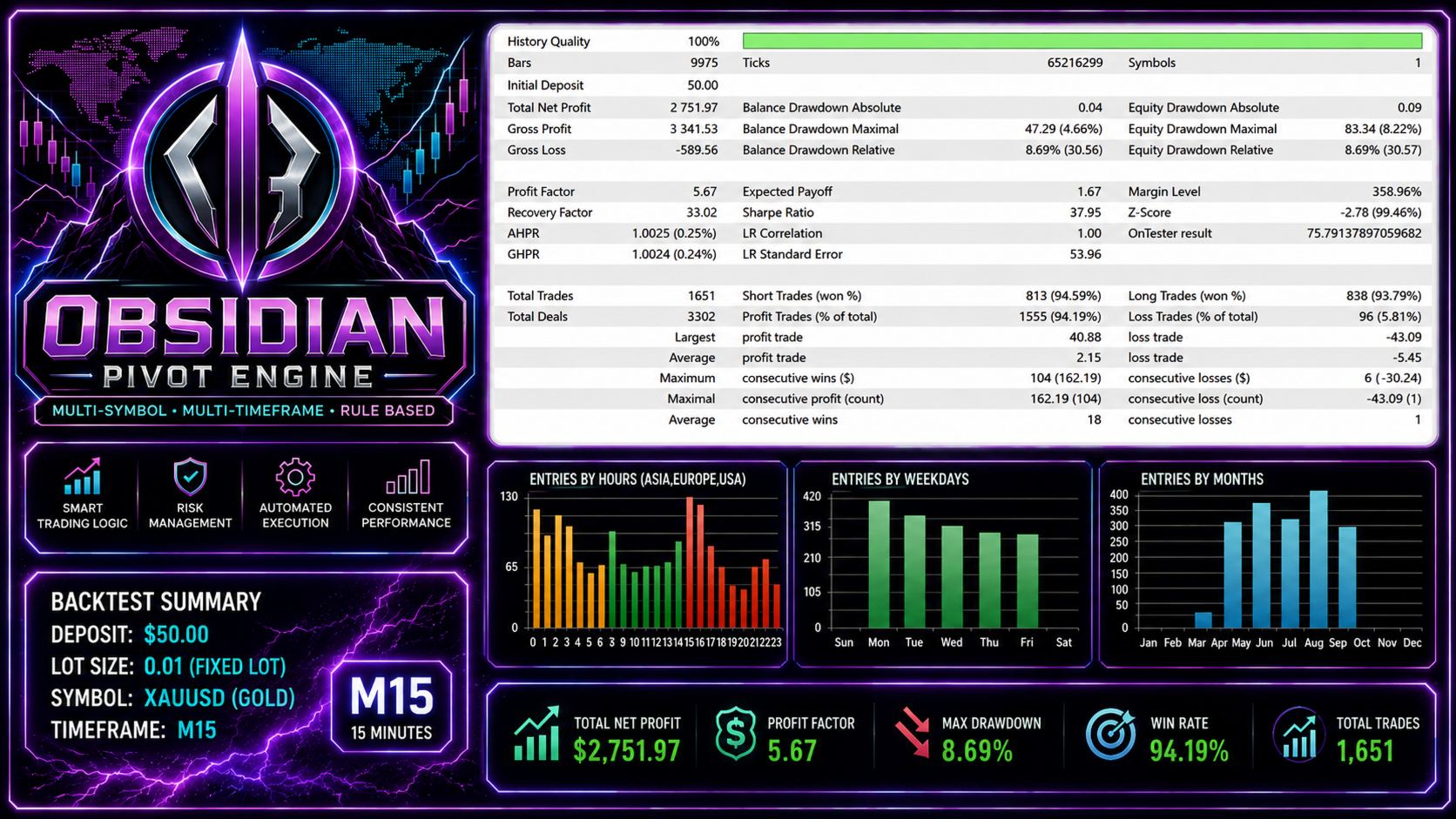
Obsidian Pivot Engine can be tested directly using the MetaTrader 5 Strategy Tester.
For more representative testing, users are advised to use the most accurate tick-generation mode available and configure trading costs that are reasonable for the instrument and conditions being evaluated.
Results obtained from historical data represent tests performed under past market conditions and do not represent actual live trading results.
Historical performance does not guarantee future results.
Live trading execution conditions may differ from those used during historical testing.
Installation and Configuration
Obsidian Pivot Engine can be installed directly from the MetaTrader 5 Market.
Each supported instrument can be enabled or disabled independently through the input parameters.
Users can configure parameters related to volume, risk, spread, slippage, entry distance, and position protection individually.
Before using the Expert Advisor on a live account, users are advised to test the selected configuration in the Strategy Tester and subsequently on a demo account.
Support and Contact
For questions regarding installation, parameter configuration, or unexpected behavior, buyers can contact the developer through the MQL5 messaging system.
To facilitate troubleshooting, users are advised to provide the Expert Advisor version, symbol, broker, account type, and, whenever possible, a screenshot of the dashboard or the relevant error message.
Risk Disclaimer
Trading XAUUSD, BTCUSD, NASDAQ, Forex, and other financial instruments involves the risk of loss.
Losses are possible, and no Expert Advisor can guarantee future profits.
Results obtained from historical testing do not guarantee future results.
Users are responsible for selecting appropriate instruments, parameters, and risk levels for their account and individual circumstances.
Users should understand how the product operates, perform appropriate testing before using real funds, and monitor its operation periodically.