Maxymilian Slawomir Banaszek / Perfil
- Información
|
no
experiencia
|
1
productos
|
14
versiones demo
|
|
0
trabajos
|
0
señales
|
0
suscriptores
|
Amigos
8
Solicitudes
Enviadas
Maxymilian Slawomir Banaszek
Dziś przechodzimy od teorii do praktyki. Jednym z najskuteczniejszych narzędzi chroniących zarówno Twoje konto, jak i stan psychiczny jest automatyczny dzienny limit strat. Gdy osiągniesz ustalony próg strat w ciągu dnia, Ekspert całkowicie przestaje handlować...
Maxymilian Slawomir Banaszek
Backtesting vs Live Trading — Why the Numbers Never Match
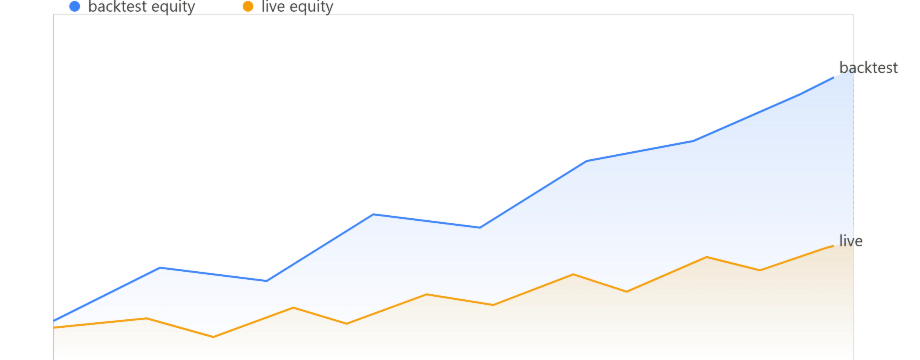
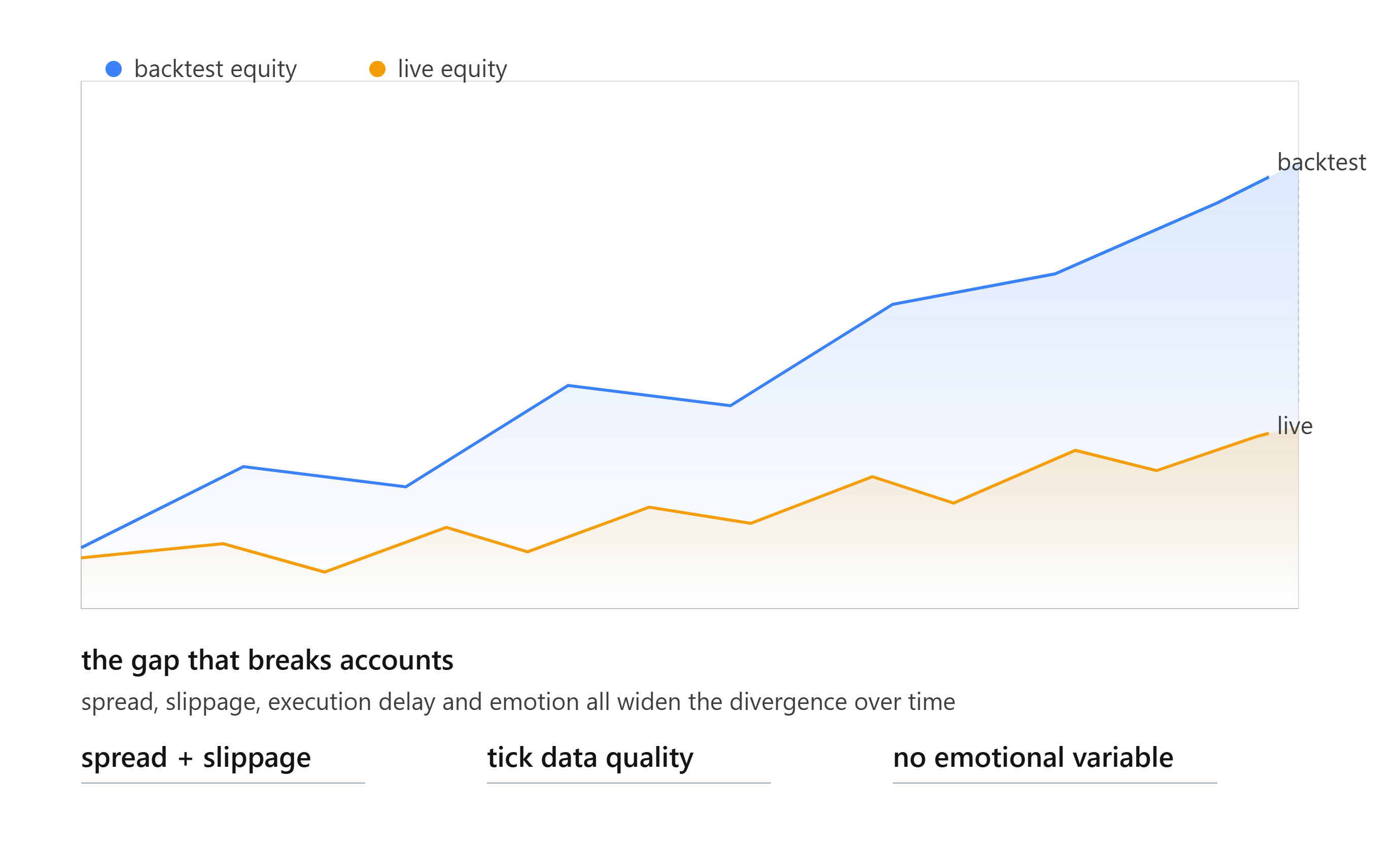
Every trader has been there: a backtest with a beautiful equity curve, a Profit Factor of 2.1, a max drawdown of 8% — and then live results that look nothing like it. This isn't a bug in your EA. It's the gap
between simulation and reality, and understanding it is what separates traders who survive from traders who get fooled by their own backtest.
Why Backtests Lie (Even Honest Ones):
Spread and Slippage Assumptions
Most backtests use average historical spread. Live markets spike spread during news, session opens, and low liquidity windows — exactly when your EA is most likely to trigger.
Tick Data Quality
"Every tick based on real ticks" sounds precise, but most brokers' historical tick data is reconstructed, not recorded live. M1 OHLC-based backtests are even less reliable — they can't see what actually happened inside the candle.
Execution Delays
A backtest fills your order instantly. A live broker has latency, requotes, and partial fills — especially during the volatile spike entries that scalping strategies depend on.
No Emotional Variable
A backtest doesn't second-guess itself, doesn't panic-close a trade early, and doesn't manually disable the EA after three red trades in a row. You do.
How to Bridge the Gap:
Always Forward Test on Demo First
Minimum 4-6 weeks on a live demo account before going real. This is the only way to see actual execution behavior, not simulated behavior.
Match Broker Conditions
Backtest with the same spread, commission, and swap your live broker actually charges — not generic defaults.
Use Walk-Forward Analysis
Don't just optimize once on five years of data. Split it: optimize on one period, validate on the next unseen period. If performance collapses out-of-sample, the strategy was overfit.
Track Live vs Backtest Divergence
Keep a running comparison. If live drawdown consistently exceeds backtest drawdown by a wide margin, something in your assumptions is wrong — fix it before scaling up risk.
Remember:
A backtest tells you a strategy can work under historical conditions. It never guarantees it will work under tomorrow's conditions. Treat it as a filter to eliminate bad ideas — not a prediction of future profit.
The traders who blow up accounts aren't the ones with the worst strategies. They're the ones who trusted a backtest more than they prepared for the moment live results diverged from it.
In the next article, I'll break down how Zeus's freeze-safe exit logic and ATR-based dynamic SL/TP are specifically designed to reduce this backtest-to-live gap.
Every trader has been there: a backtest with a beautiful equity curve, a Profit Factor of 2.1, a max drawdown of 8% — and then live results that look nothing like it. This isn't a bug in your EA. It's the gap
between simulation and reality, and understanding it is what separates traders who survive from traders who get fooled by their own backtest.
Why Backtests Lie (Even Honest Ones):
Spread and Slippage Assumptions
Most backtests use average historical spread. Live markets spike spread during news, session opens, and low liquidity windows — exactly when your EA is most likely to trigger.
Tick Data Quality
"Every tick based on real ticks" sounds precise, but most brokers' historical tick data is reconstructed, not recorded live. M1 OHLC-based backtests are even less reliable — they can't see what actually happened inside the candle.
Execution Delays
A backtest fills your order instantly. A live broker has latency, requotes, and partial fills — especially during the volatile spike entries that scalping strategies depend on.
No Emotional Variable
A backtest doesn't second-guess itself, doesn't panic-close a trade early, and doesn't manually disable the EA after three red trades in a row. You do.
How to Bridge the Gap:
Always Forward Test on Demo First
Minimum 4-6 weeks on a live demo account before going real. This is the only way to see actual execution behavior, not simulated behavior.
Match Broker Conditions
Backtest with the same spread, commission, and swap your live broker actually charges — not generic defaults.
Use Walk-Forward Analysis
Don't just optimize once on five years of data. Split it: optimize on one period, validate on the next unseen period. If performance collapses out-of-sample, the strategy was overfit.
Track Live vs Backtest Divergence
Keep a running comparison. If live drawdown consistently exceeds backtest drawdown by a wide margin, something in your assumptions is wrong — fix it before scaling up risk.
Remember:
A backtest tells you a strategy can work under historical conditions. It never guarantees it will work under tomorrow's conditions. Treat it as a filter to eliminate bad ideas — not a prediction of future profit.
The traders who blow up accounts aren't the ones with the worst strategies. They're the ones who trusted a backtest more than they prepared for the moment live results diverged from it.
In the next article, I'll break down how Zeus's freeze-safe exit logic and ATR-based dynamic SL/TP are specifically designed to reduce this backtest-to-live gap.
Maxymilian Slawomir Banaszek
How to Protect Your Trading Psychology with an Automatic Daily Loss Limit EA in MQL5
In the previous article, we discussed how emotions can destroy even the best trading strategies. Today, we move from theory to practice.
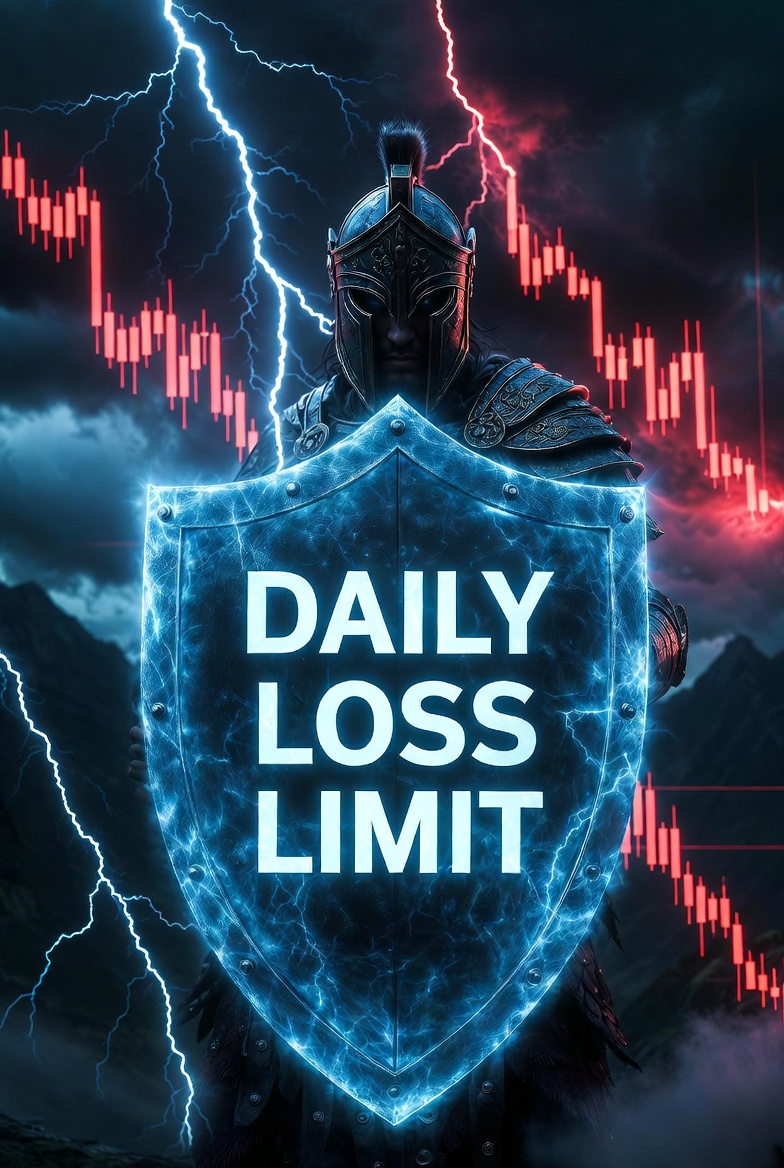
One of the most effective tools to protect both your account and your mental state is an automatic daily loss limit.
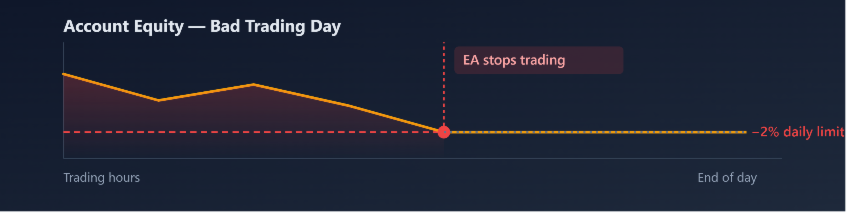
When you reach a predetermined loss threshold during the day, the Expert Advisor completely stops trading. No more trades, no revenge trading, and no attempts to “win it back.” Your account and your nerves get a forced break.
This simple feature can significantly increase your chances of long-term survival in the markets.
Why a Daily Loss Limit is a Game Changer:
Prevents falling into an emotional downward spiral after a bad day
Protects your capital from one catastrophic session
Automatically enforces discipline, even when you’re already emotionally shaken
Gives you time to reset mentally and calmly analyze what went wrong
Thanks to this, you don’t end the day with a huge loss and a blank stare at the screen.
How It Works in Practice:
At the beginning of each day, the EA records your starting balance. Throughout the day, it monitors your current result and when the loss exceeds the set percentage (for example 2% or 3%), it automatically closes all open positions and blocks any new trades until the next day.
You can also add email or phone notifications so you immediately know that trading is over for today.
Ideas for the Next Level:
Limit on the maximum number of consecutive losing trades
Maximum number of trades per day
Trading only during specific hours (e.g., only during the London and New York session overlap)
In the previous article, we discussed how emotions can destroy even the best trading strategies. Today, we move from theory to practice.
One of the most effective tools to protect both your account and your mental state is an automatic daily loss limit.
When you reach a predetermined loss threshold during the day, the Expert Advisor completely stops trading. No more trades, no revenge trading, and no attempts to “win it back.” Your account and your nerves get a forced break.
This simple feature can significantly increase your chances of long-term survival in the markets.
Why a Daily Loss Limit is a Game Changer:
Prevents falling into an emotional downward spiral after a bad day
Protects your capital from one catastrophic session
Automatically enforces discipline, even when you’re already emotionally shaken
Gives you time to reset mentally and calmly analyze what went wrong
Thanks to this, you don’t end the day with a huge loss and a blank stare at the screen.
How It Works in Practice:
At the beginning of each day, the EA records your starting balance. Throughout the day, it monitors your current result and when the loss exceeds the set percentage (for example 2% or 3%), it automatically closes all open positions and blocks any new trades until the next day.
You can also add email or phone notifications so you immediately know that trading is over for today.
Ideas for the Next Level:
Limit on the maximum number of consecutive losing trades
Maximum number of trades per day
Trading only during specific hours (e.g., only during the London and New York session overlap)
Maxymilian Slawomir Banaszek
Trading Psychology and Discipline – Why 90% of Traders Lose to Themselves
Most beginner traders believe that success in trading depends mainly on having a good strategy, indicators, or backtests. The harsh truth is: even the best MQL5 Expert Advisor will fail if you don’t have strong discipline and a controlled mindset.
The market is a mirror. It reveals exactly who you are in moments of maximum stress.
The Biggest Psychological Traps in Trading:
Fear and FOMO
Closing winning trades too early and holding losing ones hoping “it will come back.” Result? Small profits, massive losses.
Revenge Trading
After a losing streak, you increase lot size, disable stop losses, and try to “get it back.” This is the fastest way to blow up an account.
Overconfidence Bias
After a winning streak, you suddenly think you’ve “mastered the market.” You start risking more and ignoring your system’s rules.
Lack of Routine
Trading without a daily plan, without journaling, and without clear rules = emotional gambling.
How to Build Discipline with MQL5:
Code strict rules directly into your EA (maximum daily drawdown, max trades per day, allowed trading hours, etc.).
Use solid money management – never risk more than 1% of your capital on a single trade.
Keep a detailed trading journal – log not only P&L but also your emotional state and mistakes.
Thoroughly backtest and forward test strategies before going live.
Work on your mindset as seriously as on your code. Must-read books: Trading in the Zone by Mark Douglas, The Psychology of Trading by Brett Steenbarger.
Remember:
The best traders aren’t the ones with the most green trades. They are the ones who can consistently follow their plan — even when their emotions scream to do the opposite.
Discipline is doing what you need to do, even when you don’t feel like it.
And you?
How many times did you break your own rules this month?
In upcoming articles, I’ll show practical MQL5 solutions that help fight emotions — such as EAs with automatic daily loss limits, built-in trading journals, and psychology-based trailing stops.
Most beginner traders believe that success in trading depends mainly on having a good strategy, indicators, or backtests. The harsh truth is: even the best MQL5 Expert Advisor will fail if you don’t have strong discipline and a controlled mindset.
The market is a mirror. It reveals exactly who you are in moments of maximum stress.
The Biggest Psychological Traps in Trading:
Fear and FOMO
Closing winning trades too early and holding losing ones hoping “it will come back.” Result? Small profits, massive losses.
Revenge Trading
After a losing streak, you increase lot size, disable stop losses, and try to “get it back.” This is the fastest way to blow up an account.
Overconfidence Bias
After a winning streak, you suddenly think you’ve “mastered the market.” You start risking more and ignoring your system’s rules.
Lack of Routine
Trading without a daily plan, without journaling, and without clear rules = emotional gambling.
How to Build Discipline with MQL5:
Code strict rules directly into your EA (maximum daily drawdown, max trades per day, allowed trading hours, etc.).
Use solid money management – never risk more than 1% of your capital on a single trade.
Keep a detailed trading journal – log not only P&L but also your emotional state and mistakes.
Thoroughly backtest and forward test strategies before going live.
Work on your mindset as seriously as on your code. Must-read books: Trading in the Zone by Mark Douglas, The Psychology of Trading by Brett Steenbarger.
Remember:
The best traders aren’t the ones with the most green trades. They are the ones who can consistently follow their plan — even when their emotions scream to do the opposite.
Discipline is doing what you need to do, even when you don’t feel like it.
And you?
How many times did you break your own rules this month?
In upcoming articles, I’ll show practical MQL5 solutions that help fight emotions — such as EAs with automatic daily loss limits, built-in trading journals, and psychology-based trailing stops.
Maxymilian Slawomir Banaszek
Ha publicado el producto
Zeus Scalping Bot — EA de oro XAUUSD para MT5 BREVE DESCRIPCIÓN: Un scalper de oro multistrategia con 7 sistemas de entrada precisos, lógica adaptativa de mantenimiento de posiciones y filtrado de sesiones/noticias en tiempo real, creado exclusivamente para XAUUSD en MT5. DESCRIPCIÓN COMPLETA: Resumen Zeus Scalping Bot es un asesor experto profesional creado exclusivamente para XAUUSD (oro) en MetaTrader 5. A diferencia de los EA generales, que se activan con un solo indicador de cruce, Zeus
: