What to feed to the input of the neural network? Your ideas... - page 2

You are missing trading opportunities:
- Free trading apps
- Over 8,000 signals for copying
- Economic news for exploring financial markets
Registration
Log in
You agree to website policy and terms of use
If you do not have an account, please register
+ a couple more indicators.
If you are interested - I can elaborate.
Also the second part of the ballet - strategy. When training, it is a one-handed game. Because for pure analysis lot should be fixed, stops, take-outs - its own nuances. + more conditions. I will expand the idea if you wish. It is irrational to restrain oneself like this in the combat mode. But this is not all. And I will tell you at once - MT resource is not enough to cover a more or less large period with training. When training on the 5th month - the results of the first month degrade by ...%. Thus, some predictability can be detected, but the randomness of the sequences is still more than we were able to fix.
Are you looking for a good use for a neural network? Try to solve a specific problem, not a generalised eternal grail.
there is a suspicion, close to reality, that just before major news movements, the price (ticks or minute bars) behaves somewhat differently than usual.
This" different" behaviour cannot be formalised by the usual methods of technical analysis, so it is NN's way of whistling "it's about to go off" before the movement itself and spreads widen.
but it's a lot of work even at the level of data preparation and searching the history of such movements. You have to do a lot of work before you start using neurons.
To give you an idea: a news bar is the M30 bar (business news is released with a frequency of 30 minutes), which is significantly larger than the previous one with a sharp, literally stepped, increase in tick volume.
but that's about it.
PS/ such indicator/service will be much more practical and expensive than "ultra-advisors on deep NN"
There are a lot of things that can be fed from scratch, such as coffee grounds.
What impact do all of the above inputs have on performance?
Will this influence, if any, change over time?
In general, is there a tool to screen out the rubbish? Does not forget the fundamental rule of statistics: rubbish in the input - rubbish in the output.
...
1 - inertia is built into the indicators - a lag on start and finish.
Not necessarily, the indicator signal may well be ahead of events. CCI is one of such indicators. As you can see in the figure, CCI sometimes outperforms the RSI signal (signal red histogram - sell, blue histogram - buy). And if the signals of the indicators coincide, the signal is most likely correct.
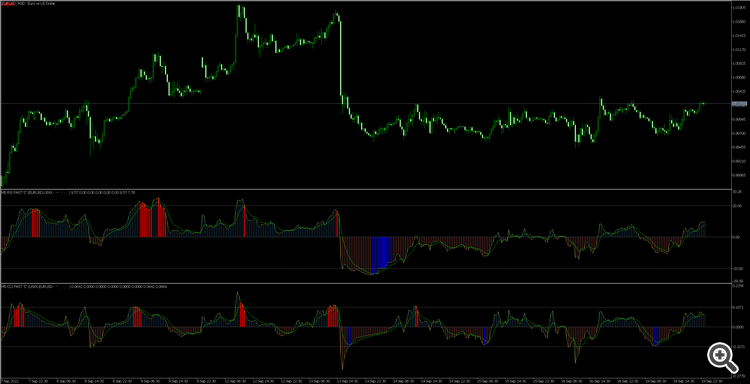
+ a couple more indicators.
If you are interested - I can elaborate.
Also the second part of the ballet - strategy. When training, it is a one-handed game. Because for the purity of analysis lot should be fixed, stops, take-outs - its own nuances. + more conditions. I will expand the idea if you wish. It is irrational to restrain oneself like this in the combat mode. But this is not all. And I will tell you at once - MT resource is not enough to cover a more or less large period with training. When training on the 5th month - the results of the first month degrade by ...%. Thus, some predictability can be detected, but the randomness of the sequences is still more than we were able to fix.
An outside view: to detect seasonality, it would be nice to add the day of the year.
rubbish in, rubbish out.
Prices or price chronology differences are rubbish? Pure expression of supply and demand, not modified by formulas...
Sort of like a reflection of the market.
Prices or price chronology differences are rubbish? Pure expression of supply and demand, not modified by formulas...
Sort of like a reflection of the market.
There are options. It is possible not to send all prices in a row to the network for training, but to select patterns preceding the moment of decision making.
For example, some oscillator crossed a level - you take a pattern from this point. And after training, when you get
an entry signal from the oscillator, you check with the network.
Prices or price chronology differences are rubbish? Pure expression of supply and demand, not modified by formulas...
Sort of like a reflection of the market.
Maybe rubbish, maybe not. Just an opinion is not proof. This issue is often discussed in the machine learning thread Multiple times this issue has been brought up, you can look at the very end of the thread.
Maybe rubbish, maybe not. Just an opinion is not a proof. This question is often discussed in the thread on machine learning This question has been raised many times, you can look at the very end of the thread.
What is the argument about? If not prices, what to submit? A graph of the average temperature for the year?