Aller Uja / Profil
- Information
|
2 Jahre
Erfahrung
|
11
Produkte
|
13
Demoversionen
|
|
0
Jobs
|
4
Signale
|
27
Abonnenten
|
📊 Systematischer & algorithmischer Trader | Live-Signale | MT5 Expert Advisors & Tools | Seit 2011
Ein Multi-Strategie-EA-Portfolio mit diszipliniertem Risikomanagement.
Handel seit 2011 · Algorithmisch seit 2018 · Live-Signale auf MQL5 seit 2024
⚙️ Handelsansatz
- Vollautomatische Strategien (Expert Advisors)
- Multi-Strategie-Portfolio
- Kapitalschutz vor Wachstum
- Kein Martingale / kein Grid / kein Nachkaufen in Verluste
📈 Meine Signale
Aufgelistet im Reiter Signale oben. Jedes arbeitet mit Stop-Loss und festem Risiko pro Trade, und hinter jedem steht eine echte Strategie, die ich selbst einsetze und überwache.
🧰 Meine Expert Advisors
Regelbasierte Systeme, die Sie auf dem eigenen Konto laufen lassen statt zu kopieren — im Reiter Markt oben. Ein harter Stop auf jeder Position, gemessene statt versprochene Zahlen, und eine kostenlose Demo für Ihren eigenen Strategietester.
🛠️ Meine Tools
MetaTrader-5-Werkzeuge, die ein Konto schützen statt es zu handeln: Stop-Loss-Durchsetzung, Prop-Firm-Regeln, Drawdown-Grenzen, Trade-Audit, lokales Kopieren. Die meisten sind kostenlos.
⚡ Infrastruktur
Professionelles VPS für stabile Ausführung und geringe Latenz.
🔎 Transparenz
Hier gibt es keine Demokonten und keine Backtests, die als Live-Handel ausgegeben werden.
Die vollständige Historie, samt der Verlustmonate: https://technotrader.net
⚠️ Risikohinweis
Handel ist mit Risiko verbunden, und Drawdowns gehören normal dazu.
Handeln Sie nie mit Geld, dessen Verlust Sie sich nicht leisten können.
_______________________________
🔗 Dienste, die ich selbst nutze und empfehle:
🌐 Broker (ICTrading)
https://www.ictrading.com/?camp=83911
📒 Handelsjournal & Analyse (FXer)
https://fxer.net
💱 Code: TECHNOTRADER50 (50% Rabatt für 6 Monate)
🏛️ Prop-Firma (The5ers)
https://www.the5ers.com/?afmc=92n
🧪 Strategie-Inkubator (Darwinex Zero)
https://www.darwinexzero.com/?fpr=y68tgd
💱 Code: TECHNOTRADER_20 (20% Rabatt)
Einige der obigen Links sind Affiliate-Links.
_______________________________
📧 Kontakt
💬 Telegram https://t.me/TechnoTrader28
▶️ YouTube https://www.youtube.com/@TechnoTraderStream
TechnoTrader | Automatisierte Handelssysteme
Folgen Sie den Signalen, betreiben Sie einen EA auf Ihrem Konto, testen Sie die kostenlosen Tools oder fragen Sie auf Telegram.
Freunde
348
Anfragen
Ausgehend
Aller Uja
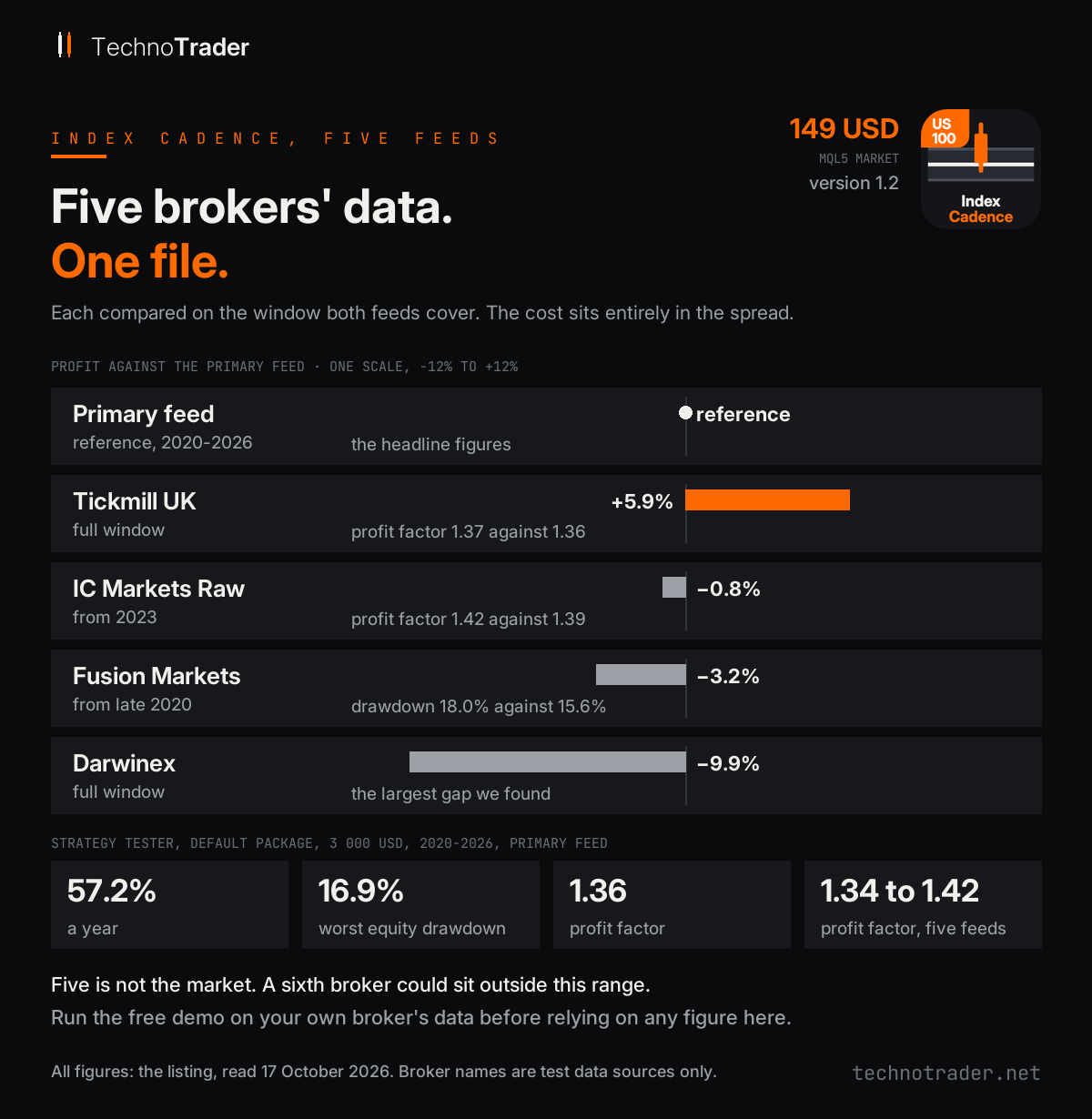
Index Cadence on five brokers' data: the same file, from 9.9% worse to 5.9% better.
⚙️ Index Cadence trades one instrument, the US tech index CFD, intraday and flat before the close, about 275 trades a year. Around the US cash open it measures how far this market normally travels by each time of day over the last 14 sessions and draws a band from that. A 15-minute candle closing outside the band is the signal: above it buys, below it sells. Every position carries a hard broker-side stop and everything is closed before the end of the trading day. No overnight, no weekend. No martingale, no grid, no averaging down.
📊 Strategy Tester, January 2020 to June 2026, 3000 USD account, default package at 1.00% a trade: 57.2% a year, 16.9% worst equity drawdown, profit factor 1.36. Those headline figures come from one raw-spread server with no separate commission on this index.
A figure from one server is a figure from one server. So the same configuration was measured on four more brokers' data, each compared on the window both feeds actually cover, not the date range printed at the top of a report:
Tickmill UK, full window: 5.9% more profit, profit factor 1.37 against 1.36.
IC Markets Raw, from 2023: 0.8% less, profit factor 1.42 against 1.39 on the matched window.
Fusion Markets, from late 2020: 3.2% less and a deeper drawdown, 18.0% against 15.6%. That is the price of a wider spread.
Darwinex, full window: 9.9% less, profit factor 1.35 against 1.36. The largest gap we found.
Across the five the profit factor runs from 1.34 to 1.42 and the win rate from 42.3% to 44.2%. None of them charges a separate commission on this index, so the cost sits entirely in the spread, and that was checked deal by deal.
What this means before you buy: the edge held on every feed we had, but its size moved with the feed. Two thirds of the profit comes from the first 45 minutes after the US cash open, so the spread your broker quotes in those minutes matters more than its average. If your broker charges a round-trip commission, enter it in the commission input so the cost gate can see it.
⚠️ The honest half. Five is not the market. A sixth broker could sit outside that range, and one whose spread widens sharply at the US open would hurt more than any of these did. The 16.9% drawdown is the worst on one path, and out of sample the same mechanism drew down about twice as deep, so plan the default for 25 to 35 percent, not 17. Run the free demo on your own broker's data: that result, not the listing, is what your account would have seen. Broker names are test data sources only, with no affiliation.
📈 Live at factory defaults on the EA Showcase account since 30 August, sharing one account with Bitcoin Interval, so its curve is not this product's own record: https://www.mql5.com/en/signals/2387565
💰 Index Cadence, 149 USD: https://www.mql5.com/en/market/product/190845
Aller Uja
Bitcoin Interval: a trend robot in the 2022 bear year, measured on its own
16 Oktober 2026, 07:59
Every trend robot looks good in a year when its market trends up. The year a buyer should ask about is the other one. For Bitcoin that was 2022, the bear year...
Aller Uja
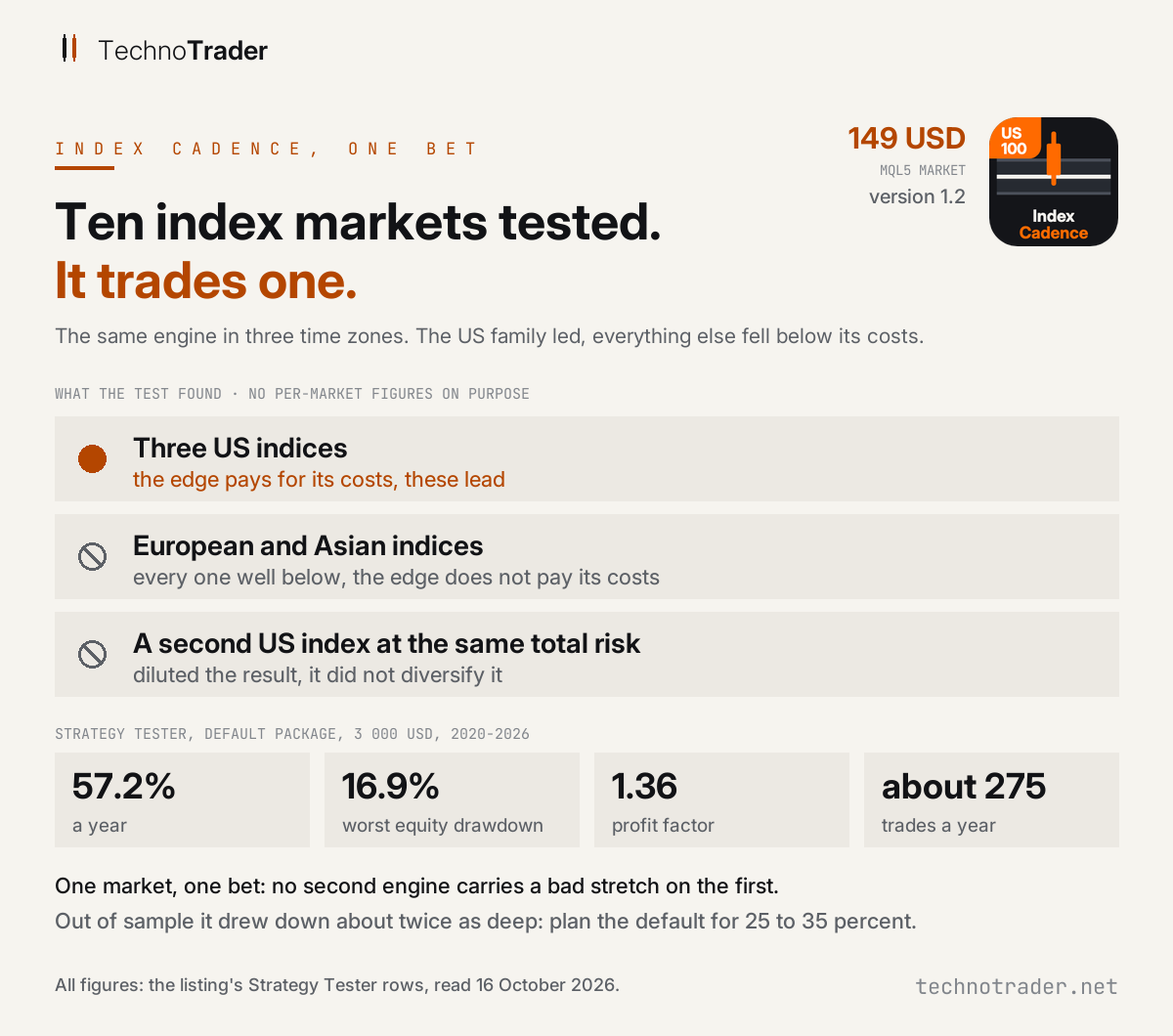
Index Cadence: ten index markets tested, it trades one. What that means if you already run an index robot.
⚙️ Index Cadence trades one instrument, the US tech index CFD, intraday and flat before the close, about 275 trades a year. Around the US cash open it measures how far this market normally travels by each time of day over the last 14 sessions and draws a band from that. A 15-minute candle closing outside the band is the signal: above it buys, below it sells. Every position carries a hard broker-side stop and everything is closed before the end of the trading day. No overnight, no weekend. No martingale, no grid, no averaging down.
📊 Strategy Tester, January 2020 to June 2026, 3000 USD account, default package at 1.00% a trade: 57.2% a year, 16.9% worst equity drawdown, profit factor 1.36.
Why only one market? Before it shipped, the same engine was measured on ten index markets in three time zones. The result was a clean gradient: the three US indices on top, every European and Asian index well below them. Outside the US family the edge does not pay for its costs, so those markets are not in the product.
The less obvious finding is the one worth knowing before you buy. Adding a second US index at the same total risk did not spread the risk. It diluted the result, because these markets move together during the day. Two US index robots on one account are mostly one bet placed twice.
So read Index Cadence for what it is: one bet, not a portfolio. No second engine inside it carries a bad stretch on the first. If you already run a robot on a US index, this one is likely to win and lose on the same days, so split the risk you already take between them rather than add to it.
⚠️ The honest half. The 16.9% drawdown is the worst on one path, a floor and not an expectation. Out of sample the same mechanism drew down about twice as deep, so plan the default for 25 to 35 percent, not 17. A Strategy Tester result describes fixed rules on prices that already happened. Run the free demo on your own broker's data before relying on any figure here.
📈 Live at factory defaults on the EA Showcase account, beside Gold Tempo on gold and Bitcoin Interval on Bitcoin, so its curve belongs to the three together: https://www.mql5.com/en/signals/2387565
💰 Index Cadence, 149 USD: https://www.mql5.com/en/market/product/190845
Aller Uja
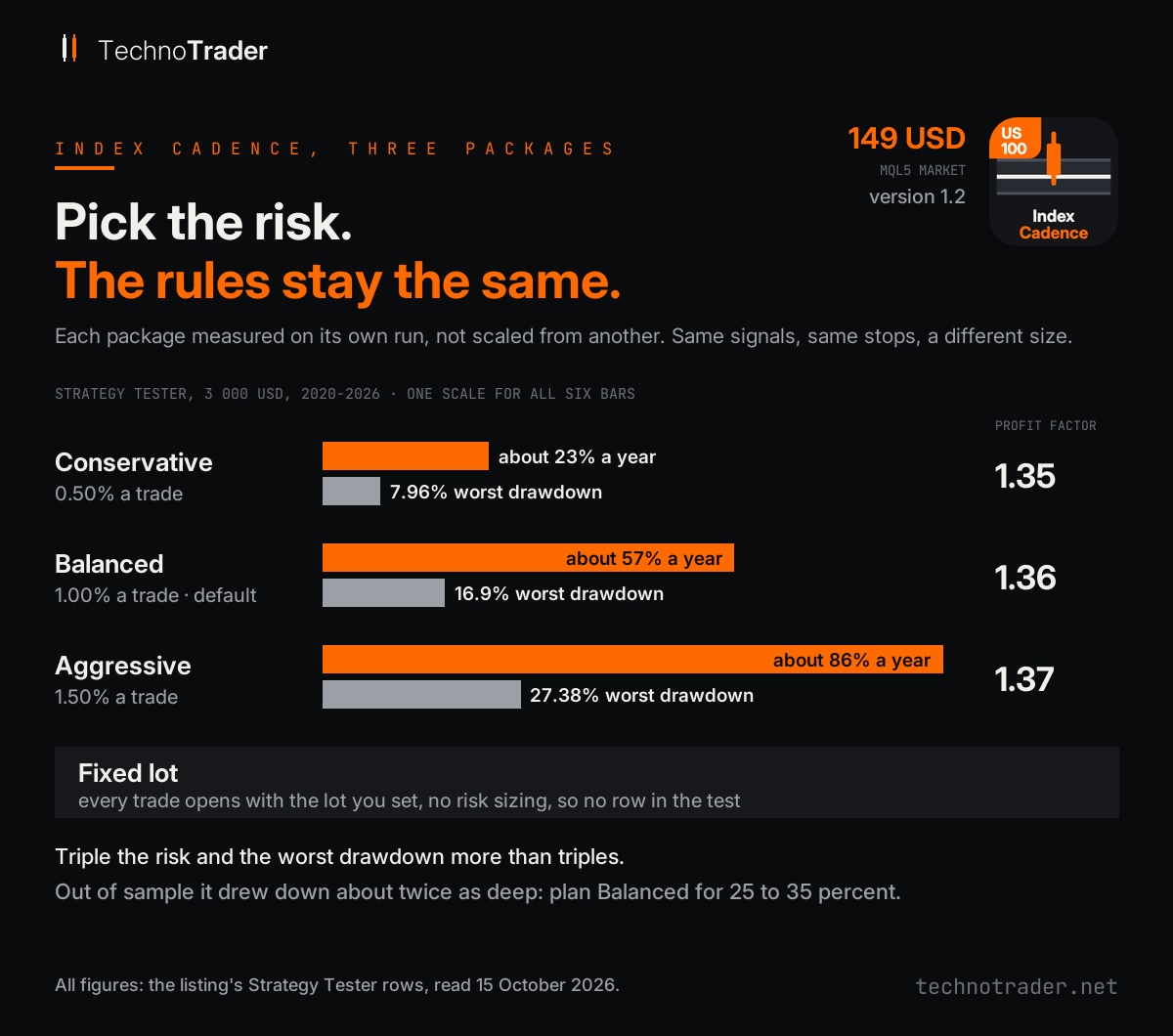
Index Cadence: pick the risk, the rules stay the same.
⚙️ Index Cadence trades one instrument, the US tech index CFD, intraday and flat before the close, about 275 trades a year. Around the US cash open it measures how far this market normally travels by each time of day over the last 14 sessions and draws a band from that. A 15-minute candle closing outside the band is the signal. Every position carries a hard broker-side stop and everything is closed before the end of the trading day. No overnight, no weekend. No martingale, no grid, no averaging down.
📊 Strategy Tester, January 2020 to June 2026, 3000 USD account. Three risk packages, each measured on its own run rather than scaled from another:
Conservative, 0.50% a trade: about 23% a year, 7.96% worst equity drawdown, profit factor 1.35.
Balanced, 1.00% a trade, the default: about 57% a year, 16.9%, profit factor 1.36.
Aggressive, 1.50% a trade: about 86% a year, 27.38%, profit factor 1.37.
What the packages change is the size of each trade. The signals, the stops and the end-of-day close are the same in all three, which is why the profit factor barely moves. Choosing a package is choosing how deep a bad stretch you can sit through, not choosing a better robot.
Read the drawdown column before the return column. Triple the risk, from 0.50% to 1.50%, and the worst drawdown more than triples, from 7.96% to 27.38%. The drawdown does not grow in a straight line with the risk setting, so do not pick the package by multiplying the default.
There is a fourth package, Fixed lot, for anyone who wants to set the size themselves: every trade opens with the lot you enter and no risk-based sizing is applied. It has no row in the test because its result depends entirely on the lot you pick against your own balance.
⚠️ The honest half. Each drawdown above is the worst on one path, a floor and not an expectation. Out of sample the same mechanism drew down about twice as deep, so plan Balanced for 25 to 35 percent, not 17, and scale the other two the same way. Strategy Tester results describe fixed rules on prices that already happened. Run the free demo on your own broker's data before relying on any figure here.
📈 Live at factory defaults on the EA Showcase account, beside Gold Tempo and Bitcoin Interval, so its curve belongs to the three together: https://www.mql5.com/en/signals/2387565
💰 Index Cadence, 149 USD: https://www.mql5.com/en/market/product/190845
Aller Uja
Below a certain account size, your broker decides your risk
14 Oktober 2026, 04:44
Every EA with a risk setting makes the same quiet promise: set 1% and each trade risks 1% of the balance. On a small account that promise depends on something the EA does not control, the broker's minimum lot...
Aller Uja
Index Cadence in a bad stretch: a losing week stops new trades, and it never lets go of a stop.
⚙️ Index Cadence trades one instrument, the US tech index CFD, intraday and flat before the close, about 275 trades a year. Around the US cash open it draws a band from how far this market normally travels by that time of day, and a 15-minute candle closing outside the band is the signal. Every position carries a hard broker-side stop from the moment it opens. No overnight, no weekend. No martingale, no grid, no averaging down.
📊 Strategy Tester, January 2020 to June 2026, 3000 USD account, Balanced (the default): 57.2% a year at a 16.9% worst equity drawdown, profit factor 1.36.
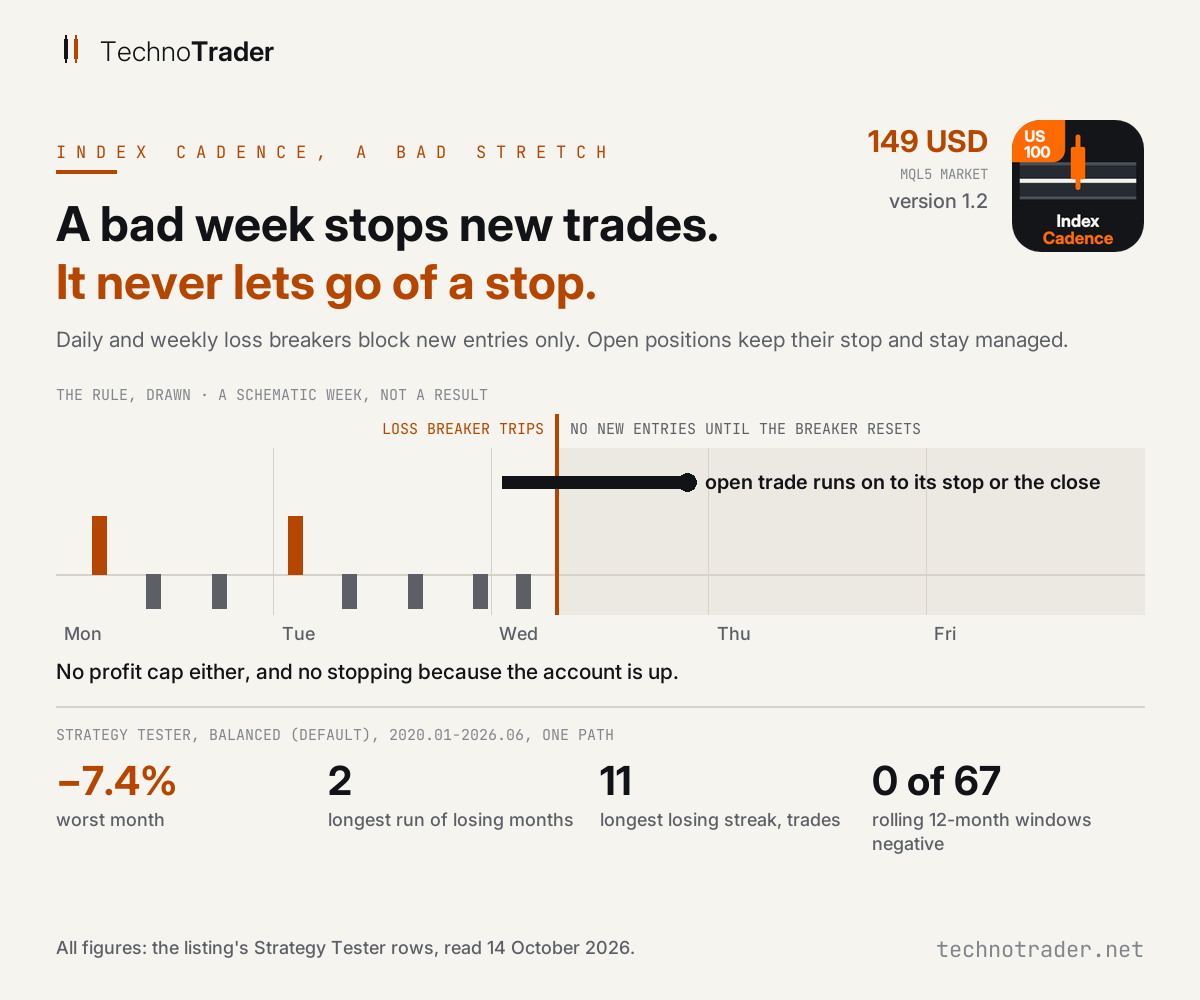
What it does when it is losing. Daily and weekly loss breakers block new entries only. A position that is already open keeps its stop and stays managed until its own exit or the end of the day. Nothing is closed in a panic, nothing is held overnight to avoid booking a loss, and there is no recovery trick that sizes up after a bad run.
What it does when it is winning: nothing different. No profit cap, no stopping because the account is up.
How bad a stretch got in the test: the worst month was -7.4%, the longest run of losing months was two, and the longest losing streak was eleven trades in a row. None of the 67 rolling twelve-month windows was negative.
Why the breaker stops entries and not the robot: the listing's own line is that the stretch you would most want to switch it off is usually the one before the recovery. A breaker pauses the bleeding for the day or the week, then the rules carry on, which is exactly what a person with a finger on the off switch finds hardest.
⚠️ The honest half. Eleven losses in a row is the longest streak on one path, not a ceiling: a longer run is entirely possible live, and the account has to be able to sit through one. The 16.9% is a floor, not an expectation. Out of sample the same mechanism drew down about twice as deep, so plan Balanced for 25 to 35 percent, not 17. Strategy Tester results describe fixed rules on prices that already happened. Run the free demo on your own broker's data before relying on any figure here.
📈 Live at factory defaults on the EA Showcase account, beside Gold Tempo and Bitcoin Interval, so its curve belongs to the three together: https://www.mql5.com/en/signals/2387565
💰 Index Cadence, 149 USD: https://www.mql5.com/en/market/product/190845
Aller Uja
Index Cadence: one winner pays for 1.84 losers, and that is the design.
⚙️ Index Cadence trades one instrument, the US tech index CFD, intraday and flat before the close, about 275 trades a year. Around the US cash open it draws a band from how far this market normally travels by that time of day, and a 15-minute candle closing outside the band is the signal. Every position carries a hard broker-side stop and everything is closed before the end of the trading day. No overnight, no weekend. No martingale, no grid, no averaging down.
📊 Strategy Tester, January 2020 to June 2026, 3000 USD account, Balanced (the default): 57.2% a year at a 16.9% worst equity drawdown, profit factor 1.36.
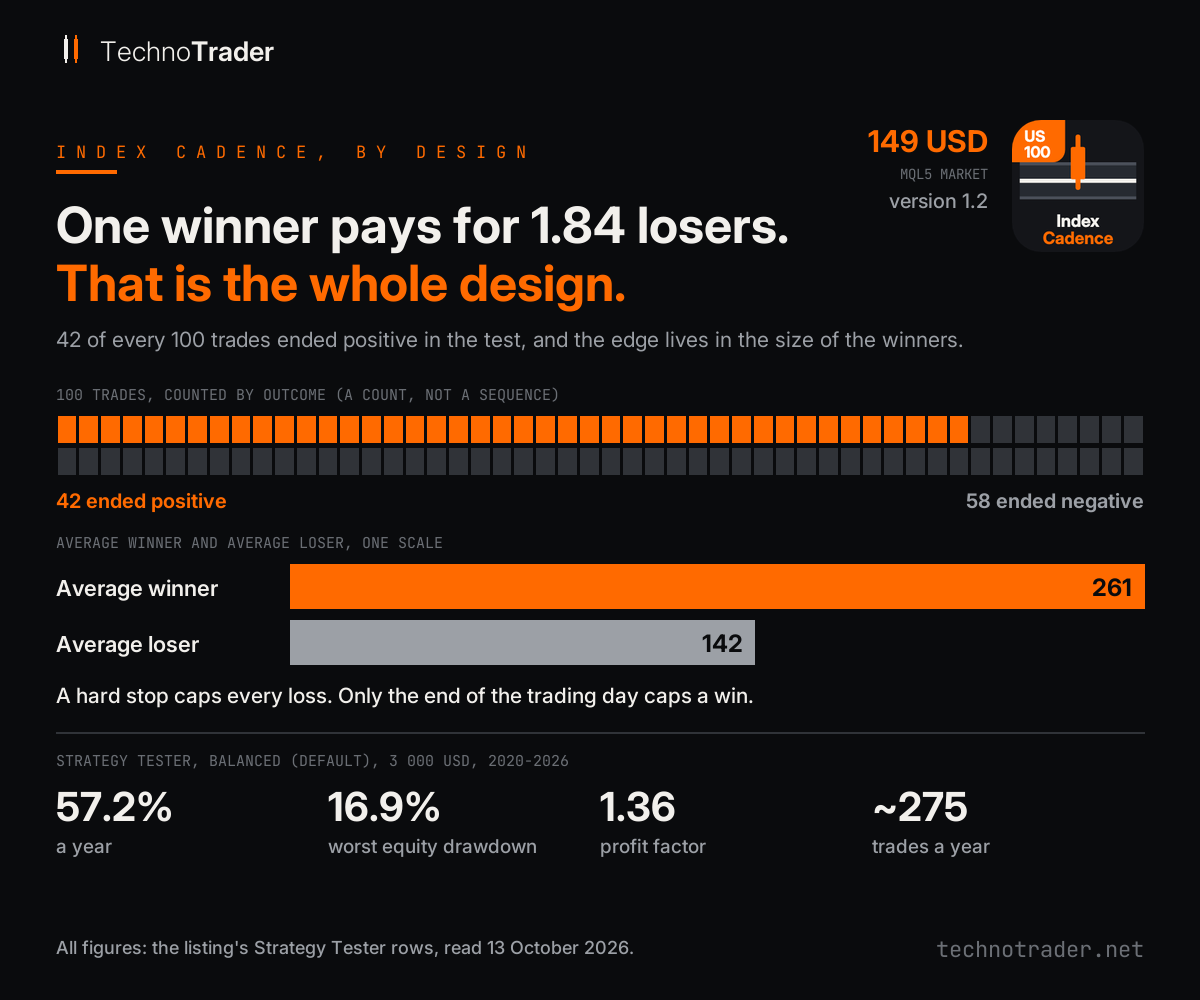
In the same test 42% of trades ended positive. Fewer than half, and not a fault to be tuned away. The average winner made 261 and the average loser lost 142, so one winner pays for 1.84 losers. The listing puts the edge at an expected 0.175 of one risk unit per trade, repeated about 275 times a year. Small, and the whole product.
Why it is built that way: a hard stop caps what a loss can become, and nothing caps a winner except the end of the day. Cut the winners short to lift the win rate and the edge goes with them.
What that means for an owner: runs of losses are arithmetic, not malfunction. Four in a row happened about eleven times a year in the test. Judge it in months, not trade by trade.
What it means for a buyer: a high win rate is the easiest number in this market to manufacture. Let losers run, close winners early, and most trades close in profit while the account bleeds. Judge any robot, this one included, by profit factor and average win against average loss. Both are in the report the free demo generates on your own broker's data.
⚠️ The honest half. The 16.9% is the worst drawdown on one path, a floor and not an expectation. Out of sample the same mechanism drew down about twice as deep, so plan Balanced for 25 to 35 percent, not 17. Strategy Tester results describe fixed rules on prices that already happened. Run the free demo on your own broker's data before relying on any figure here.
📈 Live at factory defaults on the EA Showcase account, beside Gold Tempo and Bitcoin Interval, so its curve belongs to the three together: https://www.mql5.com/en/signals/2387565
💰 Index Cadence, 149 USD: https://www.mql5.com/en/market/product/190845
Aller Uja
The number you'll never see: why every published return is a ceiling
12 Oktober 2026, 04:45
Every return printed on a product page or a signal page was measured under the best conditions its publisher had: their price feed, their fills, their window of history. That is not a trick. It is simply where the number comes from...
Aller Uja
Index Cadence and the week the clocks disagree.
⚙️ Index Cadence trades one instrument, the US tech index CFD, intraday and flat before the close, about 275 trades a year. Around the US cash open it draws a band from how far this market normally travels by that time of day, and a 15-minute candle closing outside the band is the signal. Every position carries a hard broker-side stop and everything is closed before the end of the trading day. No overnight, no weekend. No martingale, no grid, no averaging down.
📊 Strategy Tester, January 2020 to June 2026, 3000 USD account, Balanced (the default): 57.2% a year at a 16.9% worst equity drawdown, profit factor 1.36. On real ticks instead of 1-minute bars: 56.0% a year with the identical trade count. Across five brokers' data the result runs from 9.9% worse to 5.9% better.
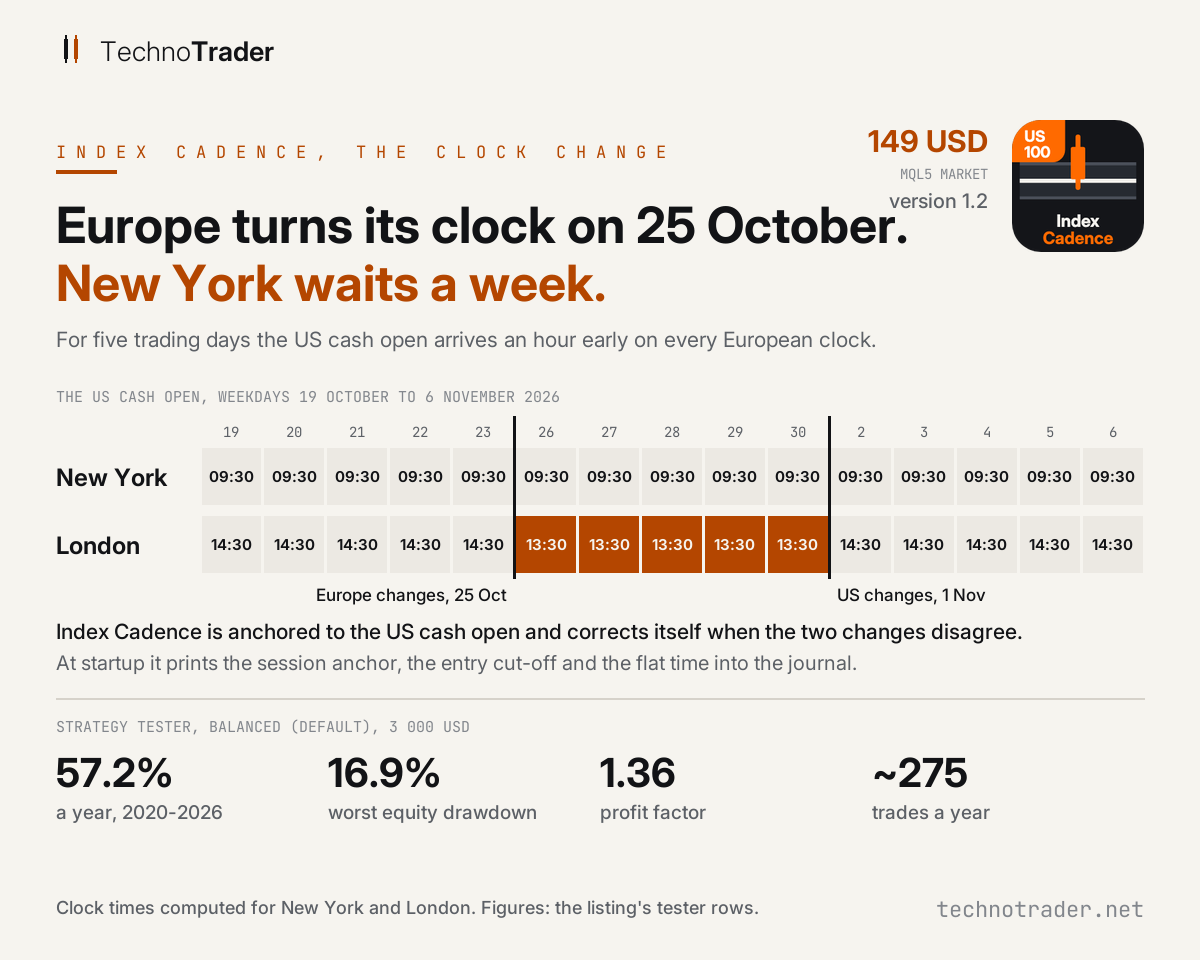
🕐 On Sunday 25 October Europe leaves summer time. New York follows a week later, on Sunday 1 November. For the five trading days in between, 26 to 30 October, the US cash open arrives an hour earlier on every European clock: in London at 13:30 instead of 14:30. It happens again in March, for two weeks.
That week matters more to this robot than to most. Two thirds of its profit comes from the first 45 minutes after the US cash open. An EA that finds the open by a fixed server hour spends that week an hour off its own market.
Index Cadence is anchored to the US cash open, not to a server hour. Out of the box it is set for GMT+2 and GMT+3 servers and corrects itself when the US and European clock changes disagree. One input covers any other offset. At startup it prints the session anchor, the entry cut-off and the flat time into the journal.
If you run it, read those three journal lines before 26 October. If your broker's server is not on GMT+2 or GMT+3, the offset input is the one setting to check. If you are testing the free demo, include last October in the window and look at that week's entry times.
⚠️ The honest half. The 16.9% is the worst drawdown on one path, a floor and not an expectation. Out of sample the same mechanism drew down about twice as deep, so plan Balanced for 25 to 35 percent, not 17. The earlier out-of-sample test, the S and P 500 for 2017-2019, gave a profit factor of 1.07: positive, but weak. Strategy Tester results describe fixed rules on prices that already happened. Run the free demo on your own broker's data before relying on any figure here.
📈 Live at factory defaults on the EA Showcase account, beside Gold Tempo and Bitcoin Interval, so its curve belongs to the three together: https://www.mql5.com/en/signals/2387565
💰 Index Cadence, 149 USD: https://www.mql5.com/en/market/product/190845
Aller Uja
Bitcoin Interval next to the robots you already run, not on top of them.
⚙️ Bitcoin Interval trades BTCUSD only, about sixty trades a year. It reads calendar windows rather than the tick stream, enters at the market only after a window has closed and its conditions agree, and sends a hard broker-side stop and a time limit in hours with every position. No martingale, no grid, no averaging down.
📊 Strategy Tester, January 2020 to August 2026, 3000 USD account, default package: +412.7% over the window, 28.3% a year, profit factor 1.50, 16.77% worst equity drawdown, 397 trades. The thin year is on the page like the good ones: 2025 returned +9.0% at a profit factor of 1.17.
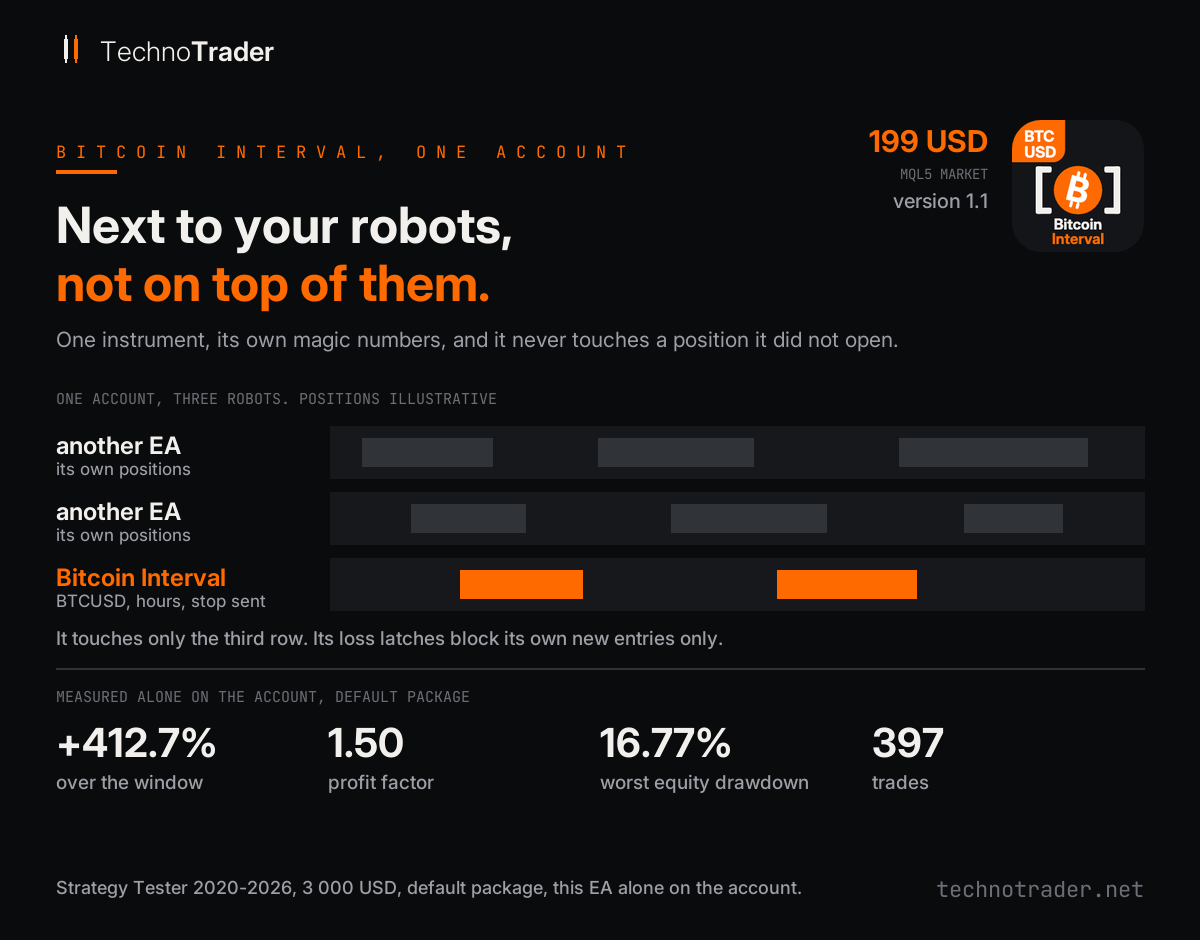
🔍 Most buyers do not start with an empty account. There is a gold robot already on it, or an index robot, or a manual position from last week. So the question before buying a second EA is not only what it makes, it is what it touches.
Bitcoin Interval was built to share an account. One instrument. It holds for hours, not weeks. It uses its own magic numbers and never touches a position it did not open, so your other robots' trades and your own manual ones stay theirs. Its daily and weekly loss latches cap its own cost in a bad week, and they block new entries only: open positions stay managed. On a netting account its two modules take turns, a new position opens only while the symbol is flat, so nothing ever merges into a trade that belongs to someone else.
⚠️ The honest half. Every figure above was measured with this EA alone on the account. Put it next to other robots and the account carries all of their risk at once, on one equity curve. The public EA Showcase shows exactly that: Bitcoin Interval at factory defaults beside Gold Tempo and Index Cadence, three strategies on one small account, so its drawdown can run deeper than this product's own figures. Read that curve as the three together and this page as the strategy alone. Strategy Tester results describe fixed rules on prices that already happened. Run the free demo on your own broker's data before relying on any figure here.
📈 Live at factory defaults on the EA Showcase account, alongside two other products from the same line: https://www.mql5.com/en/signals/2387565
💰 Bitcoin Interval, 199 USD: https://www.mql5.com/en/market/product/193069
Aller Uja
Bitcoin Interval on two prop accounts: the same robot, not the same trades.
⚙️ Bitcoin Interval trades BTCUSD only, about sixty trades a year. It reads calendar windows rather than the tick stream, enters at the market only after a window has closed and its conditions agree, and sends a hard broker-side stop and a time limit in hours with every position. No martingale, no grid, no averaging down.
📊 Strategy Tester, January 2020 to August 2026, 3000 USD account, default package: +412.7% over the window, 28.3% a year, profit factor 1.50, 16.77% worst equity drawdown, 397 trades. The thin year is on the page like the good ones: 2025 returned +9.0% at a profit factor of 1.17.
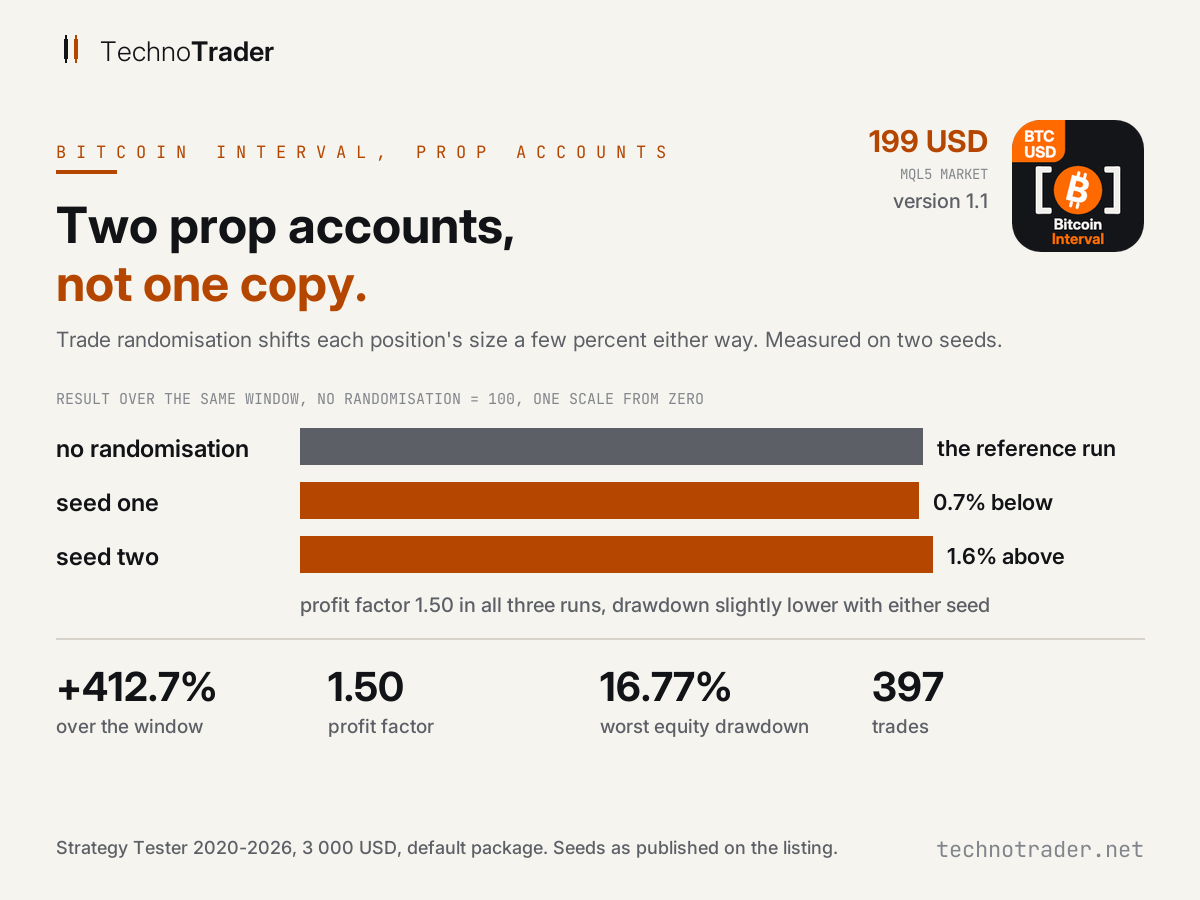
🔍 Prop firms check for identical trades across accounts. Run one file on two challenges and every entry, stop and size matches to the lot. Trade randomisation, off by default, shifts each position's size by up to a few percent either way so the two accounts are not a copy.
The price is not hidden: your risk moves by the same percentage. So we measured it rather than assume it was free. Two seeds over the same window: one run came out 0.7% below the unrandomised result, the other 1.6% above. The profit factor stayed at 1.50 in both and the drawdown came out slightly lower in both. The card draws the three runs on one scale from zero, and that is the honest picture: the difference is noise, not a setting that improves anything. Set a fixed seed if you want a repeatable run.
Two more blocks sit next to it, both off by default. Prop-firm rule protection tracks the overall and daily drawdown limits, stops new entries near either and closes only its own positions. The news filter exists because some prop firms require it, and it cannot be backtested, because the MetaTrader tester has no economic calendar.
⚠️ None of this is a promise that you pass a challenge. We have not published a pass rate for Bitcoin Interval. The protection block stops new entries near a limit, it does not decide how the market moves. Strategy Tester results describe fixed rules on prices that already happened. Run the free demo on your own broker's data before relying on any figure here.
📈 Live at factory defaults on the public EA Showcase account, alongside two other products from the same line: https://www.mql5.com/en/signals/2387565
💰 Bitcoin Interval, 199 USD: https://www.mql5.com/en/market/product/193069
Aller Uja
Most robot pages list "no overnight positions" next to "no martingale", as if both were simply good. The second one is. The first one is a trade-off: it buys some things and it costs others, and a buyer should see both lists before paying for either...
Aller Uja
Bitcoin Interval wins 47 trades in 100. It breaks even at about 37.
⚙️ Bitcoin Interval trades BTCUSD only, about sixty trades a year. It reads calendar windows rather than the tick stream, enters at the market only after a window has closed and its conditions agree, and sends a hard broker-side stop and a time limit in hours with every position. Every trade has a known worst case and a known end.
📊 Strategy Tester, January 2020 to August 2026, 3000 USD account, default package: +412.7% over the window, 28.3% a year, profit factor 1.50, 16.77% worst equity drawdown, 397 trades. The thin year is on the page like the good ones: 2025 returned +9.0% at a profit factor of 1.17.
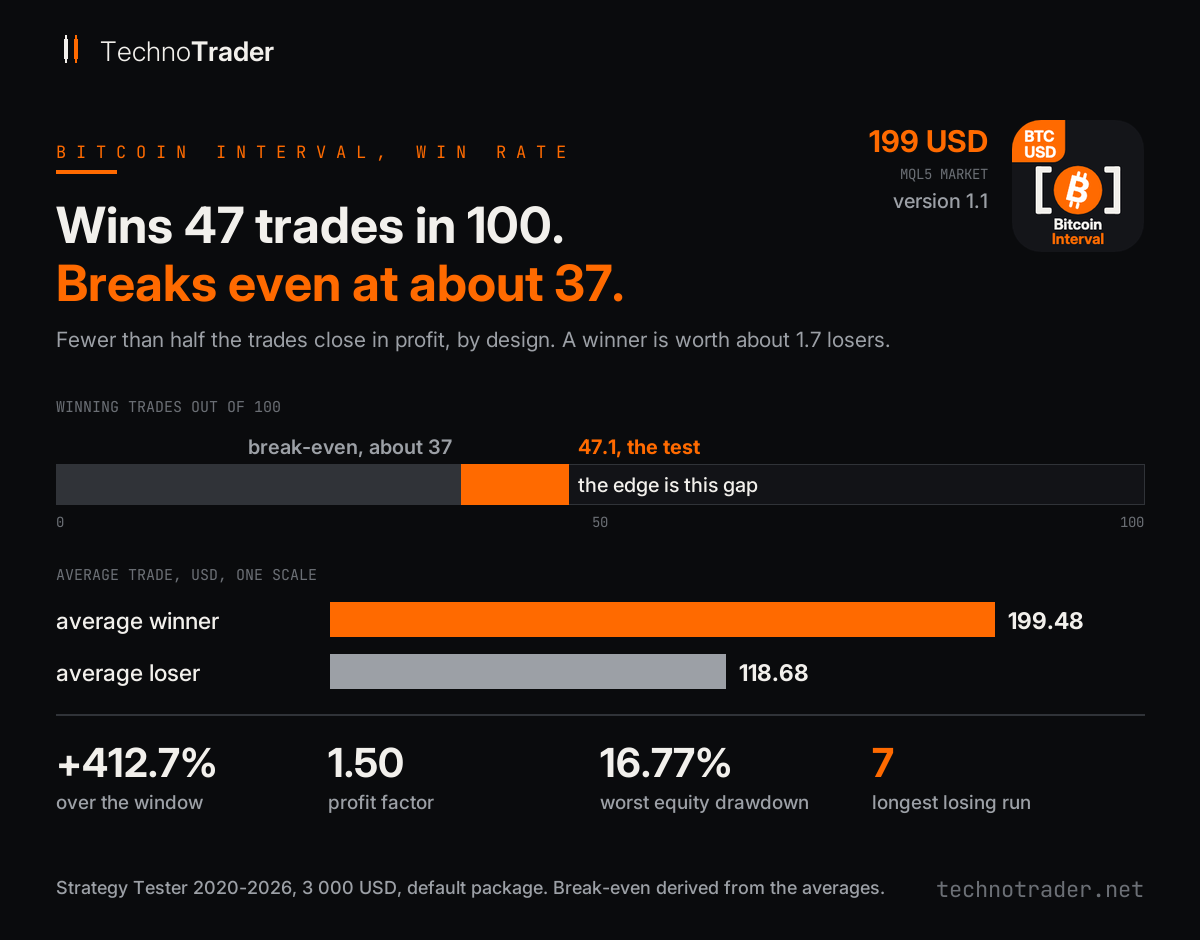
🔍 Fewer than half of those trades closed in profit: 187 of 397, 47.1%. That is how the rules are built, and the full tester report on the product page shows why it still adds up. The average winning trade made 199.48 USD. The average losing trade lost 118.68. One winner is worth about 1.7 losers, so the rules need only about 37 winners in 100 to break even, and in the test they won 47. The whole edge is that gap of about ten trades in a hundred, repeated around sixty times a year.
The 37 is our arithmetic from the report's two averages, not a row MQL5 prints. You can do the same sum on any tester report: the average loss divided by the average win plus the average loss.
⚠️ What a low win rate costs you is runs of losses. The longest in this test was 7 losing trades in a row, and a longer one is possible live. If you judge this robot by how often it is right, you will want to switch it off at the wrong time. The listing says it plainly: the profit factor and the payoff ratio are the numbers to judge it by, not the win rate. Run the free demo on your own broker's data and read those two first.
Not a holy grail. One path through one history, measured on prices that already happened. Strategy Tester results, not a promise.
📈 Live at factory defaults on the public EA Showcase account, alongside two other products from the same line: https://www.mql5.com/en/signals/2387565
💰 Bitcoin Interval, 199 USD: https://www.mql5.com/en/market/product/193069
Aller Uja
Bitcoin Interval: the same file on five brokers' data
⚙️ Bitcoin Interval trades BTCUSD only, about sixty trades a year, with a hard broker-side stop and a time limit in hours on every position. It reads calendar windows rather than the tick stream, and enters at the market only after a window has closed and its conditions agree.
📊 Strategy Tester, January 2020 to August 2026, 3000 USD account, default package: +412.7% over the window, 28.3% a year, profit factor 1.50, 16.77% worst equity drawdown, 397 trades. Those figures come from one raw-spread server with no separate commission on Bitcoin.
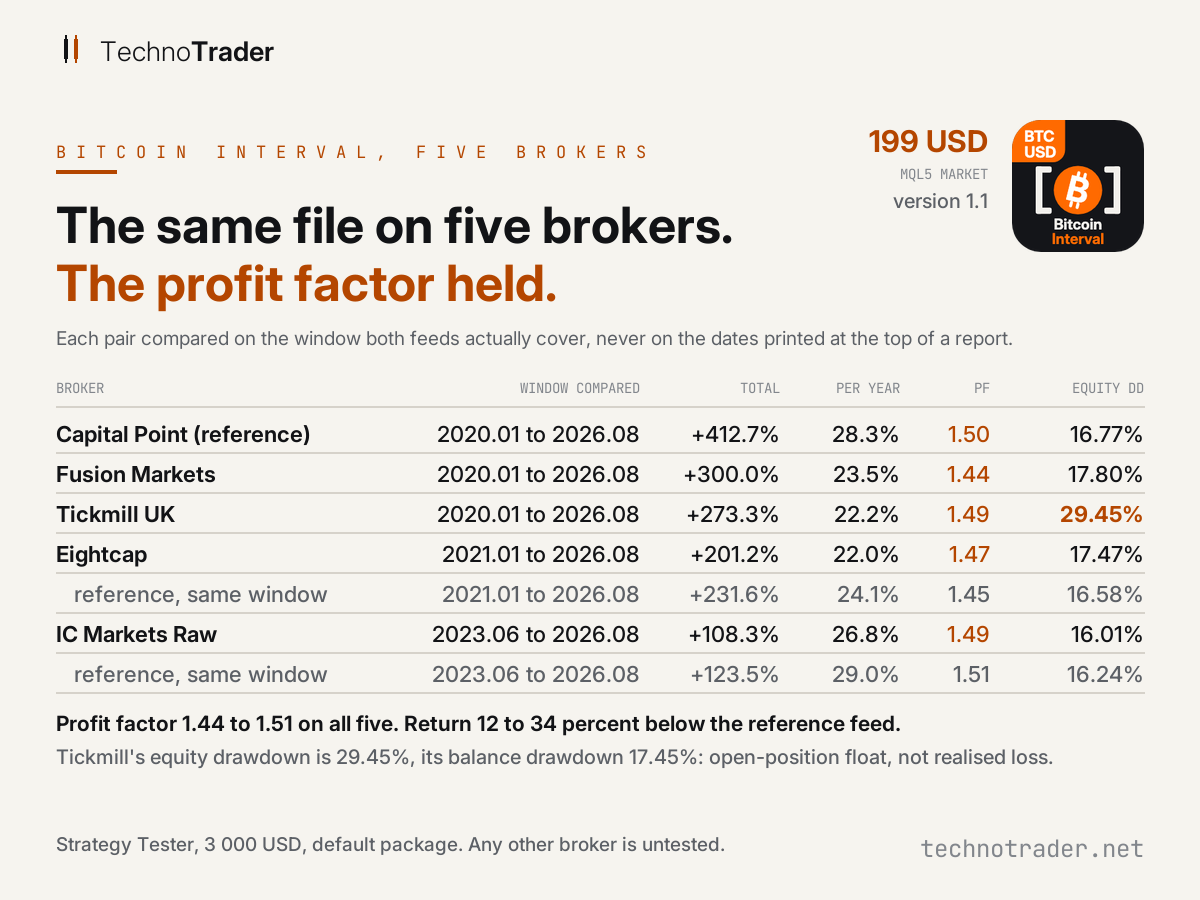
🔍 Then the same file went onto four more brokers' data, and the comparison has one rule: each pair is measured on the window both feeds actually cover, not on the date range printed at the top of a report. It matters more than it sounds. IC Markets' Bitcoin history in our terminal starts in June 2023, so its +108.3% does not sit next to the reference's +412.7%. It sits next to +123.5%, which is what the reference made over those same three years. Compared that way, the gap is small and honest instead of large and meaningless.
Across all five, the profit factor runs 1.44 to 1.51, and the return lands 12 to 34 percent below the reference feed. Bitcoin spreads differ between brokers far more than currency spreads, and a wider spread changes which setups clear the cost gate, so a lower return on another feed is expected. What held is the shape: the rules make about the same profit per unit of loss wherever we measured them.
⚠️ One row stays on the page as it is. On Tickmill the equity drawdown is 29.45%, against 16.77% on the reference. Its balance drawdown is 17.45%. The difference is open-position float, losses sat through rather than booked, and it is the row to read if your broker is not one of the five. Any other broker is untested. The free demo runs on your own broker's data, and demo results from brokers we have not measured are welcome on the product's Comments tab.
Not a holy grail. One path through one history on each feed, measured on prices that already happened. Strategy Tester results, not a promise.
📈 Live at factory defaults on the public EA Showcase account, alongside two other products from the same line: https://www.mql5.com/en/signals/2387565
💰 Bitcoin Interval, 199 USD: https://www.mql5.com/en/market/product/193069
Aller Uja
Techno Long Term IC: a note on the start of October
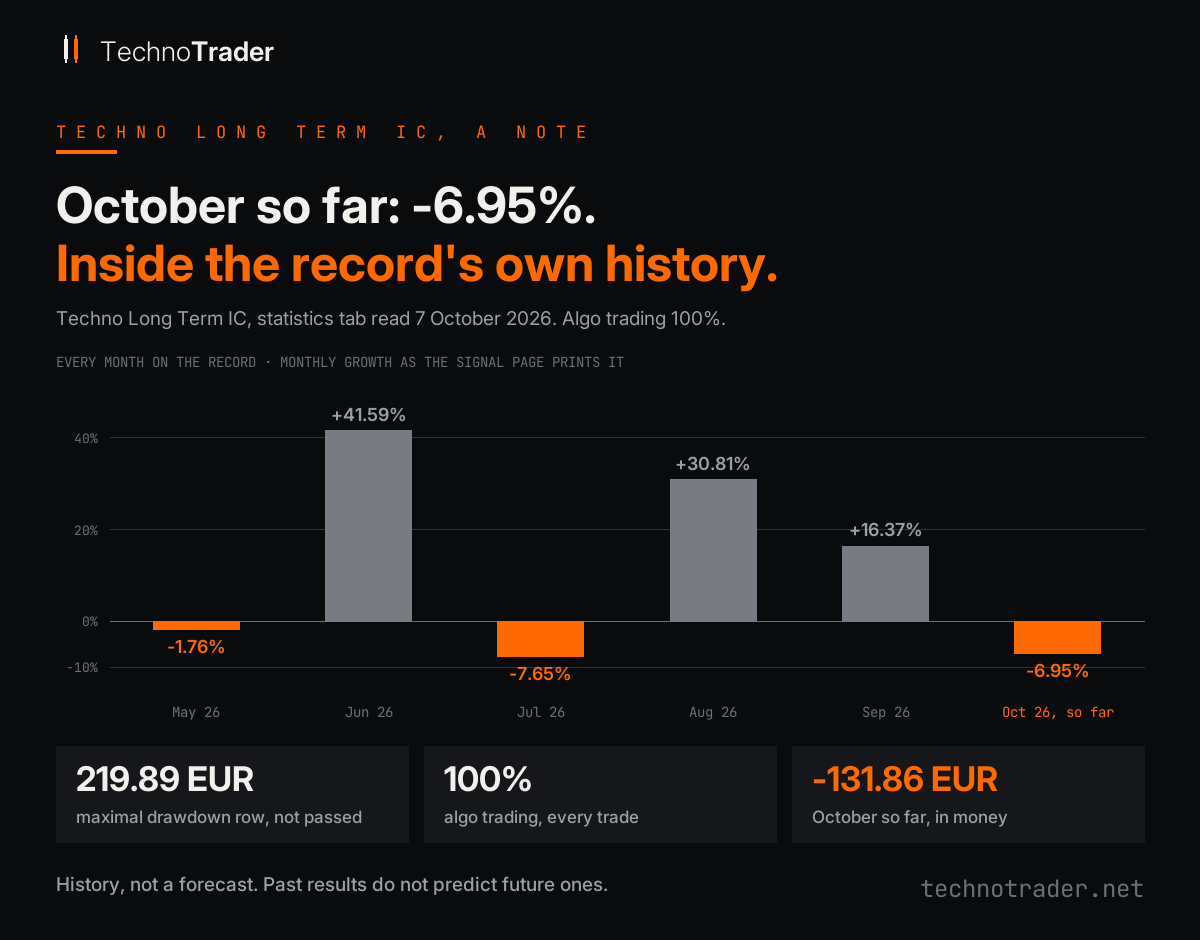
📉 What happened. October has started with gold moving against both of our long-term portfolios. On Techno Long Term IC's statistics tab this morning, the month so far reads -6.95%, or -131.86 EUR. The flagship, Techno Long Term, which runs the same rules at another broker, is at -17.15% for the month.
📊 Where it sits in the record. Techno Long Term IC has six months on its page and three of them are red, October included: May -1.76%, July -7.65% and October so far -6.95%. The maximal drawdown row, which is kept in money and only moves when a fall goes deeper than any before it, still reads 219.89 EUR. This fall has not passed it.
⚙️ What did not change. The account shows algo trading at 100%. Every trade this month, the losing ones included, was placed by the system.
🔍 How to read the earlier red months. Both red months before October were followed by a green one, June at +41.59% and August at +30.81%. Two cases is history, not a forecast, and a drawdown inside a record's own history still has to be sat through. If a fall ever goes past the record's worst, that is a different situation.
The four-step check we would run on any signal in a month like this, on our MQL5 blog: https://www.mql5.com/en/blogs/post/777033
📈 Techno Long Term IC: https://www.mql5.com/en/signals/2377446
📈 Techno Long Term: https://www.mql5.com/en/signals/2307342
Aller Uja
Your signal is down this month: a four-step check before you stop copying
7 Oktober 2026, 08:59
October has started badly on our flagship account. On its statistics tab this morning, the month so far reads -17.15%, or -433.91 EUR, almost all of it from gold...
Aller Uja
Bitcoin Interval: the test window was cut in half before it was measured
⚙️ Bitcoin Interval trades BTCUSD only, about sixty trades a year, with a hard broker-side stop and a time limit in hours on every position. It reads calendar windows rather than the tick stream, a session inside the day and the weekend, and enters at the market only after a window has closed and three conditions agree.
📊 Strategy Tester, January 2020 to August 2026, 3000 USD account, default package: +412.7% over the window, 28.3% a year, profit factor 1.50, 16.77% worst equity drawdown, 397 trades. One-minute bars and real ticks agree, so the result does not lean on optimistic fills.
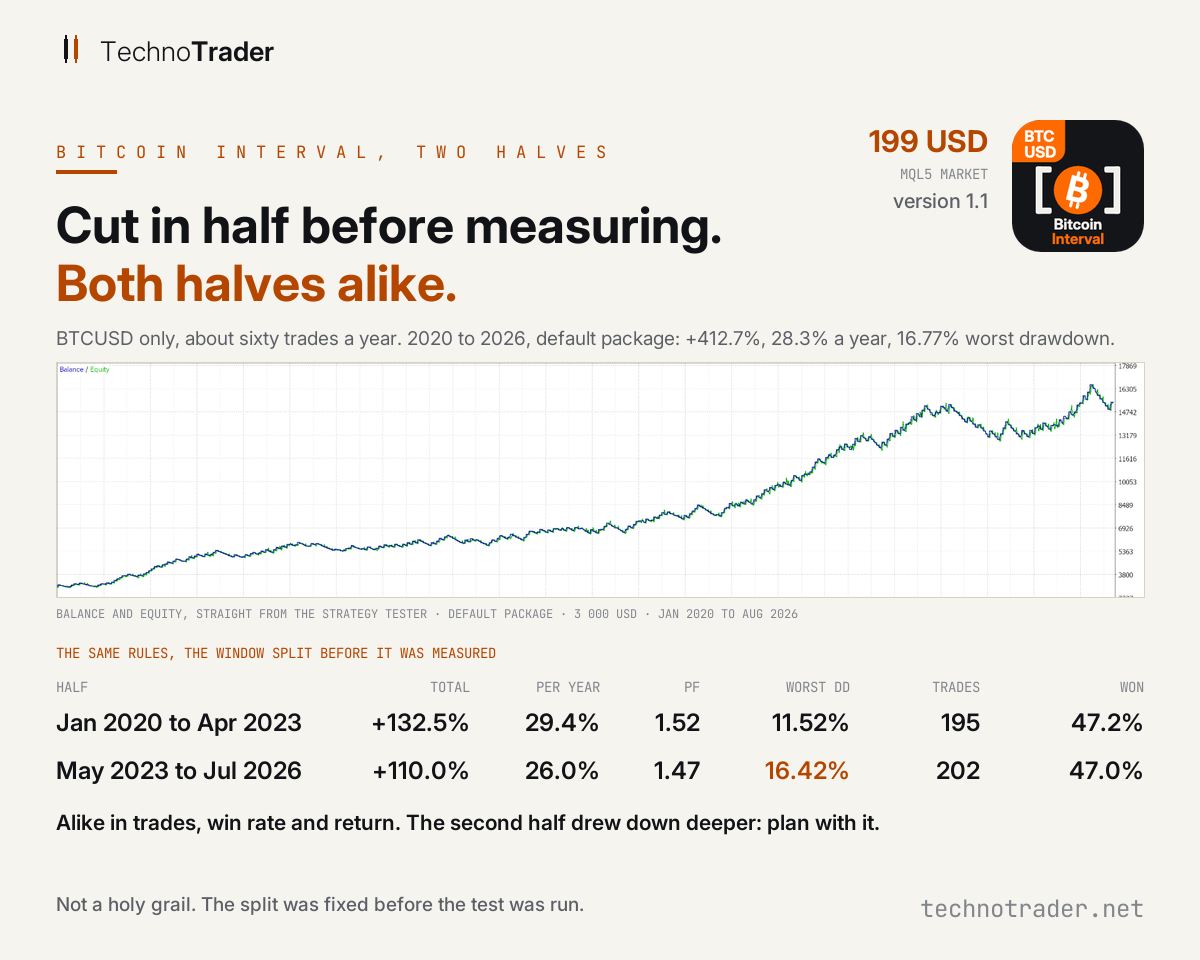
🔍 Why the split matters. Any backtest can be cut in half after the fact, at whichever point flatters it most. A split decided before the test is run cannot be chosen that way, and it answers one plain question: did the rules only work in one stretch of the market?
Bitcoin Interval's window was split before it was measured. January 2020 to April 2023: +132.5%, 29.4% a year, profit factor 1.52, 195 trades, 47.2% of them won. May 2023 to July 2026: +110.0%, 26.0% a year, profit factor 1.47, 202 trades, 47.0% won. The two halves trade alike, win alike and earn alike, with the same rules and no setting changed between them.
Where they differ is the drawdown: 11.52% in the first half, 16.42% in the second. That is what a changing market does to a fixed set of rules, and it is the number to plan with. Choose the package by the deeper half, not the gentler one. The thin year sits in the second half too: 2025 returned +9.0% at a profit factor of 1.17, and it is on the year-by-year screenshot like the good years.
⚠️ Not a holy grail. One path through one history, measured on prices that already happened. Strategy Tester results, not a promise.
📈 Live at factory defaults on the public EA Showcase account, alongside two other products from the same line: https://www.mql5.com/en/signals/2387565
💰 Bitcoin Interval, 199 USD: https://www.mql5.com/en/market/product/193069
Aller Uja
Bitcoin Interval: every trade has a known worst case and a known end
⚙️ Bitcoin Interval trades BTCUSD only, about sixty trades a year. It reads calendar windows rather than the tick stream: one module reads a session window inside the day, the other reads the weekend.
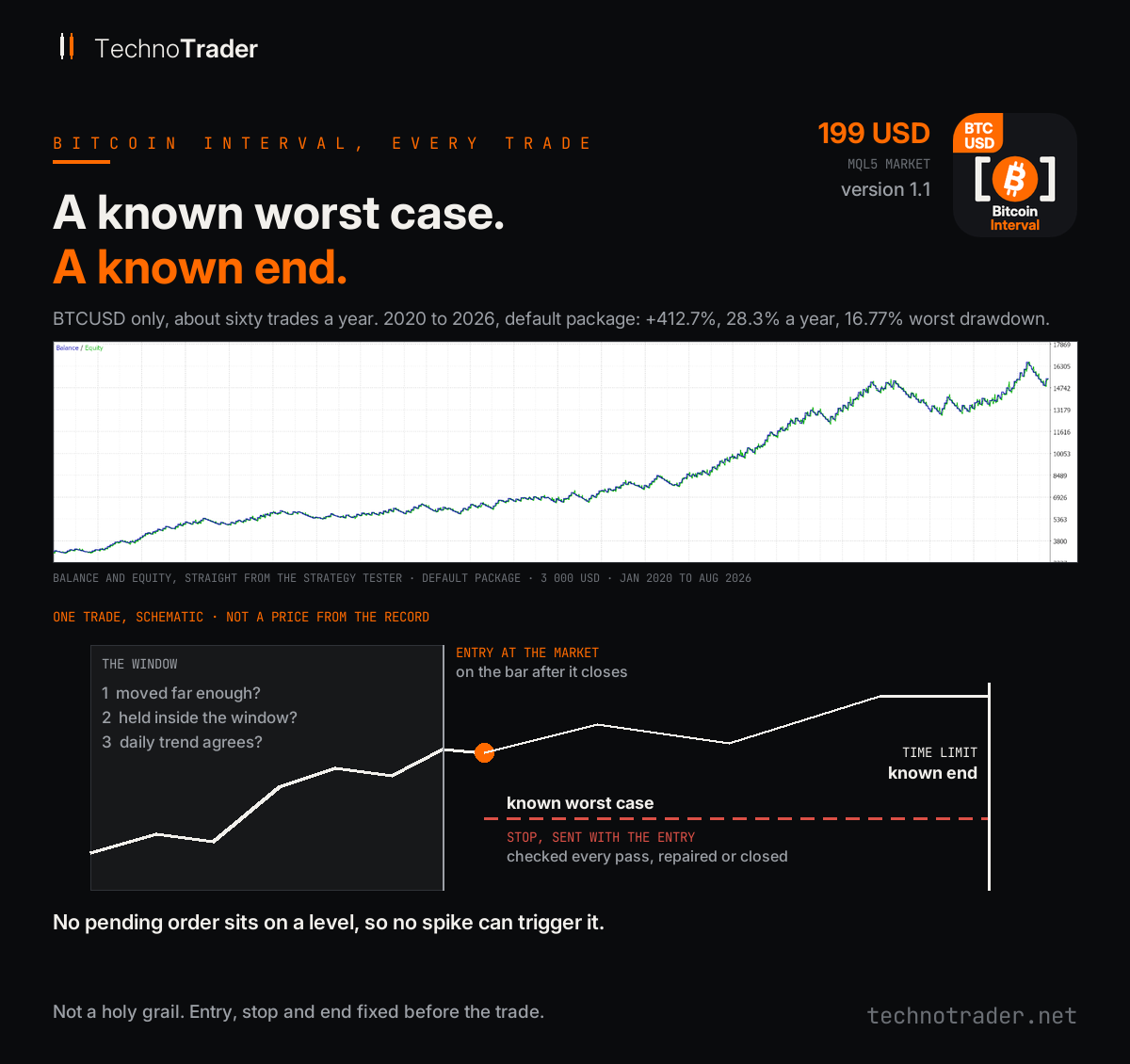
📊 Strategy Tester, January 2020 to August 2026, 3000 USD account, default package: +412.7% over the window, 28.3% a year, profit factor 1.50, 16.77% worst equity drawdown, 397 trades. Every figure was measured with the year-end pause on, as it ships.
🔍 How a trade is born, and how it ends.
No order waits on a level. Many systems park a pending order at a price and let the market trigger it, which means a spike can fill it at the worst moment. Bitcoin Interval does not do that. It waits for its window to close and asks three questions in order: did price travel far enough against recent volatility, did the move hold inside the window, does the daily trend agree. Only when all three agree does it enter, at the market, on the bar after the window closes.
The stop goes out with the entry. It is verified on every pass and repaired if the broker drops it, and if it cannot be repaired the position is closed at market. So the worst case of each trade is known the moment it opens.
Every position also carries a hard time limit, in hours, set per module. A trade that has not reached its stop or its target is closed when its time runs out. Nothing is left open to see what happens.
A known worst case and a known end, on every one of roughly sixty trades a year.
⚠️ Not a holy grail. A rules-based system, every entry, stop and exit fixed in advance. The 16.77% is one path through one history, so choose the package by the drawdown you are prepared to sit through. Strategy Tester results, not a promise.
📈 Live at factory defaults on the public EA Showcase account, alongside two other products from the same line: https://www.mql5.com/en/signals/2387565
💰 Bitcoin Interval, 199 USD: https://www.mql5.com/en/market/product/193069
Aller Uja
The same trades, two profit factors: why a pip is not a unit of money
5 Oktober 2026, 08:38
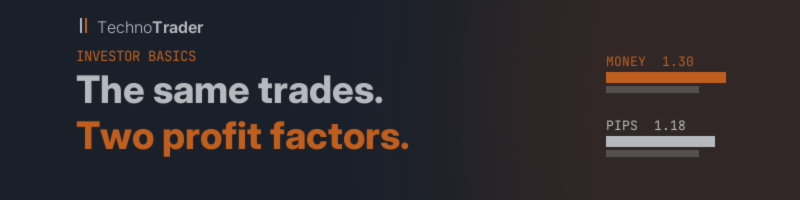
Open the statistics tab of any MQL5 signal and you will find gross profit and gross loss printed twice: once in the account's money, once in pips. Divide each pair and you get a profit factor. On our flagship account this morning the two are 1.30 and 1.18, from the same 4 684 closed trades...
Aller Uja
Index Cadence on a live account: 20 trades, and all 20 are in the tester
⚙️ One instrument, the US tech index CFD, intraday on 15-minute bars. Around the US cash open it measures how far this market normally travels by each time of day and draws a band from that. A 15-minute candle closing outside the band is the signal, above it buys, below it sells. A hard broker-side stop on every position, and everything closed before the end of the trading day.
📊 Strategy Tester, January 2020 to June 2026, 3000 USD account, Balanced default: 57.2% a year at a 16.9% worst equity drawdown, profit factor 1.36, about 275 trades a year.
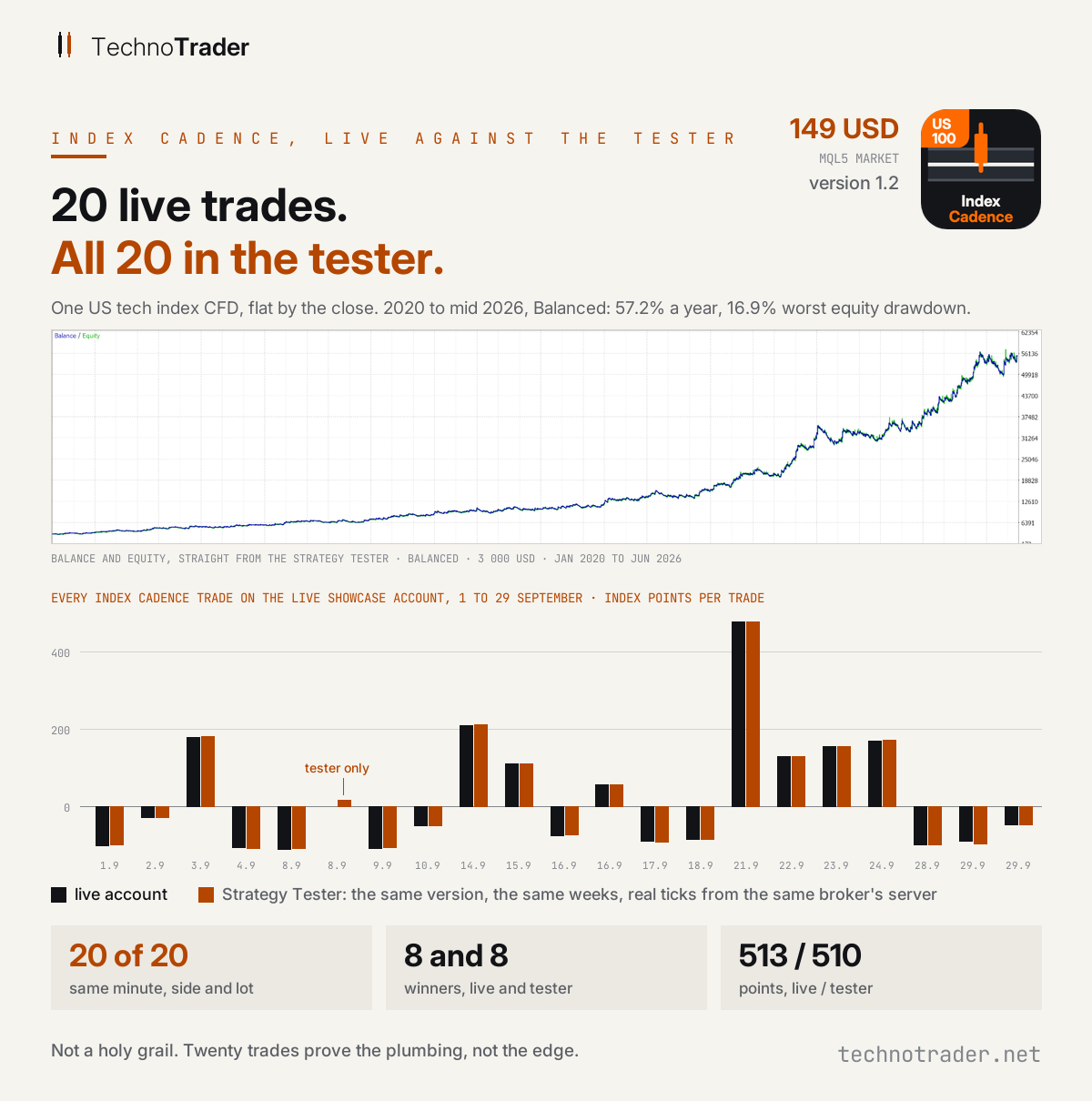
🔍 Does the tester show what a live account gets? We checked on our own. The public EA Showcase account runs Index Cadence at factory defaults. From 1 to 29 September it took 20 trades. We ran the same version, 1.2, over the same weeks in the Strategy Tester, on real ticks from the same broker's server, and put the two trade lists side by side.
All 20 live trades are in the tester: the same minute, the same direction, the same lot. 8 won in both, 12 lost in both. 18 of the 20 entries were within two index points of the tester's price, with no lean either way. Over the 20 trades the live account made 513 points and the tester 510.
The tester took one trade more, a small winner on 8 September that the live account did not take. The account also runs two other robots, and Index Cadence's daily and weekly loss breakers read the whole account, so a tester running Index Cadence alone is not quite the same account. We have not settled that one trade, and we would rather say so than leave it out.
Twenty trades prove the plumbing, not the edge. They show that the backtest and the live account are the same robot making the same decisions. Whether the edge holds is a question for many more months.
⚠️ Not a holy grail. The 16.9% is one path, not an expectation: out of sample the same mechanism drew down about twice as deep, so plan Balanced for 25 to 35 percent. Strategy Tester results, not a promise.
📈 The account, every trade in its history: https://www.mql5.com/en/signals/2387565
Three robots share it, so its curve belongs to the three together.
💰 Index Cadence, 149 USD: https://www.mql5.com/en/market/product/190845
: