Aller Uja
Aller Uja
3.5 (2)
  • Information
2 Jahre
Erfahrung
12
Produkte
3
Demoversionen
0
Jobs
5
Signale
23
Abonnenten
Algorithmic Trader | TechnoTrader in Nice Trader
X
📊 Systematischer & algorithmischer Trader | Live-Signale | MT5 Expert Advisors & Tools | Seit 2011

Ein Multi-Strategie-EA-Portfolio mit diszipliniertem Risikomanagement.
Handel seit 2011 · Algorithmisch seit 2018 · Live-Signale auf MQL5 seit 2024

⚙️ Handelsansatz
- Vollautomatische Strategien (Expert Advisors)
- Multi-Strategie-Portfolio
- Kapitalschutz vor Wachstum
- Kein Martingale / kein Grid / kein Nachkaufen in Verluste

📈 Meine Signale
Aufgelistet im Reiter Signale oben. Jedes arbeitet mit Stop-Loss und festem Risiko pro Trade, und hinter jedem steht eine echte Strategie, die ich selbst einsetze und überwache.

🧰 Meine Expert Advisors
Regelbasierte Systeme, die Sie auf dem eigenen Konto laufen lassen statt zu kopieren — im Reiter Markt oben. Ein harter Stop auf jeder Position, gemessene statt versprochene Zahlen, und eine kostenlose Demo für Ihren eigenen Strategietester.

🛠️ Meine Tools
MetaTrader-5-Werkzeuge, die ein Konto schützen statt es zu handeln: Stop-Loss-Durchsetzung, Prop-Firm-Regeln, Drawdown-Grenzen, Trade-Audit, lokales Kopieren. Die meisten sind kostenlos.

⚡ Infrastruktur
Professionelles VPS für stabile Ausführung und geringe Latenz.

🔎 Transparenz
Hier gibt es keine Demokonten und keine Backtests, die als Live-Handel ausgegeben werden.
Die vollständige Historie, samt der Verlustmonate: https://technotrader.net

⚠️ Risikohinweis
Handel ist mit Risiko verbunden, und Drawdowns gehören normal dazu.
Handeln Sie nie mit Geld, dessen Verlust Sie sich nicht leisten können.

_______________________________

🔗 Dienste, die ich selbst nutze und empfehle:

🌐 Broker (ICTrading)
https://www.ictrading.com/?camp=83911

📒 Handelsjournal & Analyse (FXer)
https://fxer.net
💱 Code: TECHNOTRADER50 (50% Rabatt für 6 Monate)

🏛️ Prop-Firma (The5ers)
https://www.the5ers.com/?afmc=92n

🧪 Strategie-Inkubator (Darwinex Zero)
https://www.darwinexzero.com/?fpr=y68tgd
💱 Code: TECHNOTRADER_20 (20% Rabatt)

Einige der obigen Links sind Affiliate-Links.

_______________________________

📧 Kontakt
💬 Telegram https://t.me/TechnoTrader28
▶️ YouTube https://www.youtube.com/@TechnoTraderStream

TechnoTrader | Automatisierte Handelssysteme
Folgen Sie den Signalen, betreiben Sie einen EA auf Ihrem Konto, testen Sie die kostenlosen Tools oder fragen Sie auf Telegram.
Aller Uja - Nice Trader
Aller Uja
A practical note on copy sizing, because it is the single decision that decides whether copying works for you.

When you copy a signal, you choose a risk multiplier: how large your positions are relative to the master's. Most people set it against the return they hope to earn. That is the wrong anchor. Set it against the drawdown you have to survive to get there.

The logic is simple. Every strategy has losing stretches, and this one's are public and in the history. If a multiplier turns a normal historical drawdown into a number that would make you close everything at the worst possible moment, the multiplier is too high, no matter how good the upside looks. The plan only works if you are still copying when the recovery happens.

So run the arithmetic backwards. Look at the deepest drawdown in the record, apply your intended multiplier to it, and ask honestly whether you would hold through that on your own account. If the answer is no, size down until the answer is yes.

A smaller position you can actually hold beats a larger one you will abandon in the third losing week. The right size is the one that lets you stay.

https://www.mql5.com/en/signals/2307342
Aller Uja - Nice Trader
Aller Uja
A question that arrives in different forms: why is the master account not larger? If the system works, why not run serious size on it?

An honest answer in three parts.

First, what the master is for. Its job is to produce a verifiable record under real conditions: real spreads, real slippage, real execution, every trade tracked by the platform. For that job, time matters and size does not. A percentage return is the same arithmetic at any scale, and copying translates proportions, not euros.

Second, capacity. The strategies trade liquid instruments at sizes far below anything that would move them. The practical constraint on your side is your own broker's execution, not the master's balance.

Third, the private part. How much of my capital sits where, across which accounts and brokers, is a financing decision, not a signal parameter. I have skin in the game, and the master is not the whole of it.

What is actually worth checking is not the master's balance. It is whether the record is long, live, and tracked by someone other than me. That part you can verify without trusting anyone.

https://www.mql5.com/en/signals/2307342
Aller Uja - Nice Trader
Aller Uja
In mid-June I posted a note here promising two follow-ups: one when the seasonal risk reduction begins, and one when normal risk resumes. This is the first of those. The window is open.

From now into early August the signal runs deliberately lighter. Fewer trades, smaller positions, and stretches where the account does nothing at all. The live broadcast follows the account, so it will also be on the air less than usual. None of this is drift or hesitation. It is the same calendar decision described in June, running on schedule.

The reasoning has not changed. In these weeks a large share of market participants are away, liquidity thins and spreads widen for reasons that have nothing to do with any system's edge. Full size into a thinner market means more risk for the same opportunity, so we carry less.

The rules stay identical. Only the size changes. Normal risk resumes in early August, and there will be a note here when it does.

https://www.mql5.com/en/signals/2307342
Aller Uja - Nice Trader
Aller Uja 2026.07.22
Fair question. There is no official holiday and nothing coordinated. Late July and August are simply peak vacation season across Europe and the US, so banks, funds and prop desks run with thinner staffing and smaller books, and retail activity drops as well. Nobody stops entirely. There is just less resting liquidity in the order books, and the dip is visible in any major exchange's monthly volume statistics for August. A thinner book means wider spreads and more erratic moves on the same news, so the same position simply carries more risk than it would in, say, October. That is the whole logic of the note above: the rules stay identical, the size comes down while conditions are thin, and normal risk resumes in early August.
Antonius Loubser
Antonius Loubser 2026.07.22
Eish.. I always see when doing back tests that this time like to go negative.
Aller Uja - Nice Trader
Aller Uja 2026.07.23
That matches what most systematic traders find. The thin-liquidity weeks are historically noisier for a lot of strategies, which is exactly why we scale down rather than trust them. Appreciate you testing it yourself rather than taking anyone's word for it.

Aller Uja - Nice Trader
Aller Uja
Primer 03 is out today, and it is the one most relevant to what you are actually subscribed to here.

The thesis: the entry is the least important part of a trading system. That is not a contrarian opinion, it is where three independent sources land from three directions. Van Tharp puts system and entry together at roughly 10% of the result. Andreas Clenow calls precise buy and sell rules largely irrelevant. Curtis Faith, one of the original Turtles, says the entry is not the most important part.

Why it matters on this page: when you subscribe, you are not buying my entries. You are buying the layers underneath them. How much risk goes into a single position. When a winner is closed and how fast a loser is. Whether the instruments move independently of each other. Whether every signal gets taken, including the uncomfortable ones after a losing run.

Those layers are also what you should judge any signal by, mine included. Not the entry logic, which nobody publishes anyway, but the sizing, the exits and the worst stretch in the history.

Free, no signup required, with the sources and two figures:
https://technotrader.net/insights/the-entry-is-not-the-edge/

https://www.mql5.com/en/signals/2307342
Aller Uja - Nice Trader
Aller Uja
An operational note worth reading before you need it: unsubscribing does not close your open trades.

If you end a subscription while positions copied from this signal are still running, MetaTrader will ask what you want to do with them. Whichever you choose, understand what changes at that moment: copying stops. No further exit will ever reach those positions from here. Whatever stays open becomes yours to manage, with your own stop and your own decision about when it ends.

This catches people out. They leave during a drawdown, keep the open trades because closing them would realise the loss, and then hold a position that no longer has a system behind it. That is the worst of both: the risk of a systematic trade with none of the process that was supposed to close it.

If you leave, leave cleanly. And if you are thinking about leaving mid-position, that is usually worth a second look at why.

https://www.mql5.com/en/signals/2307342
Aller Uja - Nice Trader
Aller Uja
A structural note, because it comes up: there is no group, no private channel, and no VIP tier here.

You will not be added to a chat. I will not message you first. There is no upgraded version of this signal behind another payment, and there is no room where the "real" calls are shared. What you see on this page is the entire product. The same trades reach every subscriber at the same moment, through the platform, because that is the only distribution that can be verified.

I am explicit about it for one reason. Almost every impersonation scam in this industry starts with a direct message offering exactly those things: a group, a better tier, personal management. If you get one using my name, it is not me, and there is nothing to discuss.

One signal, one price, one place. Anything else claiming to be TechnoTrader is not.

https://www.mql5.com/en/signals/2307342
Aller Uja - Nice Trader
Aller Uja
If you have been watching the account and seen nothing happen for a stretch, that is worth explaining.

This system has no trade quota. It does not owe you activity. The rules describe a specific setup, and when that setup is not present in any of the markets it watches, it takes nothing. A quiet run of days is not the system hesitating or stuck. It is the filter doing the only job a filter has.

Right now that effect is a little stronger than usual, because the planned summer de-risk is running and position sizes are deliberately smaller through the thin weeks. So you get fewer trades and smaller ones at the same time, which can make a normal quiet stretch feel unusually quiet.

The trades that were not taken are as much a part of the record as the ones that were. An empty day costs you nothing. A forced one is how the costs start.

https://www.mql5.com/en/signals/2307342
Aller Uja - Nice Trader
Aller Uja
A question I get often: is now a good time to subscribe. The honest answer is that the question does not apply here.

For a strategy measured in years, there is no good or bad entry point. Start today, start next month, and over the horizon this is built for, the difference disappears into the noise. The instinct to time it, to wait for a dip, to worry you missed the run or that a drawdown is due, is exactly the discretionary thinking the system exists to remove. If timing the entry mattered, you would be back to guessing, which is the thing you subscribed to avoid.

So the real question is not when the curve looks right. It is whether you are ready to set a sensible copy-ratio and leave it alone for a year, through the good stretches and the ugly ones. If yes, now is as good as any date will ever be. If no, no date will be good enough.

https://www.mql5.com/en/signals/2307342
Aller Uja - Nice Trader
Aller Uja
A note on why there are two accounts here running the same system.

Next to the main signal sits a second live account. Same strategies, same rules, same markets, on a completely different broker. It is not a copy of the trades. It runs the rules independently, on its own price feed, and places its own orders.

That independence is the point. One account can get lucky, or quietly benefit from one broker's execution. Two accounts, on two brokers, producing the same behaviour from the same rules, is much harder to fake than a single clean line. The two will never look identical, and they are not supposed to. Different ticks, different fills, same system.

If you want to check the system rather than trust it, that second account is there for exactly that. Same rules, different broker, both public.

https://www.mql5.com/en/users/aller.techno
Aller Uja - Nice Trader
Aller Uja
A note so a normal difference does not worry you. Your copied account will not match the master exactly, and that is fine.

You copy onto a different broker, with different spreads, different fill prices, and a few milliseconds of delay. So a trade can open at a slightly different price than mine, or occasionally not fire at all if the price moved before your terminal caught it. Over one trade that gap looks like an error. Over hundreds it averages out to a small, expected difference.

What you should watch is not whether your curve is identical to the page. It is whether it is close and tracking in the same direction over time. A copy that drifts a little is normal. A copy that drifts a lot usually means a terminal that was offline, a copy-ratio set differently, or a broker with much worse execution.

Set it up once, on a stable connection, and judge the copy over a sample, not trade by trade.

https://www.mql5.com/en/signals/2307342
Aller Uja - Nice Trader
Aller Uja
A field on this page you can safely ignore: the forecast.

Every signal page auto-generates a projected return, a tidy line extending into the future. It looks like analysis. It is arithmetic. The platform takes the recent slope and draws it forward, and it redraws the moment the numbers change. No market has ever moved in a straight line for a year, so no honest forecast can be one.

I did not put that number there and I would not stand behind it. The projection is the one part of the page that describes a future nobody has traded yet. Everything above it, the months already closed, the drawdowns already survived, is the part that actually happened.

Read the history, which is real and cannot be redrawn. Ignore the forecast, which is a straight line drawn through a market that has never travelled in one.

https://www.mql5.com/en/signals/2307342
Aller Uja - Nice Trader
Aller Uja
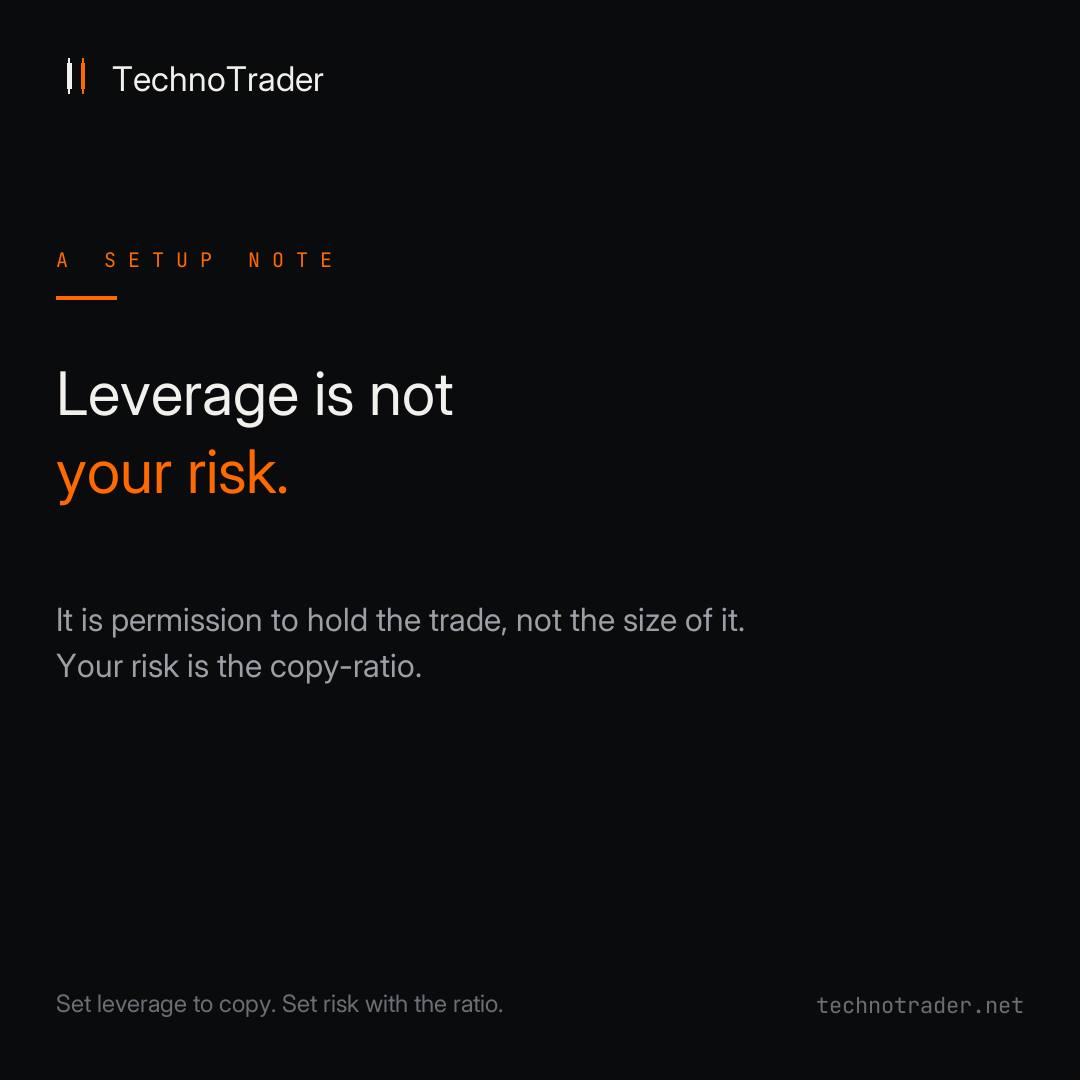
A setup note, because this one trips people up. High account leverage does not mean high risk on this signal.

Leverage sounds dangerous, and used carelessly it is. But on a copied signal it does two different jobs, and only one of them is yours. The master runs enough leverage to place its trades. Your account needs enough leverage to copy those trades faithfully. That is all leverage does here. It is the permission to hold the position, not the size of the bet.

The size of the bet, your actual risk, is set by your copy-ratio, not your leverage. Two accounts on the same signal, one at 1:100 and one at 1:500, take the same trades at the same risk if their copy-ratio is the same. The higher leverage just leaves more free margin.

So set your leverage high enough to copy cleanly, and control your risk where it is actually controlled: the copy-ratio, sized to a drawdown you can sit through.

https://www.mql5.com/en/signals/2307342
Aller Uja - Nice Trader
Aller Uja
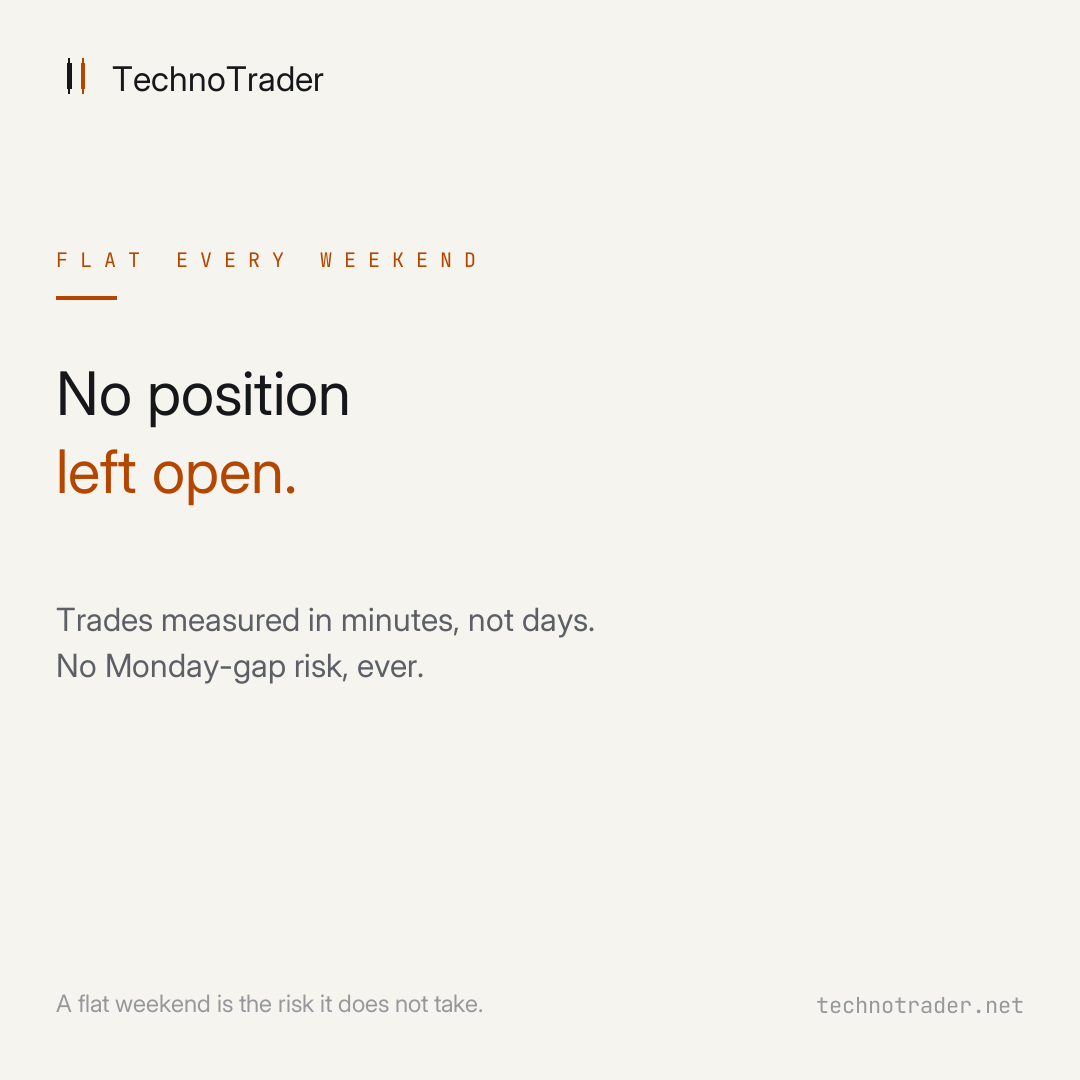
A note on why this account is flat every weekend, and why that matters.

This system trades in and out on short holds. Positions are measured in minutes, not days. By the time the market closes on Friday, there is nothing left open. The account sits in cash over the whole weekend.

That is not idleness. It is the absence of a specific risk. A strategy that carries positions over the weekend is exposed to the Monday open, where price can gap past where a stop would have been, with the market shut and nothing you can do. Systems that blow up on a Sunday-night headline were holding something they could not close.

This one holds nothing it cannot exit the same session. So the weekend gap, one of the quieter ways an account gets hurt, is a risk it simply does not take. A flat weekend is the system being where it should be.

https://www.mql5.com/en/signals/2307342
Aller Uja - Nice Trader
Aller Uja
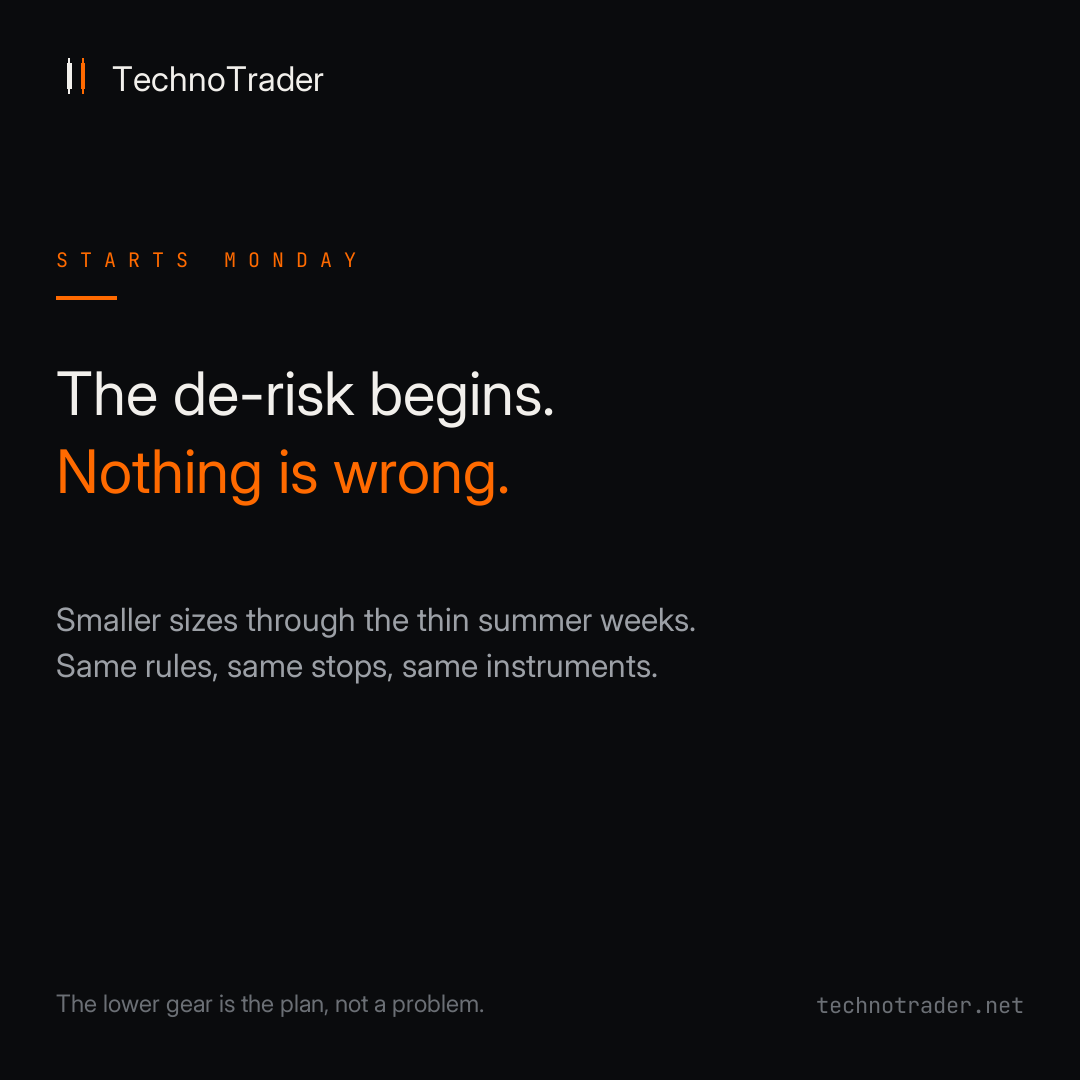
A short, timely note. The planned summer de-risk on this signal begins Monday.

I flagged this a week ago, and here it is on schedule. From next week, through the thin late-July and early-August liquidity, position sizes come down and the trading gets quieter. The rules do not change. The stops do not change. The instruments do not change. Only the size, and only for this window.

What you should do about it is nothing. Do not raise your copy-ratio to make a quiet stretch feel busier, and do not read a slower week as the system failing. The lower gear is the plan, not a problem. Normal sizing returns with the liquidity in early August.

A change explained after the fact sounds like an excuse. Announced before you see it, and again as it begins, it is a commitment you can hold me to.

https://www.mql5.com/en/signals/2307342
Aller Uja - Nice Trader
Aller Uja
A practical question I get, and the honest answer. How much do you need to copy this signal.

The page shows a minimum. That is not the real number. Copy-trading scales to whatever account you connect, so the minimum only tells you what the platform allows, not what is wise.

The real number is the one where a drawdown of about a third of the account is money you can watch fall without flinching. This signal will spend time underwater. If the amount you copy with is money you need soon, or money whose fall you feel in your chest, you will do the one thing that turns a drawdown into a loss. You will quit at the bottom.

So the honest sizing rule is not the minimum on the page. It is this. Copy with an amount you can leave alone for a year, including through its worst stretch. Under-fund it and the first ordinary drawdown feels existential. Size it right and the same drawdown is just a Tuesday.

https://www.mql5.com/en/signals/2307342
Aller Uja - Nice Trader
Aller Uja
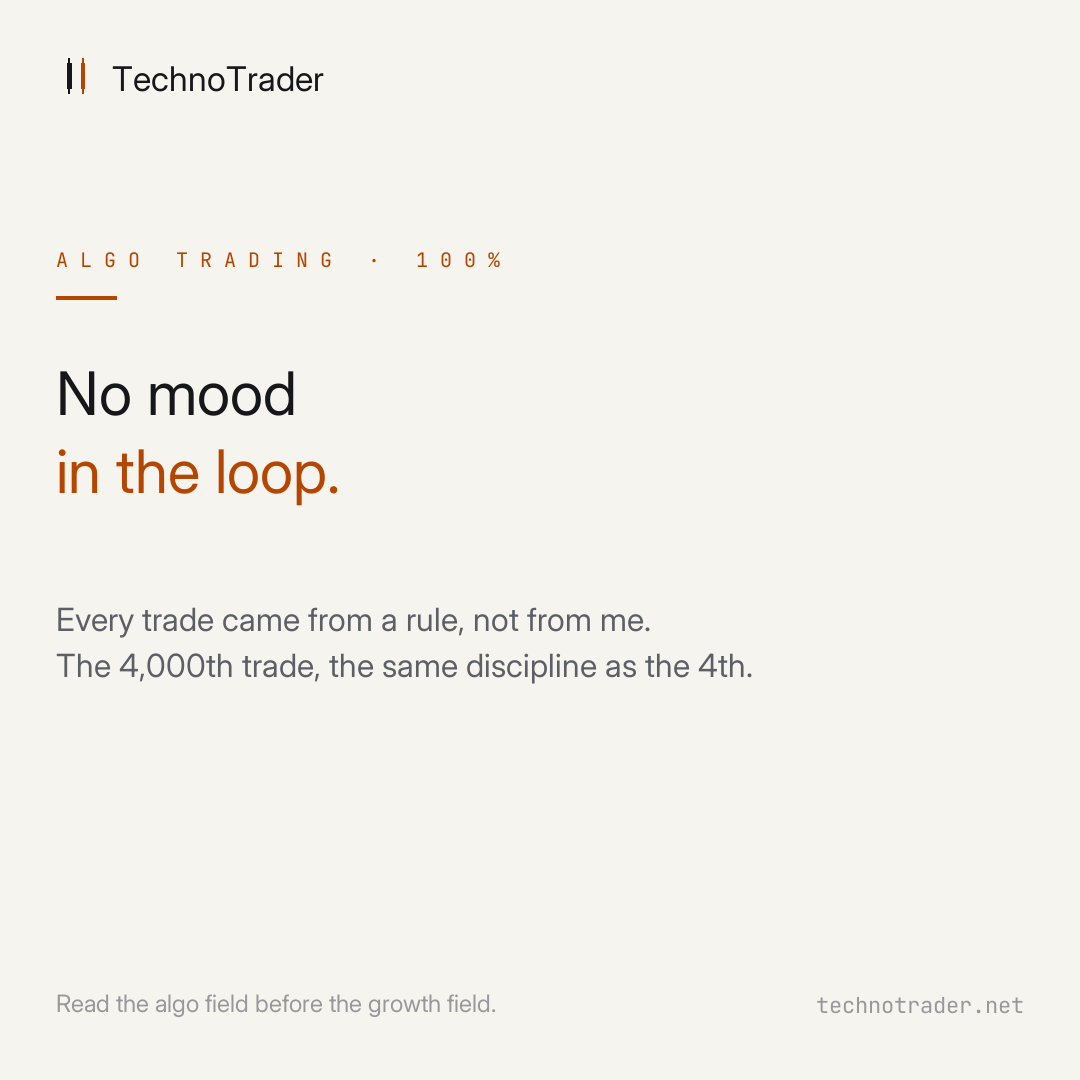
One field on the signal page reads: Algo trading, 100%. It is the most important number on the page, and the one nobody asks about.

It means every trade you would copy came from a defined rule, not from me. Not my mood that morning, not my read of the news, not a hunch about where gold goes next. One hundred percent automated means there is no point in the loop where a human decides to be brave or careful. The rule that placed the four thousandth trade is the same rule that placed the fourth, applied with the same discipline whether the last trade won or lost.

That is the whole reason a small edge can survive being repeated thousands of times. A discretionary trader pays an emotional cost on every decision. A rule pays it once, when it is written and tested, and never again. When you copy this signal you are not copying my judgment on the day. You are copying a process that does not have a mood.

Read the algo-trading field before the growth field. It tells you who is actually trading.

https://www.mql5.com/en/signals/2307342
Aller Uja - Nice Trader
Aller Uja
The loneliest number on this page is the subscriber counter. It reads 1. Here is what that number measures, and what it does not.

It measures who is paying this month. It does not measure whether the system works. Before this year's worst month it read higher. April took the account down about 16 percent from its high, and roughly seven in ten subscribers left within weeks. The system did not change that month. The same rules that built the record before April produced the recovery after it. What changed was conviction, and most conviction has a shorter horizon than an edge does.

I would rather show you a 1 with the whole record attached than a bigger number in front of a curated one. The record is the product. The counter is just this month's audience.

https://www.mql5.com/en/signals/2307342
Aller Uja - Nice Trader
Aller Uja
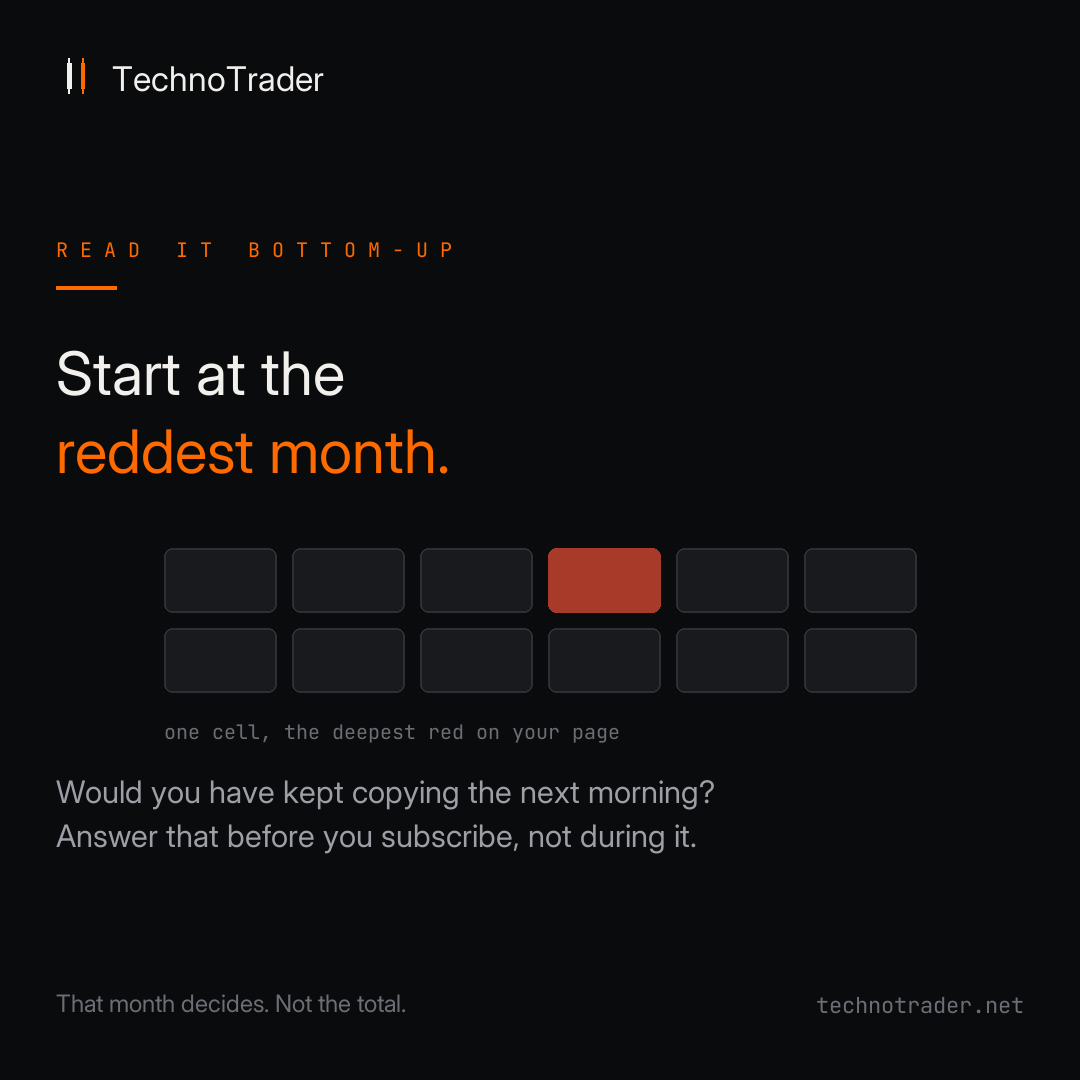
A short instruction for reading this page, or any signal page. Do not start with the growth number. Start at the bottom of the monthly table, with the reddest month you can find.

Most people read a track record top down. They see the total, scan the green months, and picture those repeating. That is the number you hope for. The useful exercise is the opposite. Find the worst month on the grid and sit with it. On this signal it is there in plain colour, and the full drawdown from a high is about a third of the account.

Look at that month and ask one honest question. If it had been your money, that month, would you have kept copying the next morning. If the answer is yes, you are reading the record correctly, and you can subscribe knowing what you signed up for. If the red month makes you flinch now, while it is only a number on a screen, it will make you quit when it is your own account, usually at the worst possible moment. Better to find that out today than inside the drawdown.

Read the record from its worst month up. That month, not the total, is the one that decides whether this is for you.

https://www.mql5.com/en/signals/2307342
Aller Uja - Nice Trader
Aller Uja
Starting next week, this signal begins its planned summer de-risk. I want you to know exactly what that means before you see it on the account.

What changes: position sizes come down through the thin weeks of late July and early August. Trading may look quieter. Some days the account will simply do less.

What does not change: the rules, the stops, the instruments. The system keeps running as before. It simply risks less per trade while summer liquidity is thin. Markets get sparse in these weeks, moves start and die without follow-through, and a smaller bet in a sloppier market is the same discipline applied to different conditions.

What you should do: nothing. In particular, do not raise your copy-ratio to make a quiet stretch feel busier. The lower gear is the plan, not a problem to fix.

I am saying this now, before it shows on the curve, on purpose. A change explained after the fact always sounds like an excuse, whatever the truth. A change announced in advance is a commitment you can hold me to.

Normal sizing returns with the liquidity, from early August onward. The record, as always: https://www.mql5.com/en/signals/2307342
Aller Uja - Nice Trader
Aller Uja
The average trade on this signal lasts 56 minutes. Of everything on the page, that small field tells you most clearly what kind of animal you would be copying.

The growth number cannot do that. Two signals can show a similar curve while one sits in positions for weeks, living on a handful of big calls, and the other is in and out inside the hour. This one is the second kind. Around 39 trades a week, over 4,000 trades since the record began, each one open for under an hour on average.

The field also tells you where the risk lives. A position held for weeks has to survive everything those weeks throw at it, and the temptation is always to nurse it through the rough stretch. At 56 minutes there is nothing to nurse. Each trade is a small, independent decision, and every one carries a stop loss that does its work while the position is still young. Nothing on this account is held and hoped for.

There is an honest cost to this style, and you should know it before you copy. When the average trade lives under an hour, the spread you pay going in and the quality of your fills take a bigger bite of the result than they would on a position held for a month. Short holds make small costs matter. I would rather write that here than have you find it in your statement.

The field is worth reading on any signal page, not only mine. A very long average hold next to a curve that never seems to dip can mean losers are being kept open until they come back, which is the oldest way a win rate gets flattered. A 56 minute average cannot sit on a loser. Whatever a trade costs the account shows up on the record almost as soon as it happens.

This is the fourth field from the page I have unpacked here, after recovery factor, profit factor and win rate. None of them is the growth number, and that is the point. The full record is here: https://www.mql5.com/en/signals/2307342