The Arbiter
- 专家
-
Noel Anjao Alube
 Dedicated to developing smart, data-driven trading solutions with a strong focus on performance, risk management, and innovation. Committed to transforming trading ideas into automated strategies.
 - 版本: 1.0
- 激活: 5
THE ARBITER — It Doesn't Vote Until the Evidence Is Unanimous
Most signal tools are built to talk. They fire on a crossed moving average, a touched Fibonacci line, or a single oscillator blip, because more signals feels like more value. The Arbiter was built on the opposite premise: silence is the default state, and a signal is something that has to be earned across seven independent lines of evidence before it is allowed to appear.
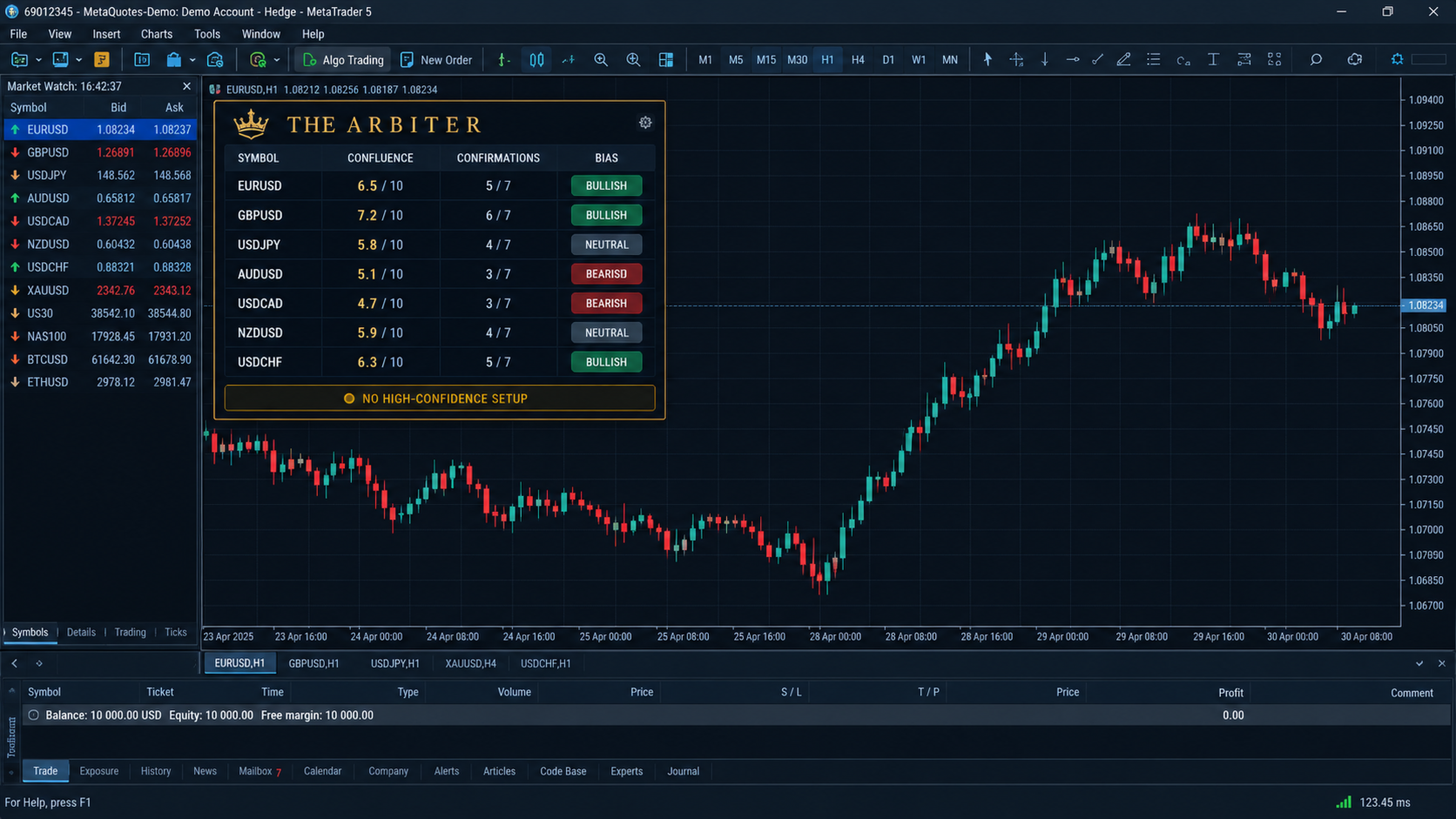
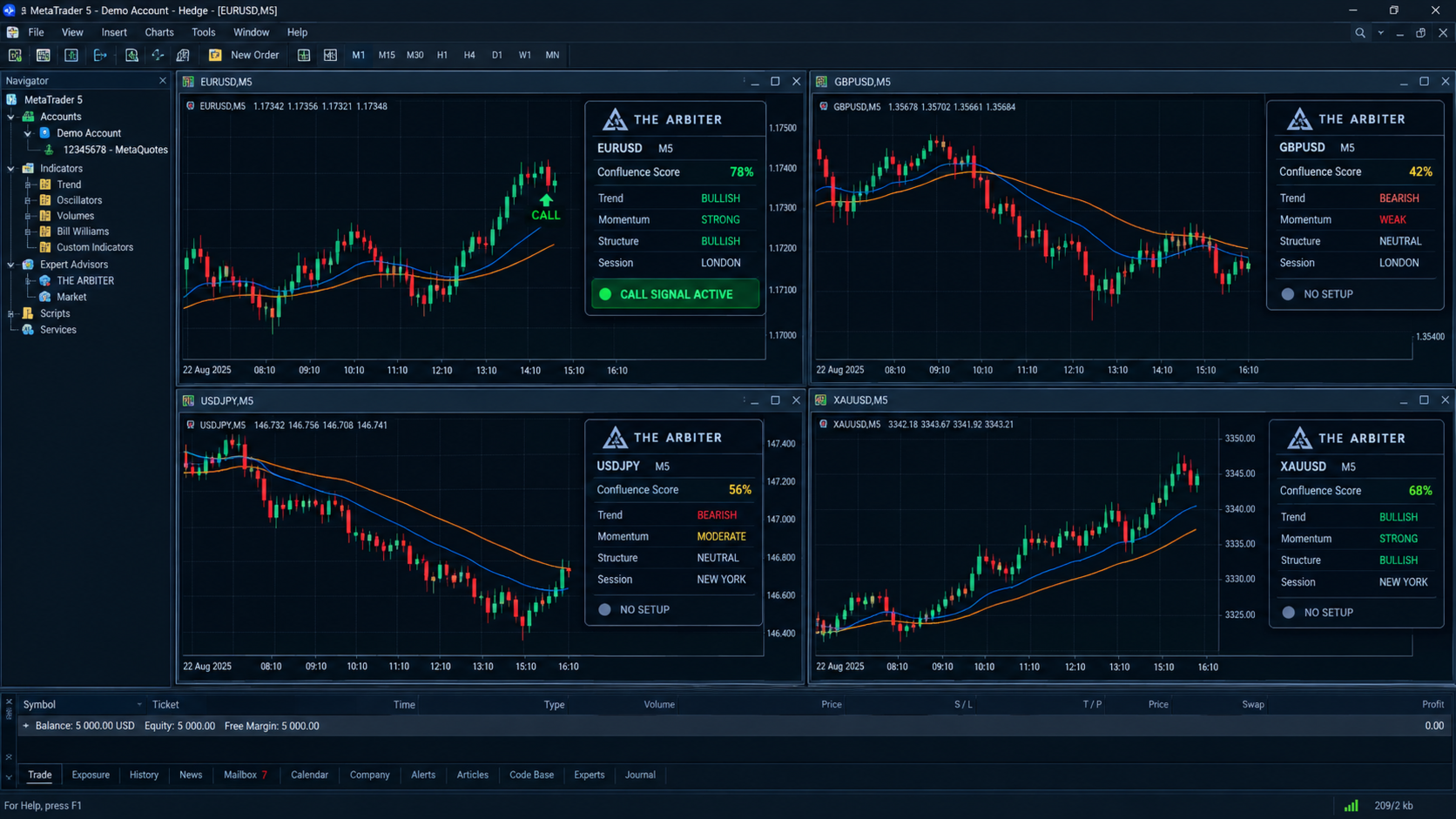
The Arbiter is a multi-symbol confluence engine for MetaTrader 5. Rather than asking you to pick a pair and watch it manually, it continuously scans an entire basket of instruments in parallel, evaluates each one against the same strict rulebook, and — only when a genuine high-confidence setup exists — identifies the single strongest candidate and its direction. If nothing in the basket meets the bar, The Arbiter says nothing. There is no consolation signal, no lower-confidence fallback, no filler trade to keep the log full. It is deliberately built for traders who have been burned by tools that mistake activity for accuracy.
How the judgment is formed
Every symbol in the basket is scored across seven confirmation layers on every scan cycle:
Trend alignment establishes directional context using a fast/slow EMA relationship, filtered for meaningful separation rather than a marginal, noise-level cross. Momentum confirmation checks that RSI is positioned in agreement with that trend without already sitting in exhaustion territory. Market structure analysis looks for an actual break of recent swing structure in the direction of the move, rather than assuming trend continuation. A support/resistance proximity check then verifies the instrument has genuine room to move before the next major level, screening out setups that look strong on an indicator but are about to run into a wall. Candle formation analysis looks for engulfing patterns or strong-bodied momentum candles that agree with everything else already found. A volatility filter cross-references current ATR against its recent average, rejecting both dead, chopped-out conditions and abnormal volatility spikes that make any signal unreliable. Finally, an oscillator layer using MACD alignment provides a seventh, independent check against the same directional hypothesis.
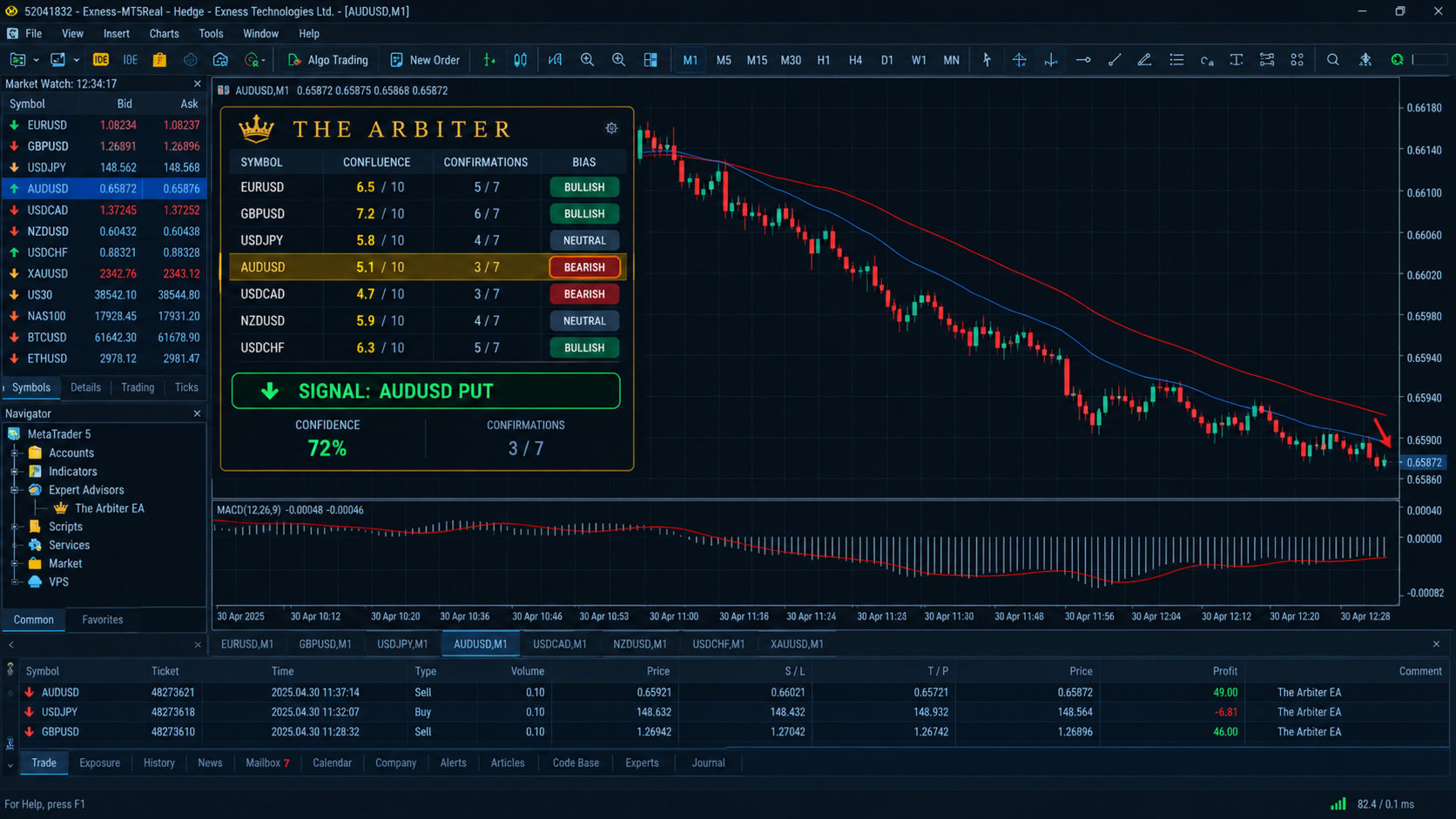
Each layer carries its own configurable weight. A composite score is produced only when a majority of layers agree — by default, a symbol needs at least six of the seven confirmations pointing the same direction, and a total confluence score of 85 out of 100, before it is even considered a candidate. Every basket symbol is then ranked, and The Arbiter surfaces only the single best-ranked setup. Everything else, no matter how close, is discarded for that cycle. There is never more than one active signal at a time, which forces genuine prioritization instead of competing alerts.
Built for real trading, not just a pretty chart tool
The dashboard is designed to be read at a glance during fast-moving conditions, not squinted at. It presents every scanned symbol with its live confluence score, confirmation count, and current directional bias, and a dedicated status bar that states plainly whether a qualifying setup currently exists, and if not, how far the market currently is from meeting the threshold. This transparency matters: you are not just told "no signal," you can see why.
When a qualifying setup does appear, The Arbiter delivers it through popup alert, push notification, and sound simultaneously, so it reaches you whether you are at the terminal or away from it. A configurable cooldown period prevents rapid re-firing on the same instrument, and optional auto-execution is available for traders who want The Arbiter to manage entries directly on its host chart, complete with broker-aware stop level handling so orders are never rejected for violating minimum distance requirements.
Configuration that respects experienced traders
Every threshold in The Arbiter's rulebook is exposed as an input: the symbol basket itself, the timeframe, the weight assigned to each of the seven confirmation layers, the minimum score and minimum confirmation count required to qualify, cooldown duration, and every indicator period involved. Conservative traders can tighten the thresholds further for a lower-frequency, higher-conviction tool. More active traders can loosen them slightly while still requiring true multi-factor agreement, rather than the effectively unfiltered output of a single-indicator EA.
What The Arbiter is not
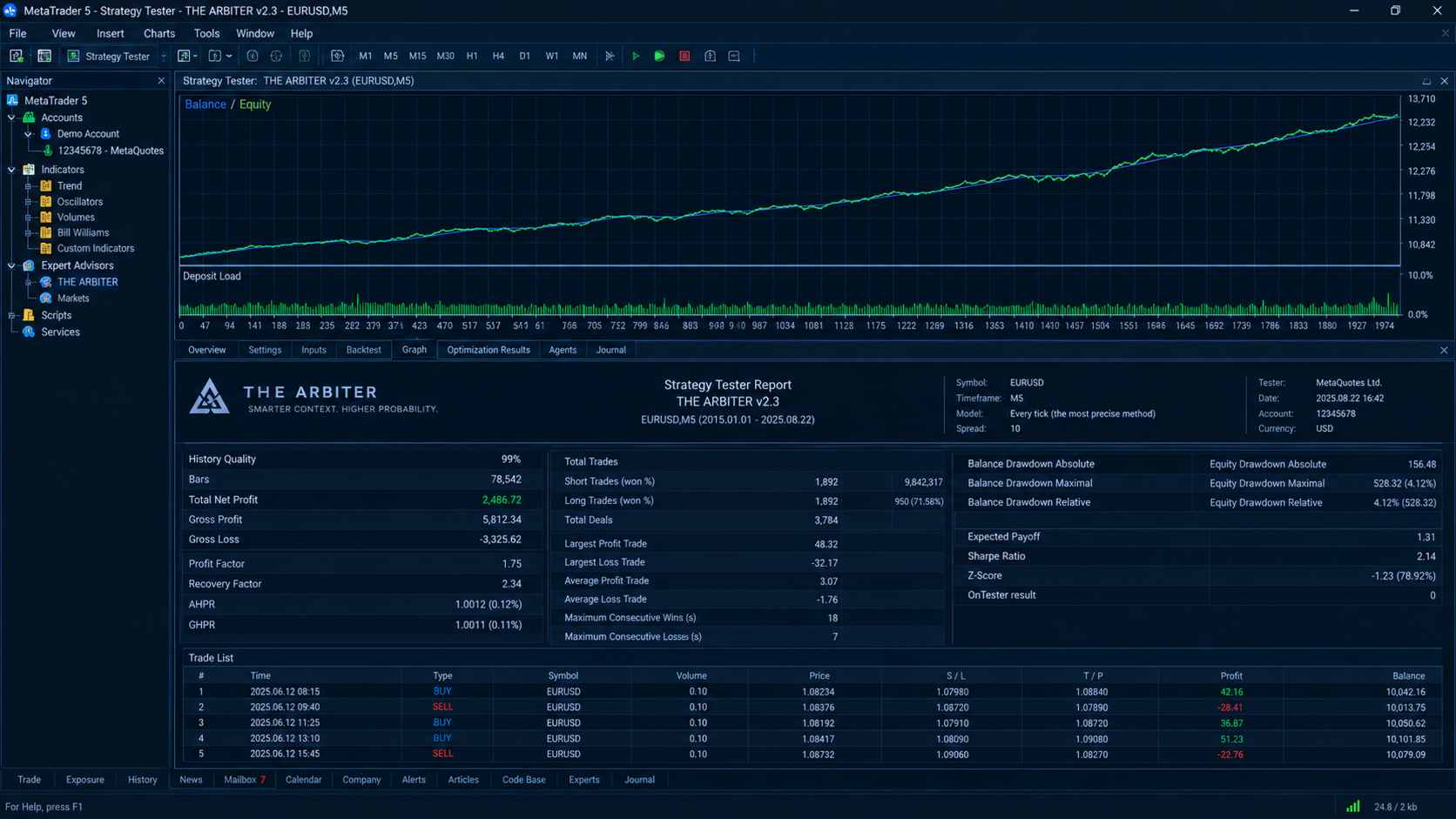
It does not promise a fixed win rate, and it will not manufacture signals to appear active during quiet markets. If the basket offers nothing worth acting on, the honest and correct output is nothing at all. That restraint is the entire value proposition: when The Arbiter does speak, it is because the case in front of it was, by its own strict standard, unanimous.