Cr7
- 专家
- 版本: 5.1
- 激活: 5

CR7 GOAL MACHINE
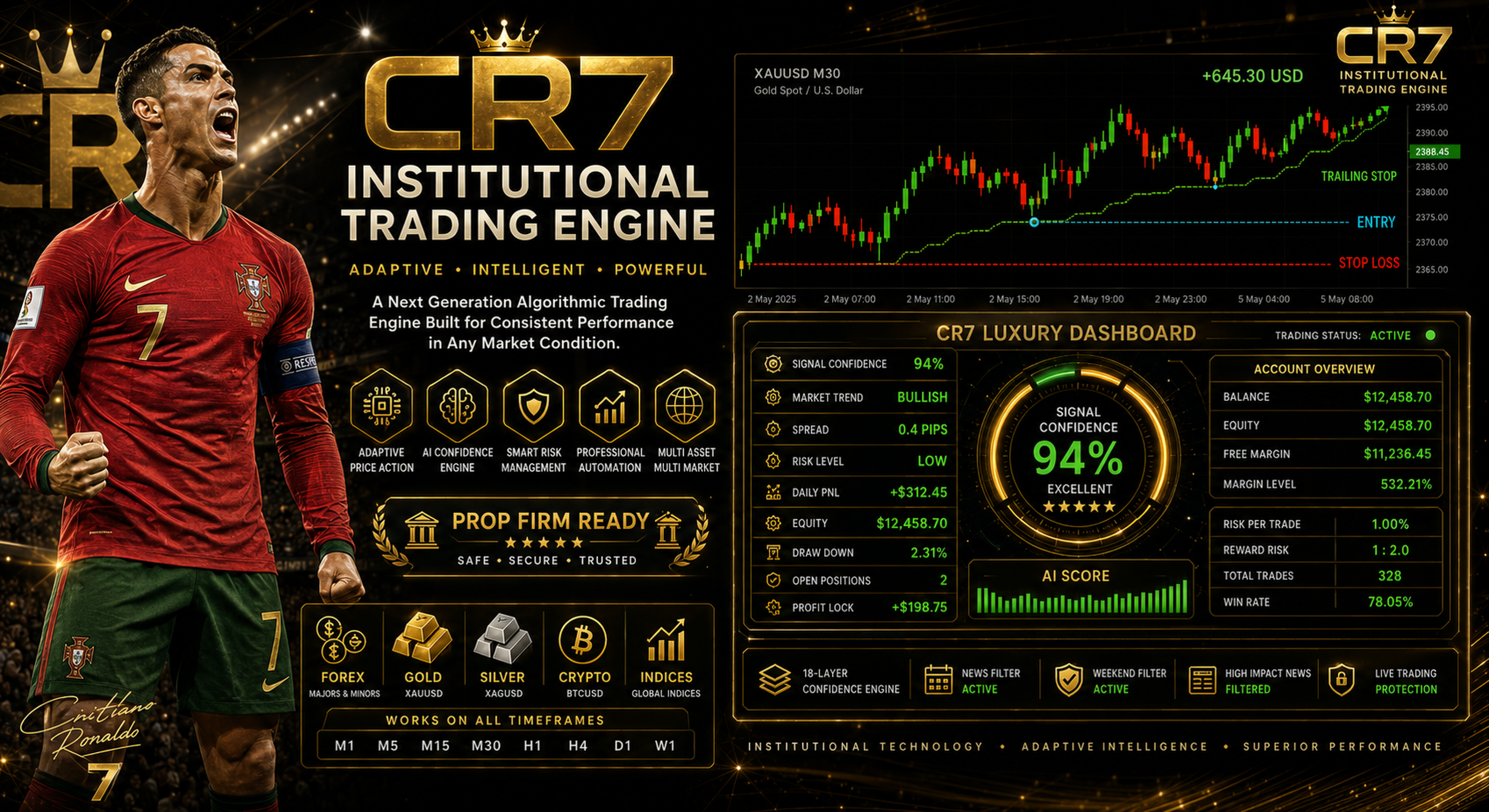
CR7 is an automated Expert Advisor for MetaTrader 5 that trades price action and manages every position with cost-aware risk control. It opens one position per signal, places a hard stop loss from the moment the order is filled, and never uses martingale, averaging or position stacking.
How a trade is evaluatedEvery candidate trade passes through three independent stages before an order is sent, and all three are measured and recorded whether or not they are configured to reject a trade.
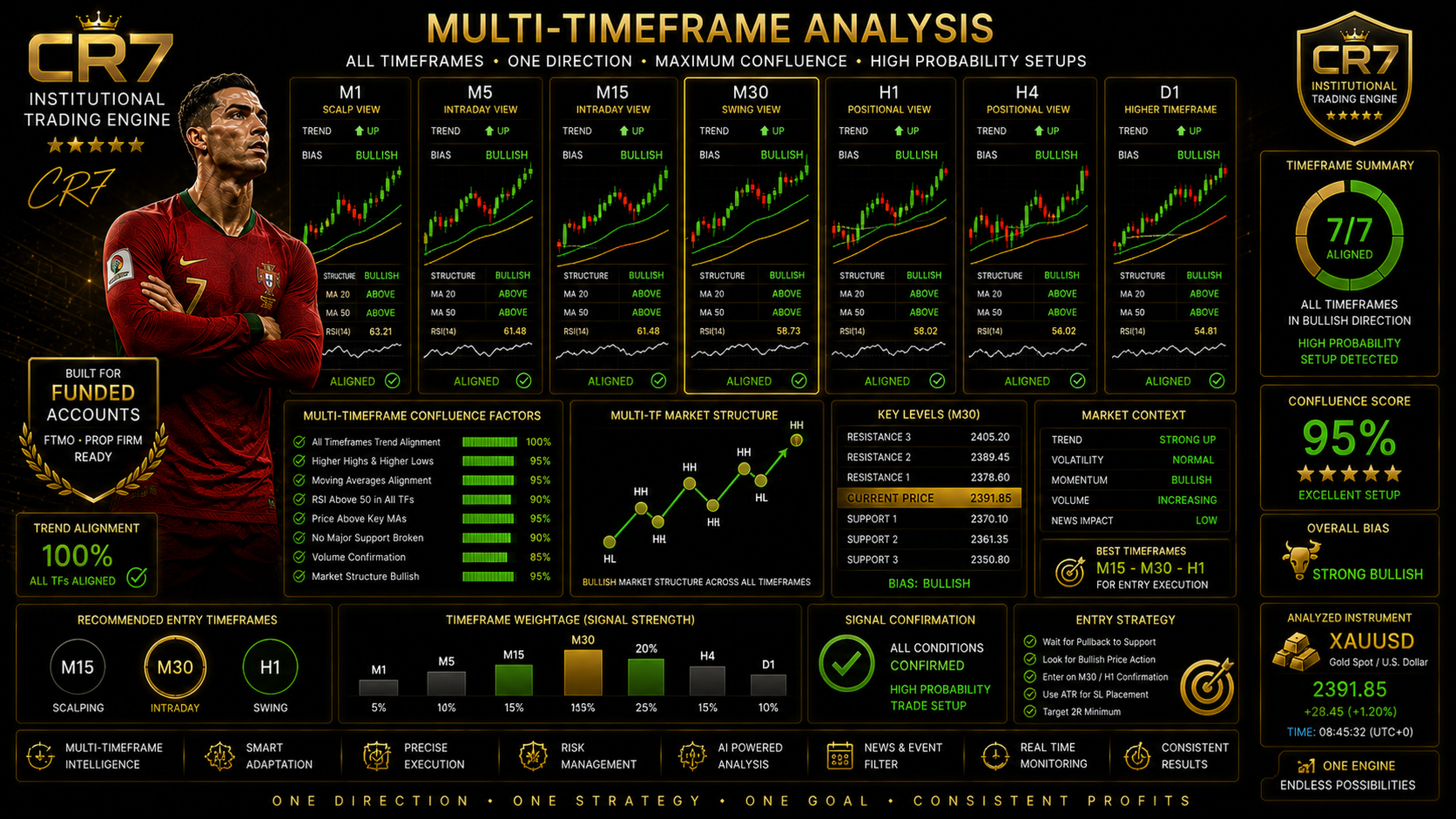
The first stage reads the market around the setup and produces a signed score from minus one hundred to plus one hundred. Fourteen separate readings contribute to it, covering support and resistance proximity, position within the recent channel, breakout structure, parabolic direction, unfilled imbalance zones, candlestick behaviour, relative currency strength, the volatility percentile of the current move, agreement across five timeframes, momentum divergence against price, a weighted regression forecast, volume absorption, exhaustion counts and directional movement strength. Because trend-following and mean-reverting evidence naturally contradict each other, the engine first establishes whether the market is trending or mean-reverting, using an efficiency ratio, smoothed directional movement, multi-timeframe agreement and a variance ratio test, and then weights the matching family of readings rather than averaging them into noise. The resulting verdict decides which side is actually traded, and can be configured to skip a setup, or to trade the opposite side when the surrounding evidence strongly opposes it.
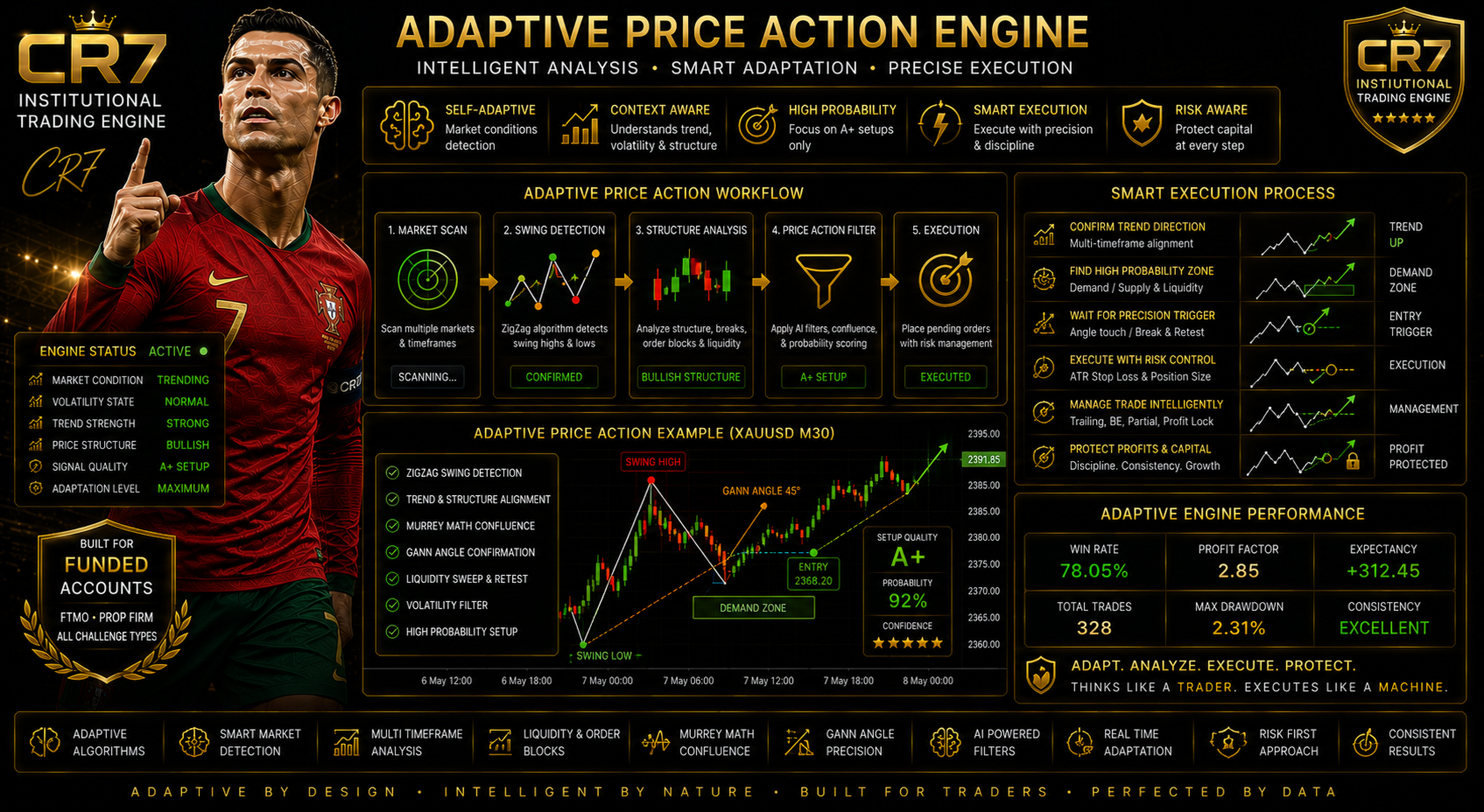
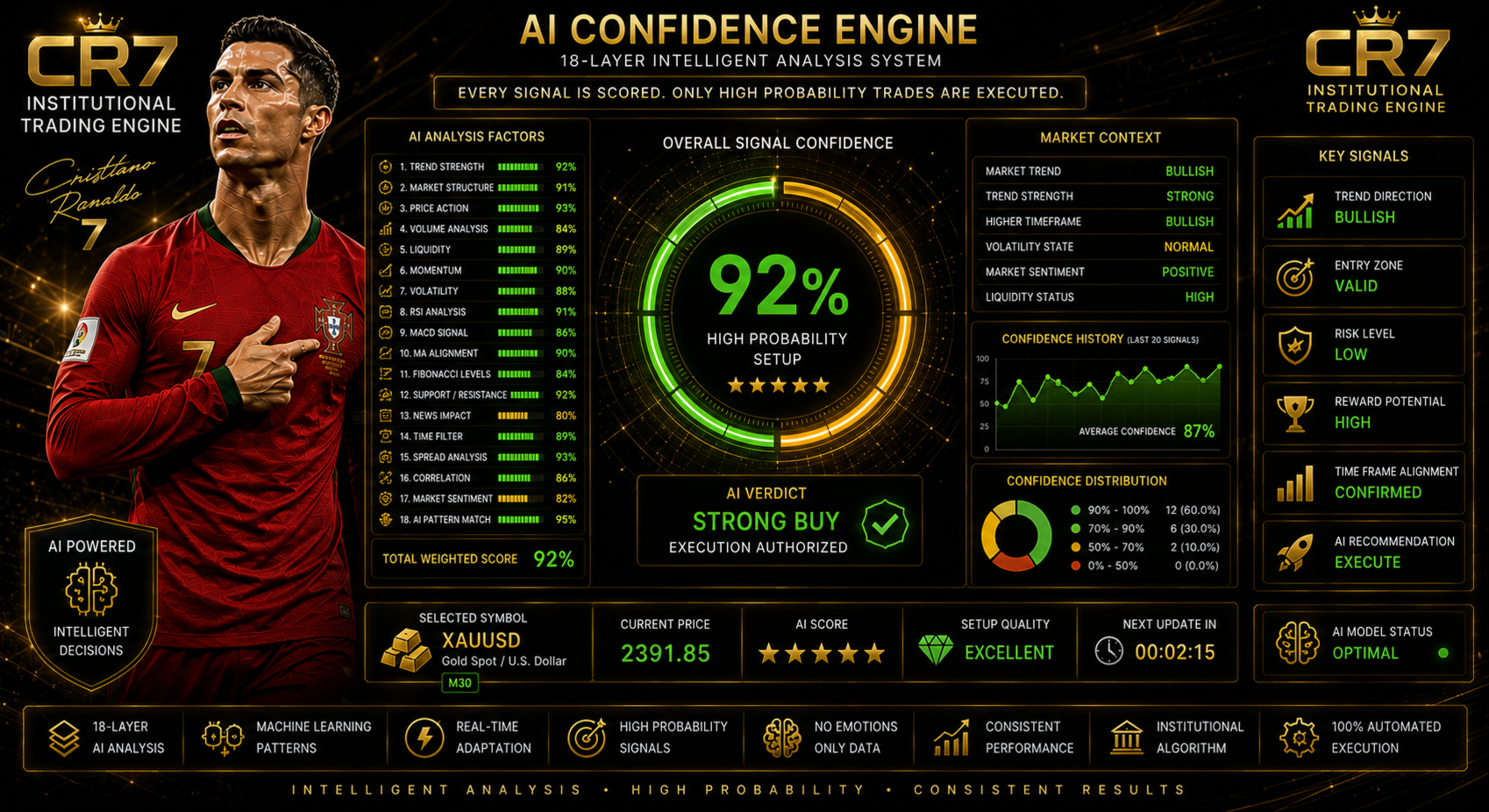
The second stage scores signal quality from zero to one hundred across eighteen weighted layers, including trend alignment, higher timeframe confirmation, market structure, momentum quality, volatility regime, shock and exhaustion limits, range position, key level proximity, volume confirmation and spread economics. Everything is computed directly from price. No indicator handles are used and nothing repaints.
The third stage measures what stands directly in front of the entry across nine readings: swing structure walls, round price levels, previous day and week extremes, channel divisions, extension levels, opposing imbalance zones, the heaviest traded price in the recent range, premium or discount position, and rejection wicks on the trigger candle. Entries running into an obstacle can be refused.
Cost and risk controlBreak-even is calculated in money rather than in price. It accounts for the spread paid to exit and the commission actually charged on that position, because a stop placed on the raw entry price closes at a small loss on any spread account. A configurable filter refuses trades where the spread would consume too large a share of the stop distance, which matters most on wide spread instruments and low timeframes.
The stop advances toward break-even in proportion to the gain, so a trade that moves most of the way to target and then reverses does not return the full risk. No order may risk more than a configured share of equity measured at its actual stop distance, in every sizing mode, and a hard ceiling applies that cannot be switched off. If a broker reports incomplete tick data the calculation falls back to contract size, and if risk cannot be evaluated at all the size falls back to the minimum volume rather than proceeding unchecked.
Two portfolio level controls are included for traders running several charts. The first counts how far open positions lean on each currency and refuses a trade that would concentrate the account beyond a set limit, because several charts taking the same side of one currency form a single large position rather than several small ones. The second reduces position size after consecutive losses on an instrument and restores it after a win.
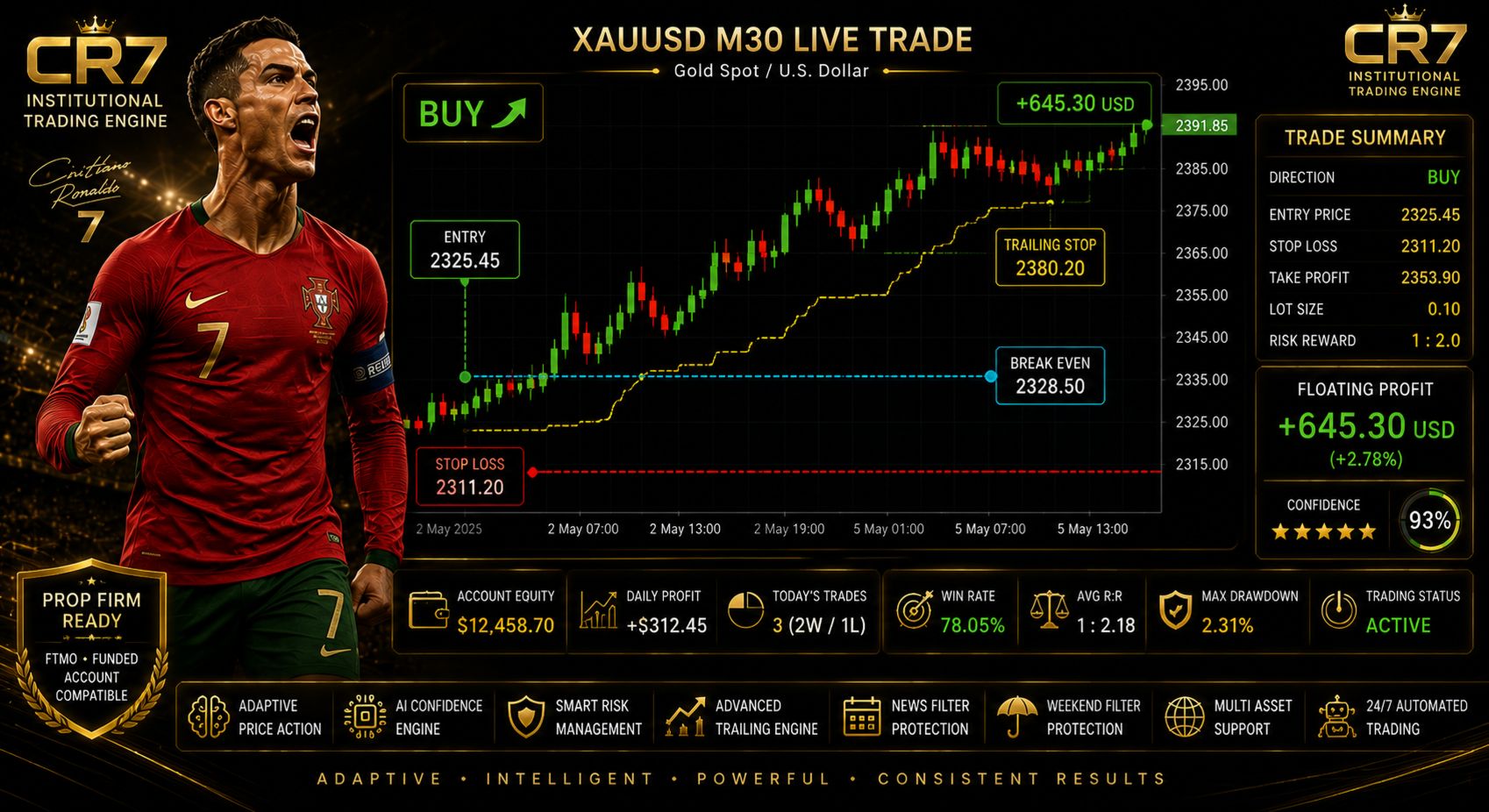
ExitsThe stop loss is placed at the price structure that invalidates the trade rather than at a fixed distance, and it is re-applied after every fill so protection holds on brokers that process orders in pure market execution and drop the stop.
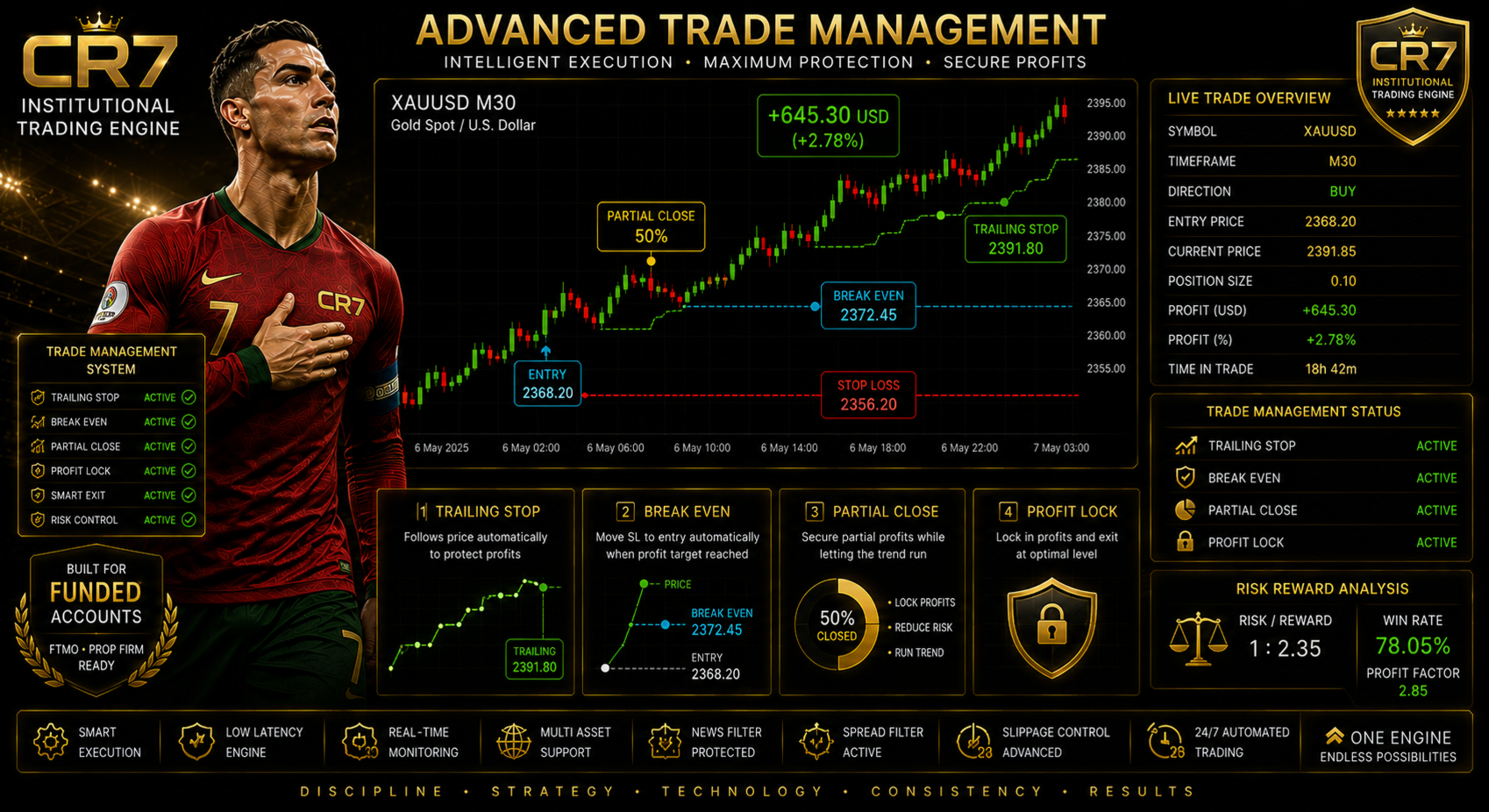
Three trailing methods are available. Structure following moves the stop with the market's own higher lows or lower highs since entry, so a genuine trend can extend rather than being cut at an arbitrary distance. Risk staged trails at multiples of the risk taken on that specific trade, tightening as profit grows. A classic staged mode is also included. All three respect a volatility floor that keeps the stop outside normal market noise, and a give-back limit that caps how much of the best price reached can be returned once a position is meaningfully in profit. Partial closing at a chosen risk multiple is available and switched off by default.
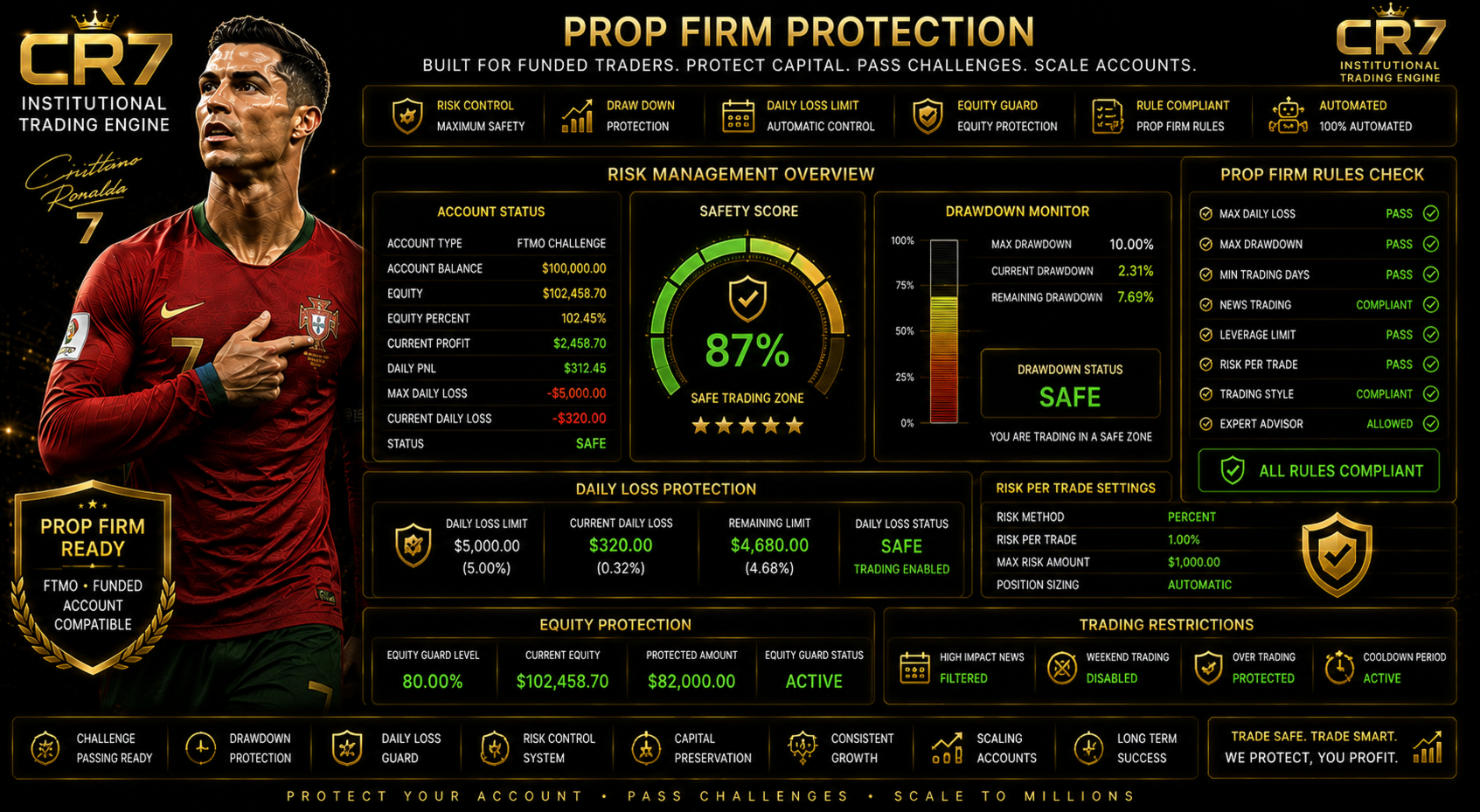
Account protectionA daily loss limit halts trading for the day when reached, with a configurable reset hour, an optional daily profit objective, and a total drawdown guard. A high impact news blackout and a Friday flat mode are included. Accounts subject to FIFO rules are detected automatically, in which case positions close oldest first and opposite direction hedging is never opened. Prop firm accounts are detected and handled with conservative daily loss anchoring, although you should always confirm your own firm's current rules yourself.
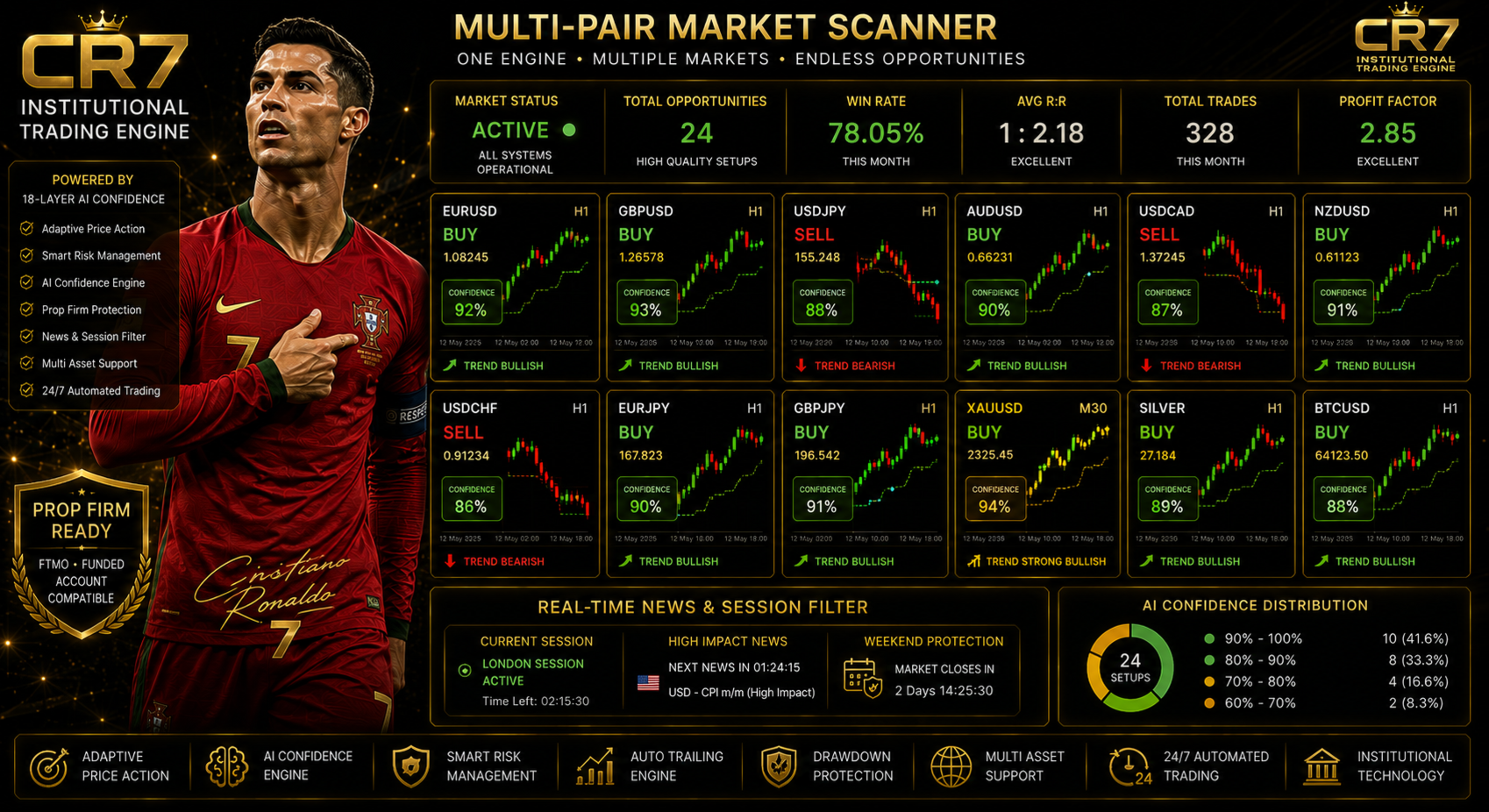
Instruments and levelsCR7 identifies the instrument class, distinguishing forex majors and crosses, metals, crypto, indices and energy, and derives its execution settings from that symbol's own live spread and volatility rather than applying forex assumptions everywhere. Broker symbol suffixes are handled automatically and crypto volume steps are normalised.
Two methods are available for establishing the price levels the engine works from. The adaptive method derives them from recent candle behaviour and requires no chart rendering, which makes it suitable for hosted terminals and for testing. The chart synchronisation method aligns the engine to the horizontal lines drawn by the terminal itself, measuring them directly from the chart and verifying each measurement twice before it is used.
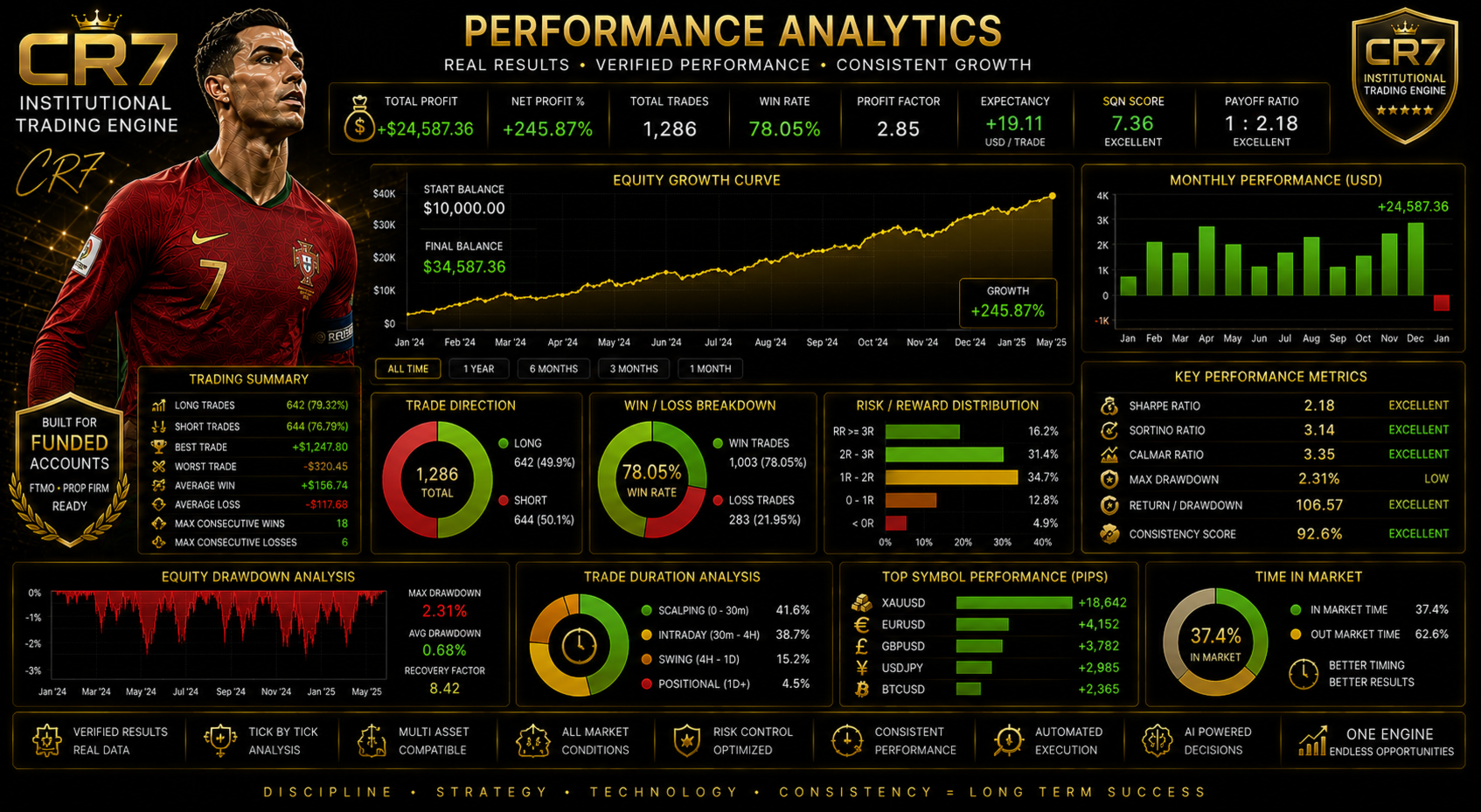
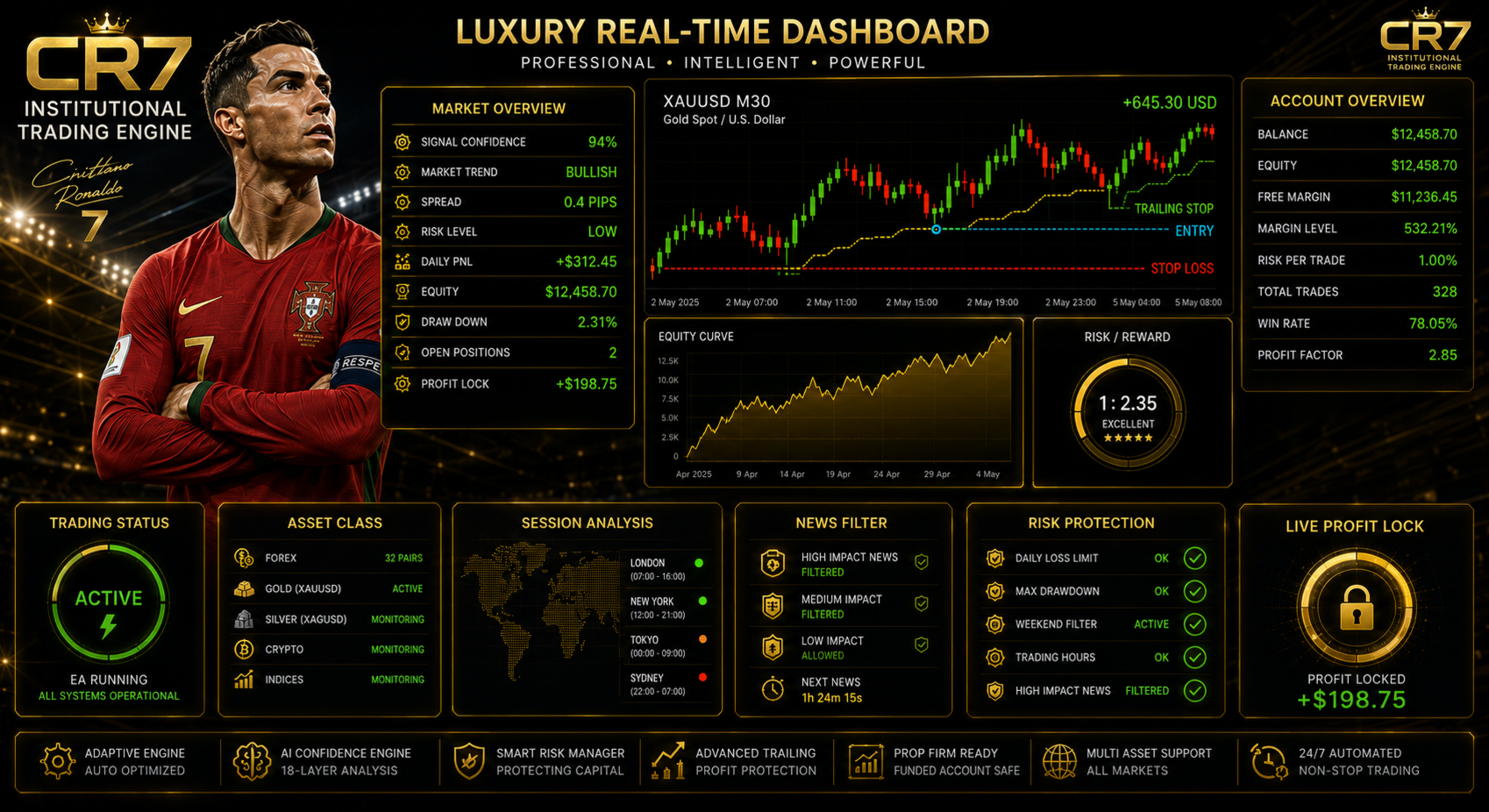
Interface and reviewA panel on the chart shows equity, floating result, balance, free margin, instrument class, spread, session state, signal readiness and the current state of the account protection settings. It can be switched off entirely for a clean chart. An optional CSV journal records every entry with its full score breakdown and every closure with its result, so settings can be reviewed against measured outcomes rather than impressions. A configuration summary is printed at startup so every active setting can be checked at a glance.
Requirements and recommended useCR7 runs on any liquid instrument. Timeframes of M5 and above are recommended, because on very low timeframes the spread forms a large share of the stop distance and materially raises the win rate required to break even. Hedging and netting accounts are both supported, with FIFO detected automatically. A deposit from two hundred units of account currency is workable and five hundred or more allows more comfortable risk settings. Any low spread broker is suitable, and the tighter the spread the better this engine performs. For testing, use every tick based on real ticks, and switch the CSV journal off during optimisation.
On accounts subject to FIFO, run one chart per symbol. This is a limitation of the netting account model rather than of the EA. Each chart instance is isolated by its own magic number, so several symbols and timeframes can run alongside each other.