News of the day. 1.03.2016
Switzerland
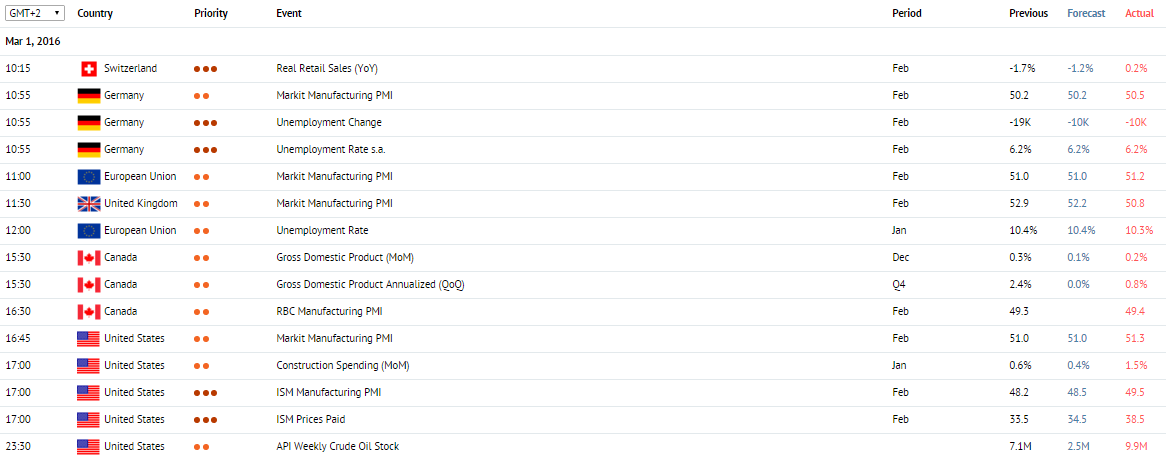
Data on Real Retail Sales for February is due in Switzerland at 10:15 am (GMT+2). The data measures changes in the volume of retail sales and is followed as an indicator of consumer confidence. A growth in retail sales represents a growth in consumption and has a positive impact on the economy. A fall in the index is seen as a negative factor for the economy. A high reading strengthens the Franc, while a low reading weakens the Franc.
Germany
Markit Manufacturing PMI is due in Germany at 10:55 am (GMT+2). The index is expected to remain unchanged at 50.2 points in February. The index, being one of the key indicators of the economy, evaluates economic conditions in the manufacturing sector and its prospects. A result above 50 points is perceived positive and strengthens the Euro. A result below 50 points, on the contrary, is seen as a negative signal and weakens the Euro.
Data on Unemployment Rate is due in Germany at 10:55 am (GMT+2). The indicator is expected to remain unchanged at 6.2% in February. The unemployment rate measures the percentage of the total labour force that is unemployed. A growth in the index represents a slowdown of economic growth and pressures the Euro. A fall in the index has a positive impact on economic growth and strengthens the Euro.
EU
Markit Manufacturing PMI is due in the EU at 11:00 am (GMT+2). The index is expected to remain unchanged at 51 points in February. The index, being one of the key indicators of the economy, evaluates economic conditions in the manufacturing sector and its prospects. A result above 50 points is perceived positive and strengthens the Euro. A result below 50 points, on the contrary, is seen as a negative signal and weakens the Euro.
Data on unemployment rate is due in the EU at 12:00 pm (GMT+2). The indicator is expected to remain unchanged at 10.4% in January. The unemployment rate measures the percentage of the total labour force that is unemployed. A growth in the index represents a slowdown of economic growth. A high result pressures the Euro, while a low one, on the contrary, strengthens the Euro.
UK
Markit Manufacturing PMI is due in the UK at 11:30 am (GMT+2). The index, being one of the key indicators of the economy, evaluates economic conditions in the manufacturing sector and its prospects. A result above 50 points is perceived positive and strengthens the Pound. A result below 50 points, on the contrary, is seen as a negative signal and weakens the Pound.
Canada
Data on Canada’s GDP in the fourth quarter is due at 3:30 pm (GMT+2). The indicator measures the value of all goods and services produced by the country during a certain period. A growth in the indicator supports the Canadian Dollar. A fall in the indicator weakens the Canadian Dollar.
RBC Manufacturing PMI is due in Canada at 4:30 pm (GMT+2). The index is based on survey responses from executives of 400 large companies regarding their opinion on current economic conditions in the sector and its prospects. A result above 50 represents a positive mood and strengthens the Canadian Dollar. A result below 50 represents pessimism and weakens the Canadian Dollar.
USA
Data on Construction Spending is due in the US at 5:00 pm (GMT+2). On a monthly basis, the indicator is expected to grow to 0.5% from 0.1%. The data represents expenditures by construction companies on all types of construction activities. A growth in the index indicates economic growth. A high reading strengthens the US Dollar.
Data on ISM Prices Paid is due in the US at 5:00 pm (GMT+2). The indicator is expected to grow to 35.0 from 33.5 points. The index is based on surveys of executives of manufacturing companies and evaluates current economic conditions in the manufacturing sector.
ISM Manufacturing PMI for February is due in the US at 5:00 pm (GMT+2). The indicator is expected to be up to 48.8 from 48.2 points. The index is the indicator of the general state of the US economy. Values above 50 represent economic growth and strengthen the US Dollar. Values below 50 indicate a slowdown of the economy and weaken the US Dollar.
The American Petroleum Institute releases data on crude oil inventories at 11:30 pm (GMT+2). An increase in crude oil inventories pressures oil prices. A decrease, on the contrary, supports oil prices.