📝 MQL5 Article: "Emotion is a Bug: Why Quant Beats Human"
Introduction
"Human emotion is a critical bug that disrupts the Exception Handling of any trading system. Machines don't have this bug."
If you've survived in the derivatives market for any length of time, you already know one uncomfortable truth: your instincts are lying to you.
The market doesn't care about your hopes, your fears, or your carefully constructed narratives. It only cares about one thing — the math.
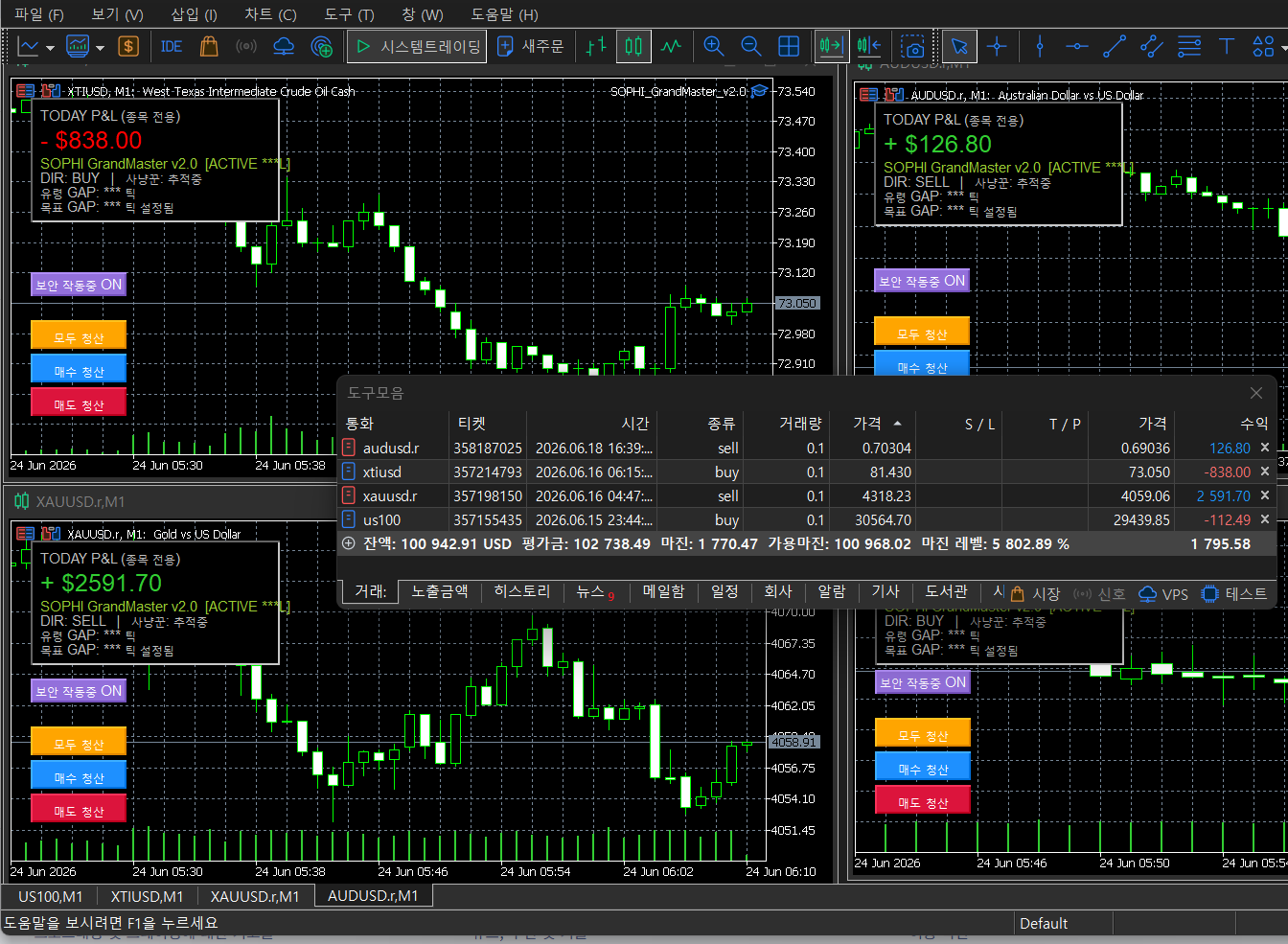
This article isn't about theory. It's about what actually happened on the night of June 22, 2026, when our automated trading engine — GrandMaster v2.0 — faced a brutal market divergence and emerged not just intact, but profitable.
We'll walk through the live scenario, dissect why the machine won, and explore what this means for the future of trading.
Chapter 1: The Night the Market Went Crazy — A Live Scenario
22:30 KST. Oil (XTIUSD) started dropping. Geopolitical risk premium began to unwind, and risk assets across the board came under pressure.
23:15 KST. Our account showed -$650 in unrealized loss. Oil was falling steadily.
Here's the question: What would you have done?
Most human traders would have reacted like this:
Check the news ("Why is it dropping?")
Check the community ("Is everyone cutting losses?")
Feel the fear creeping in ("This could get ugly")
Hit the stop-loss button.
This is exactly the moment when the "emotion bug" activates. The system encountered an exception (a drawdown), and the human operator executed the wrong exception handling — panic.
But GrandMaster v2.0 did something completely different.
The engine didn't interpret Oil's decline as a "bug." It was just another data point. The system calmly scanned the entire equity curve.
00:45 KST. Gold (XAUUSD) started surging. The +$1,280 profit being generated on the other side completely absorbed the -$650 loss on Oil.
Final result: Oil -$650, Gold +$1,280. Net profit +$630.
The human was shaken by the waves in front of them. The machine read the entire ocean.
Chapter 2: Why Machines Win — A Technical Breakdown
This scenario wasn't luck. It was design.
GrandMaster v2.0 isn't optimized for individual instrument performance. It's optimized for total portfolio balance.
The Human Limitation:
Humans are governed by Loss Aversion — a cognitive bias where losses hurt twice as much as gains feel good.
When one instrument goes negative, you become obsessed with it.
You lose sight of the profits being generated elsewhere.
The Machine Advantage:
Machines treat losses and gains as equivalent probabilistic events.
They calculate only the Expected Value of the total equity.
With emotion removed, consistent decision-making becomes possible.
This is the core of what we call "Balance Investment."
Chapter 3: The Art of Open Positions — Why We Didn't Close
What's particularly worth noting in this scenario is the "open position" strategy.
Human traders often fall into the trap of "cutting winners early and holding losers too long." GrandMaster v2.0 operates differently.
Oil's -$650: We didn't cut it. The system calculated that this position represented only 0.3% of total equity — a controlled risk.
Gold's +$1,280: We didn't take profit early. The system measured the strength of the trend (momentum) and determined that further upside was probable.
Both positions remained open. And the total equity continued to climb.
This is how "compounding over time" actually works. You step away from the short-term noise and let the system do what it was designed to do.
Chapter 4: So What's the Human's Role?
"Then we don't need to do anything?"
Not exactly. The human's role shifts to a higher-order function:
System Design: What algorithm? Which asset classes? What position sizing?
Environment Control: Is the VPS stable? Is broker slippage under control?
Mental Management: As equity grows, the absolute size of drawdowns grows too. Can you handle the weight?
The human's real job is to build a system that eliminates emotion, and then create the environment for that system to run perfectly. In other words: remove the bugs, then trust the code.
Conclusion: Does Your Equity Curve Have a "Bug"?
"Ultimately, everything is just the juniper tree in front of the courtyard."
This 1,000-year-old Zen saying from Master Zhaozhou can be reinterpreted for the 22nd century:
"Ultimately, everything is just a number on your equity curve."
Don't load it with emotion. Don't assign meaning to news. Only the numbers are real.
GrandMaster v2.0 is an "empty-mind engine" that observes the truth as it is — without judgment, without fear, without greed.
Is this engine planted in your account yet?
📌 Submission Guide for MQL5
To publish this article on MQL5.com:
Go to MQL5.com and log in.
Navigate to Articles → "Add a new article".
Enter the title and outline, then paste the full text.
Add supporting images (charts, equity curves, engine logs) — max size 750x500 pixels.
Click "Submit for review".
Pro Tip: MQL5 articles perform best when they include at least 4-5 visual elements. Consider adding:
A screenshot of the June 22 equity curve
A side-by-side comparison of Oil and Gold charts
A simple diagram showing the "emotion bug" vs. "machine logic"
- Why traders fail: 6 obstacles to success and how to avoid them
- Buy Gbp/Usd and Sell Euro/Usd
- How to Start with Metatrader 5
SOPHI: Stealth & Hedge EA
"99% lose money predicting direction. Stop trusting dead indicators. We share institutional hedging for the 1%."
"Human emotion is a critical bug that disrupts the Exception Handling of any trading system. Machines don't have this bug."
Why Quant Beats Human"
파일:
1.png
147 kb