Vanth
- エキスパート
- バージョン: 1.12
- アクティベーション: 10

VANTH — AI-prevalent Expert Advisor for MetaTrader 5
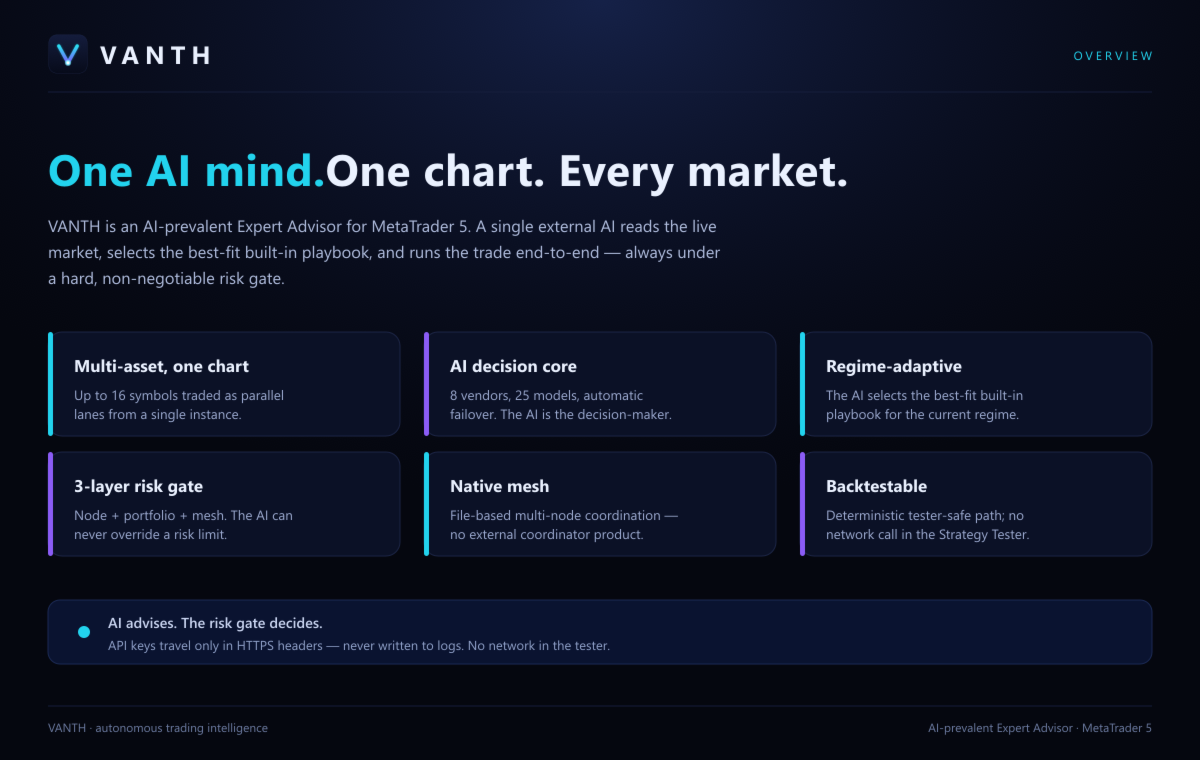
One AI mind. One chart. Every market.
Most "AI" robots are a fixed strategy with an AI label on top. VANTH is the opposite. Here a live external AI sits in the decision seat on every bar — it reads a full picture of the market, chooses the best-fit built-in playbook for the current regime, and runs the trade from entry to exit. The EA's job is to give that intelligence a rich, accurate view of the market and to hold a hard, non-negotiable risk gate around it that the AI can never override.
That single design choice — AI advises, the risk gate decides — is what makes VANTH feel less like a script and more like a trader that thinks, adapts, and respects its limits.
Why VANTH is different
- The AI is the decision-maker, not a parameter. It receives the whole market photograph in pips and returns a structured decision with its reasoning — not a yes/no from a hard-coded rule.
- One chart drives up to 16 symbols as independent parallel "lanes", all under one account-level risk manager — a safeguard you simply cannot get by running many separate single-symbol charts side by side.
- It adapts by nature. Range, trend, breakout, thin market — VANTH changes behaviour with the regime without you re-optimising anything. The lever is context, not rigid rules.
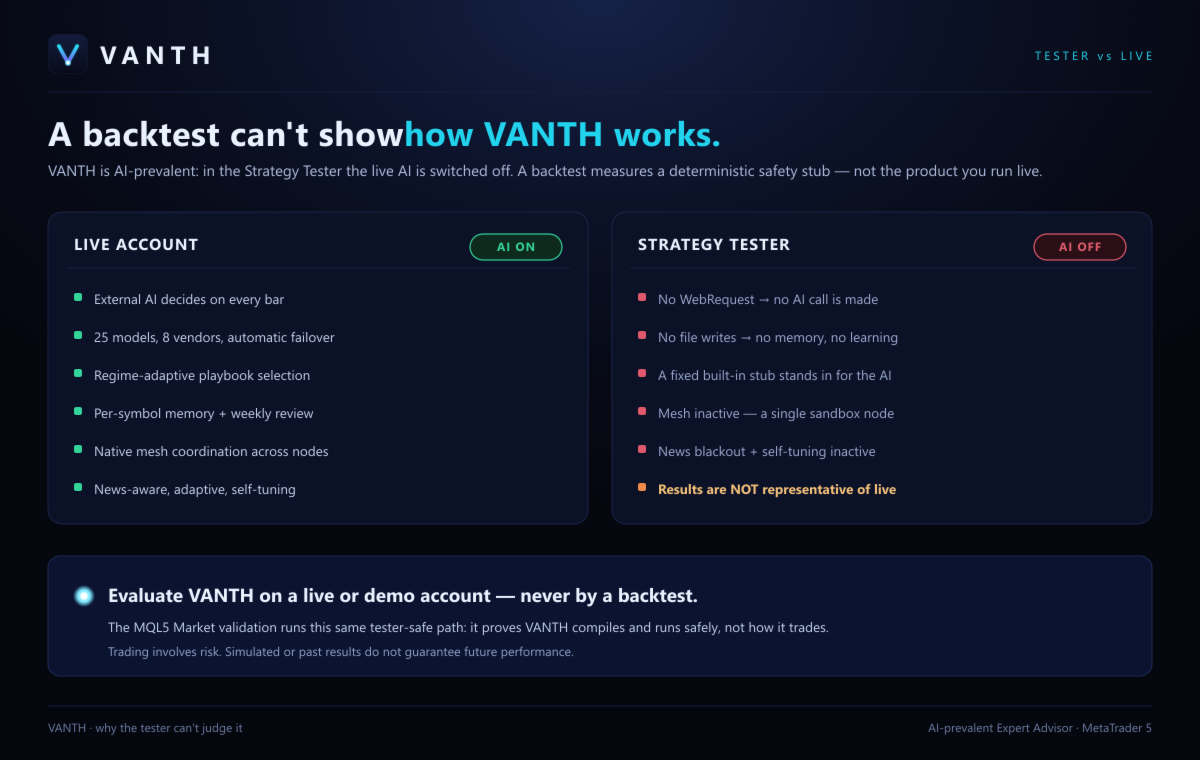
- It is honest about what it is. The live AI does not run inside the Strategy Tester, and we say so plainly (see below). You judge VANTH where it actually works: live or on demo.
Multi-asset — now including weekends and crypto
VANTH trades FX majors, crosses, metals and more from a single instance. With this release you can also enable Saturday and Sunday, so traders who run cryptocurrencies and other 24/7 markets can keep VANTH working when the FX week is closed. Weekday and weekend sessions are fully under your control — leave them off for classic FX, switch them on for round-the-clock markets.
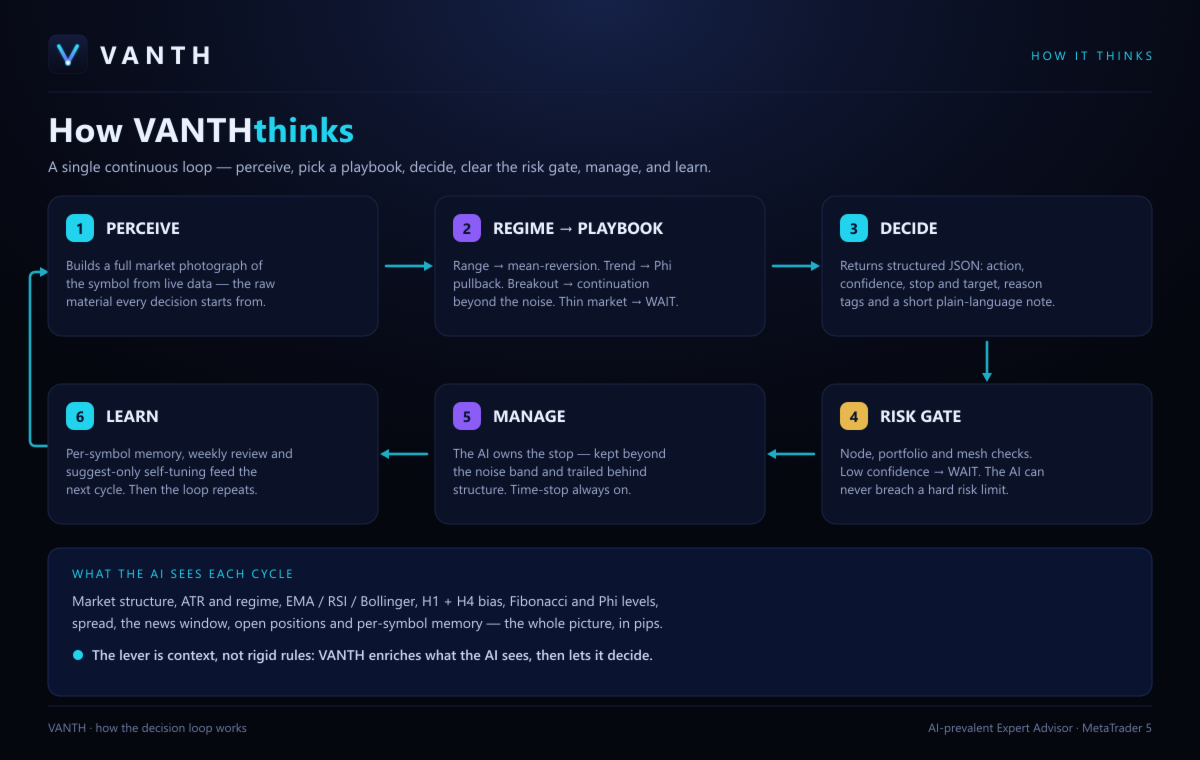
How it decides — one continuous loop
- Perceive — a full market photograph: structure, ATR and volatility regime, EMA / RSI / Bollinger context, H1 + H4 higher-timeframe bias, Fibonacci and Phi levels, spread, the news window, open positions and per-symbol memory.
- Regime to playbook — range to mean-reversion, trend to Phi (Fibonacci) pullback, breakout to continuation beyond the noise, thin or low-ATR market to wait.
- Decide — the AI returns action, confidence, stop and target, reason tags and a short plain-language rationale.
- Risk gate — node, portfolio and mesh checks. Low confidence becomes wait. The AI can never breach a hard limit.
- Manage — the AI owns the stop, gives a fresh trade room to breathe to its structural invalidation, then trails behind market structure as the move develops. A time-stop and emergency close are always armed.
- Learn — per-symbol memory, weekly review and suggest-only self-optimisation feed the next decision. Then the loop repeats.
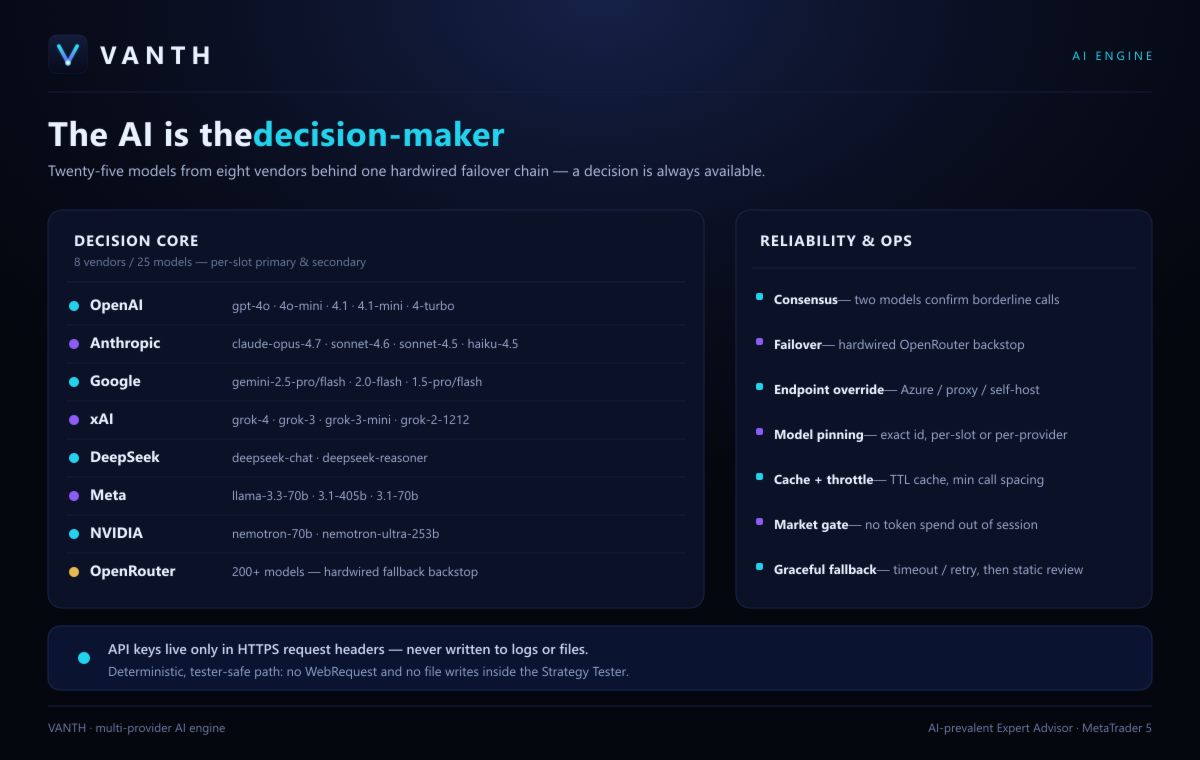
AI engine — 25 models, 8 vendors
- 25 models across 8 vendors, selectable as a primary and an optional secondary, each slot naming the exact model in use: OpenAI, Anthropic, Google, xAI, DeepSeek, Meta Llama and NVIDIA Nemotron, plus a free-text OpenRouter slot (200+ models) as a hardwired fallback backstop.
- Per-slot model override — pin an exact model id per slot, so two different models can run even on the same provider.
- Automatic failover — if your chosen model is unreachable, the call falls through the chain so a decision is always available.
- Optional consensus — on borderline calls, two models must agree before acting.
- Endpoint override and version pinning — point any provider at Azure, a proxy or a self-hosted endpoint, and pin exact, reproducible model versions.
- Cost and rate control — TTL response cache, a minimum interval between calls, and a closed-market gate that stops spending tokens out of session.
- Security — API keys travel only inside HTTPS request headers; they are never written to logs or files.
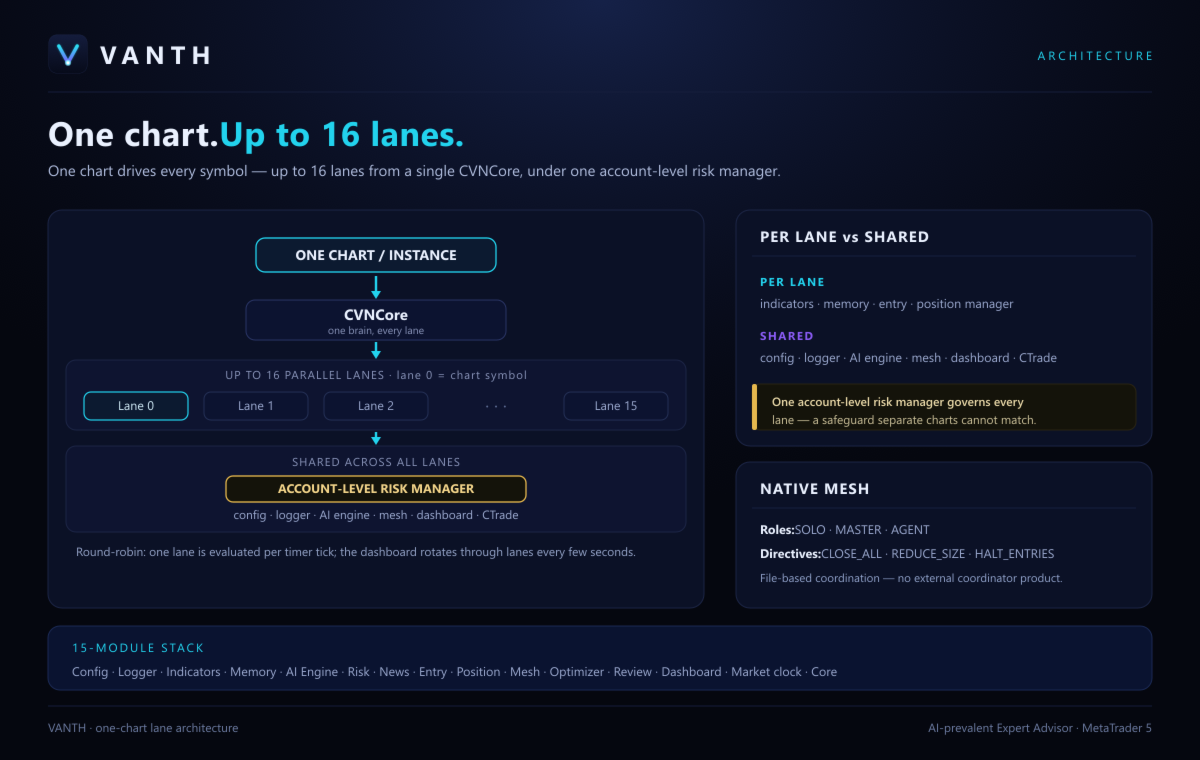
Architecture and native mesh
- One chart / instance → a single core → up to 16 lanes. Per lane: indicators, memory, entry and position management. Shared: configuration, logger, AI engine, the account-level risk manager, mesh, dashboard and execution.
- Native mesh — run VANTH across several MetaTrader 5 terminals (even on different VPS) as SOLO / MASTER / AGENT, coordinated by file-based messaging with directives such as CLOSE_ALL, REDUCE_SIZE and HALT_ENTRIES. No external coordinator product required — ideal for managing a portfolio or a prop-firm challenge under one risk umbrella.
Risk and control
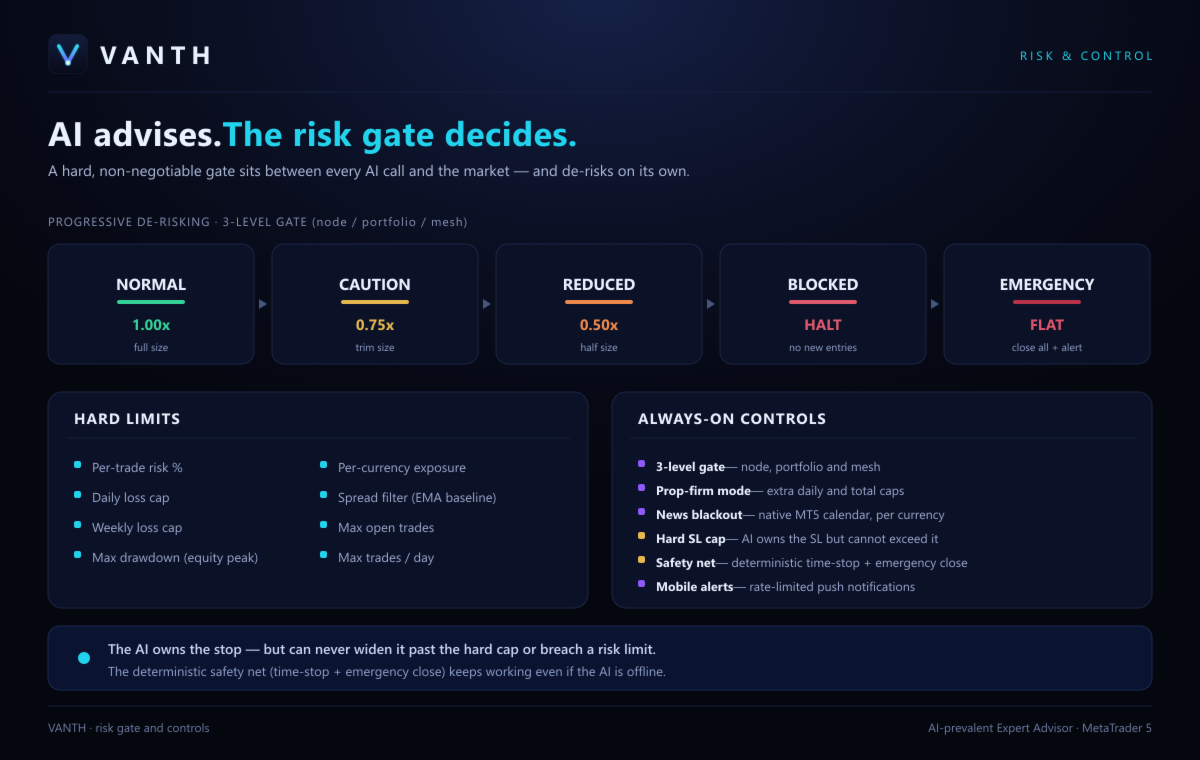
- 3-level risk gate — node, portfolio and mesh — with progressive de-risking: NORMAL (1.00x) to CAUTION (0.75x) to REDUCED (0.50x) to BLOCKED (no new entries) to EMERGENCY (close all + alert).
- Hard limits — per-trade risk %, daily and weekly loss caps, max drawdown on the equity peak, per-currency and correlated exposure, spread filter, max open trades and max trades per day.
- Prop-firm mode — additional daily and total caps; the most restrictive limit always wins.
- News blackout — built from the native MT5 economic calendar, filtered to the symbol's own currencies. No external feed required.
- Deterministic safety net — a hard SL cap the AI can never widen past, plus a time-stop and emergency close that keep working even if the AI is offline.
The honest part — please read
VANTH is AI-prevalent, and the live AI does not run inside the Strategy Tester (the tester makes no network calls and writes no files). In the tester a deterministic safe stub stands in for the AI, so a backtest shows the safety scaffolding — not the product you run live. The MQL5 automated validation runs that same tester-safe path: it proves VANTH compiles and behaves safely, not how it trades. Evaluate VANTH on a live or demo account, with your API key in place — that is the only place you see the real engine at work. We would rather tell you this up front than let a backtest mislead you.
What you get
- The compiled VANTH Expert Advisor for MetaTrader 5.
- A complete, professionally designed operating manual in English and Italian (PDF) covering every parameter, the mesh and multi-terminal scenarios, and full configuration.
- Free updates within the version line.
Launch offer
VANTH is launching in tiers. The introductory price is deliberately accessible, then steps up as licences are taken — early adopters are rewarded without the product being discounted into losing its value.
- Launch tier (first 10 licences): 497 USD — and these buyers also receive my second AI-prevalent EA, Cyberdyne System (regular price 997 USD), as a launch bonus. Two AI-prevalent systems, combined regular value over 2,100 USD.
- Licences 11 to 25: 697 USD
- Licences 26 to 50: 897 USD
- Standard price thereafter: 1,197 USD
Setup
- Tools → Options → Expert Advisors → Allow WebRequest for listed URL, then add the host(s) of the provider(s) you enable, e.g. https://api.openai.com , https://api.anthropic.com , https://generativelanguage.googleapis.com , https://api.x.ai , https://api.deepseek.com , https://openrouter.ai .
- Paste your API key for the chosen provider into the EA inputs.
- Attach VANTH to one chart, set your symbols, sessions and risk limits, enable algo trading — and watch the dashboard.
Requirements and risk note
- An AI provider account and API key are required for live AI decisions (you bring your own). At least one provider key; OpenRouter works as a universal backstop. A VPS is recommended for continuity.
- VANTH does not promise profit and does not target any win rate. Trading leveraged products carries a substantial risk of loss and is not suitable for every investor. Test thoroughly on a demo account and use risk settings you are comfortable with. Past or simulated results do not guarantee future performance.