Keystone MT5
- Experts
-
Damir Ikinic
 🔷 VELTIS — SYSTÈMES PROFESSIONNELS DE TRADING ALGORITHMIQUE
- Version: 1.8
- Activations: 10
VELTIS KEYSTONE
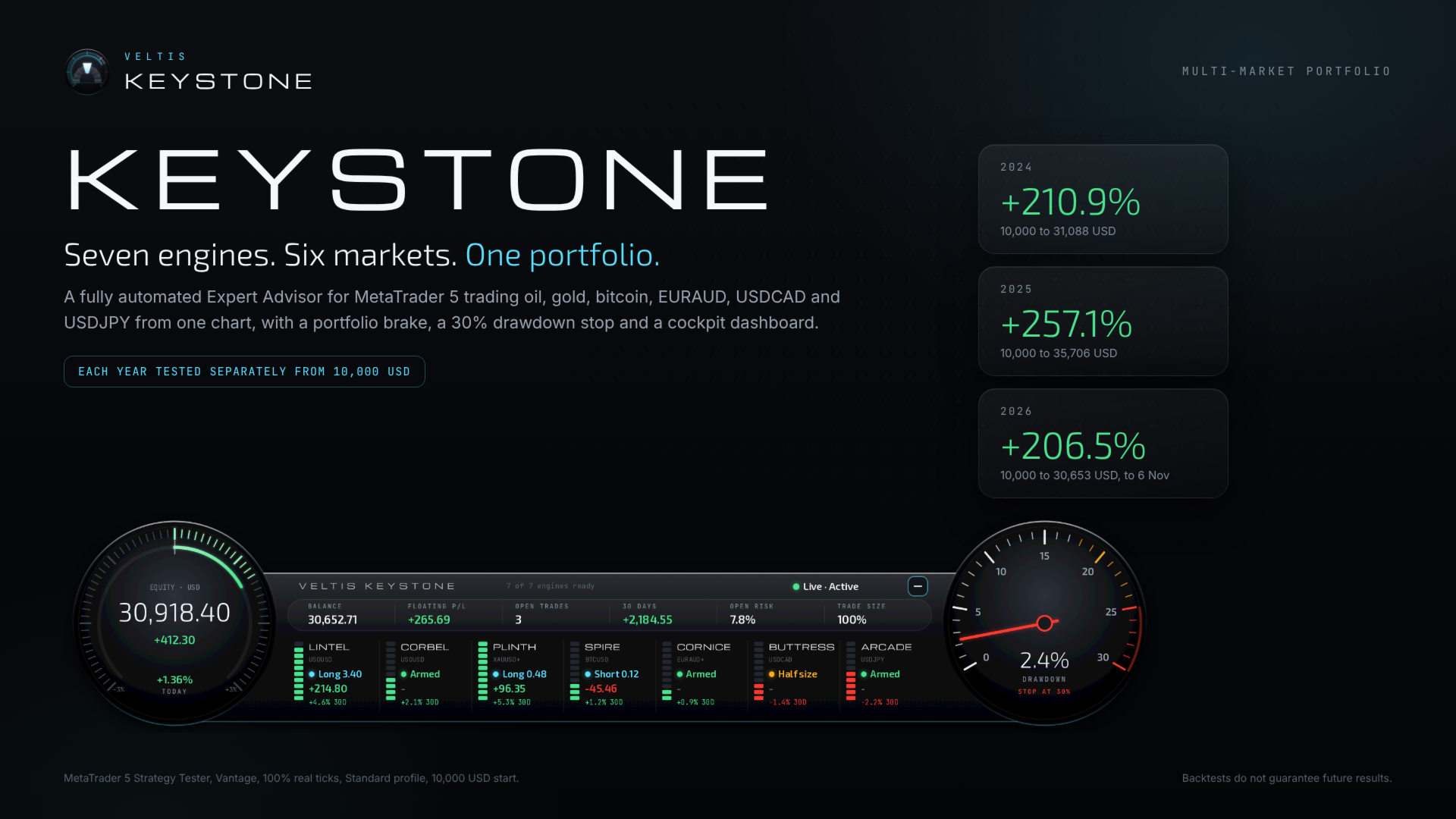
Seven engines. Six markets. One portfolio.
A fully automated Expert Advisor for MetaTrader 5 that trades oil, gold, bitcoin, EURAUD, USDCAD and USDJPY from one chart, with a portfolio brake, a 30% drawdown stop and a cockpit dashboard.
WHAT IS KEYSTONE
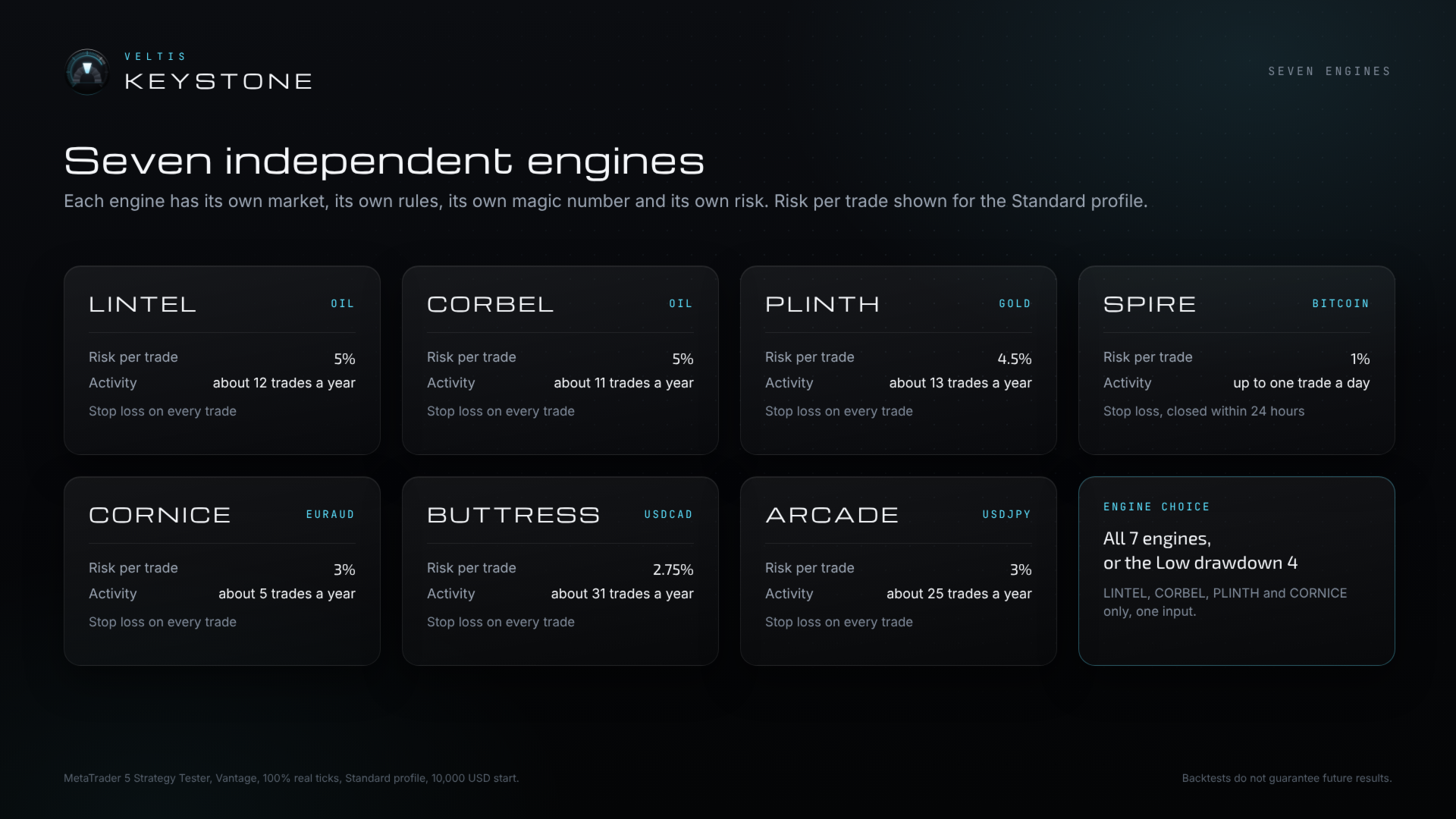
Keystone is a portfolio of seven independent trading engines in one Expert Advisor. Each engine trades its own market with its own rules, its own magic number and its own risk per trade. Because the engines work on different markets and at different times, a quiet month in one market can be balanced by activity in another.
You attach Keystone to one chart and choose a risk profile. Keystone finds the right symbol names at your broker, adds them to Market Watch and runs all seven engines from there.
THE SEVEN ENGINES
LINTEL and CORBEL trade WTI crude oil. Each one makes about 11 to 12 trades a year.
PLINTH trades gold, about 13 trades a year.
SPIRE trades bitcoin. It makes at most one trade a day and closes it within 24 hours.
CORNICE trades EURAUD, about 5 trades a year.
BUTTRESS trades USDCAD, about 31 trades a year.
ARCADE trades USDJPY, about 25 trades a year.
Every trade is opened with a stop loss. The risk of each trade is a fixed share of the balance, so position sizes grow and shrink with the account.
With the Engines input you can run all seven engines, or only the four engines that had lower drawdowns in testing: LINTEL, CORBEL, PLINTH and CORNICE.
BACKTEST RESULTS
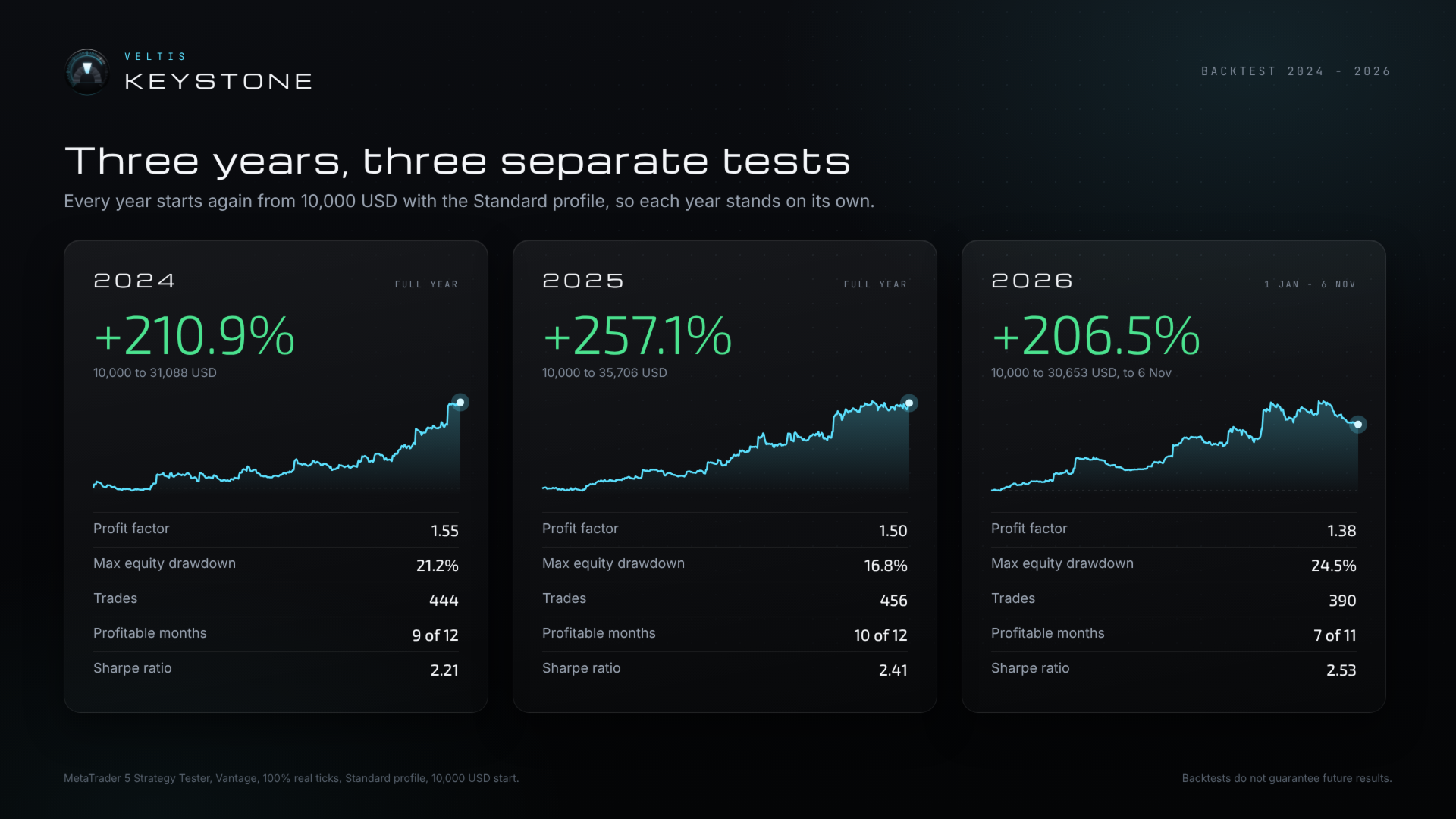
Each year was tested separately, starting from 10,000 USD with the Standard profile.
2024: from 10,000 to 31,088 USD (+210.9%). Profit factor 1.55, maximum equity drawdown 21.2%, 444 trades, 9 of 12 months in profit.
2025: from 10,000 to 35,706 USD (+257.1%). Profit factor 1.50, maximum equity drawdown 16.8%, 456 trades, 10 of 12 months in profit.
2026, 1 January to 6 November: from 10,000 to 30,653 USD (+206.5%). Profit factor 1.38, maximum equity drawdown 24.5%, 390 trades, 7 of 11 months in profit.
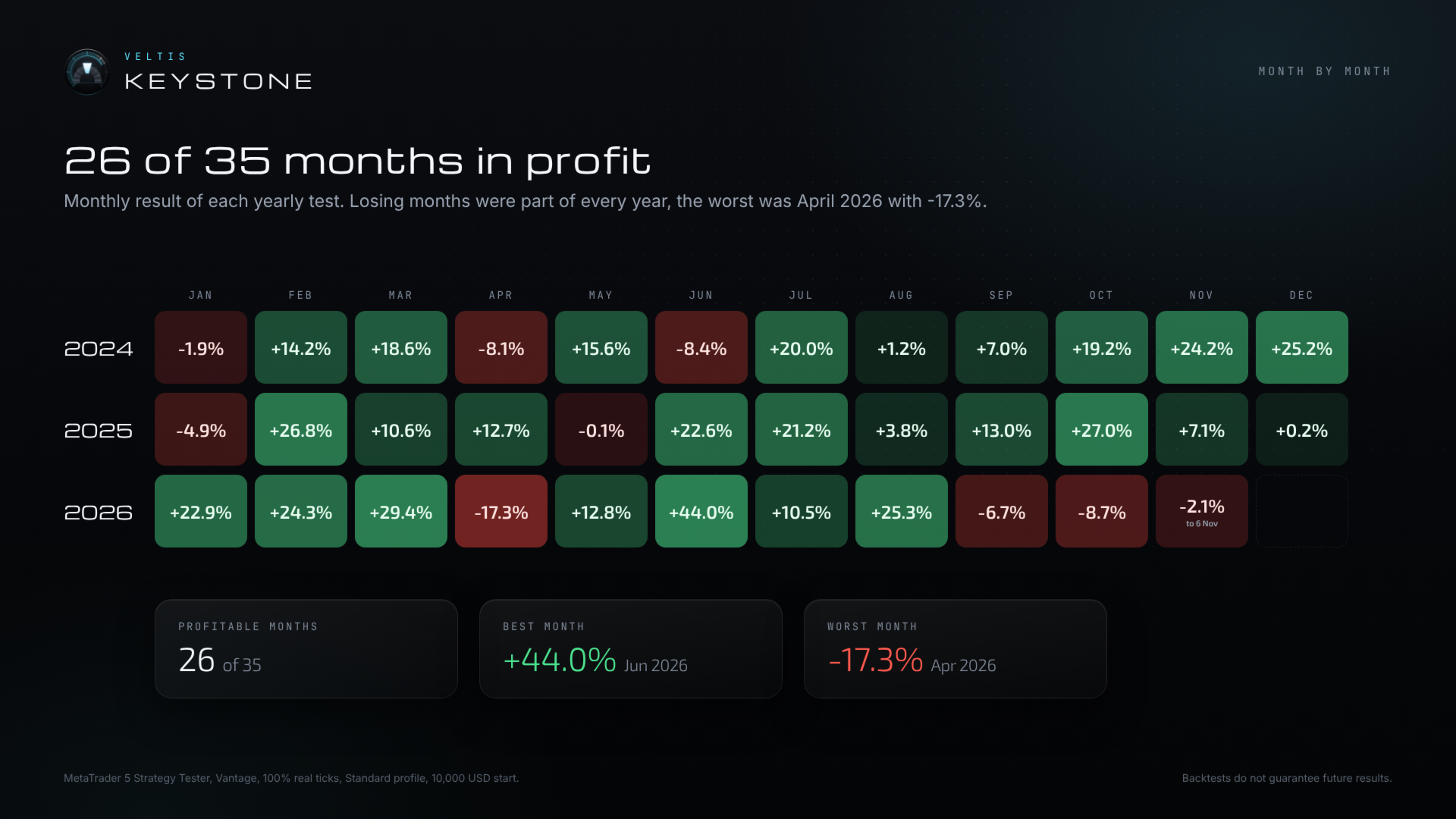
Over the three years 26 of 35 months ended in profit. The weakest month was April 2026 with minus 17.3%.
Test conditions: MetaTrader 5 Strategy Tester, Vantage demo server, 100% real ticks, leverage 1:100, Standard profile, BTCUSD H1 chart.
BUILT-IN PROTECTION
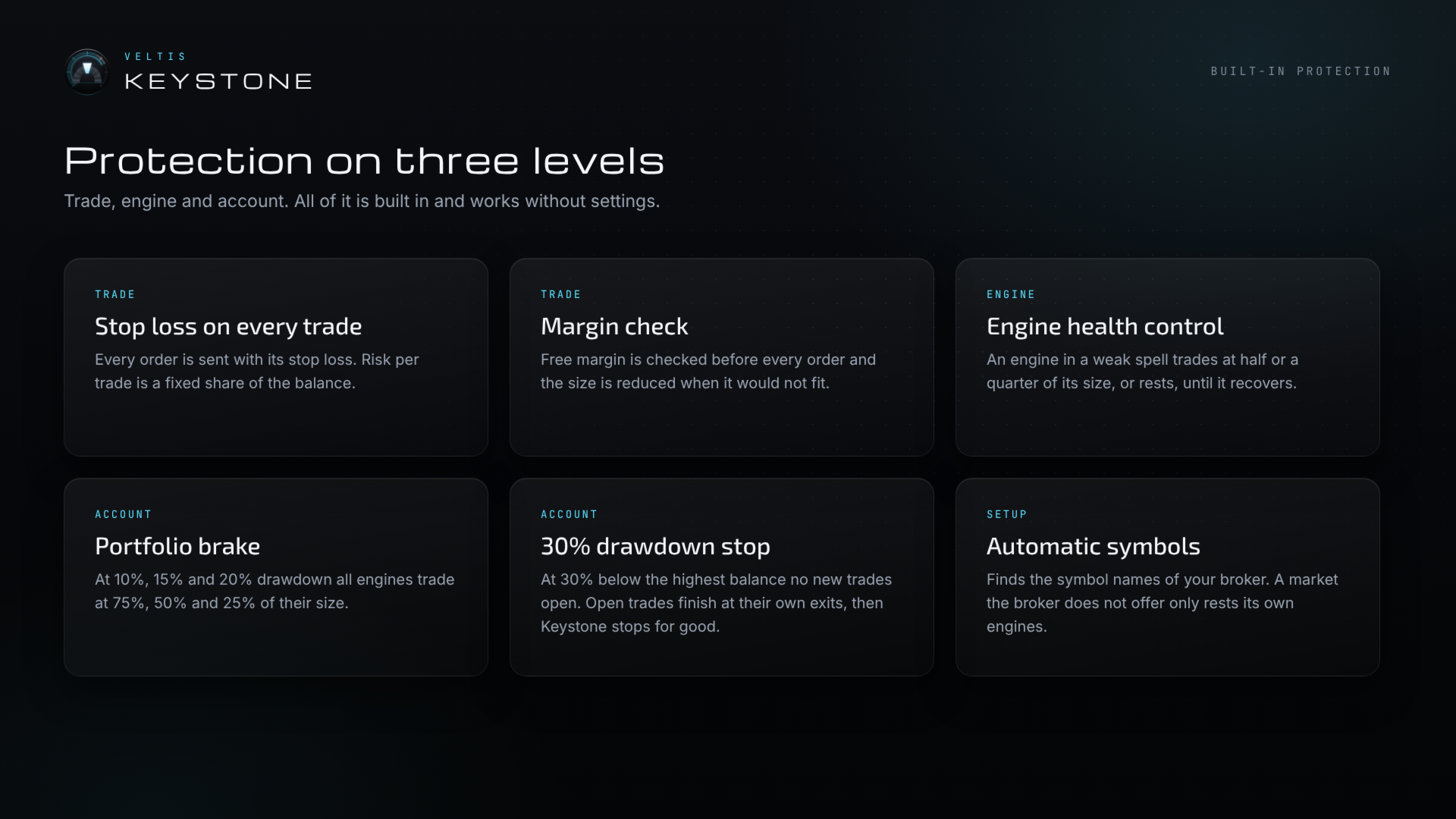
On the trade level, every order is sent with its stop loss, and free margin is checked before every order. If a trade would not fit, its size is reduced.
On the engine level, a health control watches every engine. An engine that goes through a weak spell trades at half or a quarter of its normal size, or rests completely, until its results recover.
On the account level, the portfolio brake reduces the size of all engines during a drawdown: to 75% at a 10% drawdown, to 50% at 15% and to 25% at 20%. If the account falls 30% below its highest balance, Keystone opens no new trades. The trades that are still open finish at their own exits, and then Keystone stops for good.
If your broker does not offer one of the six markets, only the engines of that market rest. All other engines keep trading, and the dashboard shows which market is missing.
RISK PROFILE
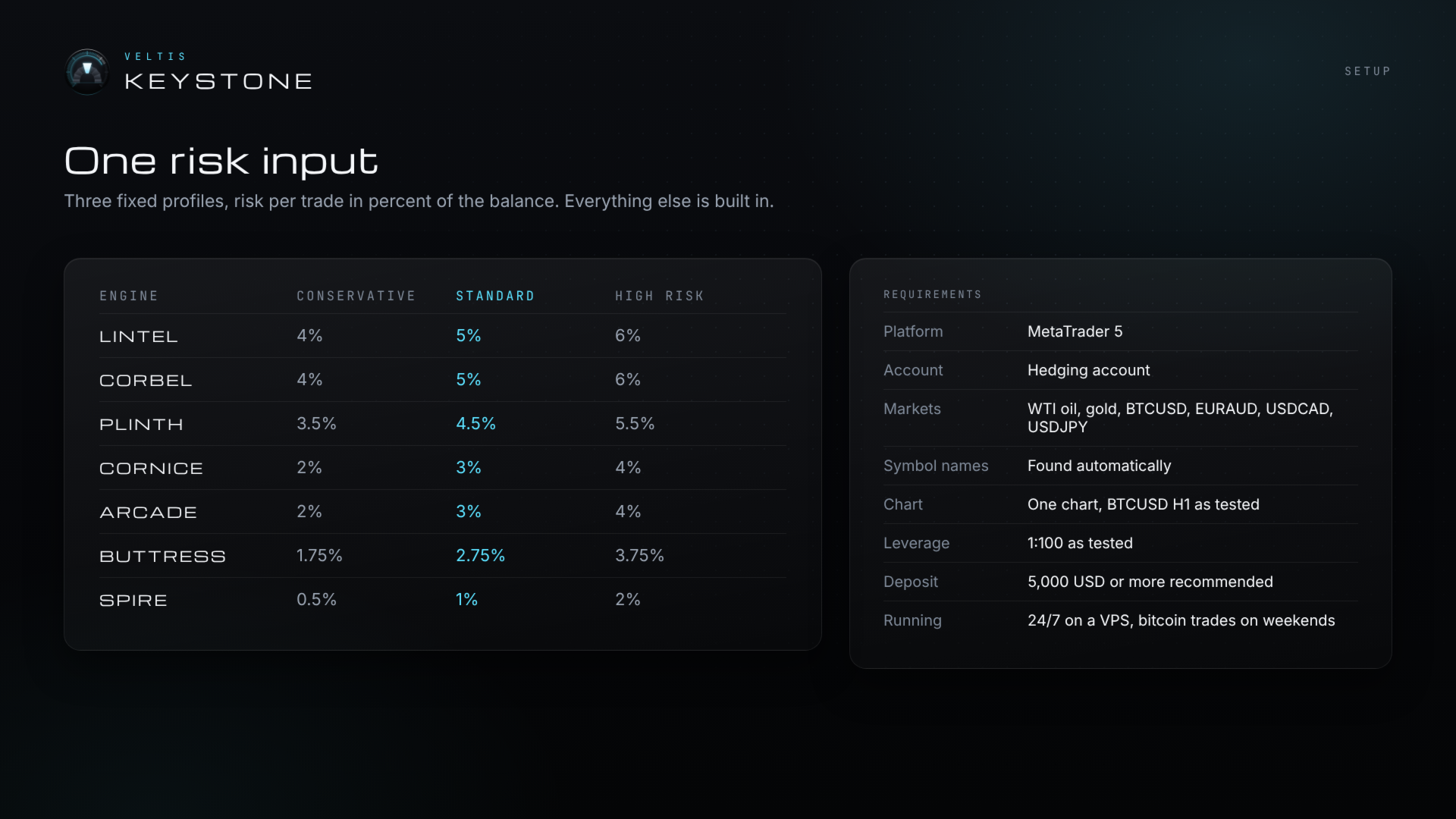
There is one risk input with three choices. The values are risk per trade in percent of the balance.
Standard (default, the tested setting): LINTEL 5%, CORBEL 5%, PLINTH 4.5%, CORNICE 3%, ARCADE 3%, BUTTRESS 2.75%, SPIRE 1%.
Conservative: every engine 1% lower, SPIRE 0.5%.
High risk: every engine 1% higher, SPIRE 2%.
The Standard profile already reached equity drawdowns of about 25% in the tests. High risk brings the account closer to the 30% stop. Choose Conservative if that is more than you are comfortable with.
COCKPIT DASHBOARD
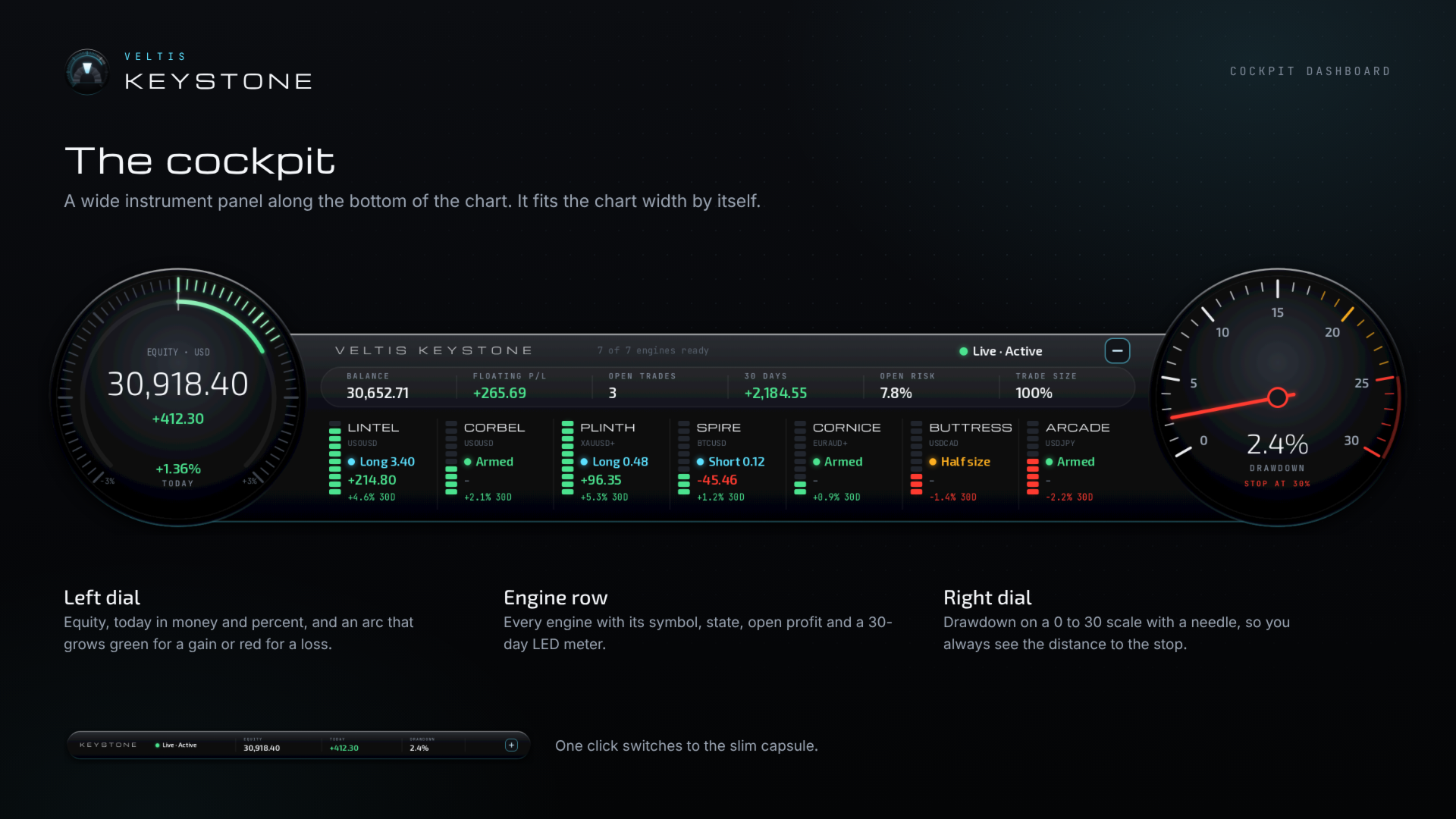
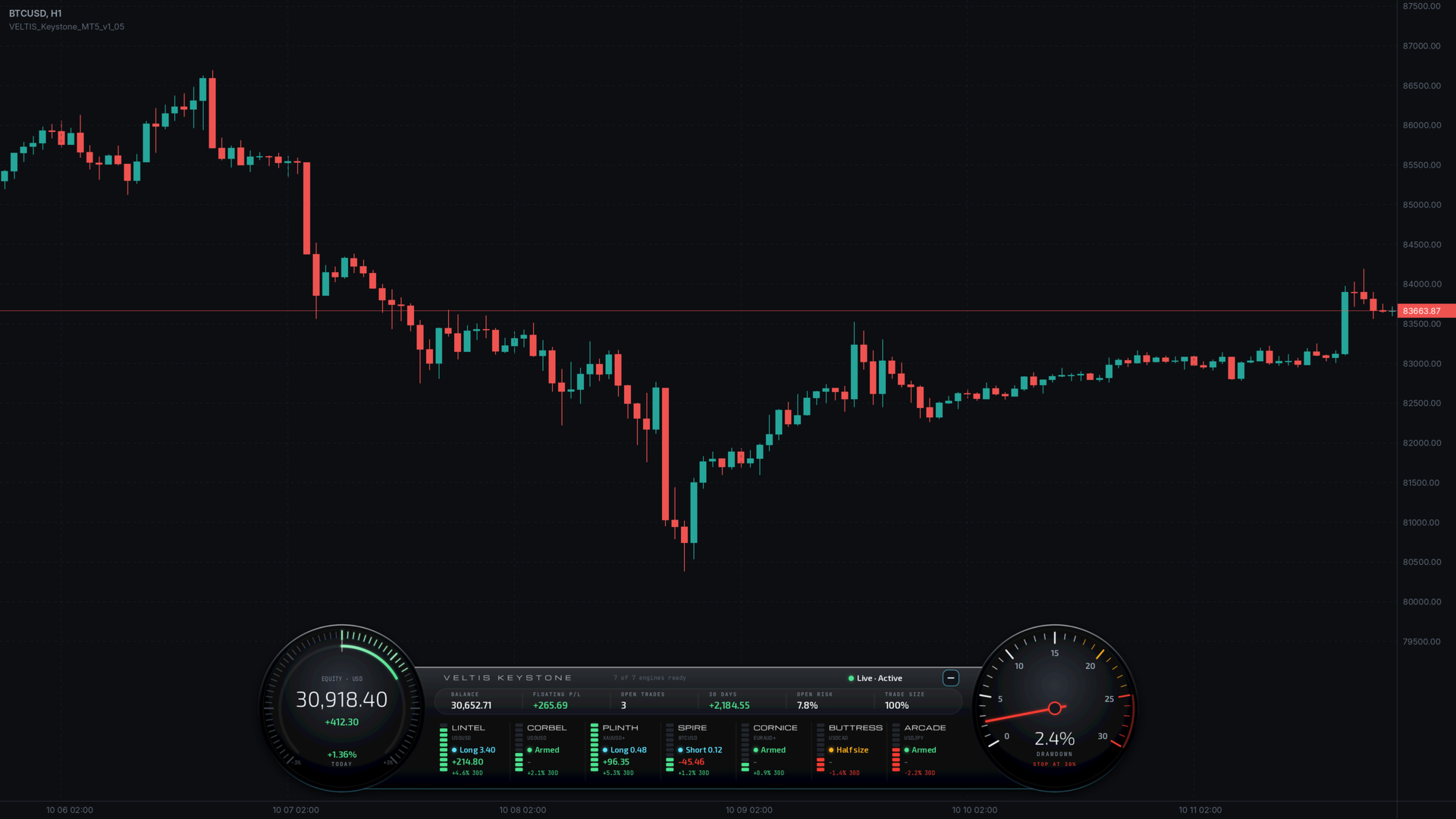
Keystone shows a wide instrument panel along the bottom of the chart. The left dial shows equity and today's result, with an arc that grows green for a gain and red for a loss. The right dial shows the current drawdown with a needle on a scale from 0 to 30, so the distance to the stop is always visible. In between you see balance, floating profit, open trades, the last 30 days, open risk and trade size, and a row with all seven engines: symbol, state, open profit and a small LED meter of each engine's last 30 days.
One click switches the panel to a slim capsule. The panel fits the chart width by itself, and its largest size can be set from 70% to 150%.
REQUIREMENTS
MetaTrader 5 with a hedging account.
A broker that offers WTI crude oil, gold, BTCUSD, EURAUD, USDCAD and USDJPY. The symbol names are found automatically.
Leverage of 1:100 was used in the tests.
A deposit of 5,000 USD or more is recommended. The tests used 10,000 USD.
Keystone should run around the clock on a VPS, because the bitcoin engine also trades on weekends.
HOW TO START
Open a BTCUSD H1 chart, the setup used in the tests. Attach Keystone and allow algo trading. Choose the risk profile and the engine set. Keystone prints the symbols it found in the Experts journal and shows its state on the dashboard.
RISK DISCLOSURE
Trading CFDs on oil, gold, bitcoin and currencies carries a high level of risk and is not suitable for everyone. Keystone sizes every trade from the balance, so results compound in both directions. Several engines can lose at the same time, and drawdowns of about 25% happened in the tests with the Standard profile. All figures above come from backtests in the MetaTrader 5 Strategy Tester on market data that was also used to select the engines, and they do not guarantee future results. Test Keystone on a demo account first and only trade with money you can afford to lose.