 MetaTrader 5
 Experts
 Indicateurs
 Scripts
 Bibliothèque
 Stockage
Rejoignez notre page de fans
- Publié par:
-
Amanda Vitoria De Paula Pereira
 I am a Software Engineer focused on quantitative architecture and high-frequency trade execution, I do not build generic retail scripts, I write clean code designed to survive live broker environments, toxic order flow, and server latency, my infrastructure handles complex math without freezing the
 - Vues:
- 229
- Note:
- Publié:
- Mise à jour:
-
 Vous manquez des opportunités de trading :
- Applications de trading gratuites
- Plus de 8 000 signaux à copier
- Actualités économiques pour explorer les marchés financiers
Inscription Se connecterVous acceptez la politique du site Web et les conditions d'utilisation
Si vous n'avez pas de compte, veuillez vous inscrire -
 Besoin d'un robot ou d'un indicateur basé sur ce code ? Commandez-le sur Freelance
Aller sur Freelance
Besoin d'un robot ou d'un indicateur basé sur ce code ? Commandez-le sur Freelance
Aller sur Freelance
Le défaut des bandes de volatilité pour les particuliers
La plupart des traders de détail s'appuient sur des outils de volatilité rigides tels que les bandes de Bollinger ou les enveloppes standard. Ces outils sont fondamentalement défectueux car ils calculent l'écart-type sur la base de moyennes mobiles linéaires. Lorsqu'un marché entre dans un état de choc systémique extrême, ces bandes traditionnelles disparaissent complètement, ne fournissant absolument aucune limite mathématique pour un retournement.
Les modèles quantitatifs institutionnels abandonnent complètement les moyennes linéaires. Ils utilisent plutôt des techniques de lissage non paramétriques pour cartographier la structure sous-jacente réelle de l'évolution des prix.
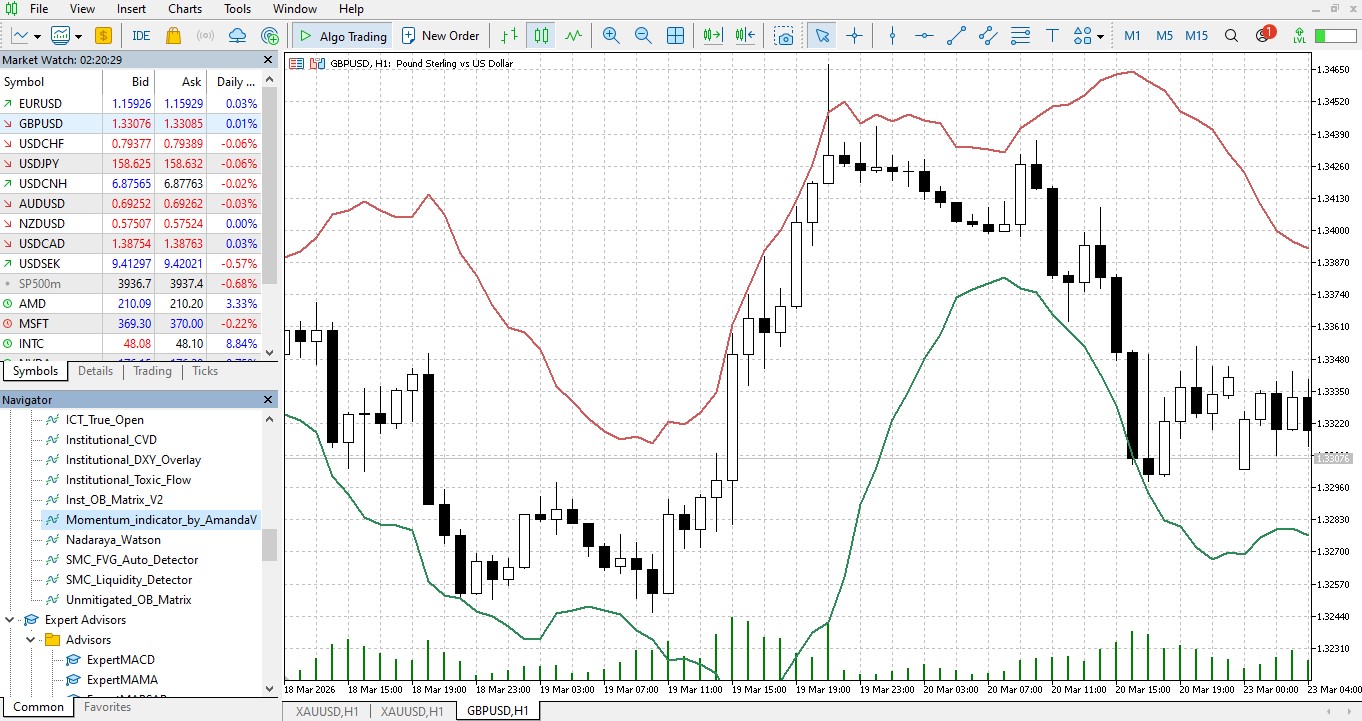
L'avantage institutionnel : la régression du noyau
L'indicateur Nadaraya-Watson Kernel Regression introduit un concept central d'apprentissage automatique directement dans votre terminal de trading local. En appliquant un noyau gaussien à l'action historique des prix, l'algorithme attribue des pondérations plus importantes aux groupes de prix localisés récents tout en filtrant de manière agressive les anomalies structurelles éloignées.
Cela crée un canal de régression hautement dynamique et non linéaire qui suit le véritable consensus du marché bien plus près que n'importe quel outil de volatilité standard.
Principales caractéristiques quantitatives
-
Renversement dynamique de la moyenne : Lorsque le prix d'exécution dépasse les limites extérieures de l'enveloppe du noyau, il s'agit d'une anomalie mathématique profonde - un vide de liquidité momentané où le marché s'est trop éloigné de sa moyenne de régression localisée.
-
Lissage non linéaire : ignore la rigidité de l'écart-type, ce qui permet aux bandes de s'adapter organiquement aux injections soudaines de volume.
-
Traitement en temps réel : L'architecture MQL5 sous-jacente est hautement optimisée pour exécuter ces calculs de distance complexes en temps réel, éliminant complètement le besoin de bibliothèques Python externes ou d'une forte limitation du processeur.
Traduit de l’anglais par MetaQuotes Ltd.
Code original : https://www.mql5.com/en/code/71353
 Institutional Gaussian Signal Filter (Zero-Lag ALMA)
Un filtre quantitatif gaussien conçu pour remplacer les moyennes mobiles de détail à retardement en appliquant un traitement numérique avancé des signaux pour éliminer le bruit du marché sans sacrifier la réactivité.
Institutional Z-Score Statistical Reversion
Cet oscillateur quantitatif professionnel remplace les indicateurs de momentum traditionnels tels que le RSI. Il calcule l'écart-type statistique de l'action des prix afin d'identifier les renversements mathématiquement épuisés.
Correlation Matrix Heatmap with Interactive Dashboard
Interactive Correlation Heatmap using high-performance MQL5 matrix functions. > Features a draggable, minimizable dashboard with instant multi-timeframe switching and a vivid 5-band color scale for real-time currency relationship analysis.
Swap Fee Monitor Panel
Swap Monitor Panel is a lightweight, fully customizable indicator that overlays a live swap rate dashboard directly on your MT5 chart. It scans every symbol in your MarketWatch window and presents long swap, short swap, estimated daily cost, and weekly cost side by side — all in one clean, readable panel.