Syed Jawad Hussain Naqvi
  • Información
no
experiencia
2
productos
0
versiones demo
0
trabajos
0
señales
0
suscriptores
Amigos 1
Syed Jawad Hussain Naqvi Ha publicado el producto

Cuadros multisesión avanzados (con etiquetas flotantes dinámicas) «Advanced Multi-Session Boxes» es una herramienta de gestión de operaciones premium y altamente optimizada, diseñada para trazar los rangos de las sesiones de Asia, Londres y Nueva York con una precisión milimétrica, basándose en la hora de su bróker. Esta herramienta ofrece una representación clara y visual de los rangos diarios de las sesiones directamente en sus gráficos, sin saturar la pantalla ni ralentizar su plataforma

Syed Jawad Hussain Naqvi
A Markov chain is a mathematical system that models a sequence of random events where the probability of the next event depends entirely on the current state, not on how the system arrived there. This "memoryless" characteristic is known as the Markov property.

How It Works
A Markov chain requires three main components:
States: All possible conditions or positions the system can be in (e.g., Sunny or Rainy).Transition Probabilities: The likelihood of moving from one specific state to another.T
ransition Matrix: A mathematical grid (or matrix) that organizes all transition probabilities.
Syed Jawad Hussain Naqvi Ha publicado el producto

Toma el control de tu rendimiento en el trading con el Pro Dashboard Screener . Diseñada para traders profesionales, esta herramienta ofrece una visión general clara, profesional y en tiempo real del estado de tu cuenta directamente en tu gráfico. Deja de cambiar de pestaña para consultar tus estadísticas. Con el Quant Pro Dashboard, tus métricas clave están siempre a la vista, lo que te permite centrarte en lo que más importa: tu análisis. Características principales: Información de la cuenta

Syed Jawad Hussain Naqvi
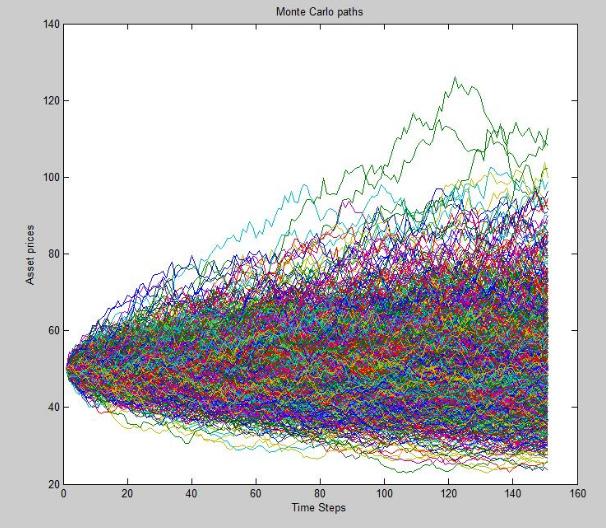
A Monte Carlo simulation is a mathematical technique that uses repeated random sampling to estimate the probability of different outcomes in complex systems. Instead of providing a single guess, it models uncertainty by running thousands of scenarios, resulting in a probability distribution of what might happen.

How It Works:
The name was inspired by the famous casinos in Monaco, as chance and randomness are the core of the modeling approach.

The simulation relies on three fundamental steps:

Define Probability Distributions: Replace uncertain variables (like market returns or task durations) with probability distributions (e.g., normal, uniform).

Random Sampling: Use a computer to randomly pick a value for each uncertain variable.

Repeat and Aggregate: Run this process thousands or millions of times. The result is a large dataset of possible outcomes that shows the most likely results and their probabilities.
Syed Jawad Hussain Naqvi
Se ha registrado en MQL5.community