Syed Jawad Hussain Naqvi
  • 정보
no
경험
4
제품
2
데모 버전
0
작업
0
거래 신호
0
구독자
Founder & Quant Developer Kernelis Capital
X
Quantitative Developer 🇵🇰

• MQL5 Author — algorithmic trading systems built on statistical modeling, recursive signal processing, and quantitative market analysis
• Technical skills: MQL5, Python, C++, statistical modeling, competitive programming
• Focus: correct engineering — proper recursive state management, honest backtesting, no shortcuts
• Belief: complex mathematics deserves clear, accessible explanations

📊 Working toward a career in quantitative finance

"If you can't explain it simply, you don't understand it well enough." — Albert Einstein
Syed Jawad Hussain Naqvi
게재된 코드 Fisher Transform Indicator
A Fisher Transform oscillator built from statistical first principles — normalizing price into a bounded range, then applying a logarithmic transform to produce sharp, well-defined reversal signals instead of the gradual turns typical of conventional oscillators. Internal recursive state is handled through proper calculation buffers for reliable, correct behavior across backtests. From the article series "Making Custom Indicators for Beginners."
Syed Jawad Hussain Naqvi
게재된 코드 SuperTrend Indicator
A custom SuperTrend indicator built from first principles, combining an ATR-based volatility band with a ratchet mechanism to produce a clean, non-repainting trend line. Internal recursive state is managed through properly registered calculation buffers, avoiding the state-loss bugs common in manually-managed array implementations. From the article series "Making Custom Indicators for Beginners."
Syed Jawad Hussain Naqvi
게재된 기고글 Making Custom Indicators for Beginners (Part 1): SuperTrend Indicator
Making Custom Indicators for Beginners (Part 1): SuperTrend Indicator

This article builds a robust SuperTrend indicator in MQL5 using ATR-based bands, a ratchet mechanism, and strict series indexing to avoid silent recursion errors and repainting on closed bars. We walk through buffer binding, ATR handle management, seeding, and arrow confirmation logic. A companion EA demonstrates practical integration

1
Syed Jawad Hussain Naqvi
게재된 코드 PRO SCREENER
Pro 대시보드 스크리너로 거래 성과를 직접 관리해 보세요. 진지한 트레이더를 위해 설계된 이 유틸리티는 차트 화면에서 바로 계좌의 상태를 깔끔하고 전문적이며 실시간으로 한눈에 파악할 수 있게 해줍니다.
Syed Jawad Hussain Naqvi 출시돈 제품

Alexander The Great EA is a premium Expert Advisor developed exclusively for MetaTrader 5. It is designed to automate disciplined trend-following strategies using intelligent market analysis, advanced risk management, and professional trade execution. Unlike traditional Expert Advisors that rely on basic indicator crossovers, Alexander The Great EA combines trend confirmation, execution filters, and structured money management into a reliable automated trading solution. Every component has been

Syed Jawad Hussain Naqvi
🚀 Why I Prefer Rule-Based Trading Over Emotional Trading

One of the biggest advantages of algorithmic trading is consistency.

An Expert Advisor doesn't get nervous after a losing trade.
It doesn't become overconfident after a winning streak.
It simply follows the rules it's been programmed to execute.

That's exactly why clear trading logic is so important.

Before writing a single line of MQL code, I always believe a strategy should answer these questions:

✔ What is the exact entry condition?
✔ What invalidates the setup?
✔ Where is the stop loss placed?
✔ When should the trade be closed?
✔ How much capital should be risked?
✔ When should the EA avoid trading?

If any of these questions can't be answered precisely, the strategy isn't ready for automation.

A successful Expert Advisor isn't built on assumptions—it's built on measurable, repeatable rules.

Automation doesn't improve a bad strategy, but it can execute a well-defined strategy with discipline and consistency.

What's one rule in your trading strategy that you think is impossible to automate? I'd love to hear different perspectives.

#MQL5 #MQL4 #ExpertAdvisor #AlgorithmicTrading #MetaTrader #Forex #TradingBots #Automation
Syed Jawad Hussain Naqvi
💡 A Good Expert Advisor Is More Than Just Buy and Sell Signals

Many traders focus only on entry conditions when designing an Expert Advisor.

In reality, professional algorithmic trading is about much more than finding the perfect entry.

A robust EA should answer questions like:

✅ When should trading stop after reaching a daily loss limit?

✅ Should the EA avoid trading during high-impact news?

✅ What happens if the spread suddenly doubles?

✅ How many positions can be open at the same time?

✅ Should trades be filtered by the higher timeframe trend?

These aren't "extra features"—they're part of building a reliable trading system.

I've found that the difference between a basic EA and a professional one is often the attention given to execution, risk control, and adaptability rather than the entry signal itself.

When developing an automated strategy, think beyond "When do I buy?" and start asking "How will this system behave in every market condition?"

A strong trading algorithm isn't just about generating signals—it's about making smart decisions consistently.

Which feature do you think every professional Expert Advisor should include?

#MQL5 #MQL4 #ExpertAdvisor #MetaTrader #AlgoTrading #Forex #Automation #TradingSystems
Syed Jawad Hussain Naqvi
📊 Backtesting Success Doesn't Always Mean Live Trading Success

One of the biggest misconceptions in algorithmic trading is believing that an excellent backtest guarantees future profits.

A strong backtest is important—but it's only the beginning.

Here are a few reasons why live results can differ:

✅ Spread Changes – Historical spreads are often lower than live market conditions.

✅ Slippage – Orders may execute at different prices during high volatility.

✅ Execution Speed – Network latency and broker execution can affect entries and exits.

✅ Market Evolution – Markets change over time. A strategy that worked well in one period may struggle in another.

✅ Over-Optimization – Tuning an EA too closely to historical data can create impressive backtests that fail in real trading.

When developing an Expert Advisor, I believe the goal isn't to create the "perfect" backtest—it's to build a system that remains consistent and robust across different market conditions.

A reliable trading algorithm should prioritize stability, disciplined risk management, and realistic testing over impressive historical statistics.

Would you rather have an EA with a 95% backtest that fails in live trading, or one with a realistic 70% backtest that performs consistently over time?

#MQL5 #MQL4 #ExpertAdvisor #AlgoTrading #Forex #MetaTrader #Backtesting #AlgorithmicTrading
Syed Jawad Hussain Naqvi
⚡ Why Most Trading Strategies Fail After Automation

A trading strategy may perform well manually, but that doesn't mean it will work the same as an Expert Advisor.

The biggest challenge isn't the strategy—it's translating it into precise code.

Here are a few common issues:

🔹 Ambiguous Rules
"Buy after a strong bullish candle" is not a programming rule. The EA needs exact conditions, such as candle size, timeframe, and confirmation criteria.

🔹 Repainting Indicators
Some indicators look perfect on historical charts but change their signals after a candle closes, leading to unrealistic backtests.

🔹 Execution Differences
Manual traders can interpret market conditions. An EA executes only the logic it's given, with no assumptions.

🔹 Missing Risk Controls
A robust EA should include features like spread filters, maximum daily loss, trading session controls, and proper position sizing—not just entry and exit rules.

🔹 Lack of Testing
Successful automation requires thorough backtesting, forward testing, and optimization before going live.

A reliable Expert Advisor isn't just a coded strategy—it's a complete trading system built with clear logic, disciplined risk management, and stable execution.

What do you think is the hardest part of turning a manual strategy into an automated one?

#MQL5 #MQL4 #ExpertAdvisor #AlgoTrading #MetaTrader #ForexTrading #Automation #Programming
Syed Jawad Hussain Naqvi
🚀 5 Common Mistakes That Make Most Expert Advisors Fail

Many traders believe an Expert Advisor becomes profitable simply because it follows a strategy. In reality, poor implementation is often the reason EAs fail.

Here are five mistakes I frequently see:

✅ No spread filter – Trades open when spreads are unusually high, increasing costs.

✅ No trading session control – Running the EA 24/7 can lead to unnecessary trades during low-liquidity hours.

✅ Weak risk management – Using fixed lots without proper money management can quickly increase drawdown.

✅ Ignoring news events – High-impact economic news can create volatility that many strategies aren't designed to handle.

✅ Poor code structure – Even a good strategy can become unreliable if the code is inefficient or difficult to maintain.

A well-developed EA is more than entry and exit rules. Features like risk controls, execution filters, and clean architecture often make the difference between a reliable trading system and one that struggles in live markets.

What feature do you think is most important in a professional Expert Advisor?

#MQL5 #MQL4 #ExpertAdvisor #AlgoTrading #MetaTrader #Forex #TradingAutomation
Syed Jawad Hussain Naqvi 출시돈 제품

SuperTrend Indicator for MetaTrader 5 "BEST IN INDUSTRY"  PLEASE LEAVE A REVIEW BELOW The SuperTrend Indicator is a trend-following technical indicator designed to  help traders identify the current market direction using the Average True Range (ATR). It automatically plots dynamic support and resistance lines that adjust according to market volatility, making it suitable for both trending and volatile market conditions. Unlike fixed moving averages, the SuperTrend adapts to changing

Syed Jawad Hussain Naqvi 출시돈 제품

Advanced Multi-Session Boxes (with Dynamic Floating Labels) Advanced Multi-Session Boxes is a premium, highly optimized trade-management utility designed to map out the Asian, London, and New York sessions with pinpoint accuracy based on your broker's time. This tool provides a clean, visual representation of daily session ranges directly on your charts without cluttering your screen or lagging your platform. Key Features: Anti-Overlap Graphics Engine: Built-in protection against the MetaTrader

Syed Jawad Hussain Naqvi
A Markov chain is a mathematical system that models a sequence of random events where the probability of the next event depends entirely on the current state, not on how the system arrived there. This "memoryless" characteristic is known as the Markov property.

How It Works
A Markov chain requires three main components:
States: All possible conditions or positions the system can be in (e.g., Sunny or Rainy).Transition Probabilities: The likelihood of moving from one specific state to another.T
ransition Matrix: A mathematical grid (or matrix) that organizes all transition probabilities.
Syed Jawad Hussain Naqvi 출시돈 제품

Take control of your trading performance with the Pro Dashboard Screener  Designed for serious traders, this utility provides a clean, professional, and real-time overview of your account's health directly on your chart. Stop switching between tabs to check your stats. With the Quant Pro Dashboard, your key metrics are always front and center, allowing you to focus on what matters most: your analysis. Key Features: Account Intelligence: Automatically detects your Account Number and Broker

Syed Jawad Hussain Naqvi
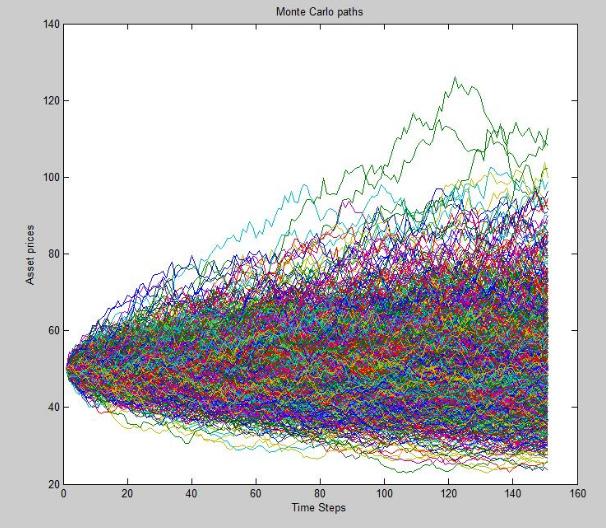
A Monte Carlo simulation is a mathematical technique that uses repeated random sampling to estimate the probability of different outcomes in complex systems. Instead of providing a single guess, it models uncertainty by running thousands of scenarios, resulting in a probability distribution of what might happen.

How It Works:
The name was inspired by the famous casinos in Monaco, as chance and randomness are the core of the modeling approach.

The simulation relies on three fundamental steps:

Define Probability Distributions: Replace uncertain variables (like market returns or task durations) with probability distributions (e.g., normal, uniform).

Random Sampling: Use a computer to randomly pick a value for each uncertain variable.

Repeat and Aggregate: Run this process thousands or millions of times. The result is a large dataset of possible outcomes that shows the most likely results and their probabilities.
Syed Jawad Hussain Naqvi
MQL5.커뮤니티에 등록됨