Discussing the article: "MQL5 Wizard Techniques you should know (Part 77): Using Gator Oscillator and the Accumulation/Distribution Oscillator"
Hi @Stephen Njuki
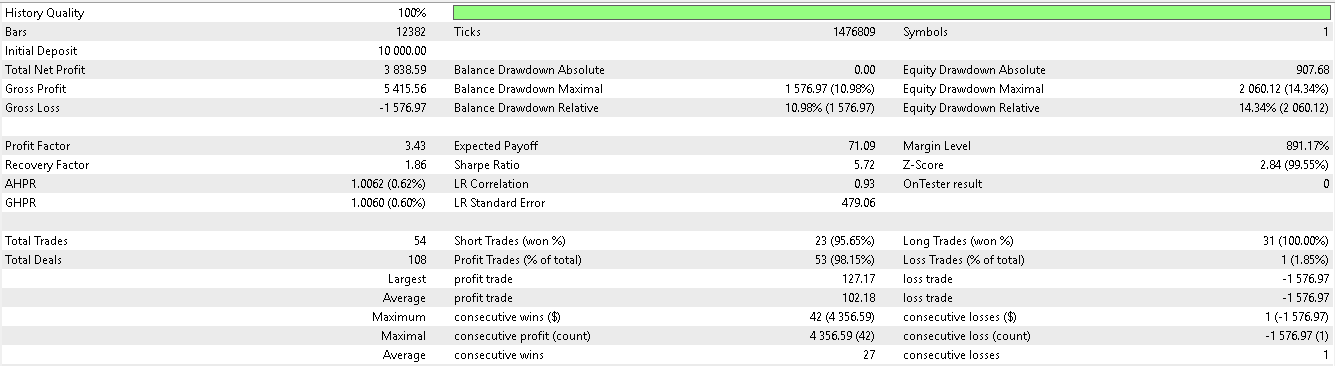
Thanks for the article! Which inputs were you using on GBPJPY in the M30 timeframe? I can't reproduce the outcome. Thanks in advance!
Thanks for the article! Which inputs were you using on GBPJPY in the M30 timeframe? I can't reproduce the outcome. Thanks in advance!
Dominic Michael Frehner #:
Hi @Stephen Njuki
Thanks for the article! Which inputs were you using on GBPJPY in the M30 timeframe? I can't reproduce the outcome. Thanks in advance!
Hi @Stephen Njuki
Thanks for the article! Which inputs were you using on GBPJPY in the M30 timeframe? I can't reproduce the outcome. Thanks in advance!
The statement in the Article that references GBPJPY is:
"We are going to be training with the pair GBP JPY, on the 30-minute timeframe for the year 2023 with 2024 being a forward walk test year."
- As the FX market is off-exchange (over-the-counter), each broker-dealer supplies its own unique data feed. The odds of you having the very same broker-dealer as the Author are slim.
- Did you train on the year 2023, and then walk forward on the year 2024? This would be your best shot toward an approximate reproduction of the Author's outcome.
- The greater point here is that it's likely up to you to train and walk forward the EA per your own environment, especially given the Author's above statement. This is generally the case with any off-the-shelf EA.
Hello,
you could try the attached input settings. I tested them for the year 2025.
Past performance is not a guarantee of future results. This is not financial advice.
Files:
77_0_GBPJPY.set
3 kb
77_0_GBPJPY.png
17 kb

You are missing trading opportunities:
- Free trading apps
- Over 8,000 signals for copying
- Economic news for exploring financial markets
Registration
Log in
You agree to website policy and terms of use
If you do not have an account, please register
Check out the new article: MQL5 Wizard Techniques you should know (Part 77): Using Gator Oscillator and the Accumulation/Distribution Oscillator.
The Gator Oscillator by Bill Williams and the Accumulation/Distribution Oscillator are another indicator pairing that could be used harmoniously within an MQL5 Expert Advisor. We use the Gator Oscillator for its ability to affirm trends, while the A/D is used to provide confirmation of the trends via checks on volume. In exploring this indicator pairing, as always, we use the MQL5 wizard to build and test out their potential.
The ‘alligator lines’, our signature buffers of ‘jaws’,’teeth’, and ‘lips’ use SMMAs with forward shift - making the indicator ‘see ahead’ and perform more like a market phase detector as opposed to a regular MA crossover. The gator-up histogram is the absolute difference between the jaw and teeth. When this increases, we can infer that the gator’s mouth is opening and therefore trends are commencing. The gator-down histogram on the other hand is the negative absolute difference between the teeth and the lips - an increase in this, meaning it is becoming more negative, confirms a trend phase or its exhaustion. The bar colours often used are green to mark increases in bar length. Red is for marking declines, and with stalls we maintain the previous bar colour.
The gator oscillator can be resourceful in timing entries to avoid sleepy/low-volatility markets. Entry can be devoted to only when the histogram bars are both expanding, as marked by the green signal - the eating phase. This indicator is also ideal for trend following and not range trading or mean-reversion. The use of shifts for these MA buffers is critical - the replacing of these with zero leads to a very different and not very helpful indicator. Finally, combination with price action in spotting breakouts or higher highs or lower lows, is essential as this is the only way this indicator can be used since it is direction neutral.
Author: Stephen Njuki