Discussion of article "Brute force approach to patterns search (Part III): New horizons"
A Bruteforce approach to pattern search (Part III) has been published: New Horizons:
Author: Evgeniy Ilin
Very interesting, but "announce the whole list please". :-)
Can we have a brief digest of the previous parts ?
A Bruteforce approach to pattern search (Part III) has been published: New Horizons:
Author: Evgeniy Ilin
I wonder if the author has any idea how the equity of TS used in real trading looks like?
I wonder if the author has any idea what the equity of the TS used in real trading looks like?
The author realises a lot of things, but he does not have enough time for all of them. Ask your question more boldly. I'm not biting.
Very interesting, but "announce the whole list please". :-)
Can we have a brief digest of the previous parts ?
I think I put some links at the end, you can look at the previous articles
The author presents a lot of things, but he doesn't have enough time for everything. Ask your question more boldly. I don't bite.
The topic is close and interesting, but the results are unimpressive to say the least.
That's why I'm asking if the author has an understanding of what he is looking for and/or wants to get as a result of his search?
I have many systems that exploit patterns. The methods by which these patterns are extracted I will not describe, of course.
But as a help, I will give a picture of one of the systems working on real money.

The system was made in April 2019, since then OUS proper.
P.S..
Every time I post something on this resource, I get very upset with the reaction of the natives in the future. So I'll probably delete this post after a while. No judgement.
The topic is close and interesting, but the results are, to put it mildly, unimpressive.
That's why I'm asking if the author has an understanding of what he is looking for and/or wants to get as a result of his search?
I have many systems that exploit patterns. Of course, I will not describe the methods by which these patterns are extracted.
But as a help, I will give a picture of one of the systems working on real money.
The system was made in April 2019, since then actually OUS.
P.S..
Every time I post something on this resource, I get very frustrated with the reaction of the natives afterwards. So I will probably delete this post after some time. No judgement.
The purpose of the article is not to find one or 2 working systems, but to develop a toolkit to automatically find just such a thing as you have shown, but there you have only 5 years of backtesting. I can find such a system with the help of my software. In general, I have a complete understanding of what how and why, and naturally my goals. Already the next article is slowly being prepared, the software is already well enough. Not all at once. It is not as important to get a profitable backtest as estimating the possible duration of the found pattern, which I am also investigating
The most recent picture (scheme) shows some deficiency of MT4 in the sense of working with spread.
Back in early 2013 I bought Tick Data Suite (TDS), and Click Bank still takes a small amount of money from my card every month as asubscription fee (about $5, probably at the exchange rate of 2013.And I wasable to usereal spread inan EA on ECNbackin 2013 after testing it on TDS.Of course, even then I didn't use home computers, but used VPS (in that period when RoboForex gave it for free to everyone).
Why such ignoring of TDS? Are you simply unaware of the existence of TDS?
Dear Evgeniy Ilin.
The most recent picture (scheme) shows some deficiency of MT4 in terms of working with spread.
Back in early 2013 I bought Tick Data Suite (TDS), and Click Bank still takes a small amount of money from my card every month as asubscription fee (about $5, probably at the exchange rate of 2013.And I wasable to usereal spread inan EA on ECNbackin 2013 after testing it on TDS.Of course, even then I didn't use home computers, but used VPS (in that period when RoboForex gave it for free to everyone).
Why such ignoring of TDS? Are you simply unaware of the existence of TDS?
There is MT5 platform, so hardly anyone is interested in TDS for testing.
There is MT5 platform, so hardly anyone is interested in TDS for testing.
I know about it, and this feature: "using real spread" is a relatively recent feature of MT5. But we are talking about MT4, where even earlier than MT5 it was possible to use real spread using MT4 in combination with TDS.
I know about it, and this feature: "using real spread" is a relatively recent feature of MT5. But we are talking about MT4, where even earlier than MT5 it was possible to use real spread using MT4 in combination with TDS.
This "recently" is already 5 years

- Free trading apps
- Over 8,000 signals for copying
- Economic news for exploring financial markets
You agree to website policy and terms of use
New article Brute force approach to patterns search (Part III): New horizons has been published:
This article provides a continuation to the brute force topic, and it introduces new opportunities for market analysis into the program algorithm, thereby accelerating the speed of analysis and improving the quality of results. New additions enable the highest-quality view of global patterns within this approach.
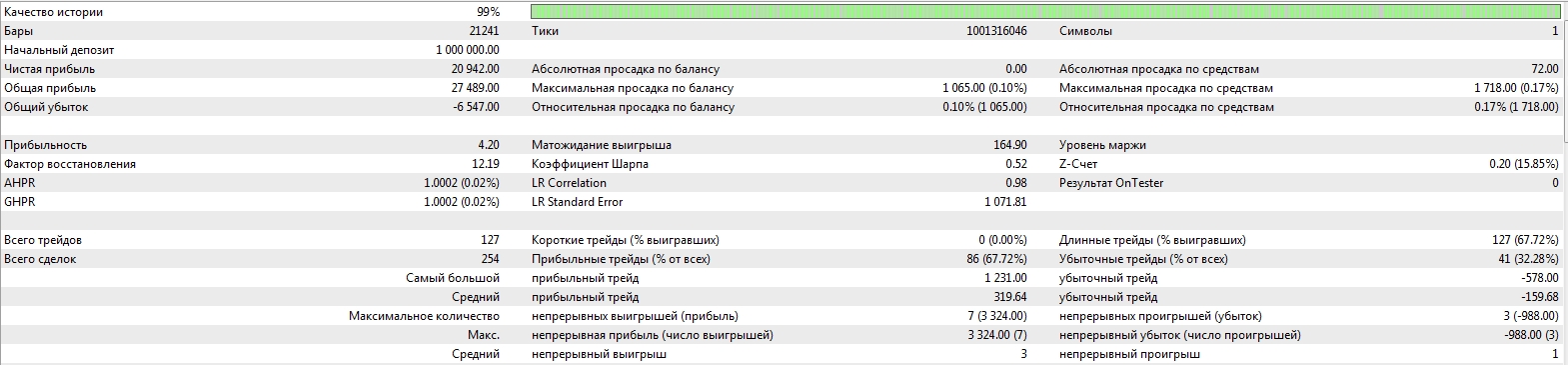
Also, during the testing process, I found some errors in the program algorithm, which often generated false results. I have already fixed them, but this reduced the number of found patterns. Nevertheless, this time was enough to find acceptable options. Now, let us the test in MetaTrader 5:
This test had less deals, because I limited the testing spread in order to obtain a stable test while trying to achieve higher profitability. However, as practice shown, this is not necessary. I will explain at the end of the article why. Despite the very small number of trades, this data can still be considered reliable, as they are based on a very long sample (it was obtained while brute forcing the formula coefficients on the first tab). In fact, on the first tab, we calculate all the bars that are in the loaded segment, so this is an ideal base for optimization. When we take a part of results of a large sample into a smaller sample, then the more data is contained in the first sample (orders), the stronger the smaller pattern.
Author: Evgeniy Ilin