Discussion of article "Optimal approach to the development and analysis of trading systems"
Eugene, good afternoon,
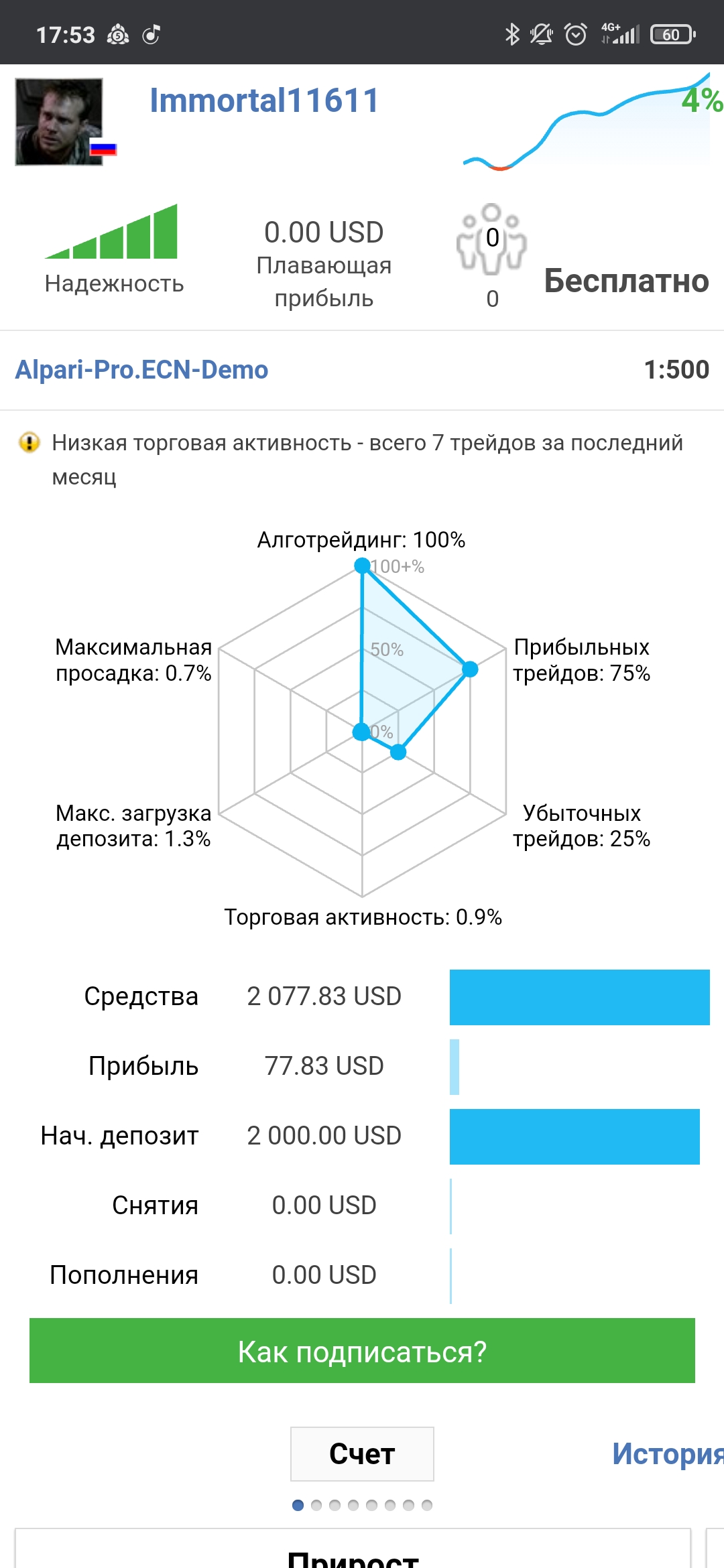
Not for a year yet, but it will be. I do not claim to be the truth in the last instance, but still there is some experience that I wanted to share, that's all. And why not? Plus some years I was engaged in theoretical research rather than real trading, gaining knowledge. And about the signal of this well imagine that the depot is not 2000 but 200, it turns out the percentage of growth in 10 times more, that is not 4 per cent and 40, less than half a year, a year will get about 100 per cent. Small but but safe.
I liked Eugene's style... some kind of original... I do not know why, but it seemed that the author is like Vasily Shukshin in a red shirt ... He writes like an axe chopping :-)
This passage made me think"what do you have to smoke to make this happen?".
...Плюс данного подхода еще в том, что чем проще система на выходе, то тем проще ее исправлять и модифицировать. Еще один интересный момент в том, что поначалу вообще ничего не работает, потом вдруг начинает работать, при этом ты задумываешь одну логику, а советник работает с инвертом вообще совсем по иной логике, понять которую не получается, в некоторых случаях нужны годы чтобы понять...
Or maybe I just didn't catch the idea, then pardon me..... But imho, it's better to know your algorithm exactly. Even if it is primitive at first.... Techno once wrote well about it.

- www.mql5.com
I liked Eugene's style... some kind of original... I do not know why, but it seemed that the author is like Vasily Shukshin in a red shirt ... He writes like an axe chopping :-)
This passage made me think"what do you have to smoke to make this happen?".
Or maybe I just didn't catch the idea, then pardon me..... But imho, it's better to know your algorithm exactly. Even if it is primitive at first.... Techno once wrote well about it.
I'm still reading the article, but I've looked at the author's code, a lot of non-standard methods cut the eye.
for example, a series of if() with checking of the only repeating condition (enum comparison)
and then in the body of the transition on the truth of this condition, loops that are duplicated in content
In general, when you learn to write such code, you will get this epiphany,
because you are used to solving problems in a simple way, for example, like this:
switch(MODE0)
{
 case MODE_1 : func(param1, param2, param3);
 break;
case MODE_2 : func(param4, param5, param6);
 break;
}
;)
UPD: I'm still figuring out the logic of using statics, but I think it's not as simple as it seems at first glance.
;)
I'm still reading the article, but I looked at the author's code, a lot of non-standard methods cuts the eye...
But I repent, I didn't even look at the code.... Mama-mia... I'm embarrassed to ask, what is this for?
class TickBox
   {
   public:
   static int BarsUp;
   static int BarsDown;
   static double PowerUp;
   static double PowerDown;
   static double PercentUp;
   static double PercentDown;
   static double PercentPowerUp;
   static double PercentPowerDown;
There is OOP and procedural style... Lapota...
Interesting function. And the main thing is that there are no checks that something is copied....
void CalcAllMQL5Values()//array recalculation
  {
   ArraySetAsSeries(High, false);
   ArraySetAsSeries(Low, false);
   ArraySetAsSeries(Close, false);
   ArraySetAsSeries(Open, false);
   ArraySetAsSeries(Time, false);
   ArraySetAsSeries(Volume, false);
   CopyHigh(_Symbol, _Period, 0, CandlesE, High);
   CopyLow(_Symbol, _Period, 0, CandlesE, Low);
   CopyClose(_Symbol, _Period, 0, CandlesE, Close);
   CopyOpen(_Symbol, _Period, 0, CandlesE, Open);
   CopyTime(_Symbol, _Period, 0, CandlesE, Time);
   CopyTickVolume(_Symbol, _Period, 0, CandlesE, Volume);
   ArraySetAsSeries(High, true);
   ArraySetAsSeries(Low, true);
   ArraySetAsSeries(Close, true);
   ArraySetAsSeries(Open, true);
   ArraySetAsSeries(Time, true);
   ArraySetAsSeries(Volume, true);
  }
Yeah, also rethinking the material a bit... it seems to me that the title is rather suitable for the article "Subjective Approach to Developing and Analysing Trading Systems". I really liked the approach in the section "The Mathematics of Optimal Search" for its originality. To search for efficiency in the number of code lines ... however...
And here I am, I repent, I didn't even look at the code..... Oh, mama mia. I'm embarrassed to ask, what's this for?
It has OOP and procedural style... Sweet...
Interesting function. And the main thing is that there are no checks that something is copied...
Yes, having rethought the material a bit more... it seems to me that the title is rather suitable for the article "Subjective Approach to Developing and Analysing Trading Systems". I really liked the approach in the section "The Mathematics of Optimal Search" for its originality. To search for efficiency in the number of code lines ... however...
in general, you should first get used to the author's style of presentation
Throw all this out of your head and start thinking about what moves the price. Also a prerequisite for you to have a chance to find something is the knowledge of mathematics and the ability to apply it, the ability to analyse the results, isolate the working points and understand their physics. All this is only achieved by practice + theory. In the end, everything will depend on the number of trading systems you have written and tested. You don't need to cobble together someone else's code, write it yourself from scratch. If someone thinks that he/she will take a mega grail and cut cabbage, he/she is mistaken. That's what I've been thinking for years. Thinking is not knowing.
and when you get into that philosophy, it's like: "Hey, guys! Got any seeds?"
then you'll be able to "cut the cabbage".
SUS: it's been a long time since I've looked at the profiles of my interlocutors... so you have written a hundred and fifty articles, and all articles are like a copy, readable code, and the style of presentation for nerds - bookish - I think the time of such articles has passed, it's time to "cut cabbage".
))))
okay, I apologise in advance for my behaviour to the author, I will not go into the discussion any more, there is an article - there is a customer, perhaps there is also a target audience
thanks for the article! - good mood can not be bought
And here I am, repenting, I didn't even look at the code..... Oh, mama mia. I'm embarrassed to ask, what's this for?
It has OOP and procedural style... Sweet...
Interesting function. And the main thing is that there are no checks that something is copied...
Yes, having rethought the material a bit more... it seems to me that the title is rather suitable for the article "Subjective Approach to Developing and Analysing Trading Systems". I really liked the approach in the section "The Mathematics of Optimal Search" for its originality. To search for efficiency in the number of code lines ... however...

- Free trading apps
- Over 8,000 signals for copying
- Economic news for exploring financial markets
You agree to website policy and terms of use
New article Optimal approach to the development and analysis of trading systems has been published:
In this article, I will show the criteria to be used when selecting a system or a signal for investing your funds, as well as describe the optimal approach to the development of trading systems and highlight the importance of this matter in Forex trading.
As we can see, there are signs of a global pattern here as well, and we just have to test the entire interval and see how it looks on a global scale:
The graph is far from perfect, but we can see the working segments. We may also try to introduce filters or carry out deep optimization. The choice of a specific tool is always optional. If we conduct a test on other pairs, then the result will probably be different, but after a certain amount of time spent, we will most likely find the optimal parameters for several pairs at the same time. If we manage to grasp and reinforce the physics, then the results will be even greater.
Even in its current form, the robot yielded acceptable results. There were very few deals but the EA worked on multiple currencies. Event the simplest code can serve as a powerful basis for developing an idea. Some systems can even be used without modifications.
Author: Evgeniy Ilin