Steve Rosenstock / Profil

- Information
|
8+ Jahre
Erfahrung
|
7
Produkte
|
186
Demoversionen
|
|
0
Jobs
|
0
Signale
|
0
Abonnenten
|
Neben meiner Tätigkeit als Trader habe ich jahrelang als Softwareentwickler gearbeitet und dabei Marktkenntnisse in maßgeschneiderte algorithmische Strategien und professionelle Trading-Tools umgesetzt.
Ich bin ein erfahrener Portfoliomanager und leidenschaftlicher Trader mit über einem Jahrzehnt Erfahrung. Ich verstehe sowohl den Code als auch die Charts. Nutzen Sie meine Erfahrung.
Senden Sie mir eine FREUNDSCHAFTSANFRAGE, damit wir Ideen austauschen können.
https://mql5.com/de/channels/xperthub
Ich bin ein erfahrener Portfoliomanager und leidenschaftlicher Trader mit über einem Jahrzehnt Erfahrung. Ich verstehe sowohl den Code als auch die Charts. Nutzen Sie meine Erfahrung.
Senden Sie mir eine FREUNDSCHAFTSANFRAGE, damit wir Ideen austauschen können.
https://mql5.com/de/channels/xperthub
Freunde
336
Anfragen


Ausgehend

Steve Rosenstock

September 14, 2026 – September 18, 2026
The FOMC Dot-Plot Massacre and the $4,390 Golden Stratosphere: Warsh’s Tightrope, 3-Hawks Revolt, and the Carry Trade Liquidation
Forex: The Fed Dot-Plot Whiplash and the Yen Short-Covering Squeeze
The foreign exchange complex operated as an industrial-scale liquidity shredder for retail momentum traders this week, proving yet again that trading breakout candles into a live FOMC interest-rate decision is merely a creative way to donate equity to prime brokers. The center of gravity all week was Washington on Wednesday, September 16, as the Federal Open Market Committee concluded its policy meeting. Under Chair Kevin Warsh, the Fed delivered an 8–3 split decision to hold the federal funds rate at 3.50%–3.75%. The fireworks erupted the moment the Summary of Economic Projections crossed the wires: the infamous "Dot Plot" shifted aggressively upward, indicating that the terminal rate will remain pinned well into 2027. Retail accounts that spent Wednesday afternoon front-running a dovish dollar dump on EUR/USD were ruthlessly trapped as the pair reversed from an intraday high of 1.1615 straight back down into the 1.1520 liquidity trough. Concurrently, USD/JPY experienced a violent 180-pip liquidation cascade down to 145.80 as algorithm-driven carry trade unwinds hit the tape ahead of the weekend. If your Expert Advisor lacked an automated spread-widening shutdown filter during the post-FOMC volatility spike, it was systematically drained by interbank market-maker sweeps.
Gold (XAU/USD): The $4,390 Stratospheric Breakout and the Paper Trapdoor
Gold’s order book delivered a spectacular, violent masterclass in algorithmic liquidity collection. After grinding through two weeks of suffocating range compression in the low $4,300s, spot gold erupted on Thursday following the Fed's formal admission that structural supply bottlenecks are keeping inflation sticky. Retail shorters—who had heavily loaded into resistance zones near $4,345 expecting the Fed's hawkish dot plot to trigger a massive selloff—were forced into immediate margin-call liquidation. The resulting cascade launched XAU/USD through the roof, tapping an intraday all-time high of $4,392.60 an ounce. But the smart money wasn’t done. The moment retail FOMO buyers piled into market-long orders at the top of the candle on Friday morning, institutional paper desks dumped massive block orders into the New York cash open. Gold violently plunged $55 in less than four hours to test resting liquidity at $4,338 before consolidating around $4,355. The move wasn't a sudden change in macro sentiment; it was a textbook stop-hunt designed to extract premium from both breakout buyers and over-leveraged shorts.
Macro: The 3-Hawk Revolt, AI Grid Squeezes, and the 2027 Capital Cost Reality
In the macroeconomic arena, the delusional fantasy of an imminent pivot back to cheap credit has officially received its final burial. While Chair Warsh attempted to project a steady hand during his press conference, the committee's deep ideological divide was on full display: the three hawkish dissenters once again demanded an immediate 25-basis-point rate hike, citing unanchored energy costs and sticky service-sector inflation. Compounding the pressure on risk assets, industrial reports released this week confirmed that electrical utilities are drastically hiking wholesale tariffs on regional AI data centers, turning tech infrastructure costs into an active stagflationary driver. Equity markets responded with a sharp spike in the VIX, shaking speculative capital out of mega-cap growth and rotating it aggressively into defensive commodities and high-yield short paper. We do not trade mainstream consensus, optimistic corporate guidance, or backward-looking moving averages. We exploit the cold mathematical divergence between institutional macro realities and retail chart illusions. Tighten your risk parameters, update your swap-fee calculations, or prepare to have your capital redistributed.
The FOMC Dot-Plot Massacre and the $4,390 Golden Stratosphere: Warsh’s Tightrope, 3-Hawks Revolt, and the Carry Trade Liquidation
Forex: The Fed Dot-Plot Whiplash and the Yen Short-Covering Squeeze
The foreign exchange complex operated as an industrial-scale liquidity shredder for retail momentum traders this week, proving yet again that trading breakout candles into a live FOMC interest-rate decision is merely a creative way to donate equity to prime brokers. The center of gravity all week was Washington on Wednesday, September 16, as the Federal Open Market Committee concluded its policy meeting. Under Chair Kevin Warsh, the Fed delivered an 8–3 split decision to hold the federal funds rate at 3.50%–3.75%. The fireworks erupted the moment the Summary of Economic Projections crossed the wires: the infamous "Dot Plot" shifted aggressively upward, indicating that the terminal rate will remain pinned well into 2027. Retail accounts that spent Wednesday afternoon front-running a dovish dollar dump on EUR/USD were ruthlessly trapped as the pair reversed from an intraday high of 1.1615 straight back down into the 1.1520 liquidity trough. Concurrently, USD/JPY experienced a violent 180-pip liquidation cascade down to 145.80 as algorithm-driven carry trade unwinds hit the tape ahead of the weekend. If your Expert Advisor lacked an automated spread-widening shutdown filter during the post-FOMC volatility spike, it was systematically drained by interbank market-maker sweeps.
Gold (XAU/USD): The $4,390 Stratospheric Breakout and the Paper Trapdoor
Gold’s order book delivered a spectacular, violent masterclass in algorithmic liquidity collection. After grinding through two weeks of suffocating range compression in the low $4,300s, spot gold erupted on Thursday following the Fed's formal admission that structural supply bottlenecks are keeping inflation sticky. Retail shorters—who had heavily loaded into resistance zones near $4,345 expecting the Fed's hawkish dot plot to trigger a massive selloff—were forced into immediate margin-call liquidation. The resulting cascade launched XAU/USD through the roof, tapping an intraday all-time high of $4,392.60 an ounce. But the smart money wasn’t done. The moment retail FOMO buyers piled into market-long orders at the top of the candle on Friday morning, institutional paper desks dumped massive block orders into the New York cash open. Gold violently plunged $55 in less than four hours to test resting liquidity at $4,338 before consolidating around $4,355. The move wasn't a sudden change in macro sentiment; it was a textbook stop-hunt designed to extract premium from both breakout buyers and over-leveraged shorts.
Macro: The 3-Hawk Revolt, AI Grid Squeezes, and the 2027 Capital Cost Reality
In the macroeconomic arena, the delusional fantasy of an imminent pivot back to cheap credit has officially received its final burial. While Chair Warsh attempted to project a steady hand during his press conference, the committee's deep ideological divide was on full display: the three hawkish dissenters once again demanded an immediate 25-basis-point rate hike, citing unanchored energy costs and sticky service-sector inflation. Compounding the pressure on risk assets, industrial reports released this week confirmed that electrical utilities are drastically hiking wholesale tariffs on regional AI data centers, turning tech infrastructure costs into an active stagflationary driver. Equity markets responded with a sharp spike in the VIX, shaking speculative capital out of mega-cap growth and rotating it aggressively into defensive commodities and high-yield short paper. We do not trade mainstream consensus, optimistic corporate guidance, or backward-looking moving averages. We exploit the cold mathematical divergence between institutional macro realities and retail chart illusions. Tighten your risk parameters, update your swap-fee calculations, or prepare to have your capital redistributed.
Steve Rosenstock
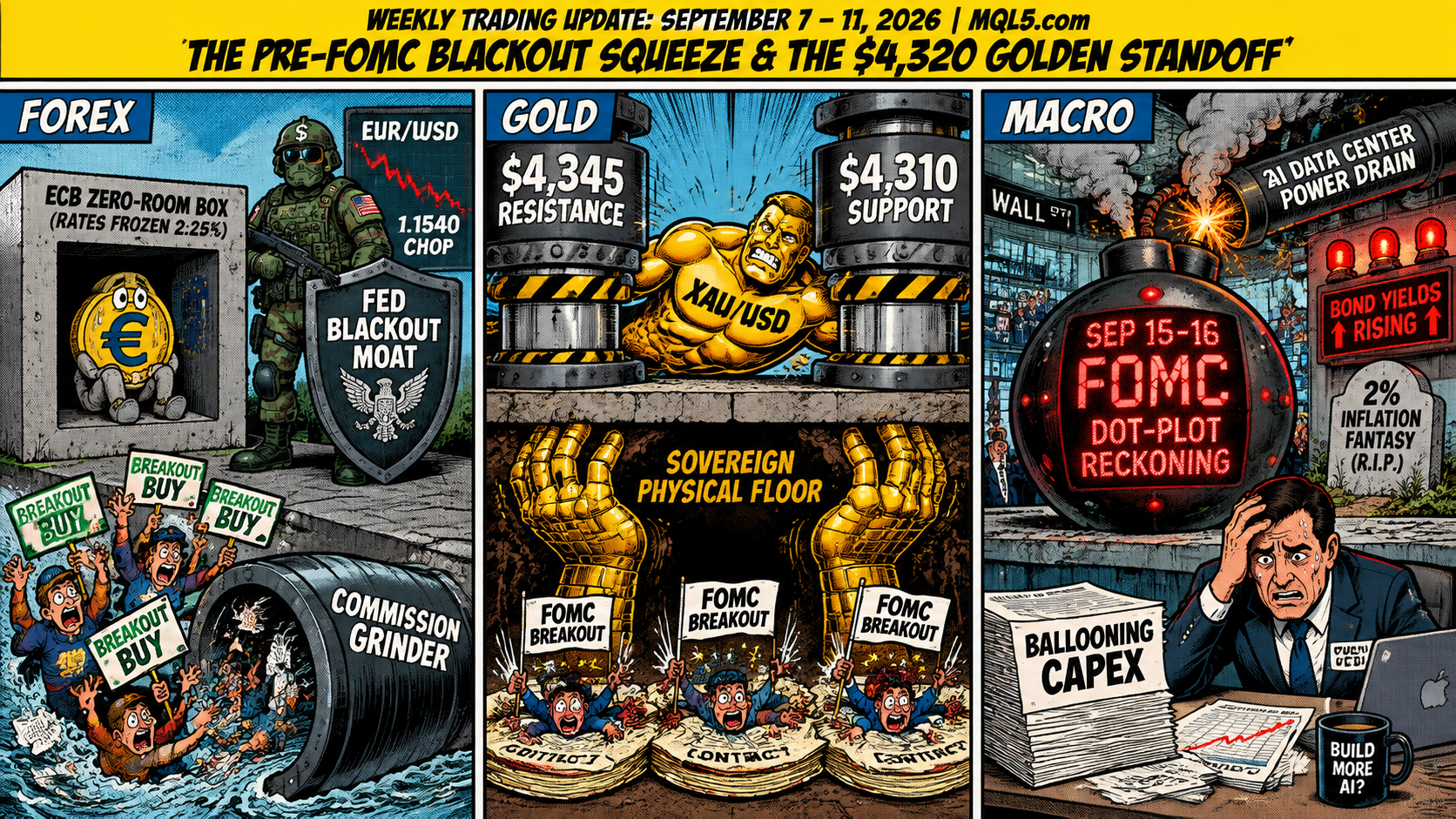
September 7, 2026 – September 11, 2026
The Pre-FOMC Blackout Squeeze and the $4,320 Golden Standoff: ECB Paralysis Redux, Silicon Illusions, and the Dot-Plot Ambush
Forex: The ECB’s Zero-Room Box and the Pre-FOMC Dollar Moat
The foreign exchange market operated as a textbook chop machine for retail sentiment this week, proving once again that trading major currency pairs with standard moving average crosses ahead of a double-barreled central bank calendar is simply an efficient way to fund tier-1 bank clearing desks. All eyes were on Frankfurt on Thursday, September 10, as the European Central Bank held its monetary policy meeting. With core European inflation stubbornly clinging near 2.8% and regional manufacturing metrics stagnating, Christine Lagarde and company delivered the expected non-event: benchmark rates were left firmly frozen at 2.25%. Lagarde’s press conference attempted to walk the tightrope between inflation fears and recession threats, but interbank desks recognized the structural reality: the ECB has zero policy ammo left. EUR/USD was repeatedly rejected at the 1.1590 liquidity pocket, sliding into an agonizing chop around 1.1540. Meanwhile, with Federal Reserve officials locked into their mandatory communications blackout ahead of the September 15–16 FOMC showdown, the US Dollar built a fortified defensive moat. Algorithmic liquidity sweeps ruthlessly hunted stops on both sides of the tape on EUR/USD and GBP/USD. If your automated grid EA traded without tight spread and volatility filters this week, it spent five days giving up balance to broker commissions.
Gold (XAU/USD): The $4,320 Blackout Trap and the Sovereign Floor Re-Test
Gold’s order book delivered a masterclass in synthetic range compression, designed to choke off volatility and force leveraged retail momentum traders into forced liquidations. Following the post-payroll flash drop to the low $4,300s, spot gold spent the week grinding inside a razor-thin $4,310 – $4,345 channel. Retail accounts, convinced that the upcoming Fed meeting guarantees an aggressive dollar dump, spent Tuesday through Thursday loading into early breakout longs. The institutional reaction was swift and mechanical: paper sell blocks were quietly unloaded into the early New York sessions, triggering algorithmic stop-runs back down to $4,318. However, every attempt to smash gold below the psychological $4,300 barrier collided with massive sovereign limit-buy orders quietly resting off-exchange. The metal bounced back to close near $4,328, trapping both late shorters and over-leveraged breakout buyers. The smart money isn’t taking speculative directional bets inside the blackout window; they are letting retail margin burn while positioning for the upcoming dot-plot repricing.
Macro: The Dot-Plot Reckoning, AI Capex Fatigue, and the Stagflationary Standoff
In the macro sphere, complacency met the cold arithmetic of structural stagflation. Equity indices spent the week drifting sideways near record highs on visibly thinning volume, while underneath the surface, institutional smart money began rotating defensive hedges into place. Tech equities faced mounting scrutiny as semiconductor forward-guidance revealed ballooning power grid and capital expenditure costs that standard quarterly cash flows simply cannot match. Simultaneously, sovereign bond yields across the US and Europe consolidated at elevated multi-year levels, reflecting zero market confidence in a painless return to 2% inflation targets. The market heads into next week’s FOMC meeting facing an explicit split: will Kevin Warsh hold the benchmark rate at 3.50%–3.75%, or will the three vocal hawkish dissenters force the issue to combat unanchored energy and services inflation? We do not gamble on central bank press conferences, corporate PR statements, or lagging oscillators. We exploit the mathematical divergence between retail fairy tales and institutional liquidity architecture. Tighten your EA risk limits, turn off unhedged martingale logic, or prepare to have your account balance redistributed.
The Pre-FOMC Blackout Squeeze and the $4,320 Golden Standoff: ECB Paralysis Redux, Silicon Illusions, and the Dot-Plot Ambush
Forex: The ECB’s Zero-Room Box and the Pre-FOMC Dollar Moat
The foreign exchange market operated as a textbook chop machine for retail sentiment this week, proving once again that trading major currency pairs with standard moving average crosses ahead of a double-barreled central bank calendar is simply an efficient way to fund tier-1 bank clearing desks. All eyes were on Frankfurt on Thursday, September 10, as the European Central Bank held its monetary policy meeting. With core European inflation stubbornly clinging near 2.8% and regional manufacturing metrics stagnating, Christine Lagarde and company delivered the expected non-event: benchmark rates were left firmly frozen at 2.25%. Lagarde’s press conference attempted to walk the tightrope between inflation fears and recession threats, but interbank desks recognized the structural reality: the ECB has zero policy ammo left. EUR/USD was repeatedly rejected at the 1.1590 liquidity pocket, sliding into an agonizing chop around 1.1540. Meanwhile, with Federal Reserve officials locked into their mandatory communications blackout ahead of the September 15–16 FOMC showdown, the US Dollar built a fortified defensive moat. Algorithmic liquidity sweeps ruthlessly hunted stops on both sides of the tape on EUR/USD and GBP/USD. If your automated grid EA traded without tight spread and volatility filters this week, it spent five days giving up balance to broker commissions.
Gold (XAU/USD): The $4,320 Blackout Trap and the Sovereign Floor Re-Test
Gold’s order book delivered a masterclass in synthetic range compression, designed to choke off volatility and force leveraged retail momentum traders into forced liquidations. Following the post-payroll flash drop to the low $4,300s, spot gold spent the week grinding inside a razor-thin $4,310 – $4,345 channel. Retail accounts, convinced that the upcoming Fed meeting guarantees an aggressive dollar dump, spent Tuesday through Thursday loading into early breakout longs. The institutional reaction was swift and mechanical: paper sell blocks were quietly unloaded into the early New York sessions, triggering algorithmic stop-runs back down to $4,318. However, every attempt to smash gold below the psychological $4,300 barrier collided with massive sovereign limit-buy orders quietly resting off-exchange. The metal bounced back to close near $4,328, trapping both late shorters and over-leveraged breakout buyers. The smart money isn’t taking speculative directional bets inside the blackout window; they are letting retail margin burn while positioning for the upcoming dot-plot repricing.
Macro: The Dot-Plot Reckoning, AI Capex Fatigue, and the Stagflationary Standoff
In the macro sphere, complacency met the cold arithmetic of structural stagflation. Equity indices spent the week drifting sideways near record highs on visibly thinning volume, while underneath the surface, institutional smart money began rotating defensive hedges into place. Tech equities faced mounting scrutiny as semiconductor forward-guidance revealed ballooning power grid and capital expenditure costs that standard quarterly cash flows simply cannot match. Simultaneously, sovereign bond yields across the US and Europe consolidated at elevated multi-year levels, reflecting zero market confidence in a painless return to 2% inflation targets. The market heads into next week’s FOMC meeting facing an explicit split: will Kevin Warsh hold the benchmark rate at 3.50%–3.75%, or will the three vocal hawkish dissenters force the issue to combat unanchored energy and services inflation? We do not gamble on central bank press conferences, corporate PR statements, or lagging oscillators. We exploit the mathematical divergence between retail fairy tales and institutional liquidity architecture. Tighten your EA risk limits, turn off unhedged martingale logic, or prepare to have your account balance redistributed.
Steve Rosenstock
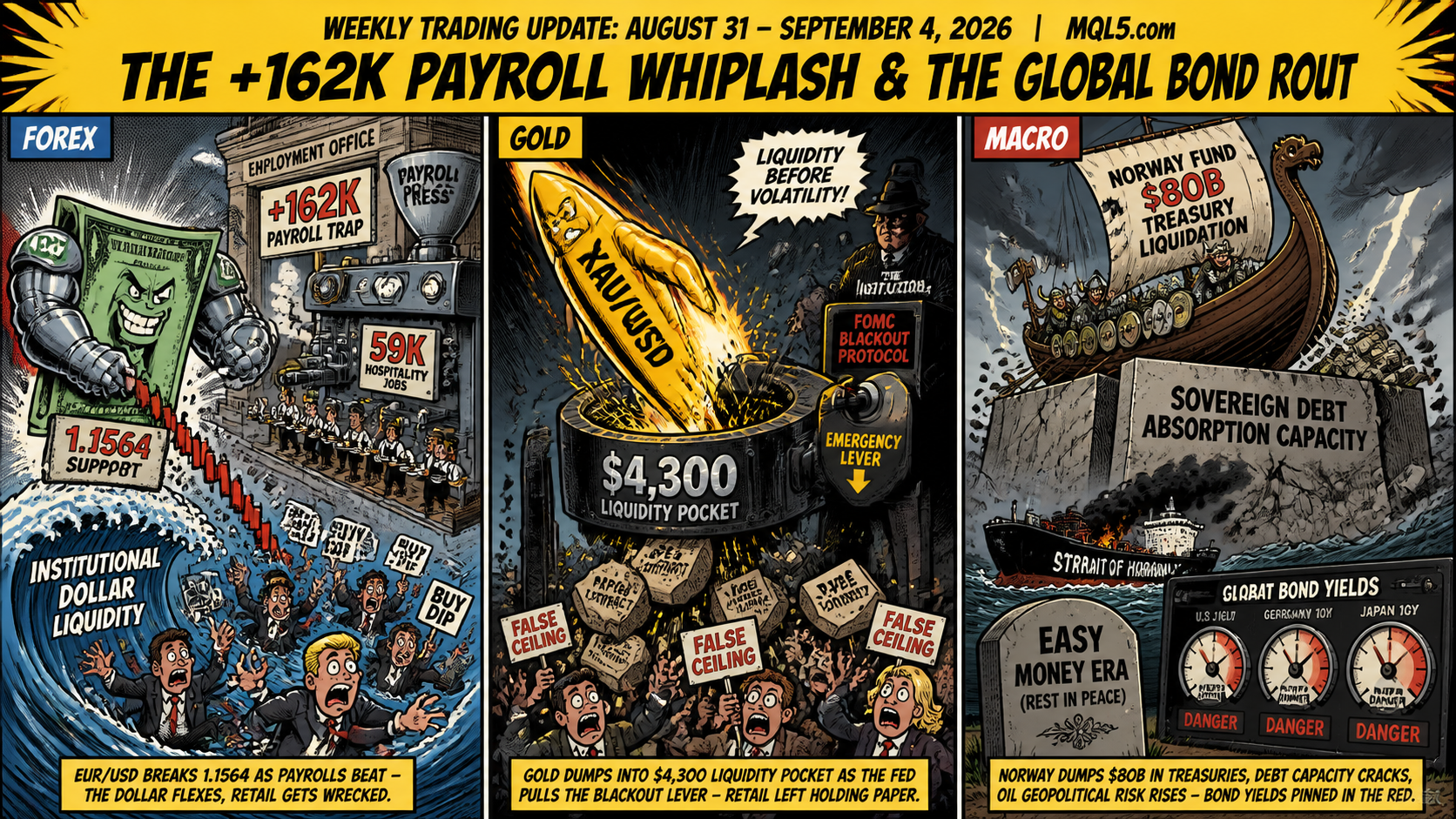
August 31, 2026 – September 4, 2026
The +162K Payroll Whiplash and the Global Bond Rout: Barista Math, Blackout Windows, and the $4,300 Gold Clampdown
Forex: The +162K Payroll Trap and the 1.1564 Euro Defence
The foreign exchange complex transformed into an aggressive stop-hunting execution zone on Friday, September 4, proving yet again that trying to front-run US employment data with retail RSI divergences is merely an expensive donation to interbank clearing desks. All week long, retail accounts had aggressively loaded up on EUR/USD longs near the 1.1630 ceiling, betting that July's dismal negative payroll revisions would repeat. The institutional algorithms had an entirely different trap prepared. Friday’s headline nonfarm payrolls printed a scorching +162,000 additions—pulverizing the consensus expectation of 55,000. The Greenback exploded higher in milliseconds, hammering EUR/USD straight down to test critical weekly support at 1.1564/78. Retail breakout buyers were systematically flushed, completely ignoring the fact that 59,000 of those "miracle" jobs were generated by bars and restaurants while the core Information sector shed 23,000 professional positions. Meanwhile, USD/JPY surged back toward its high-yield carry trajectory as market participants realized that the interest-rate differential remains firmly anchored in Washington’s favor. If your Expert Advisor wasn't equipped with a news-event kill switch this week, its margin balance was liquidated into the interbank spread.
Gold (XAU/USD): The $4,300 Blackout Squeeze and the Rate-Hike Phantom
Gold’s tape this week offered a textbook clinic in institutional risk reduction ahead of the Federal Reserve’s mandatory pre-meeting communications blackout. Spot gold entered the week trading defensively, before Friday’s data shock stripped late-joining retail longs of their collateral. As the blockbuster payrolls report crossed the terminals, institutional desks rushed to price in the possibility that the hawkish voting bloc at the FOMC might push for a 25-basis-point rate hike at the September 15–16 meeting. COMEX paper blocks were aggressively dumped into the New York session, driving spot gold down roughly 1% to drill into the $4,300 – $4,320 liquidity pocket. Retail dip-buyers who attempted to catch the falling knife near $4,350 saw their trailing stops swept clean as spot yields spiked. The smart money didn’t panic; institutional accounts simply vacuumed up the stop-loss orders of over-leveraged retail traders, resetting their books at the bottom of the weekly range before Fed officials went radio silent for the blackout period.
Macro: The Multi-Decade Sovereign Bond Rout and the Illusion of Easy Capital
In the macro sphere, the mainstream media's desperate attempts to spin a "goldilocks economy" collided directly with structural math. The real story this week wasn't corporate PR; it was the brutal, coordinated rout across global sovereign debt markets. Benchmark bond yields across five major economies hit multi-decade highs simultaneously, underscored by Norway’s sovereign wealth fund executing an eye-watering $80 billion liquidation of US Treasuries. Sovereign debt supply is overwhelming global absorption capacity, pushing terminal yields higher and driving equity indices into late-week chop. Compounding the friction, persistent geopolitical flashpoints in the Strait of Hormuz kept crude oil bids elevated, preventing central banks from declaring victory over sticky supply-chain inflation. We do not trade manufactured headline optimism, political election narratives, or backward-looking moving averages. We trade the brutal mathematical divergence between structural bond selloffs and retail complacency. Recalibrate your risk limits, adjust your automated strategies for permanent sovereign debt stress, or prepare to have your account balance extracted by the market.
The +162K Payroll Whiplash and the Global Bond Rout: Barista Math, Blackout Windows, and the $4,300 Gold Clampdown
Forex: The +162K Payroll Trap and the 1.1564 Euro Defence
The foreign exchange complex transformed into an aggressive stop-hunting execution zone on Friday, September 4, proving yet again that trying to front-run US employment data with retail RSI divergences is merely an expensive donation to interbank clearing desks. All week long, retail accounts had aggressively loaded up on EUR/USD longs near the 1.1630 ceiling, betting that July's dismal negative payroll revisions would repeat. The institutional algorithms had an entirely different trap prepared. Friday’s headline nonfarm payrolls printed a scorching +162,000 additions—pulverizing the consensus expectation of 55,000. The Greenback exploded higher in milliseconds, hammering EUR/USD straight down to test critical weekly support at 1.1564/78. Retail breakout buyers were systematically flushed, completely ignoring the fact that 59,000 of those "miracle" jobs were generated by bars and restaurants while the core Information sector shed 23,000 professional positions. Meanwhile, USD/JPY surged back toward its high-yield carry trajectory as market participants realized that the interest-rate differential remains firmly anchored in Washington’s favor. If your Expert Advisor wasn't equipped with a news-event kill switch this week, its margin balance was liquidated into the interbank spread.
Gold (XAU/USD): The $4,300 Blackout Squeeze and the Rate-Hike Phantom
Gold’s tape this week offered a textbook clinic in institutional risk reduction ahead of the Federal Reserve’s mandatory pre-meeting communications blackout. Spot gold entered the week trading defensively, before Friday’s data shock stripped late-joining retail longs of their collateral. As the blockbuster payrolls report crossed the terminals, institutional desks rushed to price in the possibility that the hawkish voting bloc at the FOMC might push for a 25-basis-point rate hike at the September 15–16 meeting. COMEX paper blocks were aggressively dumped into the New York session, driving spot gold down roughly 1% to drill into the $4,300 – $4,320 liquidity pocket. Retail dip-buyers who attempted to catch the falling knife near $4,350 saw their trailing stops swept clean as spot yields spiked. The smart money didn’t panic; institutional accounts simply vacuumed up the stop-loss orders of over-leveraged retail traders, resetting their books at the bottom of the weekly range before Fed officials went radio silent for the blackout period.
Macro: The Multi-Decade Sovereign Bond Rout and the Illusion of Easy Capital
In the macro sphere, the mainstream media's desperate attempts to spin a "goldilocks economy" collided directly with structural math. The real story this week wasn't corporate PR; it was the brutal, coordinated rout across global sovereign debt markets. Benchmark bond yields across five major economies hit multi-decade highs simultaneously, underscored by Norway’s sovereign wealth fund executing an eye-watering $80 billion liquidation of US Treasuries. Sovereign debt supply is overwhelming global absorption capacity, pushing terminal yields higher and driving equity indices into late-week chop. Compounding the friction, persistent geopolitical flashpoints in the Strait of Hormuz kept crude oil bids elevated, preventing central banks from declaring victory over sticky supply-chain inflation. We do not trade manufactured headline optimism, political election narratives, or backward-looking moving averages. We trade the brutal mathematical divergence between structural bond selloffs and retail complacency. Recalibrate your risk limits, adjust your automated strategies for permanent sovereign debt stress, or prepare to have your account balance extracted by the market.
Steve Rosenstock
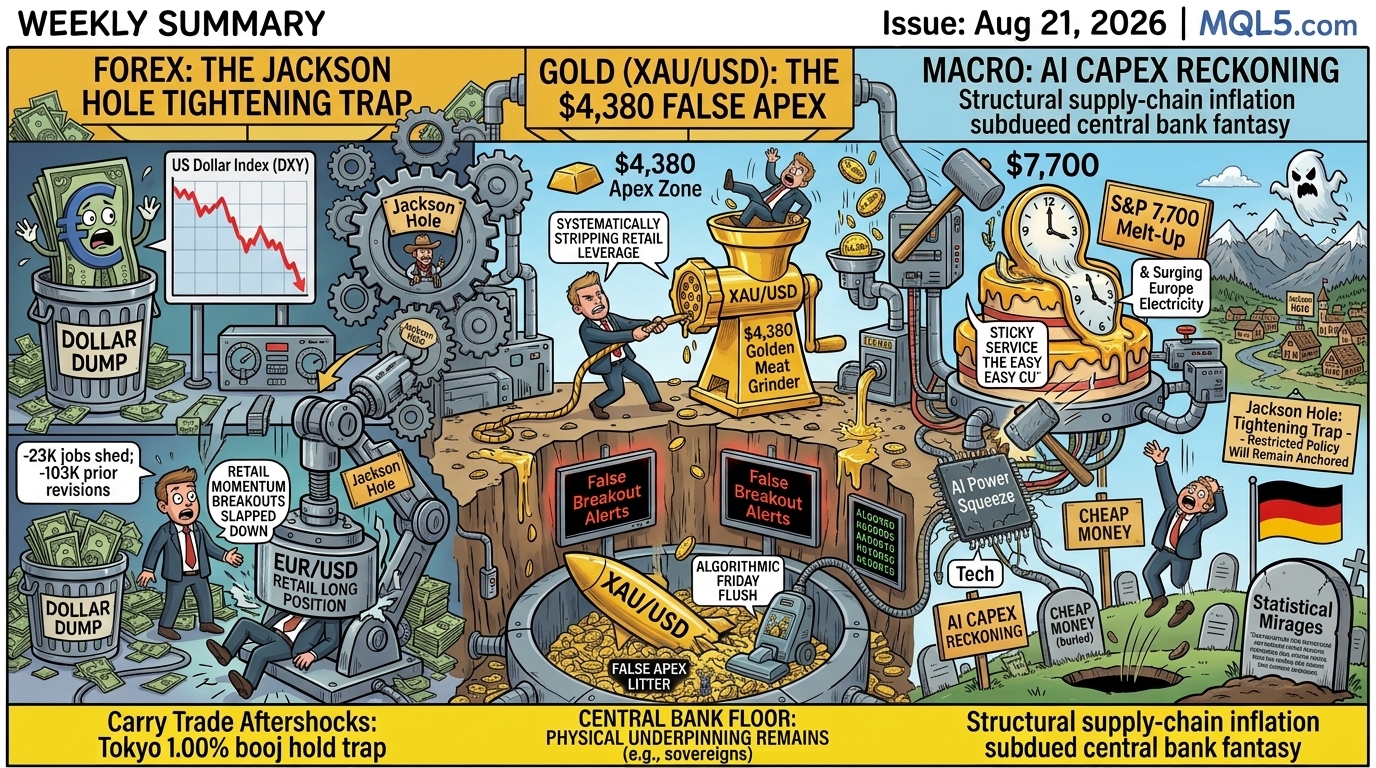
August 24, 2026 – August 28, 2026
The Jackson Hole Hangover and the 147-Yen Carry Trap: PCE Revisions, Sovereign Floor Runs, and the $4,350 Algorithmic Ping-Pong
Forex: The 147-Yen Carry Trap and the Euro’s Yield Paralysis
The currency markets functioned as a high-frequency slaughterhouse this week, proving yet again that trading major FX pairs on oscillator divergences during the post-Jackson Hole hangover is simply voluntary liquidity provision for interbank algorithms. Following last week’s symposium rhetoric, institutional order flow spent the entire week methodically weaponizing the wide interest-rate differentials against retail dip-buyers. The epicenter of the chop was USD/JPY. Retail accounts, convinced that the Bank of Japan's 1.00% benchmark hold signaled a structural top in the Dollar, spent Monday and Tuesday relentlessly building long Yen positions. Smart money algorithms responded with textbook execution: resting bids below 146.50 were systematically swept, triggering stop-runs that propelled USD/JPY straight back up through 147.80. Meanwhile, EUR/USD remained trapped in an expensive, high-fee chop zone around 1.1580. Every retail attempt to buy EUR breakouts on the back of sticky European producer prices was swiftly slapped down by automated institutional cross-asset selling as US 10-year yields held firm above 4.30%. If your Expert Advisor ran unhedged grid parameters into the Friday fixes, it was dismantled by algorithmic liquidity sweeps.
Gold (XAU/USD): The $4,350 Algorithmic Ping-Pong and the Sovereign Physical Vacuum
Gold’s order book delivered a masterclass in engineered distribution and high-altitude range containment. Following the sharp algorithmic flush from previous highs, spot gold spent the weekly sessions bouncing inside a vicious $4,330 – $4,365 corridor. Retail momentum chasers spent Wednesday's session aggressively shorting every intraday rally, assuming the upward momentum had finally broken after the Fed reiterated its restrictive stance. However, the retail crowd failed to inspect the structural tape: sovereign physical buyers and eastern central banks quietly absorbed off-exchange allocations every time the price touched the $4,335 support pocket. On Friday, the release of the US Core PCE price index—arriving firmly at 3.3% year-over-year—triggered an immediate algorithmic short-squeeze, rocketing XAU/USD through overhead resistance to test $4,368.20 before settling into an illiquid weekend close. The smart money didn’t launch a massive breakout; they simply vacuumed up the stops of late shorters while preserving their structural physical floor.
Macro: Sticky Core PCE, The Sovereign Debt Squeeze, and the 2026 Rate-Cut Mirage
In the macro theater, the mainstream media's desperate campaign to sell the "painless disinflation" fairy tale was once again dismantled by mathematical reality. The headline event of the week—Friday’s US Personal Consumption Expenditures (PCE) report—confirmed that core inflation remains firmly glued above central bank comfort zones, driven by relentless logistics bottlenecks, tariff pass-throughs, and runaway grid-power demands from industrial AI data centers. While equity indices drifted near all-time highs on thin late-August volume, structural credit markets flashed persistent warning lights. Sovereign debt supply pressures pushed benchmark yields higher, burying whatever lingering hopes retail traders had for a dovish pivot in the autumn. The economic machine is not returning to the era of zero-cost capital; it is grinding through a structural stagflationary plateau where real borrowing costs remain permanently higher. We don’t trade mainstream optimism, political press conferences, or lagging indicators. We exploit the mathematical divergence between institutional macro realities and retail chart delusions. Recalibrate your backtests for elevated swap costs, enforce strict volatility filters in your algorithms, or prepare to have your margin balance redistributed.
The Jackson Hole Hangover and the 147-Yen Carry Trap: PCE Revisions, Sovereign Floor Runs, and the $4,350 Algorithmic Ping-Pong
Forex: The 147-Yen Carry Trap and the Euro’s Yield Paralysis
The currency markets functioned as a high-frequency slaughterhouse this week, proving yet again that trading major FX pairs on oscillator divergences during the post-Jackson Hole hangover is simply voluntary liquidity provision for interbank algorithms. Following last week’s symposium rhetoric, institutional order flow spent the entire week methodically weaponizing the wide interest-rate differentials against retail dip-buyers. The epicenter of the chop was USD/JPY. Retail accounts, convinced that the Bank of Japan's 1.00% benchmark hold signaled a structural top in the Dollar, spent Monday and Tuesday relentlessly building long Yen positions. Smart money algorithms responded with textbook execution: resting bids below 146.50 were systematically swept, triggering stop-runs that propelled USD/JPY straight back up through 147.80. Meanwhile, EUR/USD remained trapped in an expensive, high-fee chop zone around 1.1580. Every retail attempt to buy EUR breakouts on the back of sticky European producer prices was swiftly slapped down by automated institutional cross-asset selling as US 10-year yields held firm above 4.30%. If your Expert Advisor ran unhedged grid parameters into the Friday fixes, it was dismantled by algorithmic liquidity sweeps.
Gold (XAU/USD): The $4,350 Algorithmic Ping-Pong and the Sovereign Physical Vacuum
Gold’s order book delivered a masterclass in engineered distribution and high-altitude range containment. Following the sharp algorithmic flush from previous highs, spot gold spent the weekly sessions bouncing inside a vicious $4,330 – $4,365 corridor. Retail momentum chasers spent Wednesday's session aggressively shorting every intraday rally, assuming the upward momentum had finally broken after the Fed reiterated its restrictive stance. However, the retail crowd failed to inspect the structural tape: sovereign physical buyers and eastern central banks quietly absorbed off-exchange allocations every time the price touched the $4,335 support pocket. On Friday, the release of the US Core PCE price index—arriving firmly at 3.3% year-over-year—triggered an immediate algorithmic short-squeeze, rocketing XAU/USD through overhead resistance to test $4,368.20 before settling into an illiquid weekend close. The smart money didn’t launch a massive breakout; they simply vacuumed up the stops of late shorters while preserving their structural physical floor.
Macro: Sticky Core PCE, The Sovereign Debt Squeeze, and the 2026 Rate-Cut Mirage
In the macro theater, the mainstream media's desperate campaign to sell the "painless disinflation" fairy tale was once again dismantled by mathematical reality. The headline event of the week—Friday’s US Personal Consumption Expenditures (PCE) report—confirmed that core inflation remains firmly glued above central bank comfort zones, driven by relentless logistics bottlenecks, tariff pass-throughs, and runaway grid-power demands from industrial AI data centers. While equity indices drifted near all-time highs on thin late-August volume, structural credit markets flashed persistent warning lights. Sovereign debt supply pressures pushed benchmark yields higher, burying whatever lingering hopes retail traders had for a dovish pivot in the autumn. The economic machine is not returning to the era of zero-cost capital; it is grinding through a structural stagflationary plateau where real borrowing costs remain permanently higher. We don’t trade mainstream optimism, political press conferences, or lagging indicators. We exploit the mathematical divergence between institutional macro realities and retail chart delusions. Recalibrate your backtests for elevated swap costs, enforce strict volatility filters in your algorithms, or prepare to have your margin balance redistributed.
Steve Rosenstock
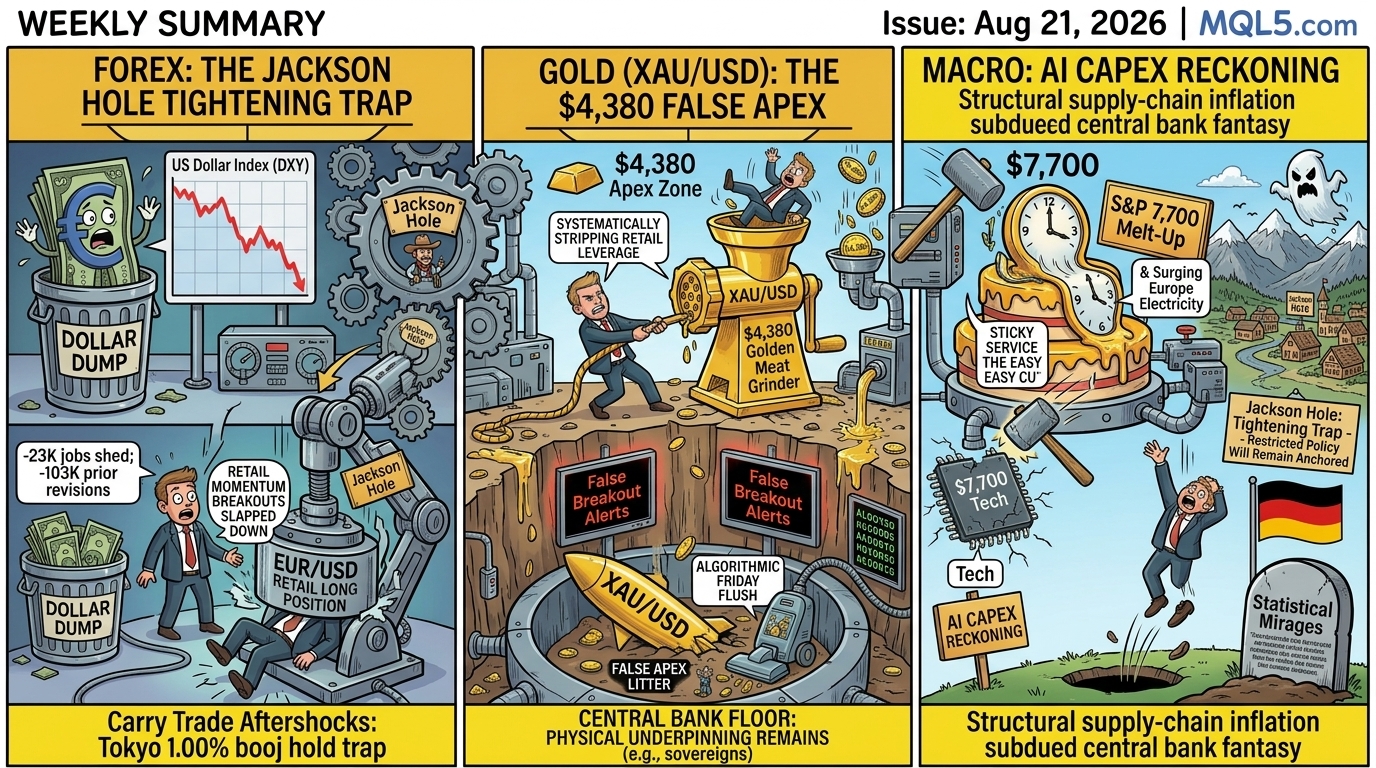
August 17, 2026 – August 21, 2026
The Jackson Hole Hawkish Phantom and the $4,380 Golden Meat Grinder
Forex: The Jackson Hole Tightening Trap and the Yen Carry Aftershocks
The foreign exchange complex operated as an unforgiving slaughterhouse for breakout traders this week, proving once more that leaning on legacy oscillator setups during the lead-up to the Jackson Hole Economic Symposium is nothing more than voluntary capital donation. All focus converged on central banker chatter ahead of Fed Chair Kevin Warsh’s Friday keynote. Retail momentum traders, convinced that July’s negative payroll revisions guaranteed a dovish pivot, spent the first half of the week aggressively bidding up EUR/USD toward the 1.1640 zone. Institutional algorithms promptly flipped the switch. Interbank desks, fully aware that the FOMC's hawkish minority continues to demand tighter policy to combat sticky non-core inflation, unleashed automated dollar-buying waves into the New York fixes. The Greenback clawed back yield dominance, sending EUR/USD crashing through the 1.1570 support handle and trapping late retail longs in an expensive liquidity vacuum. Over in Tokyo, USD/JPY whipped violently between 146.20 and 148.80 as markets struggled to price whether the Bank of Japan has the structural spine to follow up on its 1.00% benchmark hold. If your automated grid systems traded major FX pairs this week without a volatility throttle, they were likely chopped to pieces by algorithmic liquidity sweeps.
Gold (XAU/USD): The $4,380 False Apex and the Algorithmic Friday Flush
Gold’s order book delivered a brutal clinic in range-top manipulation, systematically stripping retail leverage right before resetting the board. Spot gold kicked off Monday morning with explosive upward momentum, riding geopolitical hedging demand to tap a fresh nominal peak of $4,382.40 per ounce. Retail trend-followers took the bait, piling into leveraged longs with dreams of an effortless cruise to $4,500. Institutional paper desks responded with textbook precision: as Warsh took the podium in Jackson Hole on Friday, reiterating that restrictive policy will remain anchored until structural supply-chain inflation is subdued, institutional desks dumped massive sell blocks into the COMEX tape. XAU/USD plummeted like a stone, slicing through key intraday support levels to test $4,318.50 before stabilizing in a high-spread chop around $4,335. The retail crowd provided the exact exit liquidity institutional desks needed to take profits on long swings before the weekend. If you chased the all-time high with market orders, you are now officially an unpaid liquidity provider.
Macro: The AI Capex Reckoning, Sticky Sticky Services, and the Death of the Easy Cut
In the macro realm, the narrative architects spent the week desperately trying to keep the "painless disinflation" fairy tale alive, even as the cold arithmetic of structural cost pressures shattered equity complacency. Wall Street’s tech giants faced renewed pressure as quarterly capex disclosures confirmed billions in unmonetized data center infrastructure spending, triggering heavy institutional rotation into defensives and energy commodities. Simultaneously, global services PMI data and surging European electricity costs reminded markets that core inflation remains firmly glued in place, rendering the 2% central bank target a statistical fantasy. Market participants expecting a dovish roadmap from Jackson Hole were met with cold water: structural labor shortages, geopolitical shipping re-routes, and massive energy consumption have permanently reset the global neutral rate higher. We don’t trade mainstream optimism or wishful earnings multiples; we exploit the mathematical divergence between institutional macro realities and retail chart delusions. Update your risk matrices, adjust your Expert Advisors for sustained higher swap rates, or prepare to have your account balance redistributed by the machine.
The Jackson Hole Hawkish Phantom and the $4,380 Golden Meat Grinder
Forex: The Jackson Hole Tightening Trap and the Yen Carry Aftershocks
The foreign exchange complex operated as an unforgiving slaughterhouse for breakout traders this week, proving once more that leaning on legacy oscillator setups during the lead-up to the Jackson Hole Economic Symposium is nothing more than voluntary capital donation. All focus converged on central banker chatter ahead of Fed Chair Kevin Warsh’s Friday keynote. Retail momentum traders, convinced that July’s negative payroll revisions guaranteed a dovish pivot, spent the first half of the week aggressively bidding up EUR/USD toward the 1.1640 zone. Institutional algorithms promptly flipped the switch. Interbank desks, fully aware that the FOMC's hawkish minority continues to demand tighter policy to combat sticky non-core inflation, unleashed automated dollar-buying waves into the New York fixes. The Greenback clawed back yield dominance, sending EUR/USD crashing through the 1.1570 support handle and trapping late retail longs in an expensive liquidity vacuum. Over in Tokyo, USD/JPY whipped violently between 146.20 and 148.80 as markets struggled to price whether the Bank of Japan has the structural spine to follow up on its 1.00% benchmark hold. If your automated grid systems traded major FX pairs this week without a volatility throttle, they were likely chopped to pieces by algorithmic liquidity sweeps.
Gold (XAU/USD): The $4,380 False Apex and the Algorithmic Friday Flush
Gold’s order book delivered a brutal clinic in range-top manipulation, systematically stripping retail leverage right before resetting the board. Spot gold kicked off Monday morning with explosive upward momentum, riding geopolitical hedging demand to tap a fresh nominal peak of $4,382.40 per ounce. Retail trend-followers took the bait, piling into leveraged longs with dreams of an effortless cruise to $4,500. Institutional paper desks responded with textbook precision: as Warsh took the podium in Jackson Hole on Friday, reiterating that restrictive policy will remain anchored until structural supply-chain inflation is subdued, institutional desks dumped massive sell blocks into the COMEX tape. XAU/USD plummeted like a stone, slicing through key intraday support levels to test $4,318.50 before stabilizing in a high-spread chop around $4,335. The retail crowd provided the exact exit liquidity institutional desks needed to take profits on long swings before the weekend. If you chased the all-time high with market orders, you are now officially an unpaid liquidity provider.
Macro: The AI Capex Reckoning, Sticky Sticky Services, and the Death of the Easy Cut
In the macro realm, the narrative architects spent the week desperately trying to keep the "painless disinflation" fairy tale alive, even as the cold arithmetic of structural cost pressures shattered equity complacency. Wall Street’s tech giants faced renewed pressure as quarterly capex disclosures confirmed billions in unmonetized data center infrastructure spending, triggering heavy institutional rotation into defensives and energy commodities. Simultaneously, global services PMI data and surging European electricity costs reminded markets that core inflation remains firmly glued in place, rendering the 2% central bank target a statistical fantasy. Market participants expecting a dovish roadmap from Jackson Hole were met with cold water: structural labor shortages, geopolitical shipping re-routes, and massive energy consumption have permanently reset the global neutral rate higher. We don’t trade mainstream optimism or wishful earnings multiples; we exploit the mathematical divergence between institutional macro realities and retail chart delusions. Update your risk matrices, adjust your Expert Advisors for sustained higher swap rates, or prepare to have your account balance redistributed by the machine.
Steve Rosenstock

August 10, 2026 – August 14, 2026
The 'Negative Payrolls' Mirage and the $4,375 Golden Tug-of-War
Forex: The -23K Labor Shock, the 1.1600 Squeeze, and the Dollar Dump
The currency markets converted into a high-frequency execution chamber for dollar bulls this week, proving yet again that relying on standard lagging indicators while the macroeconomic data gets radically rewritten is an express ticket to donating margin to institutional desks. The entire FX complex spent the week reeling from the aftermath of July's disastrous US labor revisions, where the economy didn't merely miss targets—it outright shed 23,000 jobs, with prior months slashed down by an additional 103,000. Retail accounts, conditioned to trade the "US exceptionalism" narrative, tried frantically to buy the dip on the US Dollar Index (DXY) as it touched its weakest levels since early spring. The institutional response was swift and merciless: automated algorithms triggered an aggressive short squeeze across major pairs. EUR/USD was systematically propelled right through the 1.1600 liquidity barrier, while Sterling capitalized on the greenback's sudden yield deflation to grind higher. The market's implied probability of another Fed rate hike in September collapsed from roughly 55% down to 40% in a matter of sessions. If your automated Expert Advisor was running a trend-continuation grid on the Dollar without scanning the macroeconomic calendar, it was likely liquidated by the sharpest greenback pullback of the summer.
Gold (XAU/USD): The $4,375 High-Altitude Battle and the Central Bank Floor
Gold’s tape this week was a textbook masterclass in institutional range containment, operating near record altitudes while retail trend-followers were chopped to pieces by intraday false breakouts. After the vertical rocket ride that carried spot gold past $4,340 the week prior, the yellow metal pushed into a fierce tug-of-war, kissing weekly highs near $4,375.33 before entering a tight consolidation trap. Retail shorters—convinced that a cooling 3.4% US CPI print on Wednesday would trigger an aggressive profit-taking cascade—eagerly shorted every spike into the $4,360–$4,375 zone. What the retail herd failed to see in the order book was the structural physical bid. Sovereign buyers and central banks quietly absorbed over 155 tons of physical bullion via off-exchange swaps, effectively underpinning the market and pulling real yields into deep negative territory (-0.8%). Friday saw typical algorithmic ping-pong, shaking out leveraged longs and shorts alike inside the $4,340–$4,370 corridor. If you traded the chop with high leverage thinking gold had hit a structural ceiling, your stop losses were vacuumed up by institutional paper desks resetting for the next leg.
Macro: The 7,700 Index Melt-Up, Vanishing Workers, and the 0.1% CPI Illusion
In the macro sphere, traditional economic logic has officially decoupled from market mechanics. On Wall Street, equity indices staged an absurd, liquidity-fueled melt-up: the S&P 500 pierced the 7,700 mark for the first time in history, accompanied by record highs on the Dow and Russell 2000, completely unfazed by mounting economic cracks. The mainstream financial press celebrated the headline unemployment rate falling to 4.1% alongside a mild 0.1% monthly CPI print. However, system-level traders know how to read the fine print: the jobless rate dropped exclusively because the labor participation rate collapsed to 61.4%—its lowest level in six years—as hundreds of thousands of workers simply vanished from the statistical model. Meanwhile, across the Atlantic, German CPI flared back up to 2.8% on persistent energy pressures, reminding market participants that global inflation is far from extinguished. We do not trade statistical mirages or headline euphoria; we exploit the divergence between institutional capital flow and retail confusion. Adjust your risk limits, account for negative real yields in your algorithmic strategies, or prepare to be liquidated by the machine.
The 'Negative Payrolls' Mirage and the $4,375 Golden Tug-of-War
Forex: The -23K Labor Shock, the 1.1600 Squeeze, and the Dollar Dump
The currency markets converted into a high-frequency execution chamber for dollar bulls this week, proving yet again that relying on standard lagging indicators while the macroeconomic data gets radically rewritten is an express ticket to donating margin to institutional desks. The entire FX complex spent the week reeling from the aftermath of July's disastrous US labor revisions, where the economy didn't merely miss targets—it outright shed 23,000 jobs, with prior months slashed down by an additional 103,000. Retail accounts, conditioned to trade the "US exceptionalism" narrative, tried frantically to buy the dip on the US Dollar Index (DXY) as it touched its weakest levels since early spring. The institutional response was swift and merciless: automated algorithms triggered an aggressive short squeeze across major pairs. EUR/USD was systematically propelled right through the 1.1600 liquidity barrier, while Sterling capitalized on the greenback's sudden yield deflation to grind higher. The market's implied probability of another Fed rate hike in September collapsed from roughly 55% down to 40% in a matter of sessions. If your automated Expert Advisor was running a trend-continuation grid on the Dollar without scanning the macroeconomic calendar, it was likely liquidated by the sharpest greenback pullback of the summer.
Gold (XAU/USD): The $4,375 High-Altitude Battle and the Central Bank Floor
Gold’s tape this week was a textbook masterclass in institutional range containment, operating near record altitudes while retail trend-followers were chopped to pieces by intraday false breakouts. After the vertical rocket ride that carried spot gold past $4,340 the week prior, the yellow metal pushed into a fierce tug-of-war, kissing weekly highs near $4,375.33 before entering a tight consolidation trap. Retail shorters—convinced that a cooling 3.4% US CPI print on Wednesday would trigger an aggressive profit-taking cascade—eagerly shorted every spike into the $4,360–$4,375 zone. What the retail herd failed to see in the order book was the structural physical bid. Sovereign buyers and central banks quietly absorbed over 155 tons of physical bullion via off-exchange swaps, effectively underpinning the market and pulling real yields into deep negative territory (-0.8%). Friday saw typical algorithmic ping-pong, shaking out leveraged longs and shorts alike inside the $4,340–$4,370 corridor. If you traded the chop with high leverage thinking gold had hit a structural ceiling, your stop losses were vacuumed up by institutional paper desks resetting for the next leg.
Macro: The 7,700 Index Melt-Up, Vanishing Workers, and the 0.1% CPI Illusion
In the macro sphere, traditional economic logic has officially decoupled from market mechanics. On Wall Street, equity indices staged an absurd, liquidity-fueled melt-up: the S&P 500 pierced the 7,700 mark for the first time in history, accompanied by record highs on the Dow and Russell 2000, completely unfazed by mounting economic cracks. The mainstream financial press celebrated the headline unemployment rate falling to 4.1% alongside a mild 0.1% monthly CPI print. However, system-level traders know how to read the fine print: the jobless rate dropped exclusively because the labor participation rate collapsed to 61.4%—its lowest level in six years—as hundreds of thousands of workers simply vanished from the statistical model. Meanwhile, across the Atlantic, German CPI flared back up to 2.8% on persistent energy pressures, reminding market participants that global inflation is far from extinguished. We do not trade statistical mirages or headline euphoria; we exploit the divergence between institutional capital flow and retail confusion. Adjust your risk limits, account for negative real yields in your algorithmic strategies, or prepare to be liquidated by the machine.
Steve Rosenstock
August 3, 2026 – August 7, 2026
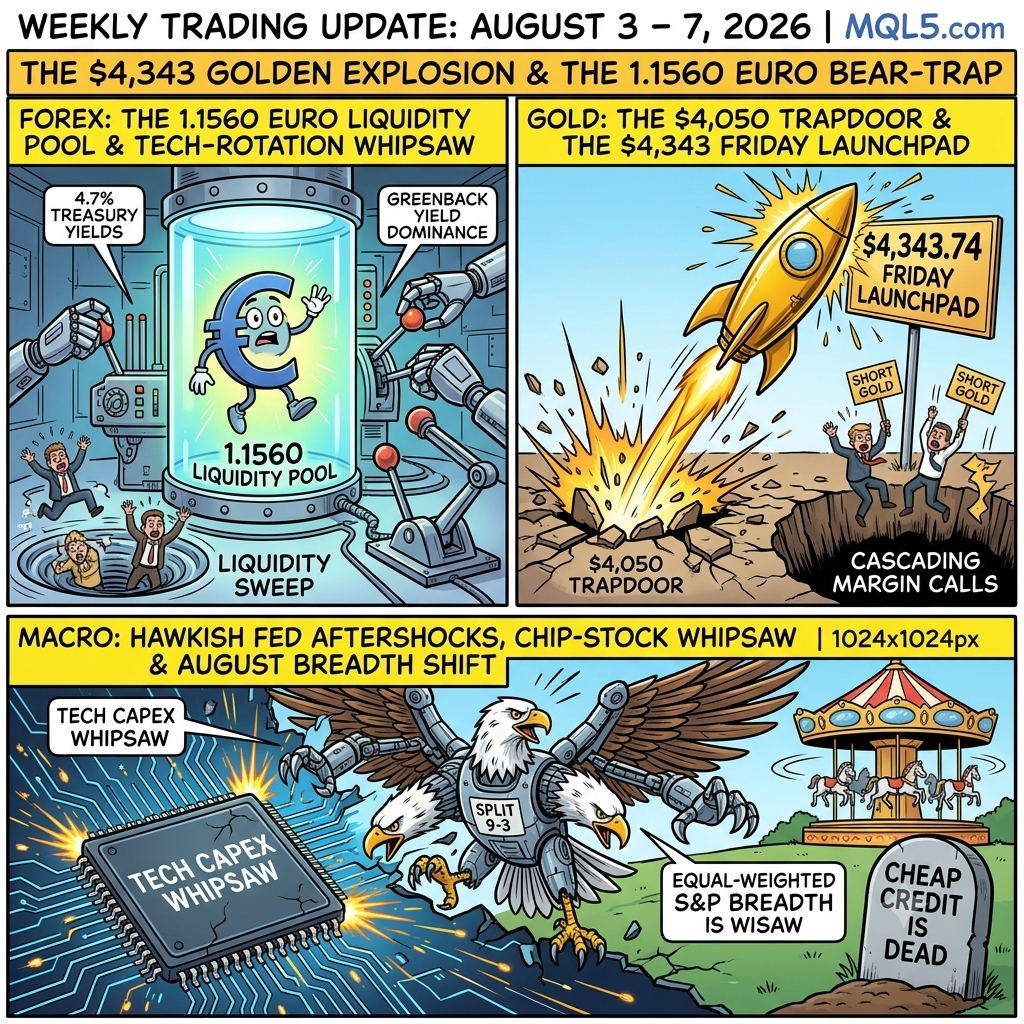
The $4,343 Golden Explosion and the 1.1560 Euro Bear-Trap
Forex: The 1.1560 Euro Liquidity Pool and the Tech-Rotation Whipsaw
The currency markets functioned as a high-frequency meat grinder for retail sentiment this week, proving once again that trading major pairs based on lagging momentum indicators during a mega-cap tech rotation is just a fast track to subsidizing institutional desks. EUR/USD spent the week trapped in a deceptively tight chop zone around the 1.1560 handle, with every retail breakout attempt ruthlessly slapped down by automated sell programs. Retail accounts, misinterpreting early-week weakness in US chip stocks as a sign of imminent dollar capitulation, aggressively loaded up on long Euro positions. Institutional algorithms promptly punished the herd. The smart money recognized that with US Treasuries yielding nearly 4.7% and persistent Middle Eastern energy volatility favoring Greenback safe-haven flows, any Euro rally was merely an artificial liquidity pool waiting to be drained. As US tech names staged a violent Thursday-Friday rebound, automated cross-asset algorithms squeezed late retail shorts, leaving traders whipsawed by 40-pip spikes. If your Expert Advisor spent the week searching for an orderly wave pattern on EUR/USD, it was likely systematically dismantled by algorithmic liquidity sweeps.
Gold (XAU/USD): The $4,050 Trapdoor and the $4,343 Friday Launchpad
Gold’s tape this week delivered a spectacular, multi-stage masterclass in institutional liquidity hunting. We opened Monday morning in a deceptively quiet consolidation zone near $4,053 an ounce, with mainstream financial media convincing the retail herd that the Federal Reserve's hawkish pause would keep a tight ceiling on precious metals. Retail traders, staring at resistance levels from late July, eagerly opened short positions or dumped their physical allocations. That was the exact cue for the institutional machines. On Wednesday, August 5, paper desks triggered a massive, single-day vertical launch that obliterated overhead stop-loss clusters, driving XAU/USD up over 4% to breach $4,247. The grand finale arrived on Friday, August 7, when a relentless short-covering squeeze launched spot gold straight to a high of $4,343.74—a massive +2.44% surge on the day. The V-shaped explosion completely bypassed trailing stops and triggered cascading margin calls across retail short accounts. The algorithms didn't care about Fed rhetoric; they simply vacuumed up the liquidity where retail felt safest.
Macro: Hawkish Fed Aftershocks, Chip-Stock Whiplash, and the August Breadth Shift
In the macro sphere, Wall Street spent the week digesting the aftermath of the Federal Reserve’s split 9–3 FOMC vote. While Chair Kevin Warsh tried to reassure markets during his press briefing, traders remained deeply unnerved by the three hawkish dissents demanding immediate rate hikes to combat sticky inflation. Early in the week, mega-cap semiconductor and AI stocks faced a brutal reality check over mounting capital expenditure costs and foreign competition, dragging the Nasdaq through a 6-day losing streak. Yet, in a classic August twist, capital didn't flee the market—it rotated into value names, small-caps, and international equities, helping the equal-weighted S&P 500 build steady gains. By Thursday and Friday, tech buyers returned with a vengeance, driving a nearly 3% tech rally despite mixed Q2 earnings releases. Meanwhile, with global crude oil volatility keeping inflation expectations firmly unanchored, the retail delusion of cheap credit in 2026 remains dead and buried. Adjust your backtests for structural capital costs, enforce strict risk parameters on your trading bots, or prepare to have your account balance redistributed.
The $4,343 Golden Explosion and the 1.1560 Euro Bear-Trap
Forex: The 1.1560 Euro Liquidity Pool and the Tech-Rotation Whipsaw
The currency markets functioned as a high-frequency meat grinder for retail sentiment this week, proving once again that trading major pairs based on lagging momentum indicators during a mega-cap tech rotation is just a fast track to subsidizing institutional desks. EUR/USD spent the week trapped in a deceptively tight chop zone around the 1.1560 handle, with every retail breakout attempt ruthlessly slapped down by automated sell programs. Retail accounts, misinterpreting early-week weakness in US chip stocks as a sign of imminent dollar capitulation, aggressively loaded up on long Euro positions. Institutional algorithms promptly punished the herd. The smart money recognized that with US Treasuries yielding nearly 4.7% and persistent Middle Eastern energy volatility favoring Greenback safe-haven flows, any Euro rally was merely an artificial liquidity pool waiting to be drained. As US tech names staged a violent Thursday-Friday rebound, automated cross-asset algorithms squeezed late retail shorts, leaving traders whipsawed by 40-pip spikes. If your Expert Advisor spent the week searching for an orderly wave pattern on EUR/USD, it was likely systematically dismantled by algorithmic liquidity sweeps.
Gold (XAU/USD): The $4,050 Trapdoor and the $4,343 Friday Launchpad
Gold’s tape this week delivered a spectacular, multi-stage masterclass in institutional liquidity hunting. We opened Monday morning in a deceptively quiet consolidation zone near $4,053 an ounce, with mainstream financial media convincing the retail herd that the Federal Reserve's hawkish pause would keep a tight ceiling on precious metals. Retail traders, staring at resistance levels from late July, eagerly opened short positions or dumped their physical allocations. That was the exact cue for the institutional machines. On Wednesday, August 5, paper desks triggered a massive, single-day vertical launch that obliterated overhead stop-loss clusters, driving XAU/USD up over 4% to breach $4,247. The grand finale arrived on Friday, August 7, when a relentless short-covering squeeze launched spot gold straight to a high of $4,343.74—a massive +2.44% surge on the day. The V-shaped explosion completely bypassed trailing stops and triggered cascading margin calls across retail short accounts. The algorithms didn't care about Fed rhetoric; they simply vacuumed up the liquidity where retail felt safest.
Macro: Hawkish Fed Aftershocks, Chip-Stock Whiplash, and the August Breadth Shift
In the macro sphere, Wall Street spent the week digesting the aftermath of the Federal Reserve’s split 9–3 FOMC vote. While Chair Kevin Warsh tried to reassure markets during his press briefing, traders remained deeply unnerved by the three hawkish dissents demanding immediate rate hikes to combat sticky inflation. Early in the week, mega-cap semiconductor and AI stocks faced a brutal reality check over mounting capital expenditure costs and foreign competition, dragging the Nasdaq through a 6-day losing streak. Yet, in a classic August twist, capital didn't flee the market—it rotated into value names, small-caps, and international equities, helping the equal-weighted S&P 500 build steady gains. By Thursday and Friday, tech buyers returned with a vengeance, driving a nearly 3% tech rally despite mixed Q2 earnings releases. Meanwhile, with global crude oil volatility keeping inflation expectations firmly unanchored, the retail delusion of cheap credit in 2026 remains dead and buried. Adjust your backtests for structural capital costs, enforce strict risk parameters on your trading bots, or prepare to have your account balance redistributed.
Steve Rosenstock

July 27, 2026 – July 31, 2026
he 'Hawkish Dissenter' Standoff and the 1% Yen Hold
Forex: The 1% BoJ Standoff and the Yen Carry Chop
The currency markets functioned as a high-frequency meat grinder for retail sentiment this week, proving yet again that trying to front-run central bank policy meetings with basic technical indicators is just a highly efficient way to fund institutional liquidity pools. All eyes were on Tokyo on Friday, July 31, as the Bank of Japan held its monetary policy meeting. In an 8–1 majority decision, the BoJ opted to hold its benchmark policy rate flat at 1.00%, while simultaneously trimming its fiscal 2026 core inflation forecast to 2.3%–2.7%. Retail accounts, misinterpreting board member Hajime Takata’s solitary hawkish vote for an imminent rate hike cycle, frantically piled into long Yen positions ahead of the announcement. Institutional algorithms promptly punished the herd. The smart money recognized that a 1% policy rate does virtually nothing to close the cavernous interest-rate gap against the US Dollar. Automated systems ruthlessly absorbed retail liquidity, sending USD/JPY whipping back into its high-yield carry zone while EUR/USD remained trapped in a high-fee, rangebound chop. If your Expert Advisor spent the week searching for a clean breakout trend on the Yen, it was likely systematically dismantled by central bank decision-day liquidity sweeps.
Gold (XAU/USD): The $4,130 False Flare and the $4,080 Fed Clampdown
Gold’s tape this week offered a classic demonstration of institutional range-bound distribution, designed specifically to strip leverage from retail traders before the real macro news hit the wires. Spot gold entered the week attempting a modest recovery toward two-week highs around $4,130 per ounce, as brief pauses in Middle East hostilities temporarily cooled oil prices. Retail trend-followers, looking at early-week green candles and oversold momentum indicators, eagerly loaded up on breakout longs on the assumption that the $4,000 floor was permanently secured. That optimism lasted precisely until Wednesday’s FOMC policy announcement. As the Federal Reserve revealed three explicit hawkish dissents demanding immediate rate hikes, institutional paper desks dumped massive sell blocks into the New York session. XAU/USD was swiftly knocked back down to chop inside the tight $4,080 – $4,090 range. The market didn’t launch a new structural bull run; the algorithms simply allowed retail buyers to build long positions at the top of the range before pulling the rug out ahead of the Fed's statement.
Macro: The 9–3 FOMC Split, AI Power Squeezes, and the 2% Inflation Illusion
In the macro sphere, the Federal Reserve’s two-day policy meeting on July 28–29 provided a stark reality check to anyone still hallucinating about monetary easing in 2026. Under Chair Kevin Warsh, the FOMC voted 9–3 to maintain the federal funds rate at 3.50%–3.75%. However, the real headline was the glaring rift inside the committee: three hawks—Beth Hammack, Neel Kashkari, and Lorie Logan—voted against the pause, explicitly demanding an immediate 25-basis-point rate hike. The official statement laid out the structural stagflationary reality in blunt terms: inflation remains stubbornly elevated above the 2% target, reinforced by ongoing Middle East supply shocks, newly imposed import tariffs, and a massive surge in energy demand driven by AI data center expansion. While mainstream financial media continues to preach the Gospel of the "Soft Landing," institutional desks are pricing in persistent capital costs and structural energy constraints. Turn off your legacy moving averages, adjust your algorithmic parameters for elevated swap fees, or prepare to have your capital extracted by the market.
he 'Hawkish Dissenter' Standoff and the 1% Yen Hold
Forex: The 1% BoJ Standoff and the Yen Carry Chop
The currency markets functioned as a high-frequency meat grinder for retail sentiment this week, proving yet again that trying to front-run central bank policy meetings with basic technical indicators is just a highly efficient way to fund institutional liquidity pools. All eyes were on Tokyo on Friday, July 31, as the Bank of Japan held its monetary policy meeting. In an 8–1 majority decision, the BoJ opted to hold its benchmark policy rate flat at 1.00%, while simultaneously trimming its fiscal 2026 core inflation forecast to 2.3%–2.7%. Retail accounts, misinterpreting board member Hajime Takata’s solitary hawkish vote for an imminent rate hike cycle, frantically piled into long Yen positions ahead of the announcement. Institutional algorithms promptly punished the herd. The smart money recognized that a 1% policy rate does virtually nothing to close the cavernous interest-rate gap against the US Dollar. Automated systems ruthlessly absorbed retail liquidity, sending USD/JPY whipping back into its high-yield carry zone while EUR/USD remained trapped in a high-fee, rangebound chop. If your Expert Advisor spent the week searching for a clean breakout trend on the Yen, it was likely systematically dismantled by central bank decision-day liquidity sweeps.
Gold (XAU/USD): The $4,130 False Flare and the $4,080 Fed Clampdown
Gold’s tape this week offered a classic demonstration of institutional range-bound distribution, designed specifically to strip leverage from retail traders before the real macro news hit the wires. Spot gold entered the week attempting a modest recovery toward two-week highs around $4,130 per ounce, as brief pauses in Middle East hostilities temporarily cooled oil prices. Retail trend-followers, looking at early-week green candles and oversold momentum indicators, eagerly loaded up on breakout longs on the assumption that the $4,000 floor was permanently secured. That optimism lasted precisely until Wednesday’s FOMC policy announcement. As the Federal Reserve revealed three explicit hawkish dissents demanding immediate rate hikes, institutional paper desks dumped massive sell blocks into the New York session. XAU/USD was swiftly knocked back down to chop inside the tight $4,080 – $4,090 range. The market didn’t launch a new structural bull run; the algorithms simply allowed retail buyers to build long positions at the top of the range before pulling the rug out ahead of the Fed's statement.
Macro: The 9–3 FOMC Split, AI Power Squeezes, and the 2% Inflation Illusion
In the macro sphere, the Federal Reserve’s two-day policy meeting on July 28–29 provided a stark reality check to anyone still hallucinating about monetary easing in 2026. Under Chair Kevin Warsh, the FOMC voted 9–3 to maintain the federal funds rate at 3.50%–3.75%. However, the real headline was the glaring rift inside the committee: three hawks—Beth Hammack, Neel Kashkari, and Lorie Logan—voted against the pause, explicitly demanding an immediate 25-basis-point rate hike. The official statement laid out the structural stagflationary reality in blunt terms: inflation remains stubbornly elevated above the 2% target, reinforced by ongoing Middle East supply shocks, newly imposed import tariffs, and a massive surge in energy demand driven by AI data center expansion. While mainstream financial media continues to preach the Gospel of the "Soft Landing," institutional desks are pricing in persistent capital costs and structural energy constraints. Turn off your legacy moving averages, adjust your algorithmic parameters for elevated swap fees, or prepare to have your capital extracted by the market.
Steve Rosenstock

July 20, 2026 – July 24, 2026
The 'ECB Freeze' and the $4,000 Golden Trapdoor: Energy Shocks, Hawkish Feints, and the Tech-Earnings Execution
Forex: The Euro’s 1.1380 Paralysis and the ECB’s Energy Straitjacket
The currency markets functioned as a high-frequency meat grinder for retail sentiment this week, proving yet again that trading major currency pairs based on standard moving averages during a central bank decision week is just a fast track to funding institutional liquidity pools. The primary focus of the week was the European Central Bank's policy announcement on Thursday, July 23. After initiating a rate hike back in June, Christine Lagarde and company opted to keep key interest rates frozen—holding the deposit rate at 2.25% and the main refinancing rate at 2.40%. Mainstream media spun this as a "prudent pause," but interbank desks immediately recognized the structural trap: the ECB is completely cornered by persistent Middle Eastern energy volatility, unable to cut without triggering a currency collapse, yet unable to hike without suffocating stagnant European GDP. EUR/USD spent the week paralyzed around the 1.1380 handle, with every retail breakout attempt ruthlessly slapped down by automated sell orders as the US Dollar maintained its yield dominance. Meanwhile, derivative markets priced in a 35% probability of an immediate Federal Reserve rate hike, sending capital flying back into Greenback safe havens. If your Expert Advisor was trying to trade a neat range on EUR/USD this week, it was likely chopped to pieces by algorithmic liquidity sweeps.
Gold (XAU/USD): The $4,000 Line in the Sand and the Paper Dump
Gold’s tape this week was a textbook masterclass in engineered consolidation designed specifically to starve retail trend-followers of momentum before hunting their stop-loss clusters. Following the sharp drop from earlier multi-month highs, spot gold spent the sessions bouncing around the $4,000 – $4,070 range. Retail traders, staring at oversold RSI charts, spent Monday through Wednesday aggressively trying to buy what they assumed was a impenetrable floor at $4,050. Institutional machines responded with a swift reality check: mid-week, paper blocks were quietly dumped into the New York open, driving XAU/USD lower to test the critical $3,959 – $3,980 support zone. As real yields rose alongside hawkish Fed expectations, retail longs were systematically squeezed out via automated margin calls. The metal staged a modest late-week bounce toward $4,016, but make no mistake—this wasn't the return of a structural bull run; it was institutional desks vacuuming up the retail stops before resetting order flow for the next macro catalyst.
Macro: Sticky Energy Shocks, Tech Earnings Whiplash, and the Death of the Rate Cut
In the macro sphere, the delusion of a smooth "soft landing" and quick rate cuts took another heavy beating from reality. The economic calendar was stacked with high-impact releases, from UK and Canadian CPI prints to S&P Global PMIs. However, the real fireworks occurred in the equity markets as mega-cap tech earnings hit the tape. While preliminary PMI numbers pointed to resilient business activity, Wall Street’s tech darlings faced severe volatility as investors aggressively dissected AI capital expenditures versus actual yield. Compounding the pressure, crude oil prices surged back toward the $85 per barrel mark due to geopolitical friction and supply bottlenecks, reinforcing the reality of sticky global inflation. Central banks are no longer hiding it: with energy shocks acting as a permanent tax on global growth, cheap money is officially buried. We do not trade narrative promises or corporate earnings hype. We exploit the massive divergence between structural inflation realities and retail's desperate addiction to legacy technical patterns. Adjust your backtests for high capital costs, enforce tight risk parameters on your trading bots, or prepare to have your account balance redistributed.
The 'ECB Freeze' and the $4,000 Golden Trapdoor: Energy Shocks, Hawkish Feints, and the Tech-Earnings Execution
Forex: The Euro’s 1.1380 Paralysis and the ECB’s Energy Straitjacket
The currency markets functioned as a high-frequency meat grinder for retail sentiment this week, proving yet again that trading major currency pairs based on standard moving averages during a central bank decision week is just a fast track to funding institutional liquidity pools. The primary focus of the week was the European Central Bank's policy announcement on Thursday, July 23. After initiating a rate hike back in June, Christine Lagarde and company opted to keep key interest rates frozen—holding the deposit rate at 2.25% and the main refinancing rate at 2.40%. Mainstream media spun this as a "prudent pause," but interbank desks immediately recognized the structural trap: the ECB is completely cornered by persistent Middle Eastern energy volatility, unable to cut without triggering a currency collapse, yet unable to hike without suffocating stagnant European GDP. EUR/USD spent the week paralyzed around the 1.1380 handle, with every retail breakout attempt ruthlessly slapped down by automated sell orders as the US Dollar maintained its yield dominance. Meanwhile, derivative markets priced in a 35% probability of an immediate Federal Reserve rate hike, sending capital flying back into Greenback safe havens. If your Expert Advisor was trying to trade a neat range on EUR/USD this week, it was likely chopped to pieces by algorithmic liquidity sweeps.
Gold (XAU/USD): The $4,000 Line in the Sand and the Paper Dump
Gold’s tape this week was a textbook masterclass in engineered consolidation designed specifically to starve retail trend-followers of momentum before hunting their stop-loss clusters. Following the sharp drop from earlier multi-month highs, spot gold spent the sessions bouncing around the $4,000 – $4,070 range. Retail traders, staring at oversold RSI charts, spent Monday through Wednesday aggressively trying to buy what they assumed was a impenetrable floor at $4,050. Institutional machines responded with a swift reality check: mid-week, paper blocks were quietly dumped into the New York open, driving XAU/USD lower to test the critical $3,959 – $3,980 support zone. As real yields rose alongside hawkish Fed expectations, retail longs were systematically squeezed out via automated margin calls. The metal staged a modest late-week bounce toward $4,016, but make no mistake—this wasn't the return of a structural bull run; it was institutional desks vacuuming up the retail stops before resetting order flow for the next macro catalyst.
Macro: Sticky Energy Shocks, Tech Earnings Whiplash, and the Death of the Rate Cut
In the macro sphere, the delusion of a smooth "soft landing" and quick rate cuts took another heavy beating from reality. The economic calendar was stacked with high-impact releases, from UK and Canadian CPI prints to S&P Global PMIs. However, the real fireworks occurred in the equity markets as mega-cap tech earnings hit the tape. While preliminary PMI numbers pointed to resilient business activity, Wall Street’s tech darlings faced severe volatility as investors aggressively dissected AI capital expenditures versus actual yield. Compounding the pressure, crude oil prices surged back toward the $85 per barrel mark due to geopolitical friction and supply bottlenecks, reinforcing the reality of sticky global inflation. Central banks are no longer hiding it: with energy shocks acting as a permanent tax on global growth, cheap money is officially buried. We do not trade narrative promises or corporate earnings hype. We exploit the massive divergence between structural inflation realities and retail's desperate addiction to legacy technical patterns. Adjust your backtests for high capital costs, enforce tight risk parameters on your trading bots, or prepare to have your account balance redistributed.
Steve Rosenstock
July 13, 2026 – July 17, 2026
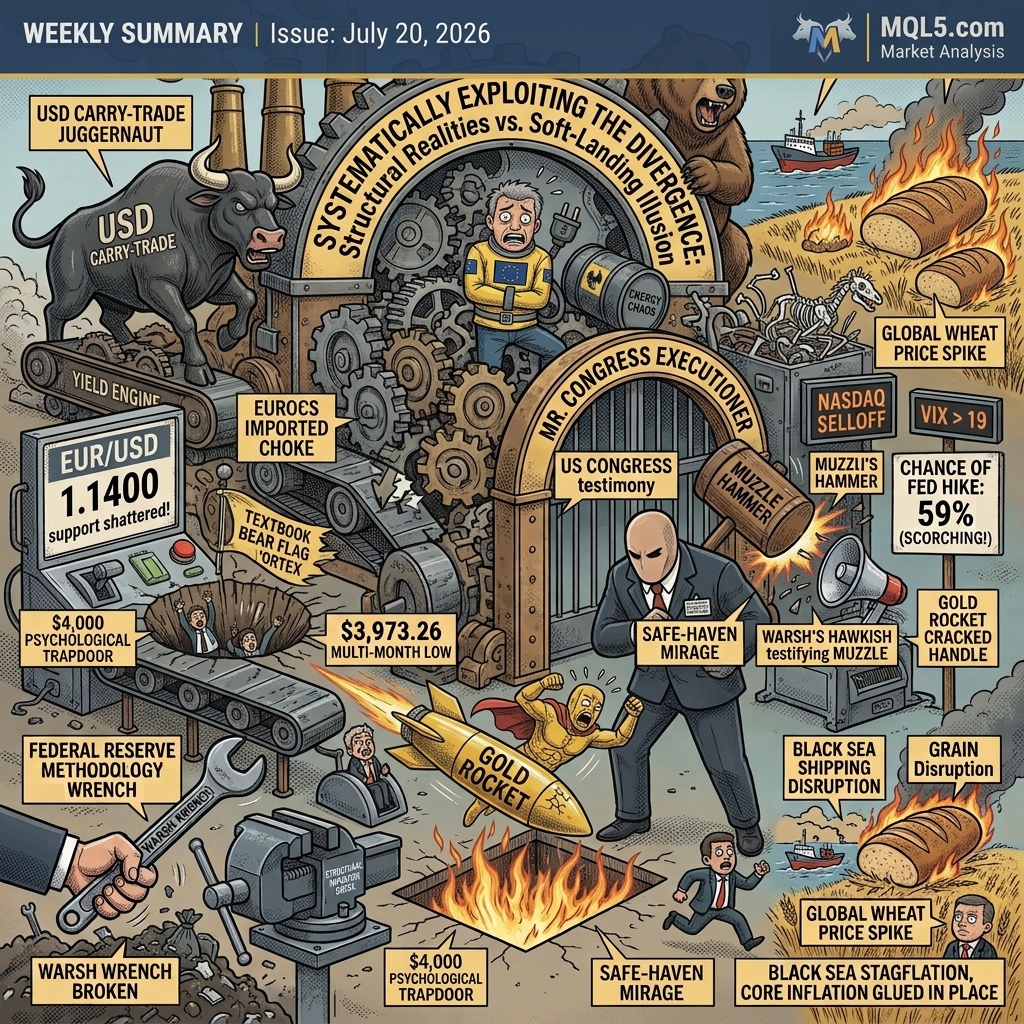
The 'Double-Engine' Dollar and the Congressional Muzzle: Bear Flags, Straitjackets, and the $4,000 Golden Trapdoor
Forex: The Bear Flag Ambush and the Euro's Energy Straitjacket
The currency markets offered a masterclass this week in how institutional order flow ruthlessly exploits structural arithmetic while retail accounts stare blankly at lagging indicators. The absolute highlight of the week was EUR/USD, which spent days carving out a textbook bear flag on the daily charts—a consolidation pattern that institutional desks used as a perfect setup to distribute short positions right before the trap snapped shut. Retail bulls, blinded by an early soft US CPI print, rushed to buy the Euro on hopes of a trend reversal. What their standard moving average systems failed to calculate was the uncomfortable reality of the "Double-Engine" US Dollar. When geopolitical headlines worsen, the Greenback sucks in the safe-haven flows; when escalating Middle East conflict drives oil prices higher, the Dollar wins as the structurally high yielder. The Euro, completely choked by Europe's heavy reliance on imported energy, sat on the losing side of both trades. As crude pushed higher, automated sell programs bulldozed straight through the crucial 1.1400 support line in a matter of hours, converting retail dip-buyers into immediate liquidity providers. If your Expert Advisor is still programmed to buy Euro breakouts without scanning a crude oil matrix, you aren't trading—you are simply donating your margin to the interbank network.
Gold (XAU/USD): The $4,000 Illusion and the Capitol Hill Executioner
Gold’s tape this week was a brutal, systematic slaughter of late-joining buyers who fell for the classic safe-haven mirage. We entered the weekly session with spot gold holding precariously near $4,070. As fresh geopolitical anxieties flared across the news networks, retail FOMO kicked into overdrive, piling into longs under the assumption that a geopolitical escalation would effortlessly rocket the metal past overhead resistance. Instead, Monday delivered a lesson in institutional reality. Right at the New York open, the market was slammed with renewed restrictions on shipping through the Strait of Hormuz, driving oil up and sending structural inflation expectations higher. Rather than flocking to gold, the smart money chose the high-yielding US Dollar, triggering a steady, algorithmic grind lower that forced XAU/USD straight through its 50-period moving average. The final blow arrived on Tuesday during Fed Chair Kevin Warsh's highly anticipated congressional testimony. Warsh's hawkish tone effectively muzzled the market, pushing the mathematical odds of another Fed rate hike to a scorching 59%. Gold prices collapsed through the floor, plunging to a multi-month low of $3,973.26 and entirely cracking the psychological $4,000 handle. If you bought the safe-haven headline without checking the terminal rate pricing, you are now officially a long-term liquidity provider.
Macro: The 59% Hike Rattle, Tech-Sector Rot, and the Black Sea Reality Check
In the macro sphere, the mainstream media's desperate attempt to keep the "soft landing" delusion alive was completely undermined by structural data and raw geopolitical friction. Early in the week, the second-quarter earnings season opened with a spectacular, record-setting run from the major banking behemoths, creating an artificial wave of optimism across equity desks. But while the financials pumped, the actual economic engine began to rot from the inside. By Friday, a severe, cross-border selloff hit the technology sector. Tech-led indices like the Nasdaq plummeted as institutional desks began aggressively questioning whether multi-billion dollar AI infrastructure investments would ever yield real-world cash flow, driving the VIX to a multi-day high above 19. Meanwhile, the real stagflationary threat is shifting away from the Persian Gulf and straight into the Black Sea, where escalating shipping disruptions have sent global grain and wheat prices into an un-backed spike. With core inflation fundamentally glued in place and the Fed firmly set on a restrictive path, the illusion of cheap capital is completely dead. Adjust your backtests to account for the actual cost of capital, turn off your retail indicators, or prepare to be liquidated by the system.
The 'Double-Engine' Dollar and the Congressional Muzzle: Bear Flags, Straitjackets, and the $4,000 Golden Trapdoor
Forex: The Bear Flag Ambush and the Euro's Energy Straitjacket
The currency markets offered a masterclass this week in how institutional order flow ruthlessly exploits structural arithmetic while retail accounts stare blankly at lagging indicators. The absolute highlight of the week was EUR/USD, which spent days carving out a textbook bear flag on the daily charts—a consolidation pattern that institutional desks used as a perfect setup to distribute short positions right before the trap snapped shut. Retail bulls, blinded by an early soft US CPI print, rushed to buy the Euro on hopes of a trend reversal. What their standard moving average systems failed to calculate was the uncomfortable reality of the "Double-Engine" US Dollar. When geopolitical headlines worsen, the Greenback sucks in the safe-haven flows; when escalating Middle East conflict drives oil prices higher, the Dollar wins as the structurally high yielder. The Euro, completely choked by Europe's heavy reliance on imported energy, sat on the losing side of both trades. As crude pushed higher, automated sell programs bulldozed straight through the crucial 1.1400 support line in a matter of hours, converting retail dip-buyers into immediate liquidity providers. If your Expert Advisor is still programmed to buy Euro breakouts without scanning a crude oil matrix, you aren't trading—you are simply donating your margin to the interbank network.
Gold (XAU/USD): The $4,000 Illusion and the Capitol Hill Executioner
Gold’s tape this week was a brutal, systematic slaughter of late-joining buyers who fell for the classic safe-haven mirage. We entered the weekly session with spot gold holding precariously near $4,070. As fresh geopolitical anxieties flared across the news networks, retail FOMO kicked into overdrive, piling into longs under the assumption that a geopolitical escalation would effortlessly rocket the metal past overhead resistance. Instead, Monday delivered a lesson in institutional reality. Right at the New York open, the market was slammed with renewed restrictions on shipping through the Strait of Hormuz, driving oil up and sending structural inflation expectations higher. Rather than flocking to gold, the smart money chose the high-yielding US Dollar, triggering a steady, algorithmic grind lower that forced XAU/USD straight through its 50-period moving average. The final blow arrived on Tuesday during Fed Chair Kevin Warsh's highly anticipated congressional testimony. Warsh's hawkish tone effectively muzzled the market, pushing the mathematical odds of another Fed rate hike to a scorching 59%. Gold prices collapsed through the floor, plunging to a multi-month low of $3,973.26 and entirely cracking the psychological $4,000 handle. If you bought the safe-haven headline without checking the terminal rate pricing, you are now officially a long-term liquidity provider.
Macro: The 59% Hike Rattle, Tech-Sector Rot, and the Black Sea Reality Check
In the macro sphere, the mainstream media's desperate attempt to keep the "soft landing" delusion alive was completely undermined by structural data and raw geopolitical friction. Early in the week, the second-quarter earnings season opened with a spectacular, record-setting run from the major banking behemoths, creating an artificial wave of optimism across equity desks. But while the financials pumped, the actual economic engine began to rot from the inside. By Friday, a severe, cross-border selloff hit the technology sector. Tech-led indices like the Nasdaq plummeted as institutional desks began aggressively questioning whether multi-billion dollar AI infrastructure investments would ever yield real-world cash flow, driving the VIX to a multi-day high above 19. Meanwhile, the real stagflationary threat is shifting away from the Persian Gulf and straight into the Black Sea, where escalating shipping disruptions have sent global grain and wheat prices into an un-backed spike. With core inflation fundamentally glued in place and the Fed firmly set on a restrictive path, the illusion of cheap capital is completely dead. Adjust your backtests to account for the actual cost of capital, turn off your retail indicators, or prepare to be liquidated by the system.
Steve Rosenstock

July 6, 2026 – July 10, 2026
The 'Quarter-Millennium' Melt-Up and the Sovereign Math Hack: The 162-Yen Short Squeeze, the Target-Slashing Trap, and the Methodology Mirage
Forex: The 162-Yen Execution Chamber and the Downing Street Defence Debt
The currency markets offered a spectacular masterclass this week in how institutional order flow systematically weaponizes headline fatigue against retail accounts. The primary slaughterhouse was once again located in the USD/JPY pair. Retail accounts, convinced that the pair was completely overextended after weeks of relentless climbing, spent the post-holiday sessions aggressively loading up on shorts, praying for a Bank of Japan intervention that never arrived. Instead, institutional algorithms triggered a absolute squeeze, driving USD/JPY straight through the resting liquidity pools to print a punishing high of 162.48. Across the English Channel, the British Pound staged a desperate attempt to reclaim the 1.3400 handle as new Prime Minister Andy Burnham settled into office. While the mainstream press celebrated a smooth political transition, system-level traders were watching the actual order book: a sudden, unbudgeted £5 billion defense spending requirement landed on Burnham's desk, guaranteeing that the UK's fiscal rules are about to be creatively bent. Meanwhile, commodity currencies took a severe beating down under. The Kiwi slid below 0.5700 as retail traders eagerly bought the dip ahead of the upcoming RBNZ rate decision, completely ignoring the structural reality that failing to deliver an immediate, aggressive interest rate hike will leave the currency completely defenseless against a hardening US Dollar.
Gold (XAU/USD): The $4,103 Forecast Flop and the Institutional Target Trick
Gold’s tape this week was a ruthless demonstration of how institutional research desks manipulate retail sentiment to clear out the book. Spot gold spent the week sliding down to a local low near $4,103 an ounce, down roughly 27% from its historical January highs. The real algorithmic execution occurred on Thursday, July 9, courtesy of HSBC. In a beautifully timed maneuver, the bank publicly slashed its average 2026 gold price forecast by a massive $304 down to $4,560. Retail traders, reading the headline panic on their feeds, immediately dumped their remaining long positions at the absolute bottom of the weekly range. What the herd failed to realize—because they don’t read the fine print—was that HSBC left its year-end target completely untouched at $4,750. The smart money used the retail panic to accumulate physical allocations at a deep discount, while late-joining shorters were left holding highly exposed liabilities into the weekend close. If you let a bank's headline adjustment scare you out of your mathematical risk parameters, your margin has been successfully redistributed.
Macro: The 250th Anniversary Pump, Hormuz Tanker Fires, and the Core PCE Math Hack
In the macro sphere, traditional economic reality has been entirely replaced by institutional data manipulation and geopolitical theater. Wall Street returned from the long weekend in a state of absolute euphoria, treating the nation's 250th Independence Day celebrations as a valid fundamental reason to stage a massive tech-led melt-up, sending the S&P 500 screaming to fresh record highs near 7,533. The actual structural reality, however, is flashing bright red. The fragile Middle Eastern ceasefire completely vaporized this week as fresh Iranian attacks on tankers in the Strait of Hormuz pushed oil prices back above $70 a barrel, prompting a furious social media warning from President Trump. With inflation structurally glued to a sticky 3.4% core PCE, central bank planners have decided that if you cannot lower the inflation, you simply change how you calculate it. Institutional networks are tracking an upcoming government methodology revision designed to alter the weights of software, legal, and portfolio management services—effectively lopping an artificial 0.2 percentage points off the core inflation print by administrative decree. We do not trade the manufactured data or the anniversary patriotism. We exploit the massive divergence between structural energy shock realities and the retail herd’s desperate addiction to the soft-landing illusion. Turn off your lagging indicators, factor structural capital costs into your Expert Advisors, or prepare to be liquidated.
The 'Quarter-Millennium' Melt-Up and the Sovereign Math Hack: The 162-Yen Short Squeeze, the Target-Slashing Trap, and the Methodology Mirage
Forex: The 162-Yen Execution Chamber and the Downing Street Defence Debt
The currency markets offered a spectacular masterclass this week in how institutional order flow systematically weaponizes headline fatigue against retail accounts. The primary slaughterhouse was once again located in the USD/JPY pair. Retail accounts, convinced that the pair was completely overextended after weeks of relentless climbing, spent the post-holiday sessions aggressively loading up on shorts, praying for a Bank of Japan intervention that never arrived. Instead, institutional algorithms triggered a absolute squeeze, driving USD/JPY straight through the resting liquidity pools to print a punishing high of 162.48. Across the English Channel, the British Pound staged a desperate attempt to reclaim the 1.3400 handle as new Prime Minister Andy Burnham settled into office. While the mainstream press celebrated a smooth political transition, system-level traders were watching the actual order book: a sudden, unbudgeted £5 billion defense spending requirement landed on Burnham's desk, guaranteeing that the UK's fiscal rules are about to be creatively bent. Meanwhile, commodity currencies took a severe beating down under. The Kiwi slid below 0.5700 as retail traders eagerly bought the dip ahead of the upcoming RBNZ rate decision, completely ignoring the structural reality that failing to deliver an immediate, aggressive interest rate hike will leave the currency completely defenseless against a hardening US Dollar.
Gold (XAU/USD): The $4,103 Forecast Flop and the Institutional Target Trick
Gold’s tape this week was a ruthless demonstration of how institutional research desks manipulate retail sentiment to clear out the book. Spot gold spent the week sliding down to a local low near $4,103 an ounce, down roughly 27% from its historical January highs. The real algorithmic execution occurred on Thursday, July 9, courtesy of HSBC. In a beautifully timed maneuver, the bank publicly slashed its average 2026 gold price forecast by a massive $304 down to $4,560. Retail traders, reading the headline panic on their feeds, immediately dumped their remaining long positions at the absolute bottom of the weekly range. What the herd failed to realize—because they don’t read the fine print—was that HSBC left its year-end target completely untouched at $4,750. The smart money used the retail panic to accumulate physical allocations at a deep discount, while late-joining shorters were left holding highly exposed liabilities into the weekend close. If you let a bank's headline adjustment scare you out of your mathematical risk parameters, your margin has been successfully redistributed.
Macro: The 250th Anniversary Pump, Hormuz Tanker Fires, and the Core PCE Math Hack
In the macro sphere, traditional economic reality has been entirely replaced by institutional data manipulation and geopolitical theater. Wall Street returned from the long weekend in a state of absolute euphoria, treating the nation's 250th Independence Day celebrations as a valid fundamental reason to stage a massive tech-led melt-up, sending the S&P 500 screaming to fresh record highs near 7,533. The actual structural reality, however, is flashing bright red. The fragile Middle Eastern ceasefire completely vaporized this week as fresh Iranian attacks on tankers in the Strait of Hormuz pushed oil prices back above $70 a barrel, prompting a furious social media warning from President Trump. With inflation structurally glued to a sticky 3.4% core PCE, central bank planners have decided that if you cannot lower the inflation, you simply change how you calculate it. Institutional networks are tracking an upcoming government methodology revision designed to alter the weights of software, legal, and portfolio management services—effectively lopping an artificial 0.2 percentage points off the core inflation print by administrative decree. We do not trade the manufactured data or the anniversary patriotism. We exploit the massive divergence between structural energy shock realities and the retail herd’s desperate addiction to the soft-landing illusion. Turn off your lagging indicators, factor structural capital costs into your Expert Advisors, or prepare to be liquidated.
Steve Rosenstock

June 29, 2026 – July 3, 2026
The 'Sintra Sentiment' Trap and the Soft Non-Farm Payroll Mirage: Fake-Out Liquidity, Golden Lifelines, and the 161-Yen Game of Chicken
Forex: The 161-Yen Game of Chicken and the Sintra Central Bank Echo Chamber
The currency markets functioned as a high-frequency meat grinder for retail sentiment this week, proving yet again that trading major pairs based on laggy indicators while central bankers gather in Portugal is an expensive way to fund institutional liquidity pools. The entire FX matrix spent the first half of the week pinned to the European Central Bank's forum on central banking in Sintra, where central bank heads took turns whispering academic theories about artificial intelligence and monetary stability into a structural echo chamber. The Japanese Yen provided the week's primary slaughterhouse. Daring the Ministry of Finance to intervene, institutional algorithms engaged in a ruthless game of chicken, pushing USD/JPY to a punishing multi-decade high of 161.85. Retail accounts, convinced that a massive Bank of Japan rescue mission was minutes away, aggressively bought the Yen. Instead, smart money happily absorbed the retail liquidity, squeezing late shorts out of their positions. Meanwhile, EUR/USD spent the week trapped in a high-fee, data-dependent chop zone around 1.0710 as dollar strength weighed heavily on the Euro. The true whiplash arrived on Friday afternoon when the US Dollar index (DXY) suffered a sudden sell-off following a soft domestic data release. If your automated grid bot spent the week trying to find an orderly wave pattern amid the central bank chatter, it was likely liquidated right before the Friday reversal.
Gold (XAU/USD): The $4,100 Support Vacuum and the Friday NFP Lifeline
Gold’s tape this week was a textbook demonstration of the engineered liquidity cycle, designed specifically to strip retail trend-followers of their capital before executing a macro-driven short squeeze. We opened the week under immense pressure, with spot gold continuing its painful June correction and drifting lazily toward the $4,110 region. Retail accounts, looking at their oversold RSI charts, spent Monday through Thursday aggressively buying what they assumed was a solid technical floor, ignoring the fact that institutional desks were systematically distributing paper blocks to thin out the bid side. The true trapdoor snapped shut mid-week, clearing out weak-handed longs down to a weekly low of $4,095. However, the script completely flipped on Friday, July 3. The US Non-Farm Payrolls report arrived as a massive, dovish surprise, adding just 57K jobs against the 113K forecast. As real yields collapsed on reduced Federal Reserve rate-hike expectations, the institutional machines instantly pulled the trigger. A violent short-covering squeeze launched XAU/USD through overhead resistance straight back toward $4,190 in a matter of minutes. The market didn't suddenly rediscover a long-term bull thesis; the algorithms simply vacuumed up the stop-loss clusters before riding the soft data wave.
Macro: Reshaping the Fed, Digital Taxes, and the 57K Payroll Hallucination
In the macro sphere, traditional economic theory has officially been replaced by absolute administrative and judicial warfare. The headline circus was dominated by the administration's renewed, aggressive push to reshape the Federal Reserve. Following the Supreme Court's blocking of attempts to remove Governor Lisa Cook, the administration shifted its strategy to target the Atlanta Fed leadership vacancy, sending institutional compliance algorithms into an absolute frenzy of risk-modeling. Adding fuel to the stagflationary fire, fresh tariff brinkmanship erupted as threats were leveled at European nations over their persistent digital services taxes. Yet, while the mainstream media spent Friday screaming that the incredibly weak 57K jobs print means a "soft landing is fully intact" and rate cuts are coming soon, systematic traders are looking at the underlying rot. The headline unemployment rate dropped to 4.2% solely because 720K people vanished from the labor force, pushing participation down to 61.5%. Inflation remains sticky, and with US cash markets shutting down early for the July 4 holiday, the smart money happily walked away, leaving the retail herd holding unhedged positions into a long, illiquid weekend. Adjust your algorithmic parameters for raw data dependency, ignore the administrative noise, or prepare to be liquidated.
The 'Sintra Sentiment' Trap and the Soft Non-Farm Payroll Mirage: Fake-Out Liquidity, Golden Lifelines, and the 161-Yen Game of Chicken
Forex: The 161-Yen Game of Chicken and the Sintra Central Bank Echo Chamber
The currency markets functioned as a high-frequency meat grinder for retail sentiment this week, proving yet again that trading major pairs based on laggy indicators while central bankers gather in Portugal is an expensive way to fund institutional liquidity pools. The entire FX matrix spent the first half of the week pinned to the European Central Bank's forum on central banking in Sintra, where central bank heads took turns whispering academic theories about artificial intelligence and monetary stability into a structural echo chamber. The Japanese Yen provided the week's primary slaughterhouse. Daring the Ministry of Finance to intervene, institutional algorithms engaged in a ruthless game of chicken, pushing USD/JPY to a punishing multi-decade high of 161.85. Retail accounts, convinced that a massive Bank of Japan rescue mission was minutes away, aggressively bought the Yen. Instead, smart money happily absorbed the retail liquidity, squeezing late shorts out of their positions. Meanwhile, EUR/USD spent the week trapped in a high-fee, data-dependent chop zone around 1.0710 as dollar strength weighed heavily on the Euro. The true whiplash arrived on Friday afternoon when the US Dollar index (DXY) suffered a sudden sell-off following a soft domestic data release. If your automated grid bot spent the week trying to find an orderly wave pattern amid the central bank chatter, it was likely liquidated right before the Friday reversal.
Gold (XAU/USD): The $4,100 Support Vacuum and the Friday NFP Lifeline
Gold’s tape this week was a textbook demonstration of the engineered liquidity cycle, designed specifically to strip retail trend-followers of their capital before executing a macro-driven short squeeze. We opened the week under immense pressure, with spot gold continuing its painful June correction and drifting lazily toward the $4,110 region. Retail accounts, looking at their oversold RSI charts, spent Monday through Thursday aggressively buying what they assumed was a solid technical floor, ignoring the fact that institutional desks were systematically distributing paper blocks to thin out the bid side. The true trapdoor snapped shut mid-week, clearing out weak-handed longs down to a weekly low of $4,095. However, the script completely flipped on Friday, July 3. The US Non-Farm Payrolls report arrived as a massive, dovish surprise, adding just 57K jobs against the 113K forecast. As real yields collapsed on reduced Federal Reserve rate-hike expectations, the institutional machines instantly pulled the trigger. A violent short-covering squeeze launched XAU/USD through overhead resistance straight back toward $4,190 in a matter of minutes. The market didn't suddenly rediscover a long-term bull thesis; the algorithms simply vacuumed up the stop-loss clusters before riding the soft data wave.
Macro: Reshaping the Fed, Digital Taxes, and the 57K Payroll Hallucination
In the macro sphere, traditional economic theory has officially been replaced by absolute administrative and judicial warfare. The headline circus was dominated by the administration's renewed, aggressive push to reshape the Federal Reserve. Following the Supreme Court's blocking of attempts to remove Governor Lisa Cook, the administration shifted its strategy to target the Atlanta Fed leadership vacancy, sending institutional compliance algorithms into an absolute frenzy of risk-modeling. Adding fuel to the stagflationary fire, fresh tariff brinkmanship erupted as threats were leveled at European nations over their persistent digital services taxes. Yet, while the mainstream media spent Friday screaming that the incredibly weak 57K jobs print means a "soft landing is fully intact" and rate cuts are coming soon, systematic traders are looking at the underlying rot. The headline unemployment rate dropped to 4.2% solely because 720K people vanished from the labor force, pushing participation down to 61.5%. Inflation remains sticky, and with US cash markets shutting down early for the July 4 holiday, the smart money happily walked away, leaving the retail herd holding unhedged positions into a long, illiquid weekend. Adjust your algorithmic parameters for raw data dependency, ignore the administrative noise, or prepare to be liquidated.
Steve Rosenstock

June 22, 2026 – June 26, 2026
The 'Exemption Arbitrage' Extravaganza: The 161-Yen Meat Grinder, Golden Trapdoors, and the 130-Word Muzzle
Forex: The 161-Yen Carry Juggernaut and the Banco de España Ambush
The currency markets offered a spectacular exhibition this week in why retail technical indicators are fundamentally useless when stacked against macroeconomic structural realities. The Japanese Yen provided the week's primary algorithmic execution chamber. Following the Bank of Japan’s desperate, toothless interest rate hike, retail accounts spent the week stubbornly trying to catch the falling knife on USD/JPY based on "triple top" theories, expecting an imminent government intervention rescue mission. The institutional response? Absolute, algorithmic mockery. The institutional machines immediately recognized that a minimal yield does absolutely nothing to bridge the cavernous interest rate chasm with the Federal Reserve. Automated systems ruthlessly absorbed the retail liquidity, triggering a massive carry-trade short squeeze that catapulted USD/JPY straight through the stops of every micro-account, pinning the pair near its structural annual highs at 161.73. Meanwhile, the Eurozone faced a localized whiplash after the Banco de España unexpectedly raised its inflation outlook, pushing regional bond yields higher and ensuring the Euro remained trapped in a high-fee, data-dependent chop zone. If your FX bot spent the week trying to trade neat, orderly trendlines, it was likely just funding an institutional desk's summer vacation.
Gold (XAU/USD): The $4,000 Support Hunt and the Friday PCE Rebound Mirage
Gold’s tape this week experienced a savage, unmitigated institutional flush, proving once again that retail sentiment is an engineered metric waiting to be systematically exploited. We entered the week with major Wall Street research desks aggressively slashing their year-end price targets down to $4,900, completely deflating the late-joining retail bulls who had spent months buying the macro breakout. The intraday price action was a brutal masterclass in distribution. As geopolitical anxiety in the Middle East subtly unraveled amid progressing US-Iran diplomatic rumors, the artificial safety premium vaporized. On Wednesday, June 24, institutional desks dumped massive blocks of paper gold into the New York open, causing the metal to shed over $100 in a single session and violently crack below the critical psychological support zone at $4,000. Retail accounts, staring blankly at their oversold RSI indicators, immediately panic-sold the bottom, assuming the structural floor had completely vanished. Naturally, that was the exact cue for the machines. Following Friday's US PCE inflation data—which merely matched expectations—the smart money triggered a local short-covering rebound back to $4,017. The market didn’t find a magical new bull run; the algorithms simply went hunting exactly where the retail sector's stop-loss clusters were resting.
Macro: The 130-Word Muzzle, Geopolitical Carousels, and the Starmer Brinkmanship
In the macro sphere, traditional economic theory continues to be replaced by raw, data-driven administrative volatility. Global markets spent the first half of the week trapped on a geopolitical carousel, whip-sawed by headline contradictions regarding whether the Strait of Hormuz was reopening or negotiations had stalled. The systemic reality, however, remains firmly under the control of the Federal Reserve's ruthless communication regime under Chair Kevin Warsh. The market's ongoing, desperate hallucination of a 2026 interest rate cut was summarily executed by a brutally clipped, 7-sentence policy statement that stripped out all gentle forward guidance in favor of absolute data dependency. With US core PCE sticky at 3.3% and German producer prices accelerating at their fastest pace in three years, any retail trader positioning for cheap credit anytime soon is suffering from financial delusions. Across the Atlantic, political risk added fuel to the fire as UK Prime Minister Keir Starmer reportedly teetered on the brink of resignation following a bruising Makerfield by-election, paving the way for Andy Burnham’s ascent and leaving the FTSE 100 lagging behind its European peers. We do not trade the political illusions; we exploit the divergence between institutional "higher-for-longer" reality and retail panic. Adjust your algorithmic parameters for structural inflation, or prepare to be liquidated.
The 'Exemption Arbitrage' Extravaganza: The 161-Yen Meat Grinder, Golden Trapdoors, and the 130-Word Muzzle
Forex: The 161-Yen Carry Juggernaut and the Banco de España Ambush
The currency markets offered a spectacular exhibition this week in why retail technical indicators are fundamentally useless when stacked against macroeconomic structural realities. The Japanese Yen provided the week's primary algorithmic execution chamber. Following the Bank of Japan’s desperate, toothless interest rate hike, retail accounts spent the week stubbornly trying to catch the falling knife on USD/JPY based on "triple top" theories, expecting an imminent government intervention rescue mission. The institutional response? Absolute, algorithmic mockery. The institutional machines immediately recognized that a minimal yield does absolutely nothing to bridge the cavernous interest rate chasm with the Federal Reserve. Automated systems ruthlessly absorbed the retail liquidity, triggering a massive carry-trade short squeeze that catapulted USD/JPY straight through the stops of every micro-account, pinning the pair near its structural annual highs at 161.73. Meanwhile, the Eurozone faced a localized whiplash after the Banco de España unexpectedly raised its inflation outlook, pushing regional bond yields higher and ensuring the Euro remained trapped in a high-fee, data-dependent chop zone. If your FX bot spent the week trying to trade neat, orderly trendlines, it was likely just funding an institutional desk's summer vacation.
Gold (XAU/USD): The $4,000 Support Hunt and the Friday PCE Rebound Mirage
Gold’s tape this week experienced a savage, unmitigated institutional flush, proving once again that retail sentiment is an engineered metric waiting to be systematically exploited. We entered the week with major Wall Street research desks aggressively slashing their year-end price targets down to $4,900, completely deflating the late-joining retail bulls who had spent months buying the macro breakout. The intraday price action was a brutal masterclass in distribution. As geopolitical anxiety in the Middle East subtly unraveled amid progressing US-Iran diplomatic rumors, the artificial safety premium vaporized. On Wednesday, June 24, institutional desks dumped massive blocks of paper gold into the New York open, causing the metal to shed over $100 in a single session and violently crack below the critical psychological support zone at $4,000. Retail accounts, staring blankly at their oversold RSI indicators, immediately panic-sold the bottom, assuming the structural floor had completely vanished. Naturally, that was the exact cue for the machines. Following Friday's US PCE inflation data—which merely matched expectations—the smart money triggered a local short-covering rebound back to $4,017. The market didn’t find a magical new bull run; the algorithms simply went hunting exactly where the retail sector's stop-loss clusters were resting.
Macro: The 130-Word Muzzle, Geopolitical Carousels, and the Starmer Brinkmanship
In the macro sphere, traditional economic theory continues to be replaced by raw, data-driven administrative volatility. Global markets spent the first half of the week trapped on a geopolitical carousel, whip-sawed by headline contradictions regarding whether the Strait of Hormuz was reopening or negotiations had stalled. The systemic reality, however, remains firmly under the control of the Federal Reserve's ruthless communication regime under Chair Kevin Warsh. The market's ongoing, desperate hallucination of a 2026 interest rate cut was summarily executed by a brutally clipped, 7-sentence policy statement that stripped out all gentle forward guidance in favor of absolute data dependency. With US core PCE sticky at 3.3% and German producer prices accelerating at their fastest pace in three years, any retail trader positioning for cheap credit anytime soon is suffering from financial delusions. Across the Atlantic, political risk added fuel to the fire as UK Prime Minister Keir Starmer reportedly teetered on the brink of resignation following a bruising Makerfield by-election, paving the way for Andy Burnham’s ascent and leaving the FTSE 100 lagging behind its European peers. We do not trade the political illusions; we exploit the divergence between institutional "higher-for-longer" reality and retail panic. Adjust your algorithmic parameters for structural inflation, or prepare to be liquidated.
Steve Rosenstock
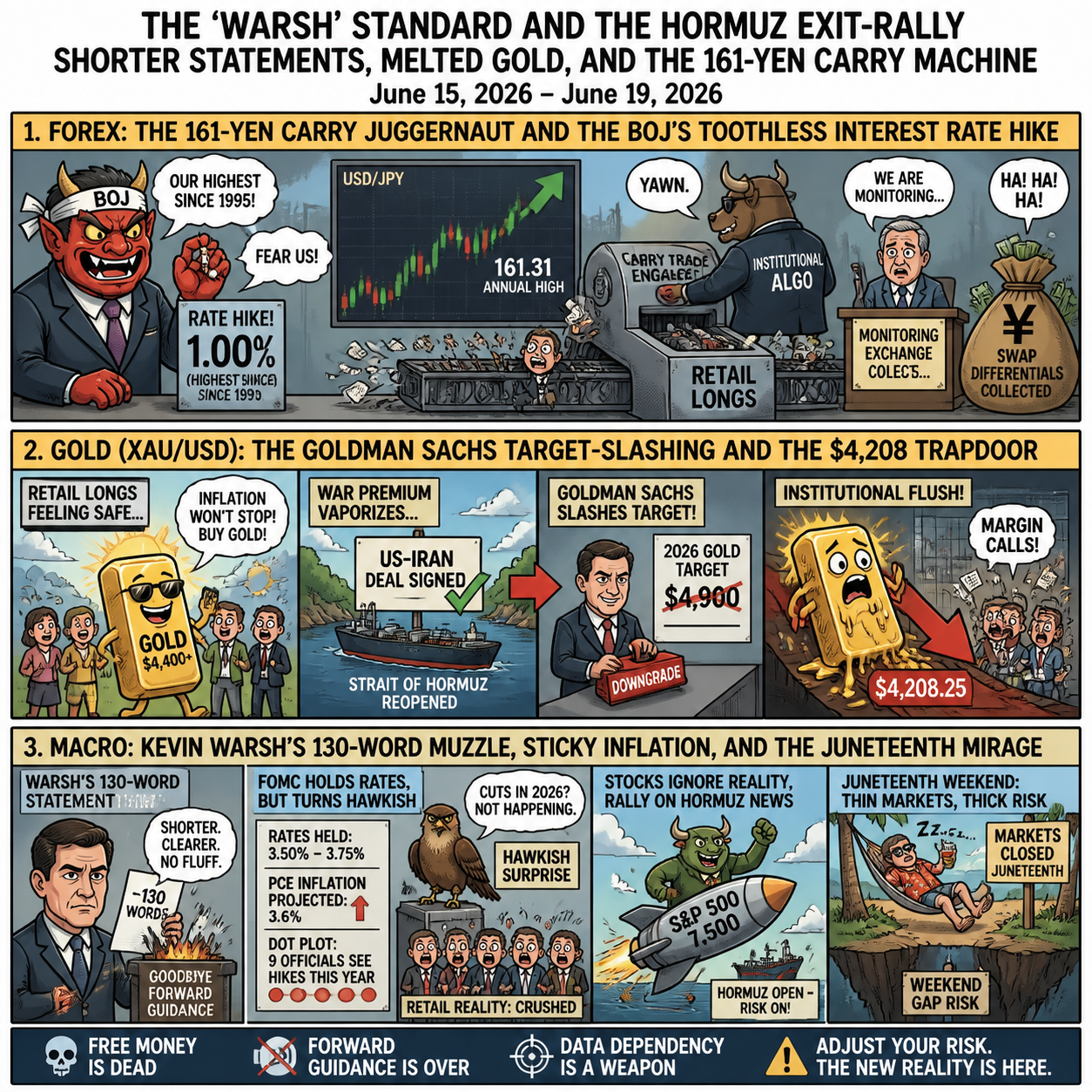
June 15, 2026 – June 19, 2026
The 'Warsh' Standard and the Hormuz Exit-Rally: Shorter Statements, Melted Gold, and the 161-Yen Carry Machine
Forex: The 161-Yen Carry Juggernaut and the BoJ's Toothless Interest Rate Hike
The currency markets offered a spectacular exhibition this week in why retail technical indicators are fundamentally useless when stacked against macroeconomic structural realities. On Tuesday, the Bank of Japan desperately threw a bone to the market, hiking its benchmark interest rate to a whopping 1.00%—its highest level since 1995. Retail accounts, misinterpreting this as a hawkish pivot, frantically piled into long Yen positions. The institutional response? Absolute, algorithmic mockery. The institutional machines immediately recognized that a 1% yield does absolutely nothing to bridge the cavernous interest rate chasm with the Federal Reserve. Automated systems ruthlessly absorbed the retail liquidity, triggering a massive carry-trade short squeeze that catapulted USD/JPY straight to a fresh annual high of 161.31 by Friday. Vague, scripted warnings from Japan's Chief Cabinet Secretary about "monitoring exchange rates" served as nothing more than comedy for institutional desks, who happily collected the swap differentials while retail accounts got systemically stopped out. If your FX bot was trying to catch the falling knife on USD/JPY based on a "triple top" theory, you successfully subsidized an institutional desk's summer vacation.
Gold (XAU/USD): The Goldman Sachs Target-Slashing and the $4,208 Trapdoor
Gold’s tape this week experienced a savage, unmitigated institutional flush, proving once again that retail sentiment is an engineered metric waiting to be exploited. We entered the week with the retail herd confidently holding long positions, convinced that sticky global inflation would permanently floor the metal well above the mid-$4,400s. Then came the twin executioners: geopolitics and Wall Street research. Mid-week, as news broke that a formal US-Iran memorandum of understanding had been signed—effectively reopening the blockaded Strait of Hormuz—the artificial "war premium" vaporized in minutes. To ensure the retail longs were completely incinerated, Goldman Sachs picked the exact moment of maximum panic to publicly slash its 2026 gold price target down to $4,900. Institutional desks aggressively dumped paper blocks into the New York open, sending XAU/USD plunging through key psychological support straight down to $4,208.25 an ounce. The V-shaped downward cascade triggered cascading margin calls across retail accounts, clearing out the board. If you bought the breakout last month and forgot to check the structural order flow, your margin has been efficiently redistributed into safer hands.
Macro: Kevin Warsh’s 130-Word Muzzle, Sticky Inflation, and the Juneteenth Mirage
In the macro sphere, Wednesday’s highly anticipated FOMC meeting marked the official dawn of a ruthless new communication regime under newly appointed Fed Chair Kevin Warsh. For years, retail traders grew addicted to reading hundreds of pages of gentle forward guidance. Warsh took one look at that playbook and threw it in the incinerator, releasing a brutally clipped policy statement stripped down to just roughly 130 words. While interest rates were held steady at 3.50% to 3.75% as expected, the accompanying Summary of Economic Projections (SEP) was an absolute hawkish ambush. The Fed sharply raised its headline PCE inflation projections to 3.6%, with the updated dot plot revealing that nine officials are now actively anticipating rate hikes later this year. The retail market's desperate, ongoing hallucination of a 2026 interest rate cut was summarily executed on live television. Yet, in a bizarre twist of algorithmic irony, equity markets chose to ignore the tighter monetary path entirely, staging a massive tech-led rally to send the S&P 500 to 7,500 simply because shipping tankers were moving through Hormuz again. With US markets heading into the thin-liquidity Juneteenth long weekend on Friday, the smart money left the retail herd exposed to raw, unhedged weekend gap risk. Adjust your risk profiles to match the new reality: free money is dead, forward guidance is over, and data dependency is a weapon.
The 'Warsh' Standard and the Hormuz Exit-Rally: Shorter Statements, Melted Gold, and the 161-Yen Carry Machine
Forex: The 161-Yen Carry Juggernaut and the BoJ's Toothless Interest Rate Hike
The currency markets offered a spectacular exhibition this week in why retail technical indicators are fundamentally useless when stacked against macroeconomic structural realities. On Tuesday, the Bank of Japan desperately threw a bone to the market, hiking its benchmark interest rate to a whopping 1.00%—its highest level since 1995. Retail accounts, misinterpreting this as a hawkish pivot, frantically piled into long Yen positions. The institutional response? Absolute, algorithmic mockery. The institutional machines immediately recognized that a 1% yield does absolutely nothing to bridge the cavernous interest rate chasm with the Federal Reserve. Automated systems ruthlessly absorbed the retail liquidity, triggering a massive carry-trade short squeeze that catapulted USD/JPY straight to a fresh annual high of 161.31 by Friday. Vague, scripted warnings from Japan's Chief Cabinet Secretary about "monitoring exchange rates" served as nothing more than comedy for institutional desks, who happily collected the swap differentials while retail accounts got systemically stopped out. If your FX bot was trying to catch the falling knife on USD/JPY based on a "triple top" theory, you successfully subsidized an institutional desk's summer vacation.
Gold (XAU/USD): The Goldman Sachs Target-Slashing and the $4,208 Trapdoor
Gold’s tape this week experienced a savage, unmitigated institutional flush, proving once again that retail sentiment is an engineered metric waiting to be exploited. We entered the week with the retail herd confidently holding long positions, convinced that sticky global inflation would permanently floor the metal well above the mid-$4,400s. Then came the twin executioners: geopolitics and Wall Street research. Mid-week, as news broke that a formal US-Iran memorandum of understanding had been signed—effectively reopening the blockaded Strait of Hormuz—the artificial "war premium" vaporized in minutes. To ensure the retail longs were completely incinerated, Goldman Sachs picked the exact moment of maximum panic to publicly slash its 2026 gold price target down to $4,900. Institutional desks aggressively dumped paper blocks into the New York open, sending XAU/USD plunging through key psychological support straight down to $4,208.25 an ounce. The V-shaped downward cascade triggered cascading margin calls across retail accounts, clearing out the board. If you bought the breakout last month and forgot to check the structural order flow, your margin has been efficiently redistributed into safer hands.
Macro: Kevin Warsh’s 130-Word Muzzle, Sticky Inflation, and the Juneteenth Mirage
In the macro sphere, Wednesday’s highly anticipated FOMC meeting marked the official dawn of a ruthless new communication regime under newly appointed Fed Chair Kevin Warsh. For years, retail traders grew addicted to reading hundreds of pages of gentle forward guidance. Warsh took one look at that playbook and threw it in the incinerator, releasing a brutally clipped policy statement stripped down to just roughly 130 words. While interest rates were held steady at 3.50% to 3.75% as expected, the accompanying Summary of Economic Projections (SEP) was an absolute hawkish ambush. The Fed sharply raised its headline PCE inflation projections to 3.6%, with the updated dot plot revealing that nine officials are now actively anticipating rate hikes later this year. The retail market's desperate, ongoing hallucination of a 2026 interest rate cut was summarily executed on live television. Yet, in a bizarre twist of algorithmic irony, equity markets chose to ignore the tighter monetary path entirely, staging a massive tech-led rally to send the S&P 500 to 7,500 simply because shipping tankers were moving through Hormuz again. With US markets heading into the thin-liquidity Juneteenth long weekend on Friday, the smart money left the retail herd exposed to raw, unhedged weekend gap risk. Adjust your risk profiles to match the new reality: free money is dead, forward guidance is over, and data dependency is a weapon.
Steve Rosenstock

June 8, 2026 – June 12, 2026
The 'Ceasefire Tease' Carousel: Headline Whiplash, The 160-Yen Squeeze, and the Friday Gold Mirage
Forex: The 160-Yen Psychological Guillotine and the Great Euro-Chop
The currency markets functioned as a high-frequency meat grinder for retail sentiment this week, proving yet again that trying to trade complex geopolitical headlines with basic technical analysis is just a highly efficient way to donate your margin to institutional liquidity pools. The entire FX matrix was pinned to the chaotic, conflicting reports surrounding the US-Iran stalemate and a "conditional ceasefire" that seemingly changed its parameters every three hours. The Japanese Yen provided the week's primary algorithmic execution chamber. As mainstream financial networks fed the herd a steady stream of "imminent Bank of Japan intervention risks" and peace-talk rumors, retail accounts aggressively shorted the pair, expecting an immediate macro rescue mission. Instead, institutional algorithms triggered a brutal stop-loss squeeze. The smart money used the retail panic to absorb the resting liquidity and push USD/JPY right back into the psychological death zone near 160.31, leaving breakout traders holding the bag. Meanwhile, the Euro was kept trapped in a strict, high-fee chop zone around 1.1567, systematically choked by the persistent threat of an energy premium while the Strait of Hormuz remained a logistical nightmare. If your automated grid bot spent the week trying to find an orderly trend, it was likely liquidated by the absolute absence of structural market order.
Gold (XAU/USD): The $4,268 Trapdoor and the Friday Illusion
Gold’s price action this week was a ruthless masterclass in institutional distribution, designed specifically to strip retail trend-followers of their capital before executing a sharp, sudden trend reversal. We opened Monday morning in a state of absolute devastation. Still reeling from the previous Friday's blockbuster Non-Farm Payrolls shocker—which effectively crushed all remaining retail dreams of a interest rate cut—spot gold opened under immense pressure, drifting straight down to a multi-month low of $4,268.52. Retail accounts, staring blindly at their oversold RSI indicators, immediately began panic-selling the dip, convinced that the structural floor had completely vanished. That was the exact cue for the institutional machines. Once the stop-loss clusters below $4,300 were fully vacuumed up, the true engineered fake-out rally began. From Tuesday to Thursday, gold slowly ground its way back upward as fresh headlines teased that a historic peace deal was "imminent". The grand finale arrived on Friday, June 12, when a massive wave of short-covering squeezed XAU/USD up by over 2%, pushing it past $4,350 on the narrative that an end to the conflict would instantly ignite global industrial demand. The market didn’t miraculously fix its structural problems on Friday; the algorithms simply ran a textbook liquidity sweep to punish the late-joining shorters.
Macro: The 'Peace Deal' Carousel, Sticky PPI, and the 2026 Rate Cut Delusion
In the macro sphere, the mainstream media's delusional fantasy of a smooth, painless "soft landing" collided head-on with a brutal stagflationary reality. The market spent the week trapped on a carousel driven entirely by the executive branch's social media accounts. In another staggering about-turn, President Trump canceled planned military strikes and declared that a historic peace deal could be signed "as soon as this weekend," causing oil prices to slide and triggering a massive cross-asset reversal. In the macro sphere, the mainstream media's delusional fantasy of a smooth, painless "soft landing" collided head-on with a brutal stagflationary reality. The market spent the week trapped on a carousel driven entirely by the executive branch's social media accounts. In another staggering about-turn, President Trump canceled planned military strikes and declared that a historic peace deal could be signed "as soon as this weekend," causing oil prices to slide and triggering a massive cross-asset reversal.
The 'Ceasefire Tease' Carousel: Headline Whiplash, The 160-Yen Squeeze, and the Friday Gold Mirage
Forex: The 160-Yen Psychological Guillotine and the Great Euro-Chop
The currency markets functioned as a high-frequency meat grinder for retail sentiment this week, proving yet again that trying to trade complex geopolitical headlines with basic technical analysis is just a highly efficient way to donate your margin to institutional liquidity pools. The entire FX matrix was pinned to the chaotic, conflicting reports surrounding the US-Iran stalemate and a "conditional ceasefire" that seemingly changed its parameters every three hours. The Japanese Yen provided the week's primary algorithmic execution chamber. As mainstream financial networks fed the herd a steady stream of "imminent Bank of Japan intervention risks" and peace-talk rumors, retail accounts aggressively shorted the pair, expecting an immediate macro rescue mission. Instead, institutional algorithms triggered a brutal stop-loss squeeze. The smart money used the retail panic to absorb the resting liquidity and push USD/JPY right back into the psychological death zone near 160.31, leaving breakout traders holding the bag. Meanwhile, the Euro was kept trapped in a strict, high-fee chop zone around 1.1567, systematically choked by the persistent threat of an energy premium while the Strait of Hormuz remained a logistical nightmare. If your automated grid bot spent the week trying to find an orderly trend, it was likely liquidated by the absolute absence of structural market order.
Gold (XAU/USD): The $4,268 Trapdoor and the Friday Illusion
Gold’s price action this week was a ruthless masterclass in institutional distribution, designed specifically to strip retail trend-followers of their capital before executing a sharp, sudden trend reversal. We opened Monday morning in a state of absolute devastation. Still reeling from the previous Friday's blockbuster Non-Farm Payrolls shocker—which effectively crushed all remaining retail dreams of a interest rate cut—spot gold opened under immense pressure, drifting straight down to a multi-month low of $4,268.52. Retail accounts, staring blindly at their oversold RSI indicators, immediately began panic-selling the dip, convinced that the structural floor had completely vanished. That was the exact cue for the institutional machines. Once the stop-loss clusters below $4,300 were fully vacuumed up, the true engineered fake-out rally began. From Tuesday to Thursday, gold slowly ground its way back upward as fresh headlines teased that a historic peace deal was "imminent". The grand finale arrived on Friday, June 12, when a massive wave of short-covering squeezed XAU/USD up by over 2%, pushing it past $4,350 on the narrative that an end to the conflict would instantly ignite global industrial demand. The market didn’t miraculously fix its structural problems on Friday; the algorithms simply ran a textbook liquidity sweep to punish the late-joining shorters.
Macro: The 'Peace Deal' Carousel, Sticky PPI, and the 2026 Rate Cut Delusion
In the macro sphere, the mainstream media's delusional fantasy of a smooth, painless "soft landing" collided head-on with a brutal stagflationary reality. The market spent the week trapped on a carousel driven entirely by the executive branch's social media accounts. In another staggering about-turn, President Trump canceled planned military strikes and declared that a historic peace deal could be signed "as soon as this weekend," causing oil prices to slide and triggering a massive cross-asset reversal. In the macro sphere, the mainstream media's delusional fantasy of a smooth, painless "soft landing" collided head-on with a brutal stagflationary reality. The market spent the week trapped on a carousel driven entirely by the executive branch's social media accounts. In another staggering about-turn, President Trump canceled planned military strikes and declared that a historic peace deal could be signed "as soon as this weekend," causing oil prices to slide and triggering a massive cross-asset reversal.
Steve Rosenstock

June 1, 2026 – June 5, 2026
The 'Ceasefire Tease' and the Non-Farm Payroll Whiplash: Fake-Out Rallies, Golden Trapdoors, and the 160-Yen Squeeze
Forex: The 160-Yen Psychological Meat Grinder and the Antipodean Squeeze
The currency markets functioned as a high-frequency meat grinder for retail sentiment this week, proving yet again that trying to trade geopolitical headlines with basic technical analysis is just an expensive way to fund institutional liquidity pools. The entire FX matrix was pinned to the chaotic, conflicting reports surrounding the US-Iran stalemate and a "conditional ceasefire" between Israel and Lebanon. The Japanese Yen provided the week's primary slaughterhouse. As headlines hinted at a diplomatic breakthrough, retail accounts aggressively shorted USD/JPY, expecting an imminent Bank of Japan rescue mission. Instead, institutional algorithms triggered a brutal squeeze, hunting stop-loss clusters and driving USD/JPY right back into the psychological death zone near 160.31. Meanwhile, the Euro was kept in a strict, high-fee chop zone around 1.1522, systematically choked by the persistent threat of an energy premium while the Strait of Hormuz remained effectively blockaded. For the final blow, the Australian Dollar suffered an immediate institutional flush; retail breakout buyers looking at laggy indicators were caught entirely off-guard when employment data deviation capped hawkish bets. If your automated grid bot spent the week trying to find an orderly trend, it was likely liquidated by the absolute absence of market order.
Gold (XAU/USD): The $4,472 Illusion and the Friday Trapdoor
Gold’s tape this week was a textbook demonstration of the engineered liquidity cycle, designed specifically to strip retail trend-followers of their capital before the real move occurred. We opened the week attempting to find stability, with spot gold drifting lazily around the $4,472 open as mainstream networks fed the herd a steady diet of "imminent Middle East peace deals". From Monday to Thursday, retail FOMO slowly built, with long positions accumulating on the naive assumption that the macro floor would hold steady. Then came Friday. Under the perfect cover of a blowout US Non-Farm Payrolls report and renewed inflation anxieties, the smart money pulled the trapdoor shut. Right at the New York open, institutional desks dumped massive blocks of paper gold, sending the price into a vertical, single-day plunge of over 3% straight down to a multi-month low of $4,331.00. The V-shaped drop completely bypassed retail trailing stops, instantly triggering automated margin calls and flushing out the entire week's leverage. The market didn’t shift its long-term fundamentals on Friday; the algorithms simply went hunting exactly where retail felt safest. If you bought the mid-week "safe-haven dip," you officially provided the liquidity for the institutional short distribution.
Macro: The 'Higher for Longer' Executioner and the Strait of Hormuz Surcharge
In the macro sphere, the mainstream media's delusional fantasy of a "soft landing" collided head-on with a brutal stagflationary reality. Despite President Trump's optimistic social media declarations that everything "would work out well in the end," the broader economic reality has devolved into administrative gridlock. A rare, bipartisan House vote attempted to curb US military exposure in Iran, underlining the staggering global costs of keeping a prolonged conflict on life support. The actual structural threat is the new "Hormuz Surcharge." With the Strait handling barely a fraction of its normal pre-conflict volume, shipping and insurance premiums are acting as a permanent, global consumption tax on the Eurozone and Asian economies. Eurozone headline inflation is now stuck at a sticky 3.2%, entirely cornered by the oil shock. Yet, the ultimate executioner of retail portfolio dreams remains the Federal Reserve. Anyone still pricing in aggressive rate cuts for 2026 is suffering from financial hallucinations; strong service PMIs hitting a three-month high of 54.5 ensure that the terminal rate stays highly restrictive. We do not trade the illusion of peace or political promises. We systematically exploit the massive divergence between structural inflation and retail's desperate, hopeless addiction to cheap credit. Turn off your standard moving averages, adjust your backtests for elevated capital costs, or prepare to be liquidated.
The 'Ceasefire Tease' and the Non-Farm Payroll Whiplash: Fake-Out Rallies, Golden Trapdoors, and the 160-Yen Squeeze
Forex: The 160-Yen Psychological Meat Grinder and the Antipodean Squeeze
The currency markets functioned as a high-frequency meat grinder for retail sentiment this week, proving yet again that trying to trade geopolitical headlines with basic technical analysis is just an expensive way to fund institutional liquidity pools. The entire FX matrix was pinned to the chaotic, conflicting reports surrounding the US-Iran stalemate and a "conditional ceasefire" between Israel and Lebanon. The Japanese Yen provided the week's primary slaughterhouse. As headlines hinted at a diplomatic breakthrough, retail accounts aggressively shorted USD/JPY, expecting an imminent Bank of Japan rescue mission. Instead, institutional algorithms triggered a brutal squeeze, hunting stop-loss clusters and driving USD/JPY right back into the psychological death zone near 160.31. Meanwhile, the Euro was kept in a strict, high-fee chop zone around 1.1522, systematically choked by the persistent threat of an energy premium while the Strait of Hormuz remained effectively blockaded. For the final blow, the Australian Dollar suffered an immediate institutional flush; retail breakout buyers looking at laggy indicators were caught entirely off-guard when employment data deviation capped hawkish bets. If your automated grid bot spent the week trying to find an orderly trend, it was likely liquidated by the absolute absence of market order.
Gold (XAU/USD): The $4,472 Illusion and the Friday Trapdoor
Gold’s tape this week was a textbook demonstration of the engineered liquidity cycle, designed specifically to strip retail trend-followers of their capital before the real move occurred. We opened the week attempting to find stability, with spot gold drifting lazily around the $4,472 open as mainstream networks fed the herd a steady diet of "imminent Middle East peace deals". From Monday to Thursday, retail FOMO slowly built, with long positions accumulating on the naive assumption that the macro floor would hold steady. Then came Friday. Under the perfect cover of a blowout US Non-Farm Payrolls report and renewed inflation anxieties, the smart money pulled the trapdoor shut. Right at the New York open, institutional desks dumped massive blocks of paper gold, sending the price into a vertical, single-day plunge of over 3% straight down to a multi-month low of $4,331.00. The V-shaped drop completely bypassed retail trailing stops, instantly triggering automated margin calls and flushing out the entire week's leverage. The market didn’t shift its long-term fundamentals on Friday; the algorithms simply went hunting exactly where retail felt safest. If you bought the mid-week "safe-haven dip," you officially provided the liquidity for the institutional short distribution.
Macro: The 'Higher for Longer' Executioner and the Strait of Hormuz Surcharge
In the macro sphere, the mainstream media's delusional fantasy of a "soft landing" collided head-on with a brutal stagflationary reality. Despite President Trump's optimistic social media declarations that everything "would work out well in the end," the broader economic reality has devolved into administrative gridlock. A rare, bipartisan House vote attempted to curb US military exposure in Iran, underlining the staggering global costs of keeping a prolonged conflict on life support. The actual structural threat is the new "Hormuz Surcharge." With the Strait handling barely a fraction of its normal pre-conflict volume, shipping and insurance premiums are acting as a permanent, global consumption tax on the Eurozone and Asian economies. Eurozone headline inflation is now stuck at a sticky 3.2%, entirely cornered by the oil shock. Yet, the ultimate executioner of retail portfolio dreams remains the Federal Reserve. Anyone still pricing in aggressive rate cuts for 2026 is suffering from financial hallucinations; strong service PMIs hitting a three-month high of 54.5 ensure that the terminal rate stays highly restrictive. We do not trade the illusion of peace or political promises. We systematically exploit the massive divergence between structural inflation and retail's desperate, hopeless addiction to cheap credit. Turn off your standard moving averages, adjust your backtests for elevated capital costs, or prepare to be liquidated.
Steve Rosenstock
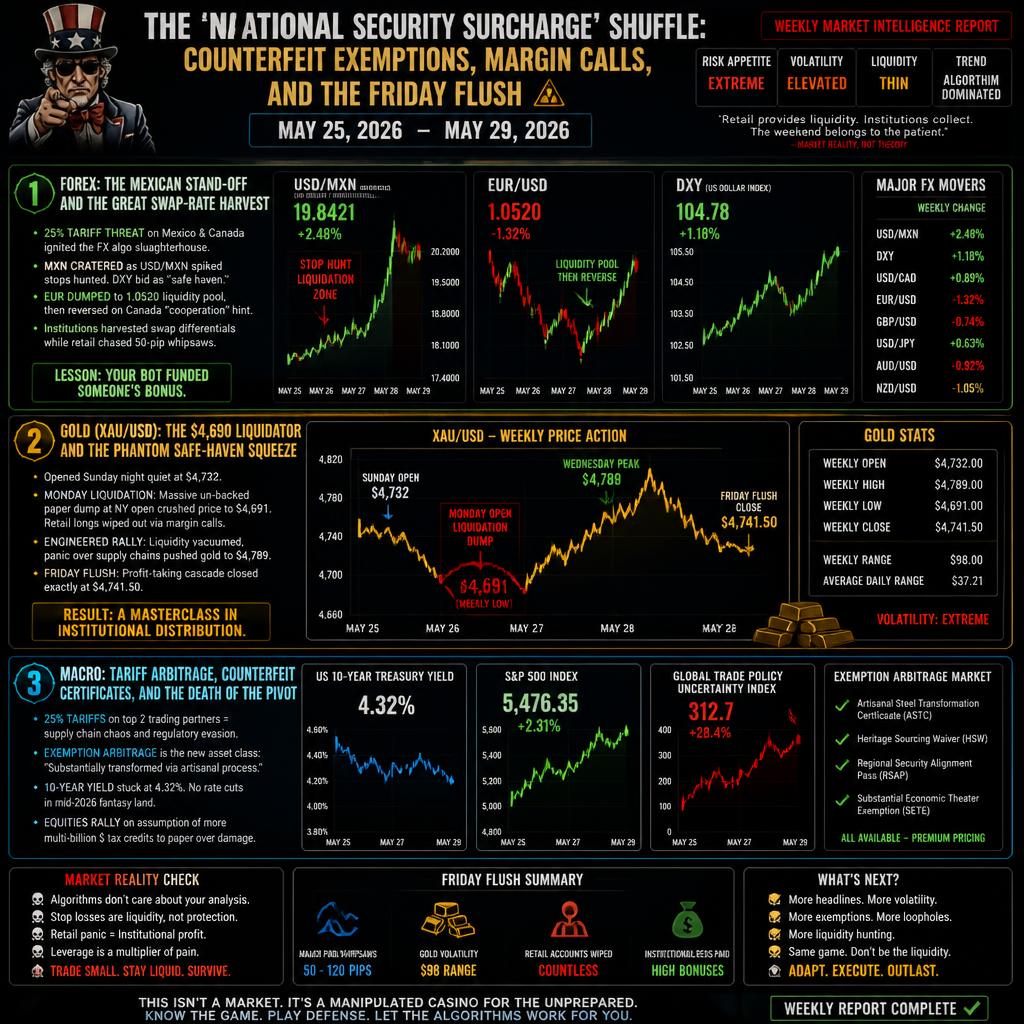
May 25, 2026 – May 29, 2026
The 'National Security Surcharge' Shuffle: Counterfeit Exemptions, Margin Calls, and the Friday Flush
Forex: The Mexican Stand-Off and the Great Swap-Rate Harvest
The currency markets converted directly into an algorithmic slaughterhouse this week, proving once again that retail traders analyzing trendlines are merely providing liquidity for the institutional machines. The entire FX matrix was electrified by the administration’s sudden threat of a "25% tariff on all imports from Mexico and Canada" unless border crossings completely cease by tomorrow afternoon. The immediate algorithmic reaction was a textbook lesson in market manipulation. The Mexican Peso (MXN) cratered instantly, sending USD/MXN into a vertical squeeze that hunted the stops of every micro-account trying to execute short-term carry trades. While retail rushed to buy the sudden breakout on the US Dollar Index (DXY) as a safe haven, the smart money calmly front-ran the move. They pushed the Euro into a desperate liquidity pool at 1.0520, only to systematically reverse the entire flow hours later when Canada subtly hinted at a "cooperative trade mechanism." Retail spent the week chasing 50-pip whipsaws driven by automated headline scanners, while institutional swap engines quietly milked the interest rate differentials. If your trading bot spent this week trying to find an orderly wave pattern, it was likely just funding an institutional desk's weekend bonus.
Gold (XAU/USD): The $4,690 Liquidator and the Phantom Safe-Haven Squeeze
Gold’s tape this week looked less like a precious metal chart and more like a carefully engineered trap designed to liquidate both sides of the order book. We opened Sunday night at a deceptively quiet $4,732, with the retail herd widely assuming that the escalating tariff rhetoric would instantly rocket the yellow metal past its previous highs. Instead, Monday delivered the classic institutional weak-hand harvest. Right at the New York open, a massive, un-backed block of institutional paper was dumped onto the market, triggering a violent, vertical plunge down to a low of $4,691. The retail longs—leveraged to the hilt and lacking deep buffers—were systematically cleared out via automated margin calls. Once the resting liquidity was completely vacuumed up, the true engineered rally began. By Wednesday afternoon, as global supply chain panic reached a fever pitch over the potential closure of northern borders, XAU/USD was aggressively squeezed upward to a weekly peak of $4,789. The cycle concluded with a textbook Friday profit-taking cascade, parking the closing price exactly back at $4,741.50. If your MT5 platform didn't melt from the sheer velocity of that V-shaped reversal, you survived a masterclass in institutional distribution.
Macro: Tariff Arbitrage, Counterfeit Certificates, and the Death of the Pivot
In the macro sphere, traditional economic theory has officially been replaced by absolute administrative chaos. With the sudden announcement of 25% across-the-board tariffs on America's top two trading partners, global supply chains have devolved into a game of regulatory evasion. The market's newest and most profitable asset class is the creation of Exemption Arbitrage. Supply chain networks are already seeing an explosion in specialized law firms offering to certify that steel coming through Montreal was "substantially transformed via an artisanal process" to bypass the national security restrictions. Meanwhile, with the 10-year US Treasury yield stubbornly entrenched at 4.32%, any retail trader still holding onto the delusion of a mid-2026 Federal Reserve rate cut is living in an economic fantasy world. The Fed’s terminal rate is structurally higher, driven by the inflationary fires of the tariff-induced price spikes. Yet, the equity markets continue their bizarre, unyielding ascent toward new highs, completely fueled by the assumption that the government will simply issue another round of multi-billion dollar business tax credits to cover the damage. Keep your leverage adjusted for systemic volatility, ignore the mainstream media noise, and let the algorithms exploit the retail panic.
The 'National Security Surcharge' Shuffle: Counterfeit Exemptions, Margin Calls, and the Friday Flush
Forex: The Mexican Stand-Off and the Great Swap-Rate Harvest
The currency markets converted directly into an algorithmic slaughterhouse this week, proving once again that retail traders analyzing trendlines are merely providing liquidity for the institutional machines. The entire FX matrix was electrified by the administration’s sudden threat of a "25% tariff on all imports from Mexico and Canada" unless border crossings completely cease by tomorrow afternoon. The immediate algorithmic reaction was a textbook lesson in market manipulation. The Mexican Peso (MXN) cratered instantly, sending USD/MXN into a vertical squeeze that hunted the stops of every micro-account trying to execute short-term carry trades. While retail rushed to buy the sudden breakout on the US Dollar Index (DXY) as a safe haven, the smart money calmly front-ran the move. They pushed the Euro into a desperate liquidity pool at 1.0520, only to systematically reverse the entire flow hours later when Canada subtly hinted at a "cooperative trade mechanism." Retail spent the week chasing 50-pip whipsaws driven by automated headline scanners, while institutional swap engines quietly milked the interest rate differentials. If your trading bot spent this week trying to find an orderly wave pattern, it was likely just funding an institutional desk's weekend bonus.
Gold (XAU/USD): The $4,690 Liquidator and the Phantom Safe-Haven Squeeze
Gold’s tape this week looked less like a precious metal chart and more like a carefully engineered trap designed to liquidate both sides of the order book. We opened Sunday night at a deceptively quiet $4,732, with the retail herd widely assuming that the escalating tariff rhetoric would instantly rocket the yellow metal past its previous highs. Instead, Monday delivered the classic institutional weak-hand harvest. Right at the New York open, a massive, un-backed block of institutional paper was dumped onto the market, triggering a violent, vertical plunge down to a low of $4,691. The retail longs—leveraged to the hilt and lacking deep buffers—were systematically cleared out via automated margin calls. Once the resting liquidity was completely vacuumed up, the true engineered rally began. By Wednesday afternoon, as global supply chain panic reached a fever pitch over the potential closure of northern borders, XAU/USD was aggressively squeezed upward to a weekly peak of $4,789. The cycle concluded with a textbook Friday profit-taking cascade, parking the closing price exactly back at $4,741.50. If your MT5 platform didn't melt from the sheer velocity of that V-shaped reversal, you survived a masterclass in institutional distribution.
Macro: Tariff Arbitrage, Counterfeit Certificates, and the Death of the Pivot
In the macro sphere, traditional economic theory has officially been replaced by absolute administrative chaos. With the sudden announcement of 25% across-the-board tariffs on America's top two trading partners, global supply chains have devolved into a game of regulatory evasion. The market's newest and most profitable asset class is the creation of Exemption Arbitrage. Supply chain networks are already seeing an explosion in specialized law firms offering to certify that steel coming through Montreal was "substantially transformed via an artisanal process" to bypass the national security restrictions. Meanwhile, with the 10-year US Treasury yield stubbornly entrenched at 4.32%, any retail trader still holding onto the delusion of a mid-2026 Federal Reserve rate cut is living in an economic fantasy world. The Fed’s terminal rate is structurally higher, driven by the inflationary fires of the tariff-induced price spikes. Yet, the equity markets continue their bizarre, unyielding ascent toward new highs, completely fueled by the assumption that the government will simply issue another round of multi-billion dollar business tax credits to cover the damage. Keep your leverage adjusted for systemic volatility, ignore the mainstream media noise, and let the algorithms exploit the retail panic.
Steve Rosenstock

May 18, 2026 – May 22, 2026
The 'Cheap Growth' Funeral: BoJ Illusions, Hormuz Headlines, and the Friday Flush
Forex: The BoJ Mirage and the Antipodean Slaughterhouse
The currency markets offered a masterclass this week in how institutional algorithms weaponize mainstream financial media against retail accounts. Take the Japanese Yen: all week, the financial press beat the drum of "imminent BoJ intervention risks," prompting retail traders to aggressively catch the falling knife on USD/JPY. The outcome? Algorithmic systems happily absorbed this retail liquidity, pushing the Yen lower and triggering cascading stop-loss clusters. Retail traded the headline; institutions traded the order flow. The true algorithmic slaughterhouse, however, was located down under. Australian unemployment unexpectedly ticked up to 4.5%. Retail traders, staring blankly at their lagging RSIs and "guaranteed" EMA30 support levels on AUD/NZD, blindly bought the dip. As systematically programmed, institutional volume bulldozed straight through these imaginary support zones, harvested the resting liquidity, and executed a textbook mean-reversion. If your EA is still relying on moving average crosses in this environment, you aren't trading—you are simply donating your margin to the interbank network.
Gold (XAU/USD): The 3-Day Pump and the Friday Bag-Holder Flush
Gold’s price action this week was a ruthless demonstration of the classic engineered liquidity cycle. We opened the week at a calm $4,710. For three days, a slow, steady, and entirely manufactured ascent took place, heavily fueled by "Fog of War" narratives and geopolitical anxiety broadcasted across every major news network. Retail FOMO kicked into overdrive, piling aggressively into long positions, entirely convinced that the breakout toward $4,785 was the start of a multi-month flight to safety. Then came the reality check. After three days of carefully distributing positions to retail buyers, Friday, May 22, delivered the inevitable institutional flush. Under the convenient guise of "weekend de-risking," smart money aggressively unloaded. The price cratered back down to the $4,720 region in a matter of hours, violently wiping out the late buyers. This wasn't a sudden shift in macro fundamentals; it was a pure, algorithmic sweep of the order book. The institutions built their short positions exactly where retail felt the safest. If you bought the top of the breakout and didn't trail your stops, you are now officially a long-term liquidity provider.
Macro: The Death of 'Cheap Growth' and the 2027 Rate Cut Hallucination
In the macro sphere, the narrative has officially shifted to what the IMF and central banks are quietly calling the end of the "Cheap Growth" regime. Let’s translate this central bank diplomacy into trader reality: the cost of keeping this debt-fueled global engine running has structurally increased, and capital is not getting cheaper anytime soon. US inflation is now practically glued to the 3.2% mark. Anyone still positioning their portfolio for a Federal Reserve pivot before early 2027 is suffering from severe financial hallucinations. The ECB is entirely cornered by stagnant growth and sticky inflation, while global energy prices continue to hold the economy hostage, acting as a massive, unavoidable consumption tax. Yet, mainstream media continues to spoon-feed retail traders the delusion that a "soft landing" is perfectly intact. We do not trade the illusion. We systematically exploit the massive divergence between the Fed’s "higher for longer" reality and the retail sector's desperate, hopeless addiction to cheap liquidity. The era of free money is dead. Adjust your backtests to reflect the cost of capital, or prepare to be liquidated.
The 'Cheap Growth' Funeral: BoJ Illusions, Hormuz Headlines, and the Friday Flush
Forex: The BoJ Mirage and the Antipodean Slaughterhouse
The currency markets offered a masterclass this week in how institutional algorithms weaponize mainstream financial media against retail accounts. Take the Japanese Yen: all week, the financial press beat the drum of "imminent BoJ intervention risks," prompting retail traders to aggressively catch the falling knife on USD/JPY. The outcome? Algorithmic systems happily absorbed this retail liquidity, pushing the Yen lower and triggering cascading stop-loss clusters. Retail traded the headline; institutions traded the order flow. The true algorithmic slaughterhouse, however, was located down under. Australian unemployment unexpectedly ticked up to 4.5%. Retail traders, staring blankly at their lagging RSIs and "guaranteed" EMA30 support levels on AUD/NZD, blindly bought the dip. As systematically programmed, institutional volume bulldozed straight through these imaginary support zones, harvested the resting liquidity, and executed a textbook mean-reversion. If your EA is still relying on moving average crosses in this environment, you aren't trading—you are simply donating your margin to the interbank network.
Gold (XAU/USD): The 3-Day Pump and the Friday Bag-Holder Flush
Gold’s price action this week was a ruthless demonstration of the classic engineered liquidity cycle. We opened the week at a calm $4,710. For three days, a slow, steady, and entirely manufactured ascent took place, heavily fueled by "Fog of War" narratives and geopolitical anxiety broadcasted across every major news network. Retail FOMO kicked into overdrive, piling aggressively into long positions, entirely convinced that the breakout toward $4,785 was the start of a multi-month flight to safety. Then came the reality check. After three days of carefully distributing positions to retail buyers, Friday, May 22, delivered the inevitable institutional flush. Under the convenient guise of "weekend de-risking," smart money aggressively unloaded. The price cratered back down to the $4,720 region in a matter of hours, violently wiping out the late buyers. This wasn't a sudden shift in macro fundamentals; it was a pure, algorithmic sweep of the order book. The institutions built their short positions exactly where retail felt the safest. If you bought the top of the breakout and didn't trail your stops, you are now officially a long-term liquidity provider.
Macro: The Death of 'Cheap Growth' and the 2027 Rate Cut Hallucination
In the macro sphere, the narrative has officially shifted to what the IMF and central banks are quietly calling the end of the "Cheap Growth" regime. Let’s translate this central bank diplomacy into trader reality: the cost of keeping this debt-fueled global engine running has structurally increased, and capital is not getting cheaper anytime soon. US inflation is now practically glued to the 3.2% mark. Anyone still positioning their portfolio for a Federal Reserve pivot before early 2027 is suffering from severe financial hallucinations. The ECB is entirely cornered by stagnant growth and sticky inflation, while global energy prices continue to hold the economy hostage, acting as a massive, unavoidable consumption tax. Yet, mainstream media continues to spoon-feed retail traders the delusion that a "soft landing" is perfectly intact. We do not trade the illusion. We systematically exploit the massive divergence between the Fed’s "higher for longer" reality and the retail sector's desperate, hopeless addiction to cheap liquidity. The era of free money is dead. Adjust your backtests to reflect the cost of capital, or prepare to be liquidated.
Steve Rosenstock

May 11, 2026 – May 15, 2026
The 'Section 122' Seesaw: Ghost Fleets, Tariff Arbitrage, and the 150-Day Clock
Forex: The 1.1770 Gravitational Well and the 'Ghost Fleet' Carry
The currency market spent the week trapped in an algorithmic house of mirrors, proving once again that retail technical indicators are just an expensive way to lose sleep. The entire Forex space revolved around the ultimate mathematical gravitational well: EUR/USD 1.1770. Every micro-move away from this anchor—whether a desperate retail push toward a peak of 1.1775 or a sudden drop to 1.1771—was met with an immediate, crushing institutional response. While retail traders used lagging indicators to chase phantom breakouts, systematic algorithms calmly ran mean-reversion plays at the fringes, pocketing the spread. The US Dollar Index (DXY) continues to sit comfortably on its throne, entirely unfazed by the fact that the US Treasury is preparing a massive $166 billion refund check for businesses caught in the crossfire of recent legal "clerical errors." On MQL5, signal providers who spent the last month shorting the Yen have seamlessly transitioned to pretending their accounts are actually long-term philanthropic liquidity reserves.
Gold (XAU/USD): The $4,830 Rollercoaster and the Weak-Hand Harvest
Gold’s intraday tape this week looked less like a commodity chart and more like an EKG of a panicked day trader. We opened Monday at a fragile $4,709, with the market desperately sniffing around for geopolitical direction. On Tuesday, right on cue, the mainstream media began broadcasting convenient rumors of a "Strait of Hormuz de-escalation." What followed was a textbook institutional stop-hunt: an engineered plunge down to $4,760, precisely calculated to trigger the stop-loss clusters of over-leveraged retail longs. Once the weak hands were thoroughly liquidated and their accounts wiped, the institutional vacuum turned on. By Thursday, a frantic spike ignited, propelled by sudden "Ghost Fleet" insurance premium scares, driving the yellow metal all the way up to an aggressive peak of $4,889. The week concluded with a classic Friday profit-taking flush, parking the price exactly back at $4,831.56. If your MetaTrader 5 setup didn't fry its logic core trying to calculate that V-shaped liquidity grab, your parameters are officially battle-tested.
Macro: Section 122 Lotteries and the Greenland Layaway Plan
In the macro sphere, traditional economic textbooks are officially being treated as kindling. With traditional tariff pathways hitting constitutional redlines, the administration dusted off Section 122 of the 1974 Trade Act—introducing a glorious "150-Day Temporary Surcharge" that acts as a financial cliffhanger for global supply chains. The absurdity has birthed an entirely new asset class: Tariff Refund Arbitrage. Major corporations are already using their expected $166 billion government refund checks as collateral to fund domestic stock buybacks. Meanwhile, global trade negotiations have officially devolved into a high-stakes auction, with the 25% "Global Surcharge" playing the role of a monthly layaway payment to see if Denmark will finally take the hint on a Greenland discount. With the 10-year US Treasury yield entrenched at 4.28%, capital remains painfully expensive for the retail sector, but the Dow continues its slow dance toward 50k on the sheer, unadulterated hope of incoming tax rebates. Keep your leverage high, your stops hidden, and your systems optimized to exploit the central bank chaos.
The 'Section 122' Seesaw: Ghost Fleets, Tariff Arbitrage, and the 150-Day Clock
Forex: The 1.1770 Gravitational Well and the 'Ghost Fleet' Carry
The currency market spent the week trapped in an algorithmic house of mirrors, proving once again that retail technical indicators are just an expensive way to lose sleep. The entire Forex space revolved around the ultimate mathematical gravitational well: EUR/USD 1.1770. Every micro-move away from this anchor—whether a desperate retail push toward a peak of 1.1775 or a sudden drop to 1.1771—was met with an immediate, crushing institutional response. While retail traders used lagging indicators to chase phantom breakouts, systematic algorithms calmly ran mean-reversion plays at the fringes, pocketing the spread. The US Dollar Index (DXY) continues to sit comfortably on its throne, entirely unfazed by the fact that the US Treasury is preparing a massive $166 billion refund check for businesses caught in the crossfire of recent legal "clerical errors." On MQL5, signal providers who spent the last month shorting the Yen have seamlessly transitioned to pretending their accounts are actually long-term philanthropic liquidity reserves.
Gold (XAU/USD): The $4,830 Rollercoaster and the Weak-Hand Harvest
Gold’s intraday tape this week looked less like a commodity chart and more like an EKG of a panicked day trader. We opened Monday at a fragile $4,709, with the market desperately sniffing around for geopolitical direction. On Tuesday, right on cue, the mainstream media began broadcasting convenient rumors of a "Strait of Hormuz de-escalation." What followed was a textbook institutional stop-hunt: an engineered plunge down to $4,760, precisely calculated to trigger the stop-loss clusters of over-leveraged retail longs. Once the weak hands were thoroughly liquidated and their accounts wiped, the institutional vacuum turned on. By Thursday, a frantic spike ignited, propelled by sudden "Ghost Fleet" insurance premium scares, driving the yellow metal all the way up to an aggressive peak of $4,889. The week concluded with a classic Friday profit-taking flush, parking the price exactly back at $4,831.56. If your MetaTrader 5 setup didn't fry its logic core trying to calculate that V-shaped liquidity grab, your parameters are officially battle-tested.
Macro: Section 122 Lotteries and the Greenland Layaway Plan
In the macro sphere, traditional economic textbooks are officially being treated as kindling. With traditional tariff pathways hitting constitutional redlines, the administration dusted off Section 122 of the 1974 Trade Act—introducing a glorious "150-Day Temporary Surcharge" that acts as a financial cliffhanger for global supply chains. The absurdity has birthed an entirely new asset class: Tariff Refund Arbitrage. Major corporations are already using their expected $166 billion government refund checks as collateral to fund domestic stock buybacks. Meanwhile, global trade negotiations have officially devolved into a high-stakes auction, with the 25% "Global Surcharge" playing the role of a monthly layaway payment to see if Denmark will finally take the hint on a Greenland discount. With the 10-year US Treasury yield entrenched at 4.28%, capital remains painfully expensive for the retail sector, but the Dow continues its slow dance toward 50k on the sheer, unadulterated hope of incoming tax rebates. Keep your leverage high, your stops hidden, and your systems optimized to exploit the central bank chaos.
Steve Rosenstock

May 4, 2026 – May 8, 2026
The 'Section 122' Boogaloo: Refund Riches and the Hormuz Heartbeat
Forex: The $166 Billion 'Oopsie' and the Bipolar Buck
The currency market spent the week behaving like a day trader who accidentally doubled his caffeine intake while staring at a frozen MT5 screen. The big news? The US Treasury admitted to a minor $166 billion clerical error regarding last year's tariffs. Apparently, "Oops, used the wrong legal framework" is now a legitimate macroeconomic catalyst. The EUR/USD, which was being fitted for a coffin at 1.1550, suddenly staged a Lazarus-style resurrection, leaping toward 1.1728 as the market realized the US is essentially mailing a giant "I’m Sorry" check to every major trading partner. Meanwhile, the JPY remains a "ghost in the machine," as signal providers on MQL5 are busy rebranding their blown Yen-short accounts as "long-term philanthropic experiments in liquidity provision." If you weren't trading the "Refund-Volatility," you were essentially standing on the sidelines of the greatest accidental wealth redistribution in history.
Gold (XAU/USD): The $4,830 Rollercoaster and the 'EA-Fried' Rally
Gold’s week was a masterclass in psychological warfare and engineered liquidity traps. We opened Monday at a fragile $4,709, with bulls and bears eyeing each other like gunslingers in a spaghetti western. By Tuesday, a rogue rumor of a "Greenland-for-Debt Swap" sent the metal dipping to $4,760, cleanly sweeping the stop-losses of every retail trader who thinks a 50-pip cushion is "safe." Wednesday was the main event: renewed "navigational friction" in the Strait of Hormuz sent Gold screaming toward a frantic intraday peak of $4,889. It was a beautiful, disorderly rally that ignored every Fibonacci level and RSI divergence on the chart. However, the "Friday Flush" was inevitable. As the market realized that $4,800+ is a steep price for a non-dividend-paying rock during a temporary ceasefire, Gold swan-dived back to close the week exactly where the institutional vacuum wanted it: $4,831.56. If your EA survived this $180 range without a "Logic Error" or a melted CPU, you should probably retire and go buy a private island.
The Greenland Layaway and the 150-Day Surcharge
In macro-land, we have officially moved past "Efficient Market Hypothesis" and entered "The Twilight Zone of Trade Policy." With the Supreme Court playing whack-a-mole with standard tariffs, the administration pivoted to Section 122 of the 1974 Trade Act—a law so old it likely remembers when the Dow had three digits and people actually liked each other. The new "150-day Global Surcharge" is the ultimate cliffhanger, conveniently timed to end exactly when the "Greenland Assessment Team" finishes their PowerPoint presentation on why the US needs more ice. The irony of the week? The government is promising $166 billion in refunds for illegal tariffs while simultaneously threatening a 25% "Fentanyl Surcharge" on Mexico. It’s a debt-fueled hallucination where the Dow stays near 50k because the market assumes that if you threaten to tax the entire planet, the numbers on the screen simply have to go up. Optimization complete. Capital extracted. Hedge on chaos.
The 'Section 122' Boogaloo: Refund Riches and the Hormuz Heartbeat
Forex: The $166 Billion 'Oopsie' and the Bipolar Buck
The currency market spent the week behaving like a day trader who accidentally doubled his caffeine intake while staring at a frozen MT5 screen. The big news? The US Treasury admitted to a minor $166 billion clerical error regarding last year's tariffs. Apparently, "Oops, used the wrong legal framework" is now a legitimate macroeconomic catalyst. The EUR/USD, which was being fitted for a coffin at 1.1550, suddenly staged a Lazarus-style resurrection, leaping toward 1.1728 as the market realized the US is essentially mailing a giant "I’m Sorry" check to every major trading partner. Meanwhile, the JPY remains a "ghost in the machine," as signal providers on MQL5 are busy rebranding their blown Yen-short accounts as "long-term philanthropic experiments in liquidity provision." If you weren't trading the "Refund-Volatility," you were essentially standing on the sidelines of the greatest accidental wealth redistribution in history.
Gold (XAU/USD): The $4,830 Rollercoaster and the 'EA-Fried' Rally
Gold’s week was a masterclass in psychological warfare and engineered liquidity traps. We opened Monday at a fragile $4,709, with bulls and bears eyeing each other like gunslingers in a spaghetti western. By Tuesday, a rogue rumor of a "Greenland-for-Debt Swap" sent the metal dipping to $4,760, cleanly sweeping the stop-losses of every retail trader who thinks a 50-pip cushion is "safe." Wednesday was the main event: renewed "navigational friction" in the Strait of Hormuz sent Gold screaming toward a frantic intraday peak of $4,889. It was a beautiful, disorderly rally that ignored every Fibonacci level and RSI divergence on the chart. However, the "Friday Flush" was inevitable. As the market realized that $4,800+ is a steep price for a non-dividend-paying rock during a temporary ceasefire, Gold swan-dived back to close the week exactly where the institutional vacuum wanted it: $4,831.56. If your EA survived this $180 range without a "Logic Error" or a melted CPU, you should probably retire and go buy a private island.
The Greenland Layaway and the 150-Day Surcharge
In macro-land, we have officially moved past "Efficient Market Hypothesis" and entered "The Twilight Zone of Trade Policy." With the Supreme Court playing whack-a-mole with standard tariffs, the administration pivoted to Section 122 of the 1974 Trade Act—a law so old it likely remembers when the Dow had three digits and people actually liked each other. The new "150-day Global Surcharge" is the ultimate cliffhanger, conveniently timed to end exactly when the "Greenland Assessment Team" finishes their PowerPoint presentation on why the US needs more ice. The irony of the week? The government is promising $166 billion in refunds for illegal tariffs while simultaneously threatening a 25% "Fentanyl Surcharge" on Mexico. It’s a debt-fueled hallucination where the Dow stays near 50k because the market assumes that if you threaten to tax the entire planet, the numbers on the screen simply have to go up. Optimization complete. Capital extracted. Hedge on chaos.
: