News of the day. 23.06.2016
Japan
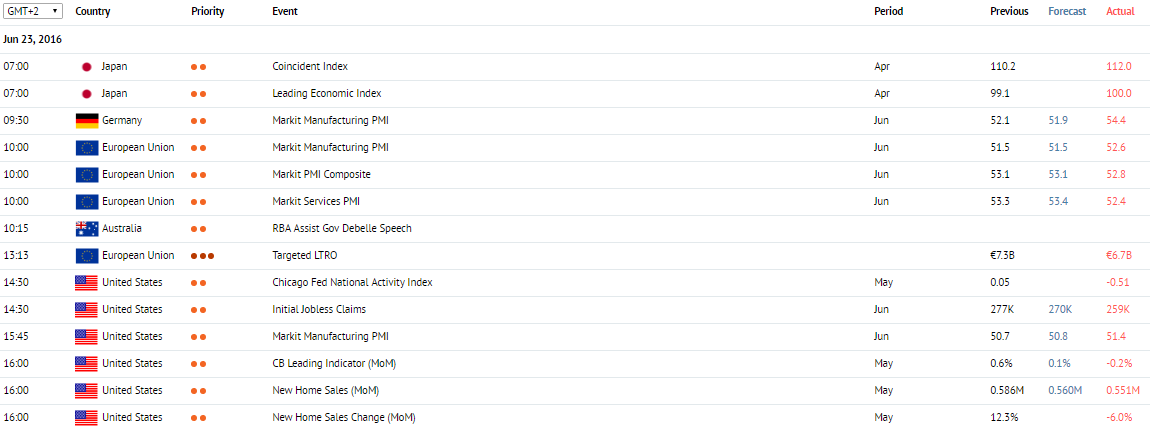
The Leading Economic Index and Coincident Index for April are due in Japan at 7:00 am (GMT+2). The Leading Economic Index, based on 13 indicators, is used to assess short- and medium-term economic conditions. A result above 50 is a positive factor for the JPY. A result below 50 is a negative factor for the JPY. The Coincident Index is based on 11 indicators and shows the current state of the economy. A result above 50 represents economic growth and strengthens the JPY. A result below 50 indicates a slowdown of the economy that, in its turn, has a negative impact on the JPY.
Germany
The Markit Manufacturing PMI is due in Germany at 9:30 am (GMT+2). The indicator is expected to decline from 52.1 to 51.9 points in June. The index represents the state of the manufacturing sector and its growth perspectives. It is one of the key indicators of the state of the German economy. A reading above 50 is perceived as positive and strengthens the EUR. A reading below 50 is perceived as negative and weakens the EUR.
EU
The Markit Services PMI is due in the EU at 10:00 am (GMT+2). The indicator is expected to grow from 53.3 to 53.4 points in June. The index represents the state of the services sector and its growth perspectives. A reading above 50 is perceived as positive and strengthens the EUR. A reading below 50, on the contrary, is perceived as negative and weakens the EUR.
Australia
Guy Debelle, Assistant Governor at the Reserve Bank of Australia, is giving his speech at 10:15 am (GMT+2). He has oversight of the Bank's operations in the domestic and global financial markets.
USA
Data on the Initial Jobless Claims is due in the US at 2:30 pm (GMT+2). The number of claims is expected to decline from 277 to 271 thousands in the week ended 17 June. The indicator represents the number of new unemployment claims. The data is published weekly on Thursdays and allows approximating what the Nonfarm Payrolls will be. A fall in the indicator strengthens the USD. A growth in the indicator weakens the USD.
The Markit Manufacturing PMI is due in the US at 3:45 pm (GMT+2). The indicator is expected to grow from 50.7 to 50.8 points in June. The index is based on survey responses from executives of American companies operating in the manufacturing sector regarding their opinion on current economic conditions in the sector and its future prospects. A reading above 50 is perceived as positive and strengthens the USD. A reading below 50 is perceived as negative and weakens the USD.
Data on the New Home Sales for May is due in the US at 4:00 pm (GMT+2). It is an important indicator of the US property market. A growth in the index represents favourable economic conditions. A high reading strengthens the USD. A low reading weakens the USD.
The CB Leading Indicator is due in the US at 4:00 pm (GMT+2). The indicator is expected to fall from 0.6% to 0.2% in May. The index is based on 10 economic indicators, amongst which are the Initial Jobless Claims, Building Permits and Average Weekly Hours. A growth in the indicator strengthens the USD.