Syed Jawad Hussain Naqvi
  • Founder & Quant Developer in Kernelis Capital
  • Pakistan
  • 2369
  • Information
nein
Erfahrung
4
Produkte
4
Demoversionen
0
Jobs
0
Signale
0
Abonnenten
Founder & Quant Developer in Kernelis Capital
X
Quantitative Developer 🇵🇰

• MQL5 Author — algorithmic trading systems built on statistical modeling, recursive signal processing, and quantitative market analysis
• Technical skills: MQL5, Python, C++, statistical modeling, competitive programming
• Focus: correct engineering — proper recursive state management, honest backtesting, no shortcuts
• Belief: complex mathematics deserves clear, accessible explanations

📊 Working toward a career in quantitative finance

"If you can't explain it simply, you don't understand it well enough." — Albert Einstein
Syed Jawad Hussain Naqvi
A Markov chain is a mathematical system that models a sequence of random events where the probability of the next event depends entirely on the current state, not on how the system arrived there. This "memoryless" characteristic is known as the Markov property.

How It Works
A Markov chain requires three main components:
States: All possible conditions or positions the system can be in (e.g., Sunny or Rainy).Transition Probabilities: The likelihood of moving from one specific state to another.T
ransition Matrix: A mathematical grid (or matrix) that organizes all transition probabilities.
Syed Jawad Hussain Naqvi Hat ein Produkt angeboten

Behalten Sie mit dem Pro Dashboard Screener die Kontrolle über Ihre Handelsperformance. Dieses speziell für professionelle Trader entwickelte Tool bietet Ihnen direkt in Ihrem Chart einen übersichtlichen, professionellen und in Echtzeit aktualisierten Überblick über den Zustand Ihres Kontos. Sie müssen nicht mehr zwischen verschiedenen Registerkarten hin- und herwechseln, um Ihre Statistiken zu überprüfen. Mit dem Quant Pro Dashboard stehen Ihre wichtigsten Kennzahlen stets im Mittelpunkt

Syed Jawad Hussain Naqvi
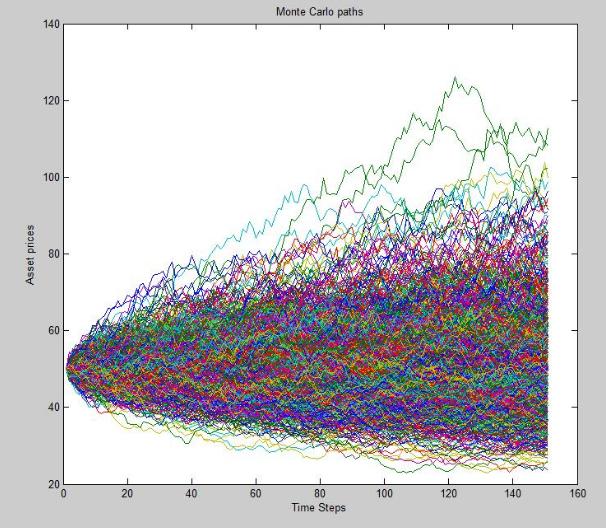
A Monte Carlo simulation is a mathematical technique that uses repeated random sampling to estimate the probability of different outcomes in complex systems. Instead of providing a single guess, it models uncertainty by running thousands of scenarios, resulting in a probability distribution of what might happen.

How It Works:
The name was inspired by the famous casinos in Monaco, as chance and randomness are the core of the modeling approach.

The simulation relies on three fundamental steps:

Define Probability Distributions: Replace uncertain variables (like market returns or task durations) with probability distributions (e.g., normal, uniform).

Random Sampling: Use a computer to randomly pick a value for each uncertain variable.

Repeat and Aggregate: Run this process thousands or millions of times. The result is a large dataset of possible outcomes that shows the most likely results and their probabilities.
Syed Jawad Hussain Naqvi
Hat sich auf MQL5.community registriert
12