BellGate
- 专家
-
Ahmed Aangour
 Based in France. I am a trader first: I run my own accounts on MT4 and MT5, and I develop my own trading robots from that experience, built only on strategies that have proven solid in the market.
- 版本: 1.8
- 激活: 5
Launch price: 99 USD. Next price: 199 USD after the first 10 copies, then +100 USD after every 10 copies.
Live signal: BellGate on a real account
One trade a day on the Nasdaq 100, at the New York open. A stop loss on every trade, closed the same evening. No grid, no martingale. Prop-firm ready.
BellGate is part of the Gate series, a set of rule-based MetaTrader 5 experts, each built around one clearly explained mechanism.
The bell rings once a day.
Before the New York stock market opens, the Nasdaq 100 builds a range while traders wait for the opening bell. Once the session is under way, the index often leaves that range and keeps going in the same direction for the rest of the day. BellGate records the range, waits for the first breakout after the open, trades it with a stop loss, follows the move with a trailing stop, and closes everything in the evening, whatever happens.
Not just another opening-range breakout: what was measured
- A range and an evening exit validated on two separate periods. The range window, the stop placement and the exit time were chosen on 2012-2018 data and confirmed on 2019-2026 real ticks. Neighbouring settings give similar results: the result does not hang on one lucky minute.
- A trailing stop that follows volatility. The stop moves with the price at a distance scaled to the Nasdaq's recent daily range: wide on agitated days, tighter on quiet ones. It lets the strong trend days run, which is where the profit of a breakout strategy comes from.
- It stands aside on US stock-market holidays and closes early on the days the US market closes early. On holidays there is no New York open to trade: in our 2019-2026 tests those days lost money on average.
- What did not pass was left out. The same mechanics on EURUSD and GBPUSD did not survive real trading costs, and 24 extra filters, re-entries and other stop or trailing variants did not improve the result on both periods. BellGate trades only the market where the edge was measured.
Works well with BoxGate
- BoxGate, also in the Gate series, trades breakouts on USDJPY and gold. BellGate trades the Nasdaq 100. Different markets, different hours, so their good and bad periods rarely coincide: in the 2019-2026 real-tick backtests their monthly results were uncorrelated (correlation −0.06), and both lost money in the same month only 9 times in 93 months.
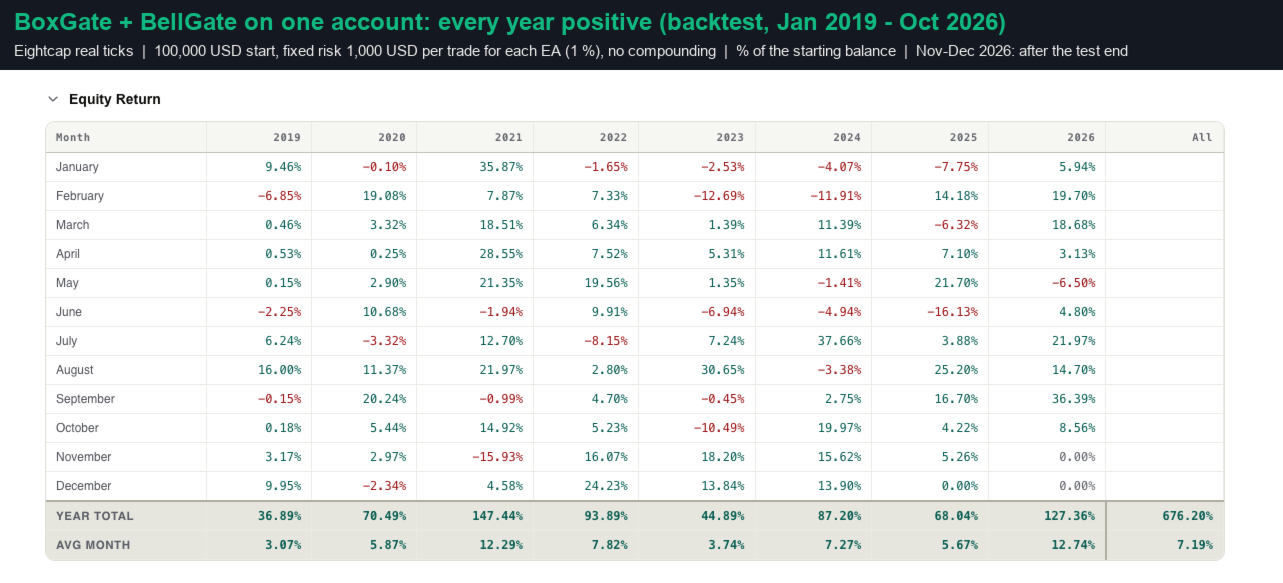
- Both on the same 100 000 USD account, 1 % risk per trade each (backtest, January 2019 to October 2026, no compounding): +86 % per year, largest drawdown 25.6 % of the starting balance. Alone over the same period: BellGate +50 % per year with a 28.7 % drawdown, BoxGate +37 % per year with 15.9 %. The pair earns more than BellGate alone with a smaller drawdown; losing months fall from 35 (BellGate alone) to 25.
- At 0.5 % risk per trade each, the pair gives about +43 % per year with a largest drawdown of about 13 %.
Key features
- One market: the Nasdaq 100 index CFD (NDX100, NAS100, USTEC, US100… any broker name is recognised).
- At most one trade a day. A stop loss on every trade, sent with the order. No take profit: a trailing stop follows the winners.
- Everything closed the same day. Nothing held overnight or over the weekend: no swap, no Monday gap.
- Risk you control: % of balance (fixed or compounding), fixed amount, fixed lot, or lot per balance amount. The lot is computed so that a stopped trade loses your chosen risk.
- No grid, no martingale, no averaging down, no lot increase after a loss.
- Optional news pause before US Nonfarm Payrolls and CPI releases.
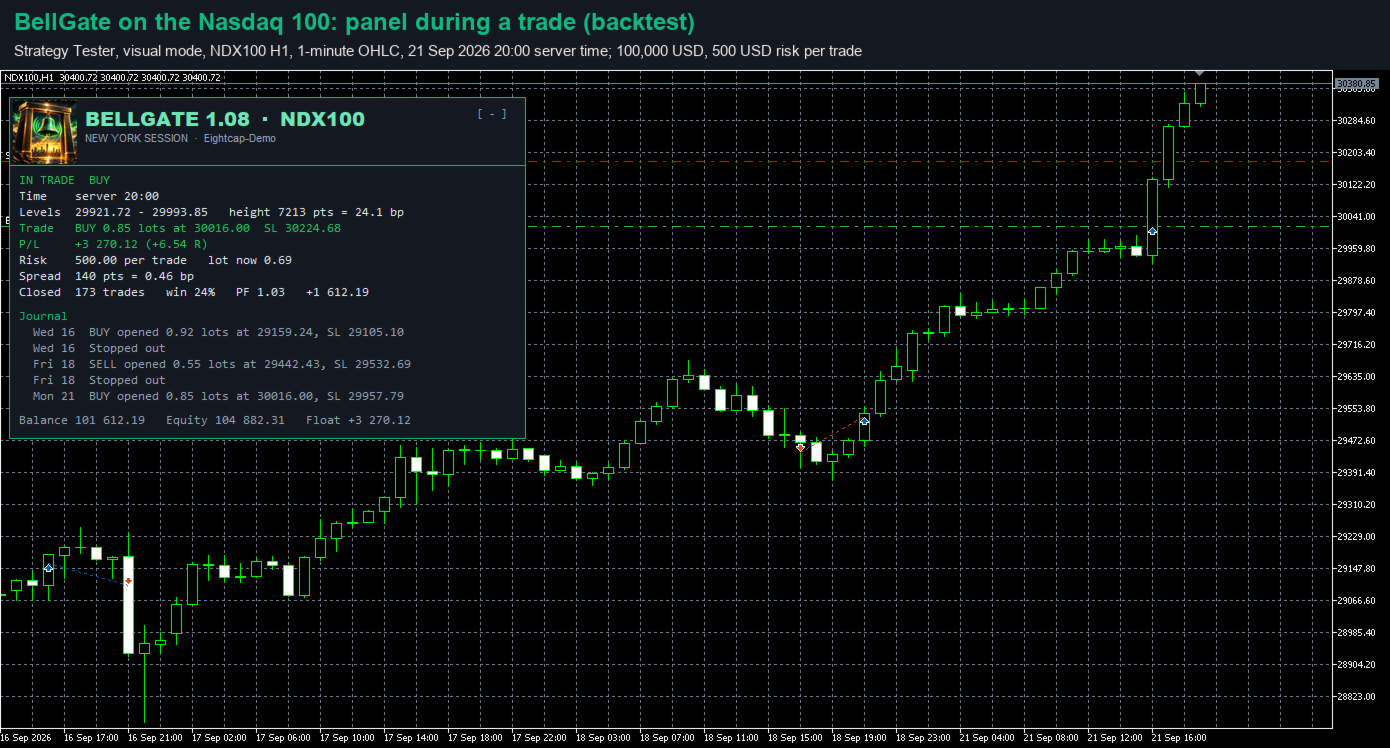
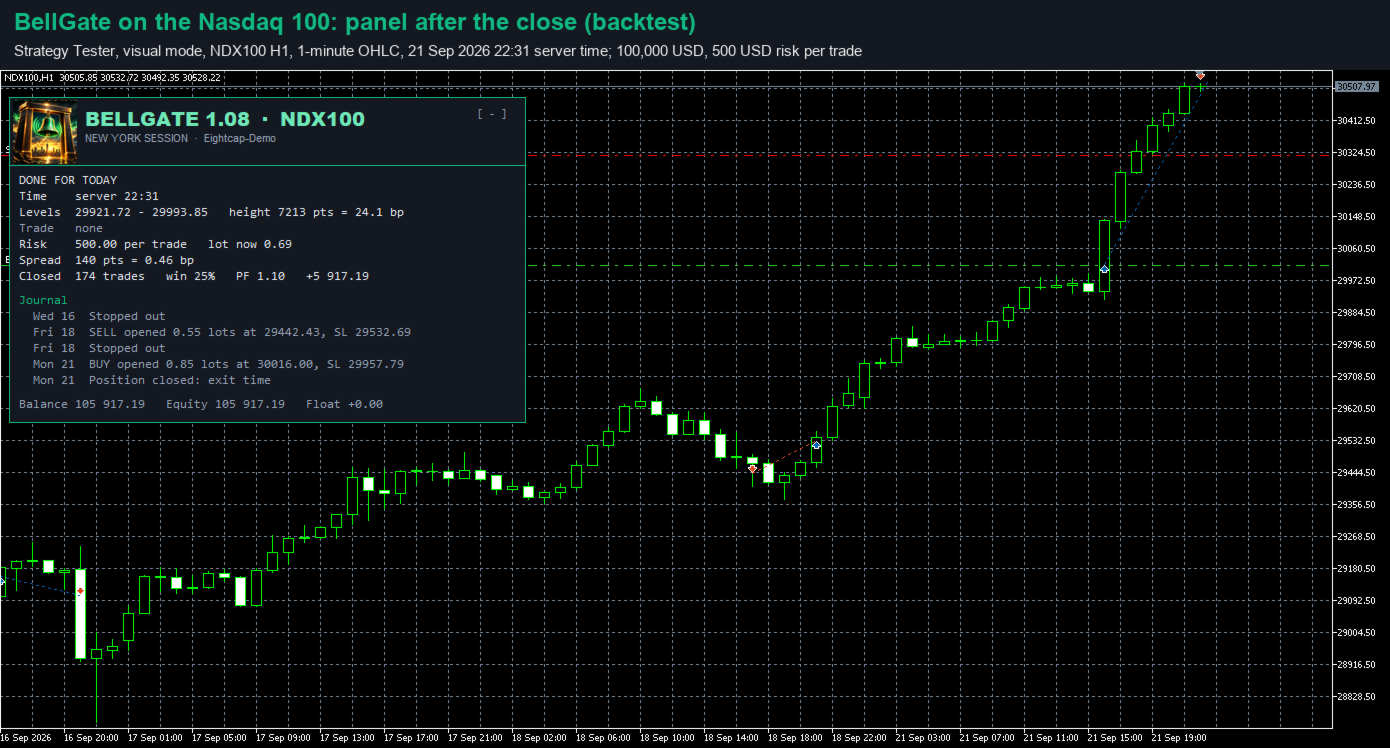
- On-chart panel: status of the day, breakout levels, open trade, risk, results and journal.
Prop-firm ready
- Known risk on every trade, one trade a day, nothing held overnight.
- At 0.25 % risk per trade, the 2019-2026 backtest shows a worst day of −0.4 %, a worst month of −4.0 % and a largest drawdown of 6.9 % of the starting balance. Use 0.25 % on a prop-firm account: at 1 % the largest drawdown was 27.7 %, far above the usual 10 % limit.
- Turn on the news pause if your account restricts trading around news.
Requirements and recommendations
- MetaTrader 5, hedging or netting account (on netting, no other EA on the same symbol).
- Any broker server time. The EA detects the broker's time zone by itself (GMT+0, GMT+2 / GMT+3, with or without daylight saving) and follows New York time, so the session is the same at every broker. Built and tested on a GMT+2 / GMT+3 server, also checked on a GMT+0 server.
- Any chart timeframe. One Nasdaq 100 chart.
- Minimum balance: about 1 500 USD at 1 % risk. At most brokers the minimum lot of the Nasdaq 100 is worth about 0.10 USD per point and a stop is usually 75 to 150 points. Below that, the EA trades the minimum lot as long as it risks no more than 3 % of the balance (setting "Minimum lot: skip if it risks more than").
- Leverage 1:20 or more on indices. A low-spread account and a VPS (the EA only trades while MetaTrader 5 is running).
Quick start
- Open a Nasdaq 100 chart (NDX100, NAS100, USTEC, US100…), any timeframe.
- Attach BellGate, keep "Market" = From the chart symbol, choose your risk, enable Algo Trading.
- Check the panel: the title shows the symbol and the first line shows the status of the day.
- Attach it before the US session starts so that it can record the day's range.
Settings
- Market: From the chart symbol (default) or Nasdaq 100 (for an unusual symbol name).
- Risk mode: % of current balance per trade (default, the risk follows the balance) · % of initial balance per trade (risk fixed on a reference balance) · fixed amount per trade · fixed lot · lot per balance amount (compounding).
- Risk per trade (% of balance): default 0.5. Risk per trade (account currency): for the fixed-amount mode. Fixed lot: for the fixed-lot mode. Lot size and Balance amount for that lot size: for the lot-per-balance mode (e.g. 0.01 lot per 1 000 USD).
- Initial balance (0 = balance at start): reference balance of the "% of initial balance" mode; enter your starting capital to keep the risk fixed whatever the balance does.
- Use the minimum lot when the risk is too small for it and Minimum lot: skip if it risks more than (% of balance): for small accounts.
- Maximum lot, Max spread at entry (points, 0 = off).
- Close before major US news (NFP, CPI): off by default; minutes before / after the release.
- Magic number (0 = automatic per market), Order comment (your text exactly, empty = BellGate), Enable logging, display settings.
Good to know
- A breakout strategy loses more often than it wins. About one trade in four is a winner; the result comes from the strong trend days, when the trailing stop lets the move run. Series of 10 to 15 losing trades in a row happened in the backtests, and about one month in three was negative.
- Starting during the day: if the price has not left the range yet, the EA stays armed; if the breakout already happened while it was off, it does not chase it and waits for the next day. A timeframe change or a restart does not disarm it.
- Small accounts: the lot is rounded down, so the risk is never above your setting, except when the minimum-lot option is used (the panel and the journal show the risk actually taken).
- Gaps: the stop is a market stop; on a sudden jump the loss can exceed the planned risk. The largest loss in the 2019-2026 backtest was 1.45 × the risk.
Backtests (Strategy Tester, not live results)
Real ticks, January 2019 to September 2026, Nasdaq 100 CFD, spread, commission and swap included, 1 % fixed risk per trade (no compounding):
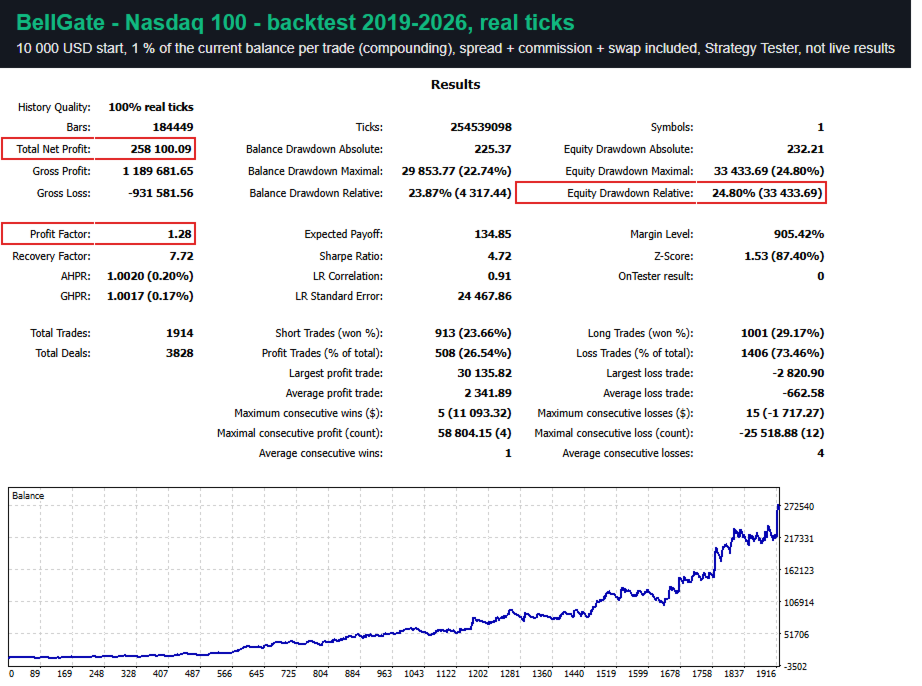
- Average gain +49.7 % per year, largest drawdown 27.7 % of the starting balance (16.3 % of the equity peak), profit factor 1.28, 1 914 trades (about 250 a year).
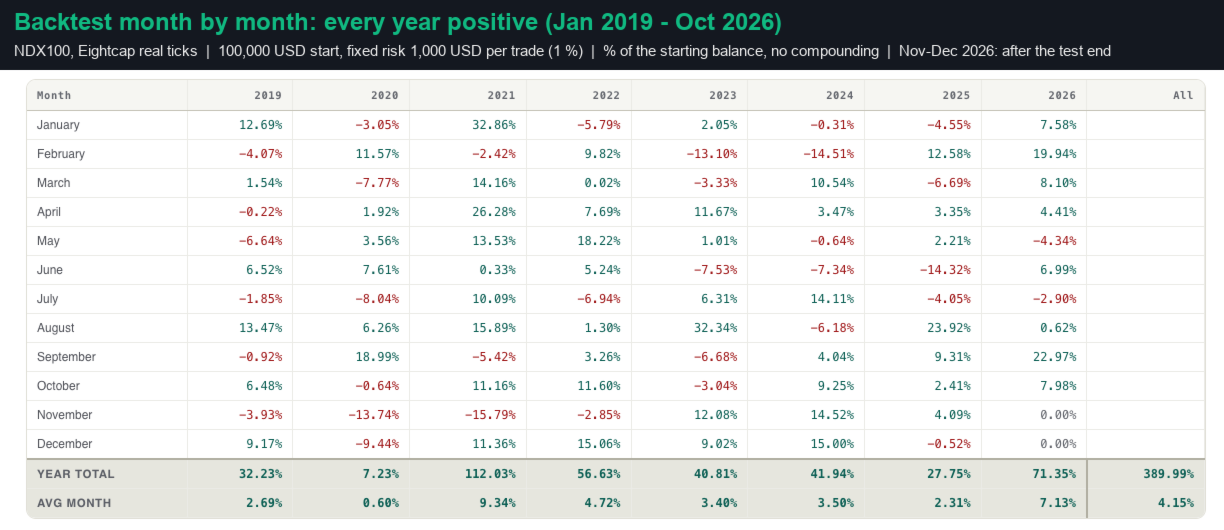
- Every year positive: 2019 +34 %, 2020 +10 %, 2021 +112 %, 2022 +57 %, 2023 +41 %, 2024 +41 %, 2025 +28 %, 2026 (to September) +63 %.
- At 0.5 % fixed risk: about +25 % per year, largest drawdown about 14 %.
- Independent test on 2012-2018 data (minute-bar data, less precise than real ticks): weaker but positive every year, about +11 to +21 % per year at 1 % risk depending on how the data precision is accounted for, largest drawdown 38 %; 2012, 2015 and 2017 were close to flat.
- Compounding, 1 % of the current balance per trade, 10 000 USD at the start, same real-tick data: 268 100 USD at the end of September 2026, +52.9 % a year compounded, largest drawdown 24.8 % of the equity peak.
Drawdowns are a % of the starting balance. The edge was clearly stronger from 2019 onwards than in 2012-2018. Simulated results have limits and do not reflect real execution, slippage or future market conditions.
Risk warning
Trading stock indices on margin carries a high level of risk and may not be suitable for every investor. You can lose part or all of your capital. Past performance, real or simulated, does not guarantee future results.