Valeriy Brusilovskyy
  • Informações
9+ anos
experiência
0
produtos
0
versão demo
0
trabalhos
0
sinais
0
assinantes
I have more than 18 years of trading experience. Except of forex trading also I worked with vanil options.
When I traded in divergences I had got 60-80% profit each year. Constantly I'm searching a new currency pairs that will be useful for my method of trading. I put currency pairs to demo-account only after their showing of good results (4-6 pips of expected value) in tester. I started to use pair in real account only after, at least, three months of successful trading (at least 3-4 pips of expected value). In the same time I don't stop to monitor the price movement of well-recommended currency pairs. Based on the results I change algorithm, time of trading and if it's necessary I change position size or even I can take of the pair from active trade.
In that moment I successfully drive a trade in six accounts.

If you are still not sure about me, please take a look on the indicators of all of my signals - https://www.mql5.com/en/signals/author/valera309

I can't wait to start working with you.
Please don't hesitate to address to me I always answer for all questions!

Sincerely yours, Valery!
Valeriy Brusilovskyy
Daily Report: Strong Risk Appetite Pushed Stocks to Record, Dollar Strengthened with Hesitation

Strong risk appetite boosted US markets to new record highs overnight. DJIA jumped 303.31 pts, or 1.46%, to close at 21115.55. S&P 500 rose 32.32 pts, or 1.37%, to close to 2395.96. NASDAQ also gained 78.59 pts, or 1.35%, to end at 5904.03. All three indices closed at records. Positive sentiments also pulled treasury yields higher with 10 year yield rose 0.105 to close at 2.463 and revived underlying bullishness. Dollar was boosted by increased speculation of March Fed hike as the Dollar index hitting at high at 101.97. The break of 101.76 in the dollar index confirmed resumption of recent rebound from 99.23. However, development in the currency markets doesn't warrant decisive momentum in the greenback yet. EUR/USD is held above 1.0493 support, AUD/USD above 0.7605 support. USD/CHF is limited below 1.0140 resistance and USD/JPY is held below 114.94 resistance. The strength in the greenback is more apparent in GBP/USD and USD/CAD only. More evidence is needed to confirm bullishness in the greenback.

Fed Brainard: Rate hike appropriate "soon"

Markets continued to raise bet on a rate hike by Fed in March. Fed fund futures are now pricing in 66.4% chance of it, comparing to 65.4% a day ago. Fed governor Lael Brainard said yesterday that "we are closing in on full employment, inflation is moving gradually toward our target, foreign growth is on more solid footing and risks to the outlook are as close to balanced as they have been in some time." She noted "bear-term risks to the United States from abroad appear to have diminished." And, "recoveries are gaining traction in China, Europe and Japan, in part reflecting greater confidence in their respective policy environments." Hence, "assuming continued progress, it will likely be appropriate soon to remove additional accommodation, continuing on a gradual path."

Fed Beige Book positive but not overwhelming

Fed released the Beige Book economic report based on information collected from early January through mid February. The reported noted that some district reported "widening labor shortages." At this point, wages only rose "modestly or moderately" though, in general. A few districts reported "some pickup in the pace of wage growth." Meanwhile, "businesses were generally optimistic about the near-term outlook but to a somewhat lesser degree than in the prior report." Overall, all 12 Fed districts reported "modest-to-moderate" growth and inflation cooled a little bit.

BoC on hold

As widely anticipated, BOC kept its monetary policy unchanged with the overnight rate at 0.5%, the Bank rate at 0.75% and the deposit rate at 0.25%. The central bank acknowledged that both global and domestic economic indicators were consistent with its projection of improving growth laid out in January. It also note Canadian growth in 4q16 came in 'slightly stronger than expected'. However, policymakers maintained a cautious tone noting that 'material excess capacity' remained and that the central bank is 'attentive to the impact of significant uncertainties weighing on the outlook'. Therefore, the risks and slacks in the economy justified leaving the policy rate at exceptionally low level. More in US Tax Reform Plan To Direct BOC Monetary Policy Outlook.

On the data front, Japan monetary base rose 21.4% yoy in February. Australia trade surplus narrowed to AUD 1.3b in January, building approvals rose 1.8% mom. Swiss will release GDP and retail sales in European session. Germany will release import price index. UK will release construction PMI. Eurozone will release PPI, CPI and unemployment rate. US will release Challenger job cuts and jobless claims in US session. Canada will release GDP.

USD/CAD Daily Outlook

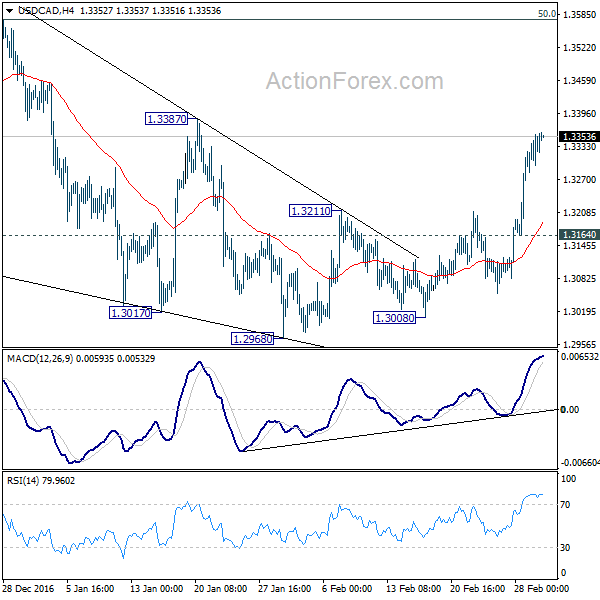
Daily Pivots: (S1) 1.3286; (P) 1.3322; (R1) 1.3360;

Intraday bias in USD/CAD remains on the upside as rebound from 1.2968 continues. As noted before, pull back from 1.3598 has completed at 1.2968 already. Break of 1.3387 will target a test on 1.3598 resistance next. Also, break there will extend the larger rally from 1.2460 towards next fibonacci level at 1.3838. On the downside, though, below 1.3164 minor support will turn bias back to the downside for 1.2968 support instead.

In the bigger picture, price actions from 1.4689 medium term top are seen as a correction pattern. The first leg has completed at 1.2460. The second leg is likely still in progress and could target 61.8% retracement of 1.4689 to 1.2460 at 1.3838. We'd look for reversal signal there to start the third leg. Break of 1.2968 wold at least bring at retest of 1.2460 low. However, sustained trading above 1.3838 would pave the way to retest 1.4689 high.
Valeriy Brusilovskyy
EUR/USD: dollar's momentum persist

The greenback is back in fashion, backed by US President Trump speech before the Congress. In a joint session, the US president pretty much reiterated his campaign pledges, without much detail on how he will achieve its goals, but anyway that was enough to revived the so-called "Trump-trade," characterized by demand of USD-related assets on hopes the world's largest economy will get a growth boost. Among the most remarkable comments, he confirmed a tax cut for corporations, to make US products more competitive worldwide, while asked the Congress to pass a bill that would lead to $1 trillion in investments in a national infrastructure program.

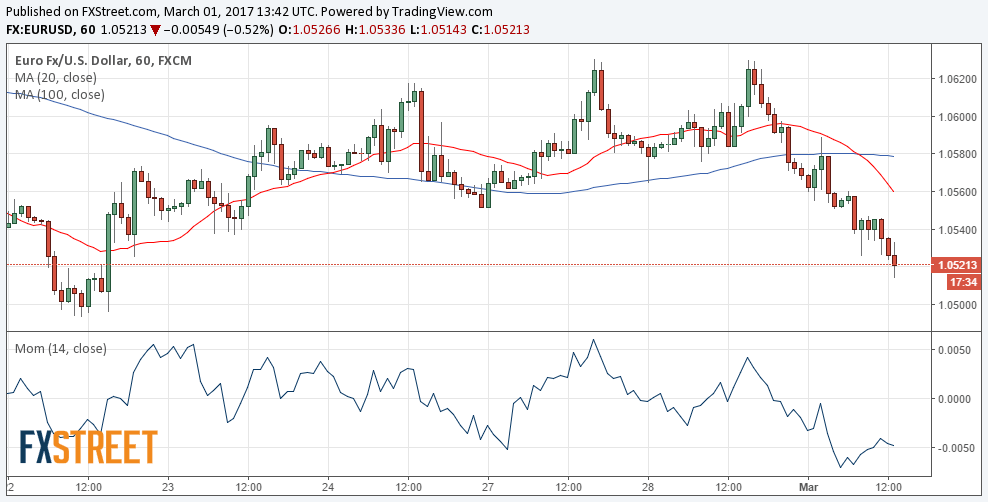
Early Europe, the release of final February manufacturing PMIs did little for the common currency, as despite figures confirmed steady economic growth in the region, the EUR/USD pair held near 1.0520. Ahead of Wall Street's opening, Germany released its preliminary February inflation figures, showing a strong advance in the month when compared to the previous month, as monthly basis, inflation advanced 0.6% against previous -0.6%, while year-on-year inflation rose by 2.2%, beating expectations of 2.1%. US personal income surged in January, up to 0.4% from previous 0.3%, although spending shrunk to 0.2%, below previous 0.5%. The Fed’s preferred measure of consumer prices, the PCE price index, climbed to 1.9% from a year earlier, not far from the 2% percent target that was last met in April 2012, leading to another round of dollar's buying.

From a technical point of view, the short term picture is clearly bearish, as the price extended to fresh daily lows of 1.0513, and with the 1 hour chart showing that the 20 SMA has accelerated its decline below the 100 and 200 SMAs, and far above the current level, whilst technical indicators maintain strong bearish slopes near oversold readings. In the 4 hours chart, technical indicators maintain a strong bearish momentum, within negative territory, while the price is well below all of its moving averages, in line with further declines.

Support levels: 1.0510 1.0470 1.0440

Resistance levels: 1.0565 1.0600 1.0635

GBP/USD Current price: 1.2299

The GBP/USD sunk below 1.2300 during the European session, weighed by broad dollar's demand and a worse-than-expected UK Markit manufacturing PMI for February, which came in at 54.6, a three month low. Money figures in the UK, however, were encouraging, as during January, Consumer Credit jumped to £1.416B from previous £0.984B in December, beating expectations of £1.400B, while mortgage approvals also rose in the same month, reaching 69.928K. Better-than-expected US consumer inflation sent the pair down to 1.2288, its lowest in six weeks, with the pair now poised to extend its decline, as in the 1 hour chart, a sharply bearish 20 SMA capped the upside at the beginning of the day, while technical indicators keep heading lower, despite the RSI indicator stands at 21. In the 4 hours chart, technical readings also back further declines despite indicators entering oversold territory, moreover after the pair broke below the 50% retracement of the January rally at 1.2345. The 61.8% retracement of the same rally stands at 1.2260 the immediate support and probable bearish target.

Support levels: 1.2260 1.2225 1.2190

Resistance levels: 1.2345 1.2380 1.2520
Valeriy Brusilovskyy
Китайские власти спешат подмять под себя рынок криптовалют, пока он не уплыл в частные руки

Банк Китая активно прикручивает гайки для своих биткоин-бирж, коих на территории страны больше чем где-либо в мире, а сам между делом разрабатывает собственную цифровую валюту.

Сформировав исследовательскую группу еще в 2014 году, Банк Китая провел первые испытания своего аналога криптовалюты и стал еще на один шаг ближе к статусу одного из первых в мире крупных Центробанков, занимающихся эмиссией цифровых денег, на которые можно приобрести что угодно, начиная с лапши и заканчивая автомобилем.

Для пользователей, осуществляющих транзакции через свои смартфоны, криптовалюта Банка Китая не будет отличаться от существующих способов оплаты, как, например, Alipay или WeChat. А продавцы, которые будут получать цифровые платежи напрямую от покупателей, смогут сократить затраты на транзакцию, минуя посредников. В процессе разработки своей криптовалюты регулятор Поднебесной уделяет пристальное внимание биткиону и активности частных компаний в цифровой индустрии. Эмиссией валют всегда занималось государство, а не частные игроки, и банк не желает уступать экосистему криптовалют компаниям, над которыми у него нет контроля.

Как гласит известная пословица, «не можешь победить – присоединись». «Более полная осведомленность о том, какие объемы кредитов выдают банки, куда идут деньги, и с какой активностью предоставляются кредиты, имеет ключевое значение для борьбы с отмыванием денег и для повышения эффективности кредитно-денежной политики», - уверен Дуан Ксинксинг, вице-президент пекинской OKCoin Co., одной из крупнейших биткоин-бирж в стране. Эмиссия цифровой валюты поможет ЦБ мониторить риски в финансовой системе и отслеживать транзакции в масштабах национальной экономики, добавил г-н Ксинксинг. OKCoin – одна из бирж криптовалют, объявивших недавно о временном прекращении вывода биткоинов в попытке сдержать отток капитала. В январе прошлого года Банк Китая заявил, что «в скором времени» обзаведется собственной криптовалютой, но официальная дата ее запуска до сих пор не анонсирована. Тем временем высокопоставленные чиновники активно ратуют за появление такого актива, включая Фана Йифей, одного из представителей Центробанка.

Банк Китая может возглавить переход к цифровым валютам

На сегодняшний день не только лишь Поднебесная уходит от использования наличных денег. В конце прошлого года премьер-министр Индии Нарендра Моди вывел из обращения две банкноты, которые составляли 86% всех находящихся в обращении рупий. Основные цели, которые преследовали власти – борьба с коррупцией и продвижение использования цифровых платежей. Немалое внимание цифровым валютам в последнее время также уделяют Банк Канады, немецкий Бендесбанк и Денежно-кредитное управление Сингапура.

Печатание денег и борьба с фальшивомонетчиками – дорогое удовольствие для страны с населением 1.4 млрд человек, особенно учитывая затраты на управление обращением денег и транзакциями. Добавление цифровой валюты к наличным деньгам в обращении поможет повысить скорость, уровень удобства и прозрачность транзакций. «Сокращение издержек – очевидная выгода, но эффект от перехода к цифровым деньгам выходит далеко за рамки этого. Криптовалютой можно заплатить любому звену системы, любому банку, любому продавцу напрямую, без посредников. Блокчейн изменит всю инфраструктуру. Мы имеем дело с революционными изменениями», - подчеркнул Ларри Као из CFA Institute в Гонконге.

Если версия цифровой валюты от Банка Китая получит широкое распространение, посредникам в лице банков и платежных сервисов Alipay и WeChat придется несладко. «Я не хочу сказать, что банки и платежные компании исчезнут, но их роль определенно изменится. Им нужно найти новую нишу в новой экосистеме платежей. Возможно, в этом секторе со временем появится инновационная бизнес-модель», - рассуждает Уильям Джи из PwC China в Пекине.

Данные в режиме реального времени

Благодаря технологии блокчейн, на базе которой создан биткоин, Банк Китая сможет отслеживать транзакции и собирать полные, достоверные данные в режиме реального времени, компилируя отдельные денежно-кредитные индикаторы, включая рост денежной массы, подчеркивает Дуан из OKCoin. «Уровень прозрачности экономической деятельности в каждом уголке страны ощутимо повысится. У Центробанка будет беспрецедентная информация о состоянии экономики», - добавляет Дуан. Таким образом, вместо ежемесячных исследований бизнеса и сбора данных из органов статистики, регулятор, а впоследствии и правительство, будут иметь под рукой все показатели в режиме реального времени.

В своем исследовании, опубликованном в прошлом году, Банк Китая обрисовал, каким образом будут работать цифровые деньги:

ЦБ создает криптовалюту и передает ее коммерческим банкам, нуждающимся в повышении уровня ликвидности
Потребители приобретают цифровую валюту в модифицированных банкоматах или кассах банка и хранят ее в криптокошельке на своем смартфоне или другом устройстве
Для совершения покупки потребители переводят криптовалюту со своего кошелька на счет продавца
Продавец вносит криптовалюту на свой счет в коммерческом банке
«Говорить сейчас о масштабах влияния цифровой валюты – все равно, что в 1980-е пытаться предсказать, насколько сильно интернет изменит нашу жизнь. Мы точно знаем, что эффект обещает быть колоссальным. Это полностью изменить экономическую инфраструктуру. Единственное, о чем мы не можем говорить с уверенностью – когда и как свершится эта революция», - резюмировал Дуан Ксинксинг.
Valeriy Brusilovskyy
No difference between safe and risk

Market Overview

Investors around the globe continue to watch in awe and disbelief as the stocks continue to climb ever higher. The Dow Jones has posted its tenth straight record-breaking session, something it has not done since the 80s.

Many analysts feel that this has been overdone but most agree that it could very well continue for a while.

Another thing you might notice is that analysts have all but stopped talking about 'risk on' and 'risk off' sentiment in the markets.

The reason being, that stocks are generally considered a 'risk on' trade, but as they just continue to go up without any regard to what's happening in the news or in other markets, this indicator is broken.

Furthermore, Gold and Silver, which are generally considered 'risk off' assets have been flying as well, with Silver on track for its ninth straight weekly gain, and Gold breaking above $1250 an ounce yesterday.

Rex-Mex
The new Secretary of State in the US, Mr. Rex Tillerson is currently in Mexico trying to clean up the mess left by Trump's spat with EPN.

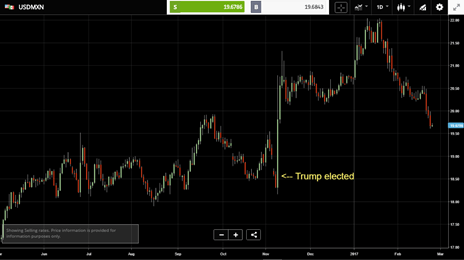
At the moment, it looks like investors are siding with the southern neighbor as the Peso is now at its the strongest level against the US Dollar since the election.

USDMXN

Rex put on a stunning show and made some pretty tall promises but the one tall promise that was not brought up was Trump's wall, which for better or for worse was not raised in the conversation.


Bill for Brexit or Brexit Bill
Updates are coming from the UK very fast and very frequently as they approach May's deadline for triggering Article 50 next month.

Some local elections yesterday yielded surprising results. We'll not get into the nitty gritty, but in short, Theresa May gained ground against the opposition, ground that the opposition had seen as safe ground.

Meanwhile, May's Brexit Bill is still being debated in the House of Lords. Currently, there are two changes that some lords would like to make.

Guaranteeing basic rights for EU citizens.

Putting the final Brexit deal to a vote before it is finalized.

The first is gaining strength and may become law. The second on the other hand seems a bit dangerous as some have argued that this would encourage lawmakers to put forward a bad deal with the goal of getting it shot down. Both proposals will hurt the UKs position going into the negotiations with the EU. Negotiations are always easier when they come without preconditions.

In the meantime, the Pound Sterling has shown some strength and stability as the outlook of Brexit becomes more clear.
Valeriy Brusilovskyy
EUR/USD Forecast: no love for the EUR

The EUR/USD pair closed the week in the red sub-1.0600, although off its weekly low of 1.0520, as the dollar lost momentum following FOMC's Minutes and comments from US Treasury Secretary Mnuchin.

Many US policy makers vowed for a rate hike "fairly soon," but market's confidence about a March hike tumbled amid officers' uncertainty about fiscal policies. On Thursday, US Treasury Secretary Mnuchin expressed his concerns about the high levels of US debt, while adding that new policies would have a limited impact on the economy during this 2017. Also, he said that he "hopes" that the tax reform will pass the Congress by August, also cooling down expectations for significant growth during the next few months, referring tax cuts focused on mid-class, with no mentions to corporate rates.

Despite broad dollar's weakness, the common currency was unable to advance beyond the early week high at 1.0632, undermined by political woes in the region, ahead of French, Dutch and German elections.

With no certain catalyst behind the move, the American dollar advanced sharply against all of its major rivals right before Wall Street's opening and ahead of the release of the Michigan Consumer Sentiment index, which resulted better-than-expected for February, up to 96.3 from 95.7 in January. New Home sales for January, however, missed expectations up by 3.7% against a 6.3% advance expected, to an annualized rate of 555,000.

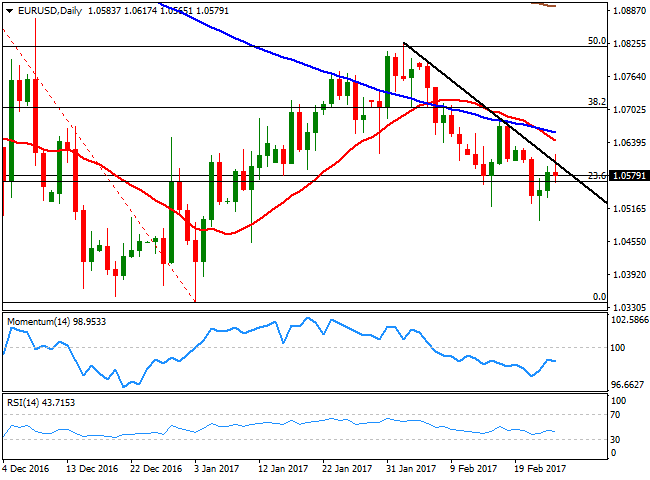
Technical readings indicate that the risk remains towards the downside, as the price failed to advance beyond a daily descendant trend line coming from this year high of 1.0828, whilst the price remained well below its 20 and 100 DMA's both bearish in the 1.0650/60 region. Additionally, technical indicators in the mentioned time frame have pared their advances within negative territory, and turned back south. In the weekly chart a strongly bearish 20 SMA above the current level keeps leading the way lower, while the RSI indicator heads south around 40, and the Momentum hovers around its 100 level, lagging amid reflecting the weekly opening.

There's an ongoing battle between bulls and bears around 1.0565, the 23.6% retracement of the post US-election slide, with the price unable to move too far away from the level. The weekly low of 1.0520 is the immediate support, with a break below opening doors for an extension towards the 1.0400/40 price zone next week, should dollar's recovery persists until today's close.

To the upside, the immediate resistance comes at 1.0630/60, whilst selling interest is aligned between 1.0700 and 1.0720, so it will take a clear break above it to see the pair recovering ground, with the next line of massive selling awaiting in the 1.0800/40 region.

The Pound however, is seen advancing modestly next week, pretty much holding around 1.2500 but with 71% of polled experts aiming for an advance. However, things change in a 1-month view, when PM May is expected to trigger the Brexit process, with bears leading the way towards 1.2280. In the longer view, bears increase to 62%, with the pair, however, seen holding above the 1.2100 region.

As for the USD/JPY pair, bears account for the 58% weekly basis, but the pair is not seen breaking below 110.00. In the longer run, the pair is seen recovering, with bulls jumping to 71% in a 1-month view and targeting 114.30. Interesting, for the 3-month view, bulls still are a majority, but 33% of the polled analyst turn neutral, leaving an average target of 115.20, as chances of a break beyond 116.00 are directly linked to a US rate hike, and seems the market won't get one before June.
avu2002
avu2002 2017.02.27
ниасилил, многабукаф
Valeriy Brusilovskyy
S&P 500: ’Buy the Dip’ May Not Work as We March Towards a New Month

What’s inside:

- U.S. indices showing vulnerability
- Volatility has been compressed, March can often be a volatile month
- Watching closely how the market responds to support for possible change in character; 'buy the dip' could soon become 'sell the rip'

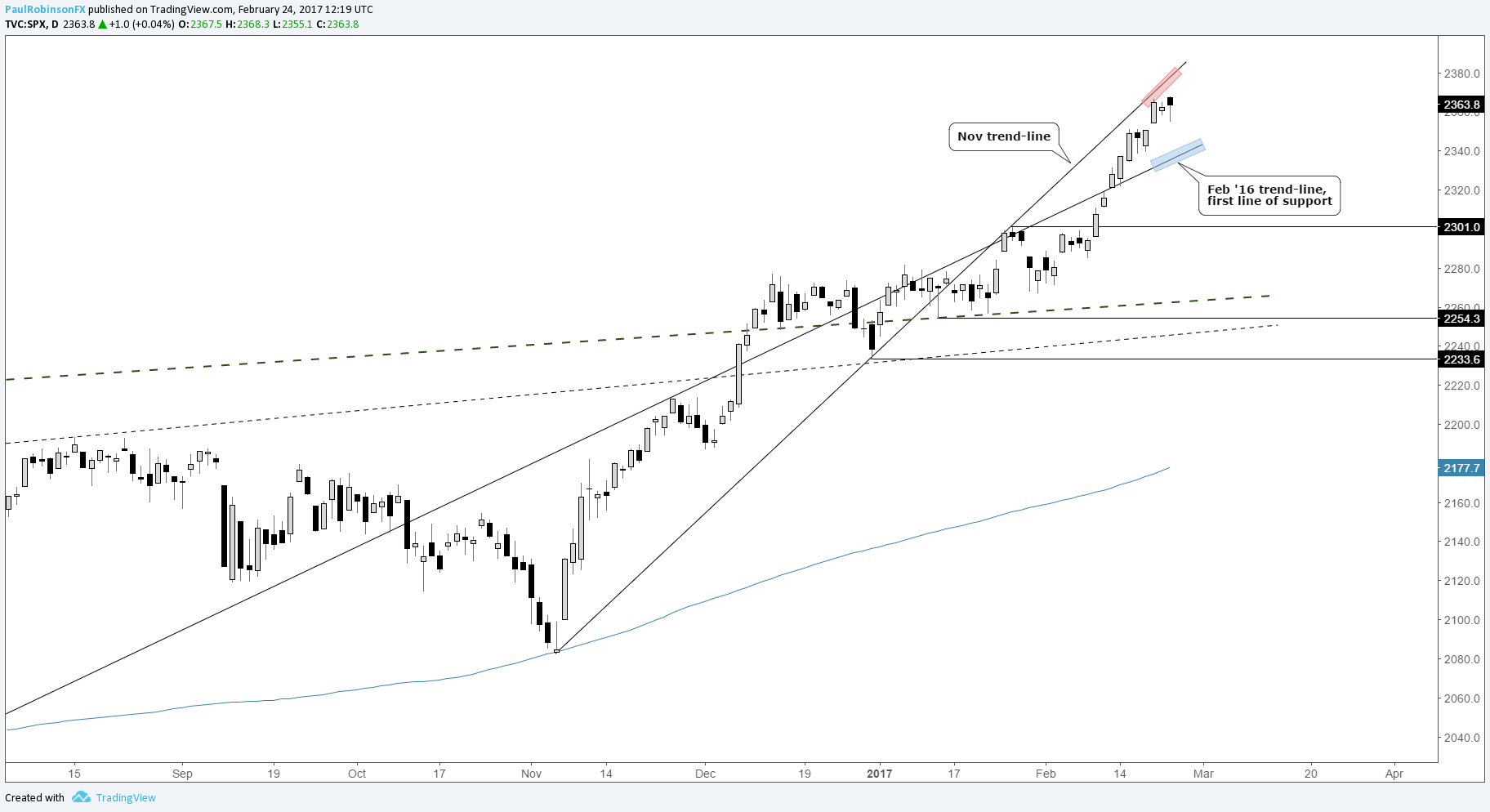
U.S. indices have been on a tear for all of February, but as of yesterday price action became unstable with a sharp morning break and afternoon rebound. The Nasdaq 100 put in an engulfing bar while the S&P 500 suffered a smaller set-back. At the time of this writing, we’re headed for a weaker open. Europe is taking it on the chin, with the DAX leading the way lower by about 1.5%, and the S&P futures following suit by heading lower by 10 handles.

With weakness in the near-term setting in, we’re starting to think about how far the S&P could decline before finding potential support. The first line of interest is the Feb ’16 trend-line about 25 handles lower. For now, all we can do is consider weakness as a pullback within an ongoing uptrend, but with volatility having been compressed for a few months, and March, an often-volatile month just ahead, we could be in for a bumpy ride. The CBOE Volatility Index (VIX) has a tendency of grinding sideways to lower for a few months then popping sharply – now may be the time for another spike to come.

With that in mind, we’ll be paying close attention to how the market reacts to support, as the pattern since the November low has been for weakness to be met quickly by buying. If that pattern begins to change, then we could have seen the best of the market for now. It may not be the ‘buy the dip’ theme we’ve become accustomed to, but rather a 'sell the rip' mantra we'll want to live by.
Valeriy Brusilovskyy
.
muratyazici
[Excluído] 2017.02.25
;))
Valeriy Brusilovskyy
Citi: Дефицита нефти не будет никогда


С момента начала реализации соглашения ОПЕК+ еще не прошло и двух месяцев, но вопрос о необходимости продлить срок его действия почему-то в последние дни серьезно будоражит умы экспертов. Сегодня к ним присоединился и Citi.

Вполне возможно, что из-за роста добычи ОПЕК, имевшего место в период согласования условий соглашения, срок его действия придется продлить, считает глава товарных исследований банка Эд Морзе. Помимо этого в сегодняшнем интервью Bloomberg TV он заявил, что:

- главный вопрос заключается в том, какими именно будут условия его продления;

- в случае продления срока действия соглашения, ОПЕК не придется идти на новые масштабные сокращения объема добычи. Рынок и так придет в состояние баланса уже в этом году;

- если бы ОПЕК не увеличил объем добычи непосредственно перед заключением соглашения, баланс был бы уже достигнут;

- во время этих переговоров объем добычи ОПЕК вырос примерно на 1 млн б/д;

- рыночные ожидания того, что к 2020 году возникнет дефицит предложения, не сбудутся никогда из-за роста объемов добычи в США.
Oleg Dubov
Oleg Dubov 2017.02.25
Типичная психология дна. Все ожидают падения.
Valeriy Brusilovskyy
Хранить нефть скоро станет невыгодно!!!

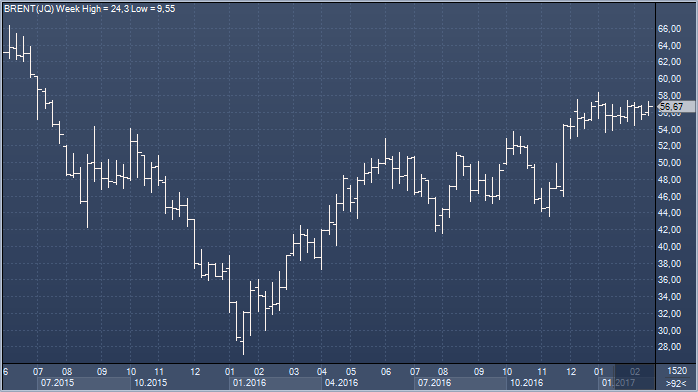
Крупнейшие в мире нефтепроизводители сокращают добычу, чтобы вернуть рынку равновесие, а инвесторы наращивают бычью позицию в расчете на то, что план ОПЕК+ сработает. Уместен ли этот оптимизм? Судя по динамике рынка фьючерсов - вполне. У финансовых управляющих сейчас больше фьючерсов и опционов на нефть Brent чем когда бы то ни было за всю историю ведения статистики - примерно 480 млн баррелей. Это почти в два раза больше, чем два месяца назад. Тогда цены на апрельские фьючерсы на Brent были росли не столь стремительно. Сейчас цены подошли к отметке 57 долларов за баррель, это на 15% выше, чем в начале года, однако не это главное. Впервые с апреля прошлого года контракты на поставку в следующем месяце могут оказаться дороже долгосрочных фьючерсов.

Это явление называется бэквордация, оно случается только в том случае, если инвесторы и трейдеры рассчитывают на то, что в скором времени спрос на нефть превысит предложение. По данным Международного энергетического агентства, в четвертом квартале 2016 года среднесуточный совокупный спрос достиг 97.3 млн баррелей; предложение было немногим выше - 97.9 млн баррелей в день. По нашим оценкам, на физическом рынке нефти уже сформировался дефицит, это значит, что объемы запасов должны сокращаться, - отмечает портфельный управляющий Том Нельсон из Investec Asset Management.

«Последний нисходящий тренд унес инвестиции на сумму около 1 трлн долларов и ограничил доступ к капиталу, поэтому мы считаем, что, структурно, на рынках будут сохраняться дефицитные условия на протяжении ближайших нескольких лет, что приведет к формированию позитивной ценовой динамики», - пояснил он. Почти три года мир купался в миллионах баррелей никому ненужной нефти, хлынувшей на рынок после сланцевой революции в США и стратегии ОПЕК с «девизом качай сколько сможешь», нацеленной на снижение уровня рентабельности на рынке.

Однако ноябрьское соглашение изменило угол зрения. Можно спорить о том, насколько добросовестно производители выполняют договоренности и придерживаются квот, но факт остается фактом: трейдеры поверили в изменение ключевых трендов. Сейчас апрельские контракты на нефть Brent продаются с премией 1.5 долларов относительно контрактов с поставкой в декабре 2018 года, и буквально на несколько центов дороже майских контрактов. Ничего подобного не случалось уже почти год (если не брать во внимание дни погашения этих контрактов, тогда цены бывают волатильны).

ОПЕК, главный поставщик жадной до нефти Азии, сократил добычу, зато поставки в регион из Северного моря в январе достигли исторических максимумов на уровне более 10 млн баррелей, экспорт из регионов Западной Африки в этом месяце немного сократился, но он все равно близок к 17-месячным максимумам. Когда рынок находится в состоянии контанго, контракты с близким сроком погашения стоят дешевле контрактов с поставкой в будущем, таким образом, трейдерам выгодно хранить нефть, а не продавать ее на рынке спот. Когда эта структура переворачивается с ног на голову, то есть, контанго превращается в бэквордацию, запасы начинают сокращаться, поскольку их владельцам выгоднее распродать их сейчас.

Сейчас развитые страны по-прежнему хранят рекордный объем нефти, но тенденция к сокращению уже наметилась. Об этом свидетельствуют данные МЭА о том, что мировые запасы в декабре спустились ниже 3 млрд баррелей, впервые за год. [IEA/M] Очевидно, что рынок увидел свет в конце туннеля. Наращивание производства в США вряд ли сможет компенсировать сокращение добычи со стороны ОПЕК, добавьте сюда прогнозы по устойчивому росту спроса, и станет ясно, что рынок движется к точке равновесия, хотя и неуверенным шагом.

Фонды делают ставку на то, что ОПЕК и другие страны сумеют выдавить нефть из хранилищ. Хотя, конечно, тут все еще вилами на воде писано, поскольку американские производители восстанавливаются, темпы роста спроса в этом году, вероятно, стабилизируются в районе 1.4 млн баррелей в день по сравнению с 1.6 млн баррелей в прошлом году. Между тем, обозревателей волнует не столько совокупный размер позиции финансовых управляющих, сколько процент всех фьючерсов и опционов на нефть Brent, сконцентрированных в руках у спекулятивных инвесторов, а не трейдеров, производителей или потребителей.

Сейчас инвесторам принадлежит 17% из общего объема фьючерсных и опционных контрактов на нефть Brent совокупным объемом 2.85 млн лотов по 1 тыс. баррелей каждый. Исторически этот процент не превышает 9%. Консалтинговая компания JBC Energy настроена менее оптимистично, полагая, что запасы продолжат расти. «Иными словами, всем быкам на рынке нефти остается только верить в то, что страны ОПЕК и другие производители продолжат сокращать добычу во втором полугодии, не снижая темп. В противном случае на всех ждет горькое разочарование».
Valeriy Brusilovskyy
Market Overview

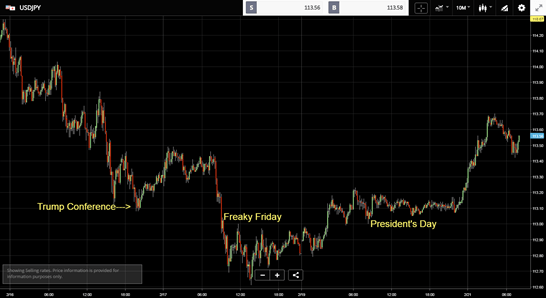
Finally, things are moving at a normal pace again and the directionless period that we've seen since Trump's confusing conference seems to be over. Hooray!!

Here are the main contributing factors...

1. Trump has picked himself a new National Security Advisor to replace the shady one that had alleged ties to Russia. Overall, the markets see this as a good thing.

2. Hawkish comments from the Federal Reserve are boosting the Buck.

3. The Greek Debt crisis has once again been swept under the rug, which is hurting the Euro.

For these three reasons and more, the US Dollar is king of the markets again. Here's a chart that shows the entire sequence of the last few days. This is the USDJPY 10 minutes per candle.

USDJPY

You can tell that Gold wants to go up but is having some trouble against the stronger Dollar. Right now we're looking at support at $1232 an ounce. If it falls below that we could be looking at $1220 before not too long.

Gold

The cherry on the top of this action packed market morning is Bitcoin with a rise of almost $40 a coin and reaching as high as $1095. If it passes $1100 today it's sure to get some very welcome love and attention.

BTC

The Fed (cont)

Fed member Harker stated that he "won't take March off the table" for a rate hike and has further reiterated the plan of three rate rises this year.

Currently, the market is pricing in a 36% chance of a rate hike in March and a 26% chance of three hikes this year.

We have an additional three fed members speaking today. Let's see if they can get those numbers up.

Greece (cont)

The Greek debt crisis is unsustainable. At the moment, the country owes more money than they can feasibly pay back.

Many were hoping for a swift resolution in Brussels before the elections in France blow the issue wide open. However, at this point, a swift resolution seems impossible and negotiations will again go down to the wire and will most likely be drawn out until July when their next payments are due.

For a full explanation of the Greek Debt Crisis, there's an excellent series on YouTube featuring Yanis Varoufakis. The former Greek finance minister who spat in the faces of the eurocrats and the only one man enough to tell them the truth to their faces.

What about the Pound?

The first item, the Brexit debates continue in the House of Lords. It's becoming clearer that even the Lords will have trouble shooting down the proposition of Brexit or calling for a second referendum. The people have spoken and though the vote was close, it is final.

The only question now is if they want to make any minor changes or stipulations to the way the negotiations are handled.

We'll also be getting some economic data from the UK this morning as well as a speech from Governor Carney so we can expect heavy volatility on the Pound today.

At the moment, the sentiment in eToro is showing 72% buying the GBPUSD and expecting it to go up from here.

https://www.fxstreet.com/analysis/bitcoin-on-the-move-again-201702211000
Valeriy Brusilovskyy
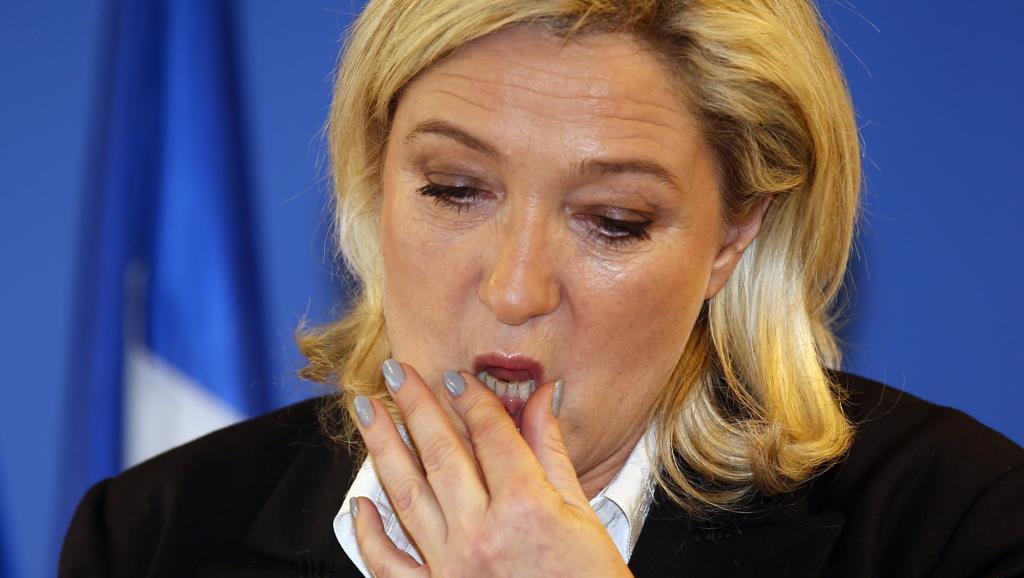
Le Pen shadow looms despite new highs

US markets are punching higher as they play catch up from yesterday’s holiday. With Le Pen’s support growing, will we continue to see a European-US divergence for stocks?

US outperforms European markets
Le Pen support drives European risk aversion
OPEC Sec.Gen sparks rally amid talk of rise to output cut

The bulls are back in charge in the US, with the divergence between US and European stock markets widening once more. Heightened political fears in Europe, ranging from Le Pen’s resurgence, to Brexit, stand in stark contrast to the overwhelming expectation of greater prosperity under Trump’s rule in the US. With US markets spiking to new all-time highs, it is simply a case of holding on for the ride as we seek to find out just how high US stocks can go.

The French elections are becoming an increasingly relevant risk to markets, with the chances of a victory for Le Pen rising with every month that passes. As the spread between French and German 10-year bond yields rises to a 4-year high, it is clear that the markets are increasingly factoring in a Le Pen victory as a distinct possibility. However, if there is anything we have learnt from polls in the UK and US, it is that the more controversial option can often be underrepresented up until the vote.

Crude prices have been a big mover today, following speculative comments from OPEC Secretary General Mohammad Barkindo, who expects the output cut compliance to not only be sustained, but built upon. Whilst the US has been gradually increasing output, the news that we could see further nations join in on trimming production has seen WTI rise to the second highest intraday price for 19-months.
Valeriy Brusilovskyy
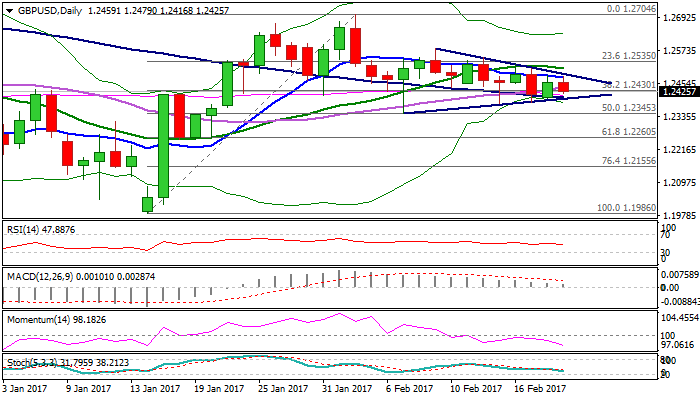
Cable is trading within near-term triangle, entrenched between daily 10 and 100SMA’s that mark key near-term levels.
The upside is limited by descending 10SMA (currently at 1.2474), while 100 SMA marks the lower pivot (currently at 1.2404).
Break of either side is needed to define fresh near-term direction, as daily studies are mixed. Extension below 100SMA would face immediate support at 1.2379 (top of descending daily cloud that so far contained downside attempts), break of which would trigger fresh weakness.
Conversely, lift above 10SMA (also upper triangle boundary) would shift near-term focus higher and expose 20SMA (1.2509), which guards upper pivots at 1.2550/80.

Res: 1.2474; 1.2509; 1.2550; 1.2580
Sup: 1.2404; 1.2379; 1.2345; 1.2300
Valeriy Brusilovskyy
EUR/USD Forecast 2017: politicians to displace Central bankers as market leaders

It took the FED a full year to raise rates for the second time in ten years, and the market almost two, to finally reflect in prices the imbalances between the FED and the rest of the world's Central Banks. The announcement came just a week after the ECB announced an extension of its QE program, which surpassed market's expectations, resulting in the EUR/USD pair suffering its longest losing streak since its inception in 1999: the pair is about to close in the red for a third consecutive year.

It was back in March 2014 when a debuting Janet Yellen said that the Federal Funds Rate could begin rising ‘around six months, that type of thing.‘ The EUR/USD pair opened that 2014 at 1.3760, and closed it at 1.2099, without the FED actually moving a finger. Enthusiasm over monetary policies' divergences faded during 2015, but the FOMC finally pulled the trigger, and the pair closed the year a 1.0857. Hopes for a second rate hike kept fading, all through this 2016, as despite strong, healthy growth in the jobs' sector, inflation has remained subdued. Still, a mild but steady improvement since mid-year backed the so long awaited second hike, resulting in the pair falling to fresh multi-year lows in the 1.0300 region.

But it was not just about the US and the FED. European slow growth, inflation holding close to deflationary levels and political woes, in the region, also affected the pair. Greece, Italy, Spain, Portugal, Ireland... Who would have thought that Great Britain was meant to be the first crack in the European Union? Greece was rescued again, and again, and again, but the UK held a referendum on its EU membership, won by Brexit supporters. PM Cameron resigned, and while the Pound suffered the most, the outcome dented further confidence in the Union.

Never-ending woes in Greece persists and while they hardly make it to center stage, the country's economic situation keeps worsening. Tsipras announced a Christmas bonus without its creditors' approval, who may refuse to keep on feeding the beast and could make the EUR tumble further. Same goes for Italy and its troubled banks, and government's intentions to rescue them against EU rules.

Ahh! and let's don't forget: Donald Trump won US elections and will be the 45th US President, taking over the office next January 20th, and with outrageous promises of boosting growth and inflation. Political risk in the Eurozone just keeps rising, while US inflation is picking up, getting closer to FED's 2% target for the first time in years.

In this scenario, how could the EUR do anything but fall? Indeed, is a tricky question, as the macroeconomic background is far larger than the above poor list of main 2016 events. And there's always two sides of a coin. The European situation can improve -German's data has been quite encouraging lately and is indeed the base of the region- while Trump can fail in its attempt to bring back the shine to the world's largest economy. The FED could once again falter to do as hinted in the dot-plot and stay on hold during 2017, while the ECB may beginning tapering.

Also, there are also hundreds of imponderables that we can't foresee right now, yet at this point, the EUR/USD pair is eminently bearish, and speculators are ready to give parity a test.

The pair has fallen too far, too fast following US election's peak of 1.1299, almost 1,000 pips in a month and a half. Considering the pair ranged within 1.0800 and 1.1400, measly 600 pips for almost two years, the sharp decline has left technical indicators in the daily and the weekly chart near oversold territory, but by no means the pair is giving signs of downward exhaustion and in fact, the largest one suggests that the ongoing bearish trend may continue developing, at least during the first quarter of 2017.

The first probable bearish target comes at 1.0206, July 2002 monthly high, while below it, parity comes next. By the time the common currency began circulating within much of Europe in 2002, the pair was trading around 0.8900, the next downward target should parity give up. Fall beyond this last level can only be triggered by financial and political chaos, which can result in the pair reaching its all-time low, posted in October 2000 at 0.8225.

1.0600 seems not that far away these days and it is the first critical resistance for this 2017, followed by the base of the 2015-16 range at 1.0840. A recovery above this last will confirm a bottom and favor additional gains in the common currency, with 1.1200 and 1.1460 as the next mid-term critical resistances to watch.
Jovan Veskovic
Jovan Veskovic 2017.02.20
THANK YOU FOR SHARING !
Valeriy Brusilovskyy
Valeriy Brusilovskyy 2017.02.21
It's a kind of important news by my opinion, I 'm happy that you agree with me!
Valeriy Brusilovskyy
Valeriy Brusilovskyy 2017.02.21
@Jovan Veskovic