Harmonic Hunter
- Indicatori
-
Antonello Belgrano
 MQL5 Programmer specialized in creating professional Expert Advisors and Indicators.
I develop high-quality strategies as well as custom solutions, optimizations, and personalized Expert Advisors tailored to your specific needs.
Feel free to contact me for any requests or custom projects. - Versione: 1.11
- Attivazioni: 5
Harmonic Hunter - Automatic Harmonic Pattern Scanner (Gartley, Bat, Butterfly, Crab, Shark, Cypher)
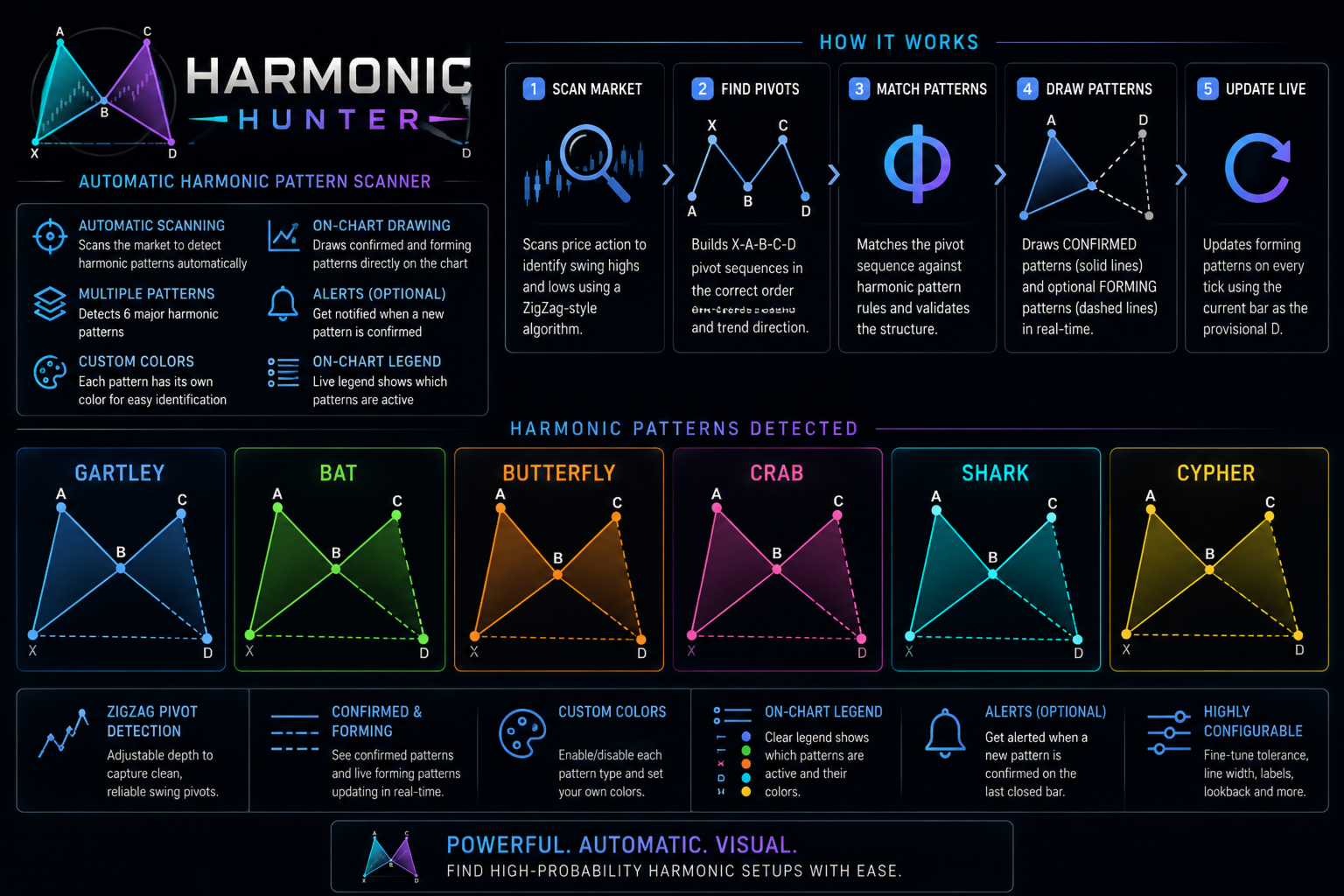
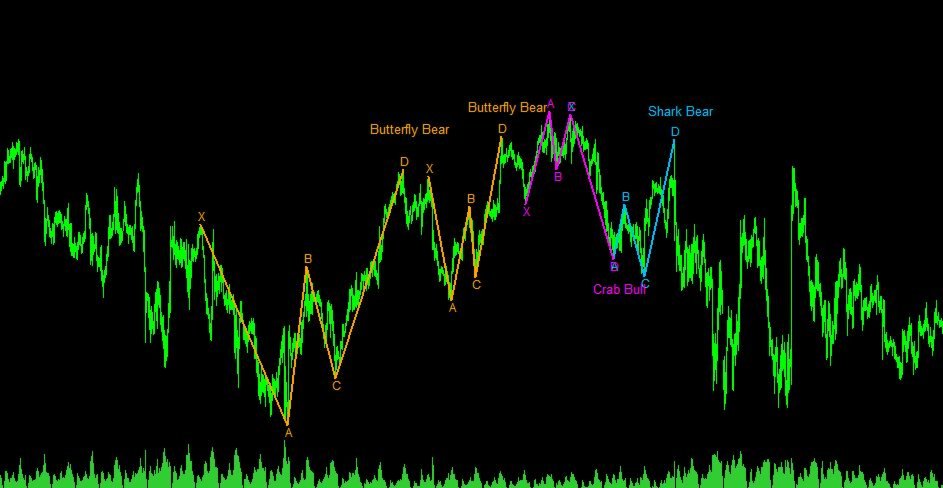
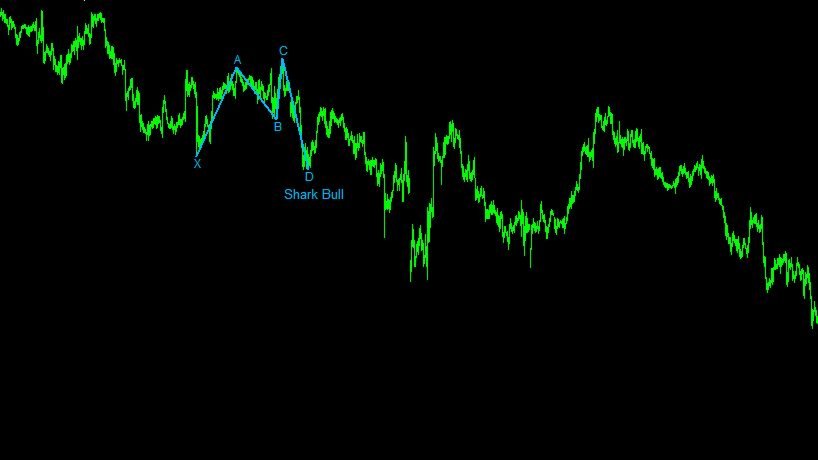
Harmonic Hunter scans price action for X-A-B-C-D swing structures and automatically plots the six most-traded harmonic patterns the moment their Fibonacci ratios align. No manual pivot-hunting required.
What it does:
- Detects swing pivots with a configurable ZigZag algorithm (adjustable depth)
- Validates each XABCD sequence against the precise ratio rules for Gartley, Bat, Butterfly, Crab, Shark, and Cypher
- Draws confirmed patterns (solid lines) once the D pivot is locked in
- Draws a live forming pattern (dashed) using the current unconfirmed bar as a provisional D, so you see the setup taking shape before it completes
- Each pattern has its own color and can be toggled independently
- Optional alerts when a new pattern confirms on a closed bar
- Full customization: tolerance %, lookback range, label offsets, legend, line width
Why it's useful: harmonic patterns are time-consuming to spot by eye and easy to mis-measure. This tool removes the manual ratio math and lets you monitor multiple pairs and timeframes for valid setups without staring at charts all day.
Works on any symbol and timeframe. Non-repainting on confirmed patterns, only the dashed "forming" overlay updates live, as expected.
Suggested Operational Use
1. Entry at D with a defined trigger, not just pattern completion
When a pattern confirms, or is forming and nears completion, don't market-buy/sell the instant D prints. Drop to a lower timeframe (e.g. pattern on H4, trigger on M15) and wait for a reversal candle or a break of the last minor swing structure inside the PRZ (Potential Reversal Zone, roughly C to the CD Fibonacci projection). Enter on that trigger.
2. Stop placement
Stop just beyond the X point for Gartley/Bat/Shark, since X-D ratios are tighter, or beyond the D pivot extreme with a buffer for Crab/Butterfly, which run wider. A break of X invalidates the structure by definition.
3. Targets, scaled at CD/AD retracement
- TP1: 38.2% retracement of the CD or AD leg
- TP2: 61.8% retracement, move stop to breakeven after TP1
- TP3 (runner): back to point C or beyond, trailed
4. Can be traded standalone, and also works as an end-of-trend signal
The pattern completion at D is a valid trade setup on its own with the entry trigger and stop rules above. It also doubles as a reliable exhaustion signal, since a completed harmonic pattern marks a point where a trending move is statistically stretched. That makes it a strong companion to other tools too: pair it with momentum divergence (RSI/MACD) or volume exhaustion at D for extra confirmation when you want it, but the pattern itself is a complete, tradeable setup without needing a second indicator.
5. Filter by pattern type per market condition
- Gartley/Bat: tighter PRZ, better on ranging/mean-reverting pairs
- Crab/Butterfly: wider PRZ, bigger extensions, better after a strong trending pullback
- Shark/Cypher: counter-trend exhaustion plays, use only after a clear extended move
6. Multi-timeframe confluence
Prioritize D-point signals that also sit near a higher-timeframe S/R level, round number, or prior swing high/low. A harmonic pattern completing in isolation, with no confluence, has meaningfully worse follow-through.