Failed Auction
- Indicateurs
- Version: 1.5

Version 1.05
The Problem With Volume in CFDs
Every serious trader understands that volume is the lifeblood of market analysis. It is the one variable that reveals intention behind price movement. Yet the vast majority of CFD instruments — indices, forex pairs, commodities — operate without access to centralized exchange volume. What brokers provide is tick volume: a raw count of price changes per bar, devoid of directional context.
Most traders accept this limitation. The FA Confluence Engine does not.
Through proprietary volume decomposition algorithms, the FA Confluence Engine reconstructs directional order flow from tick volume data, extracting buy-side and sell-side pressure with remarkable fidelity. Where the market gives you noise, this engine gives you structure. Where CFDs strip away depth, this indicator rebuilds it — bar by bar, tick by tick.
What Is a Failed Auction?
Auction Market Theory — the institutional framework that governs how markets actually move — defines price as an ongoing two-sided auction between buyers and sellers. Markets move directionally to discover new prices, and when they find a boundary where one side overwhelms the other, the auction fails and price reverses.
A Failed Auction occurs when price breaches a significant structural level — penetrating beyond it to test for acceptance — only to encounter decisive rejection. The breach itself is not the signal. What matters is how the market behaves during and immediately after the breach:
- Was there genuine commitment behind the move? Or was it a low-conviction probe driven by stop-hunting algorithms and thin liquidity?
- Did volume confirm the breakout? Or did participation collapse the moment price crossed the threshold?
- Did directional flow support continuation? Or did the opposing side absorb every contract and force a reversal?
When price pushes through a level on declining participation, lopsided directional flow, and rapid contraction — the auction has failed. The breakout is a trap. Institutional participants have rejected the new price, and a reversal is structurally underway.
This is not retail conjecture. This is the foundational principle behind how market profile practitioners, auction theorists, and institutional flow desks have analyzed markets for decades. The FA Confluence Engine translates this principle into a precise, algorithmically scored detection system.
What This Indicator Is — And What It Is Not
The FA Confluence Engine is not a buy/sell signal generator. It does not tell you when to enter or exit a trade. It does not draw support and resistance lines for you to blindly follow. It does not promise a win rate.
It is a confluence tool — purpose-built to identify high-probability Failed Auction events at structurally significant price levels. Its role within your trading system is to provide a layer of institutional-grade confirmation that no other retail indicator offers.
A Failed Auction detected in the middle of a range, with no structural context, carries limited weight. But a Failed Auction occurring precisely at the Value Area High of a volume profile, at the previous session's high, at a daily high/low, at a psychological round number, or at the convergence of multiple structural boundaries — that is an event of extraordinary significance.
The FA Confluence Engine is designed to surface exactly these moments. Pair it with your existing framework — volume profiles, market profile, order flow analysis, supply and demand zones — and it becomes the confirmation layer that separates high-probability setups from noise.
Architecture & Core Modules
The FA Confluence Engine is built on a multi-layered analytical architecture, each module engineered to isolate a specific dimension of market behavior:
Adaptive Volatility Normalization
All internal calculations are dynamically scaled against real-time volatility conditions. The engine does not use static thresholds. Every measurement — from proximity calculations to rejection depth analysis — adjusts to the current volatility regime, ensuring consistent performance across instruments, timeframes, and market conditions. Whether applied to a low-volatility forex pair or a high-beta index CFD, the engine's sensitivity self-calibrates.
Statistical Volume Anomaly Detection
At the core of the engine lies a proprietary statistical model that identifies anomalous volume events — institutional-grade transactions that deviate significantly from the local volume distribution. Using advanced probability scoring, the engine isolates bars where participation exceeds normal bounds by a statistically meaningful margin, flagging them as potential institutional footprints. These are not arbitrary volume spikes. They are mathematically validated outliers.
Directional Flow Decomposition
Raw tick volume is decomposed into estimated buy-side and sell-side components using a proprietary intra-bar distribution model. This process reconstructs what CFD brokers cannot provide: a synthetic order flow delta that approximates the directional intent behind each bar's volume. The engine then tracks cumulative directional flow across critical breach sequences to determine whether the market's commitment matches its movement.
Multi-Level Structural Mapping
The engine continuously tracks and updates a dynamic grid of structurally significant price levels derived from multiple temporal frameworks:
- Session architecture — Previous and current session highs and lows
- Daily architecture — Prior day's high and low boundaries
- Swing structure — Algorithmically detected pivot highs and lows using multi-bar confirmation
- Institutional volume benchmarks — Volume-weighted reference prices derived exclusively from statistically significant volume events
Each level category carries its own weighting coefficient within the scoring engine, reflecting the empirical significance of that structural type.
Proprietary Confluence Scoring Engine
Every potential Failed Auction event is evaluated through a multi-criteria scoring matrix that synthesizes:
- Volume commitment analysis — Was the breach supported by above-average participation, or was it a vacuum move?
- Directional flow imbalance — Did the flow during the breach align with continuation, or did the opposing side dominate?
- Approach velocity profiling — How did volume behave as price moved toward the level? Accelerating commitment or exhaustion?
- Wick distribution analysis — Did price action during the approach exhibit signs of absorption and rejection?
- Contraction detection — Did volatility compress during the breach sequence, signaling loss of momentum?
- Breach depth quantification — How far beyond the level did price penetrate before failing?
- Institutional footprint cross-referencing — Were anomalous volume events present during the breach, and did their directional bias conflict with the breakout direction?
Each criterion contributes a weighted component to a final Confidence Score scaled from 0 to 100. Only events that meet or exceed the user-defined confidence threshold are rendered on the chart.
User Controls
| Parameter | Description |
|---|---|
| Engine Sensitivity (1–10) | Controls the statistical threshold for volume anomaly detection. A setting of 1 applies the strictest filtering, surfacing only the most extreme institutional events. A setting of 10 casts a wider net. Default: 1. |
| FA Confidence Score (0–100) | Sets the minimum score a Failed Auction event must achieve to be displayed. Higher values demand stronger multi-factor confirmation. Default: 95. |
Two inputs. No clutter. The complexity lives inside the engine — not on your screen.
Visual Output
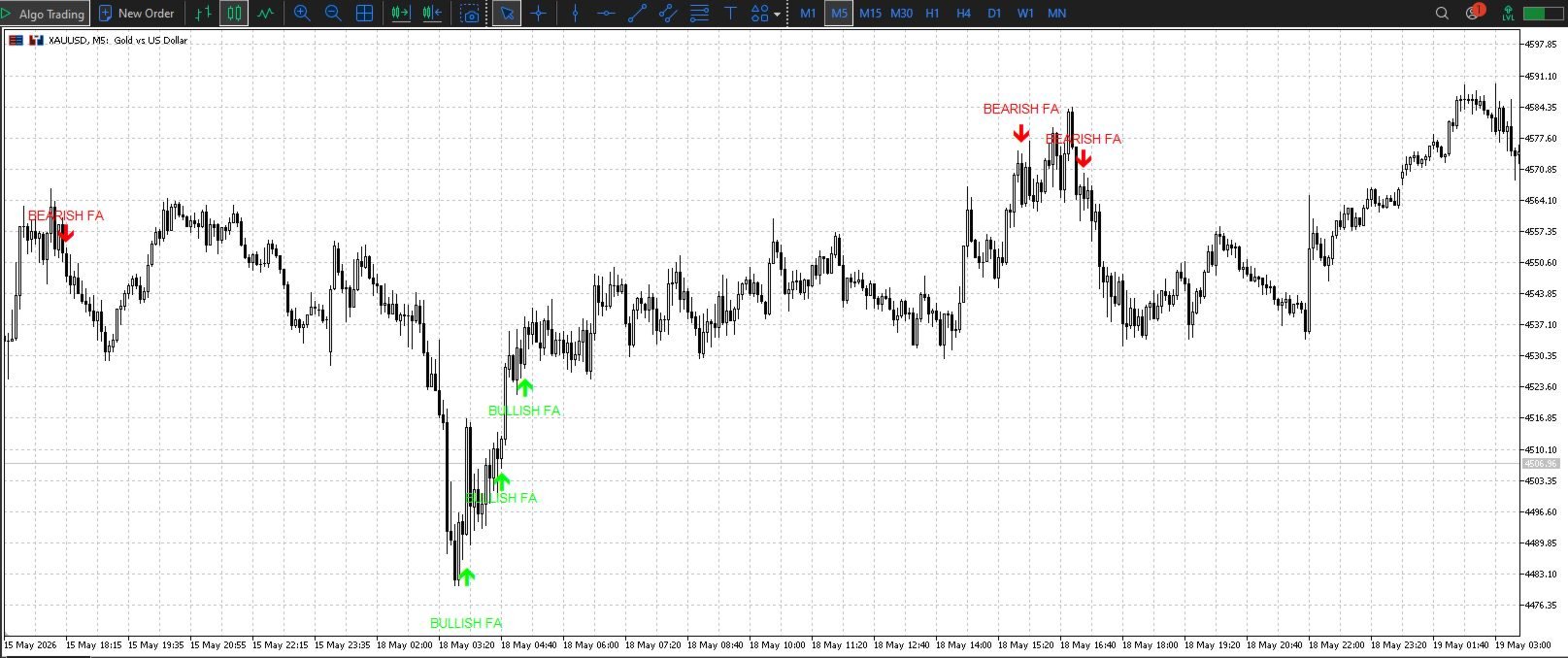
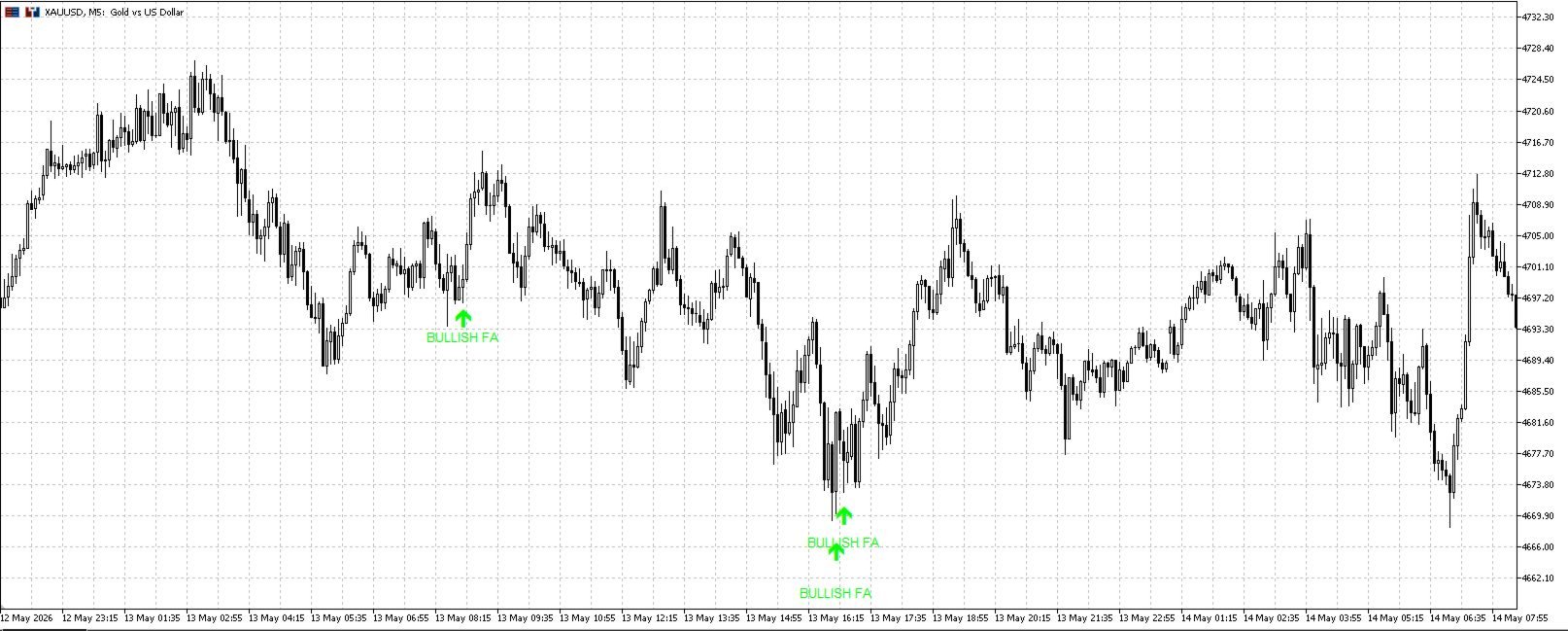
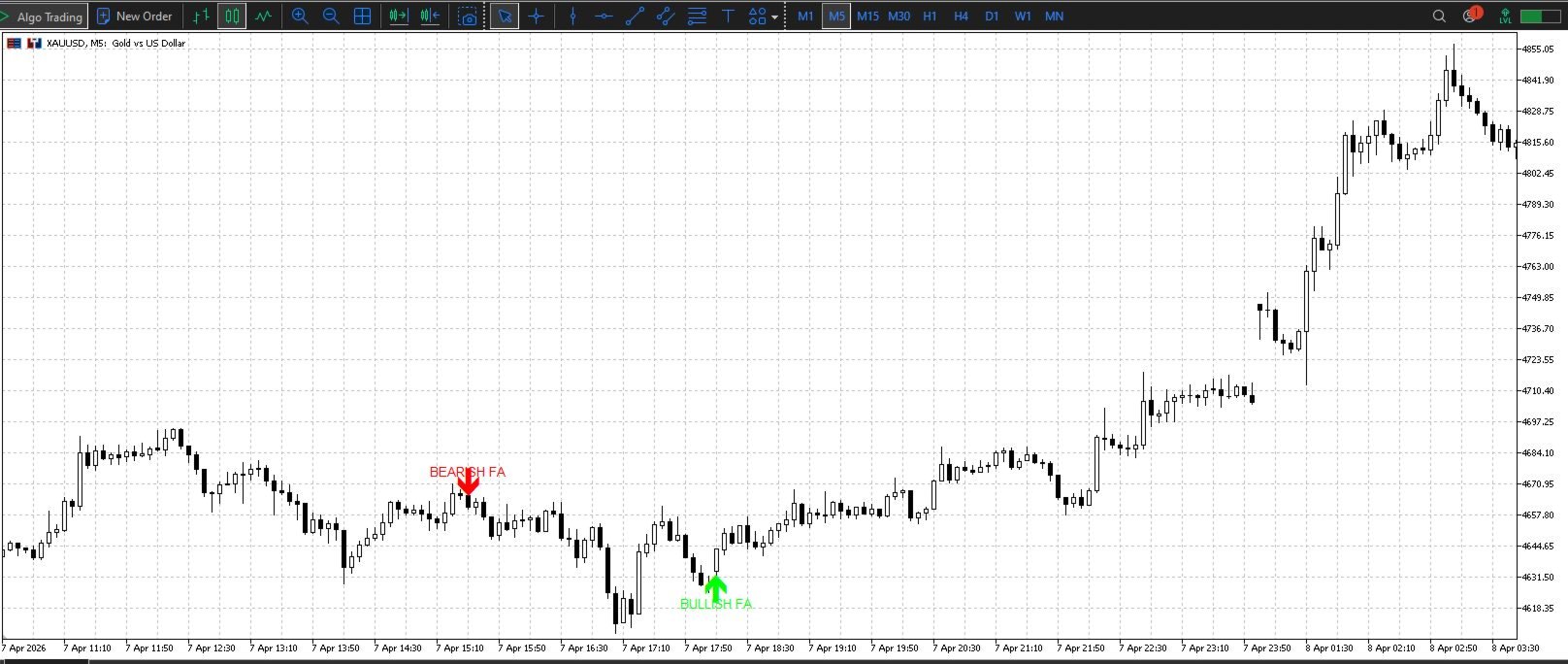
- Bullish Failed Auction — Lime upward arrow with "BULLISH FA" label, rendered below the bar where the engine detected a bearish auction failure (i.e., sellers failed to sustain a breakdown — expect upward reversal).
- Bearish Failed Auction — Red downward arrow with "BEARISH FA" label, rendered above the bar where the engine detected a bullish auction failure (i.e., buyers failed to sustain a breakout — expect downward reversal).
Clean. Unambiguous. Institutional.
Designed for CFD Markets
While most volume-based tools were conceived for centralized exchanges where true volume data is available, the FA Confluence Engine was engineered from the ground up for the realities of CFD trading. Every algorithm, every decomposition model, every statistical threshold has been calibrated to extract maximum insight from tick volume — the only volume data CFD brokers provide.
This is not a futures indicator ported to forex with a disclaimer. This is a purpose-built analytical engine for instruments that lack real volume — and it closes the gap.
How to Deploy
- Apply the FA Confluence Engine to any CFD chart (forex, indices, commodities, crypto CFDs).
- Use your existing structural analysis — volume profiles, market profile, supply/demand, psychological levels — to identify key areas of interest.
- When the engine fires a Failed Auction signal at or near one of those key areas, you have confluence. The market has spoken: the auction failed where it mattered most.
- Integrate the signal into your trade plan as a confirmation layer alongside your existing entry criteria.
The FA Confluence Engine does not replace your edge. It sharpens it.
Technical Specifications
- Platform: MetaTrader 5
- Chart Window: Main chart overlay
- Buffers: 2 (Bullish FA, Bearish FA)
- Dependencies: None — fully self-contained
- Resource Footprint: Optimized for real-time calculation with minimal CPU overhead
- Compatibility: All CFD instruments with tick volume data
The FA Confluence Engine represents a fundamental rethinking of how retail traders can access institutional-grade auction analysis on CFD instruments. Built on the bedrock of Auction Market Theory, powered by proprietary statistical and flow decomposition models, and distilled into a surgical confluence tool — it delivers the kind of structural insight that was once the exclusive domain of professional trading desks.
Two inputs. One engine. Zero guesswork.