Ignacio Rubio Bustos Fierro / Profile
- Information
|
no
experience
|
1
products
|
12
demo versions
|
|
0
jobs
|
0
signals
|
0
subscribers
|
FX automated systems developer focused on robust, rule-based strategies.
My work is centered on range-based and regime-aware automated systems, designed with an emphasis on capital preservation, statistical consistency, and long-term survivability in live market conditions.
I prioritize selective execution, controlled risk exposure, and conservative design over high-frequency or aggressive approaches. All systems are built using transparent logic, strict safety filters, and extensive historical evaluation across different market regimes.
Support, clarity, and continuous refinement are core principles behind every release.
My work is centered on range-based and regime-aware automated systems, designed with an emphasis on capital preservation, statistical consistency, and long-term survivability in live market conditions.
I prioritize selective execution, controlled risk exposure, and conservative design over high-frequency or aggressive approaches. All systems are built using transparent logic, strict safety filters, and extensive historical evaluation across different market regimes.
Support, clarity, and continuous refinement are core principles behind every release.
Friends
Requests
Add friends via their profile or user search and you will be able to see if they are online
Outgoing
Ignacio Rubio Bustos Fierro
What Does a Small Edge Actually Look Like?
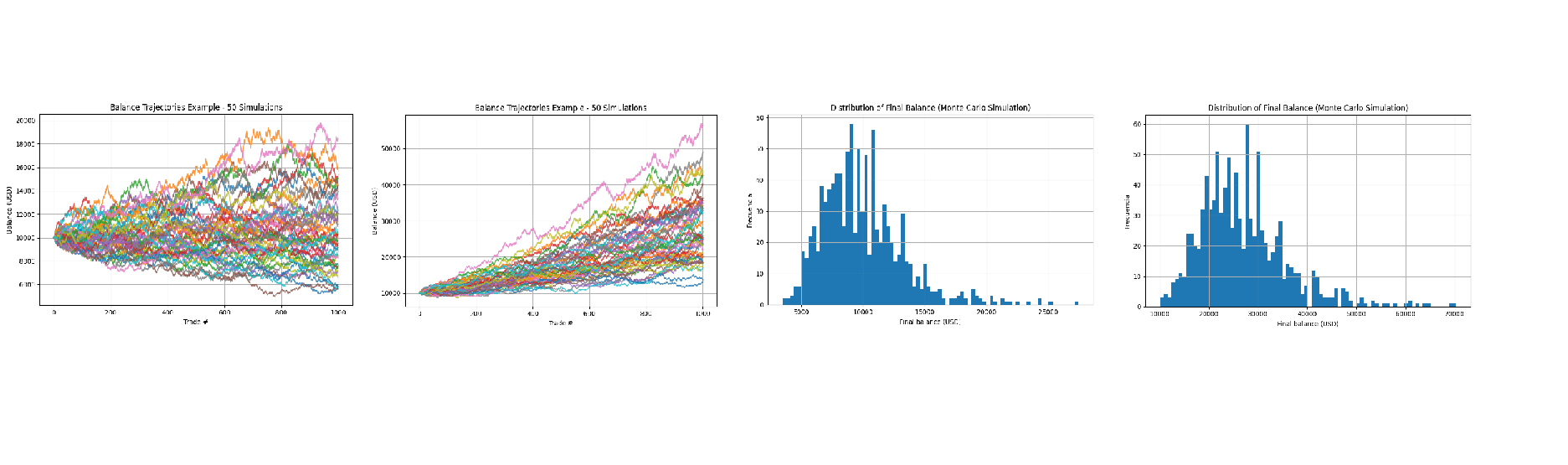
I ran 1,000 Monte Carlo simulations for two simple systems:
System A
R:R = 1:1
Win rate = 50%
No edge
System B
R:R = 1:1
Win rate = 55%
Positive edge
Each simulation:
1,000 trades
Fixed risk per trade
Initial capital: $10,000
What happens?
Breakeven system:
Final balance distribution centers around initial capital
Outcomes are purely variance-driven
Positive edge system:
Entire distribution shifts to the right
Median outcome increases materially
But dispersion remains high
Even with a real edge, not every path wins.
Conclusion
Edge does not eliminate volatility.
It shifts probability mass.
Trade by trade, the difference looks small.
Across 1,000 trades, the distribution changes completely.
Expected value determines direction.
Variance determines experience.
I ran 1,000 Monte Carlo simulations for two simple systems:
System A
R:R = 1:1
Win rate = 50%
No edge
System B
R:R = 1:1
Win rate = 55%
Positive edge
Each simulation:
1,000 trades
Fixed risk per trade
Initial capital: $10,000
What happens?
Breakeven system:
Final balance distribution centers around initial capital
Outcomes are purely variance-driven
Positive edge system:
Entire distribution shifts to the right
Median outcome increases materially
But dispersion remains high
Even with a real edge, not every path wins.
Conclusion
Edge does not eliminate volatility.
It shifts probability mass.
Trade by trade, the difference looks small.
Across 1,000 trades, the distribution changes completely.
Expected value determines direction.
Variance determines experience.
Ignacio Rubio Bustos Fierro
Sharpe Does Not Eliminate Path Risk
A systematic strategy showing:
Sharpe Ratio: 2.02
CAGR: 69.5%
Max Drawdown (realized): −15.6%
1,059 trades
Expectancy: 0.13R
From a classical perspective, this is statistically robust.
However, Sharpe measures return efficiency relative to volatility.
It does not measure sequencing risk.
What Happens If We Reshuffle the Same Trades?
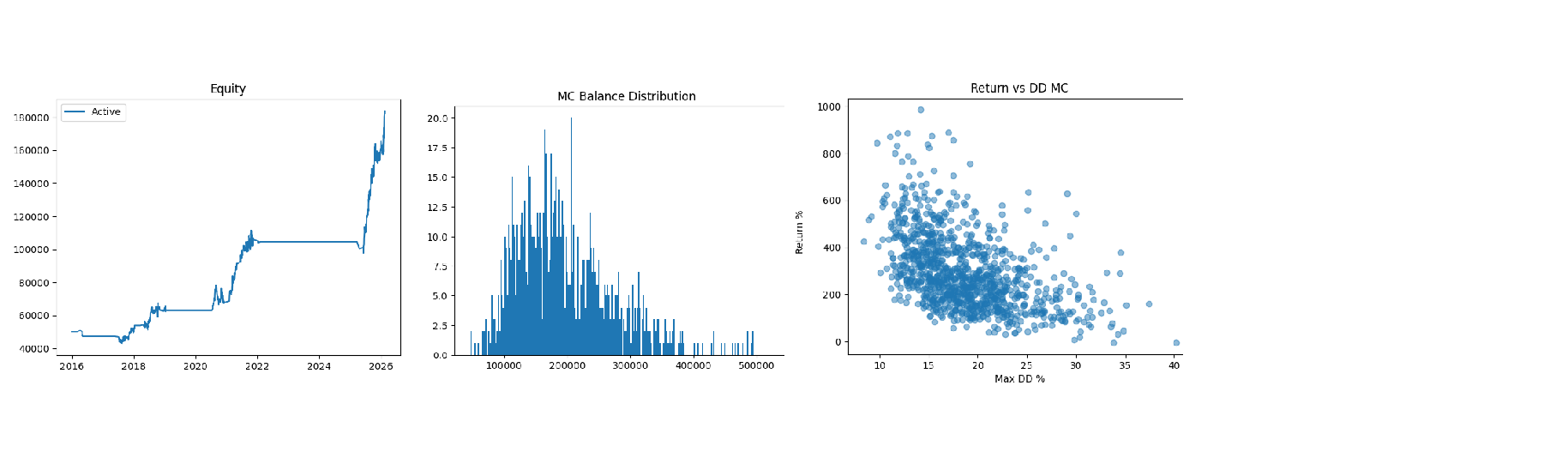
I ran a bootstrap Monte Carlo simulation:
1,000 reshuffled trade sequences
Fixed 1% risk per trade
Initial capital: $50,000
No parameter changes
Same edge, same expectancy
Only trade order randomized
Results
Final Balance Distribution:
Mean: $197,755
Median: $182,512
5th percentile: $97,235
Probability of finishing below initial capital: 0.2%
The statistical edge clearly shifts the distribution to the right.
Drawdown Behavior Under Reordering
Drawdowns across simulations:
Mean max DD: 18.7%
95th percentile max DD: 28.3%
Extreme worst case observed: 40.2%
The historical max DD was −15.6%.
Most alternative paths remain within a statistically reasonable drawdown range.
Occasional deeper drawdowns are structurally possible due to trade clustering.
Same edge.
Different paths.
Takeaway
Sharpe summarizes the realized trajectory.
It does not describe the full distribution of plausible outcomes.
Performance should be evaluated as a probability distribution — not a single equity curve.
A systematic strategy showing:
Sharpe Ratio: 2.02
CAGR: 69.5%
Max Drawdown (realized): −15.6%
1,059 trades
Expectancy: 0.13R
From a classical perspective, this is statistically robust.
However, Sharpe measures return efficiency relative to volatility.
It does not measure sequencing risk.
What Happens If We Reshuffle the Same Trades?
I ran a bootstrap Monte Carlo simulation:
1,000 reshuffled trade sequences
Fixed 1% risk per trade
Initial capital: $50,000
No parameter changes
Same edge, same expectancy
Only trade order randomized
Results
Final Balance Distribution:
Mean: $197,755
Median: $182,512
5th percentile: $97,235
Probability of finishing below initial capital: 0.2%
The statistical edge clearly shifts the distribution to the right.
Drawdown Behavior Under Reordering
Drawdowns across simulations:
Mean max DD: 18.7%
95th percentile max DD: 28.3%
Extreme worst case observed: 40.2%
The historical max DD was −15.6%.
Most alternative paths remain within a statistically reasonable drawdown range.
Occasional deeper drawdowns are structurally possible due to trade clustering.
Same edge.
Different paths.
Takeaway
Sharpe summarizes the realized trajectory.
It does not describe the full distribution of plausible outcomes.
Performance should be evaluated as a probability distribution — not a single equity curve.
Ignacio Rubio Bustos Fierro
Development update — capital management refinement in progress.
Current research is focused on implementing a new capital management framework designed to preserve balance stability while selectively exploiting performance peaks.
The objective is to maximize long-term returns without increasing overall market exposure, maintaining the system’s conservative and regime-aware philosophy.
This work is part of the ongoing effort to strengthen robustness, improve survivability in live conditions, and enhance risk-adjusted performance over time.
SteadyRange M5:
https://www.mql5.com/es/market/product/157077?source=Site+Profile+Seller
Current research is focused on implementing a new capital management framework designed to preserve balance stability while selectively exploiting performance peaks.
The objective is to maximize long-term returns without increasing overall market exposure, maintaining the system’s conservative and regime-aware philosophy.
This work is part of the ongoing effort to strengthen robustness, improve survivability in live conditions, and enhance risk-adjusted performance over time.
SteadyRange M5:
https://www.mql5.com/es/market/product/157077?source=Site+Profile+Seller
Ignacio Rubio Bustos Fierro
We are currently working on expanding the bot’s operational range, with the goal of progressively extending it to cover the 1.122 – 1.188 price zone.
This update is part of an ongoing effort to improve robustness and adaptability across broader market conditions.
Ignacio Rubio Bustos Fierro
Published product
STEADYRANGE M5 Professional Range-Trading Algorithmic System for EURUSD (M5) System Approach SteadyRange M5 is a professionally engineered Expert Advisor designed exclusively for EURUSD on the M5 timeframe , focused on: selective market participation strict risk control long-term operational consistency The system operates within a structurally defined intraday zone (1.1450 – 1.2050) , prioritizing execution quality over trade frequency. No martingale, no grid, no arbitrage, and no recovery
: