Midas Key Levels
- Indicators
- Version: 1.20
- Activations: 5

Midas Key Levels draws the levels most traders mark by hand every morning, and follows each one until price takes it.
The levels
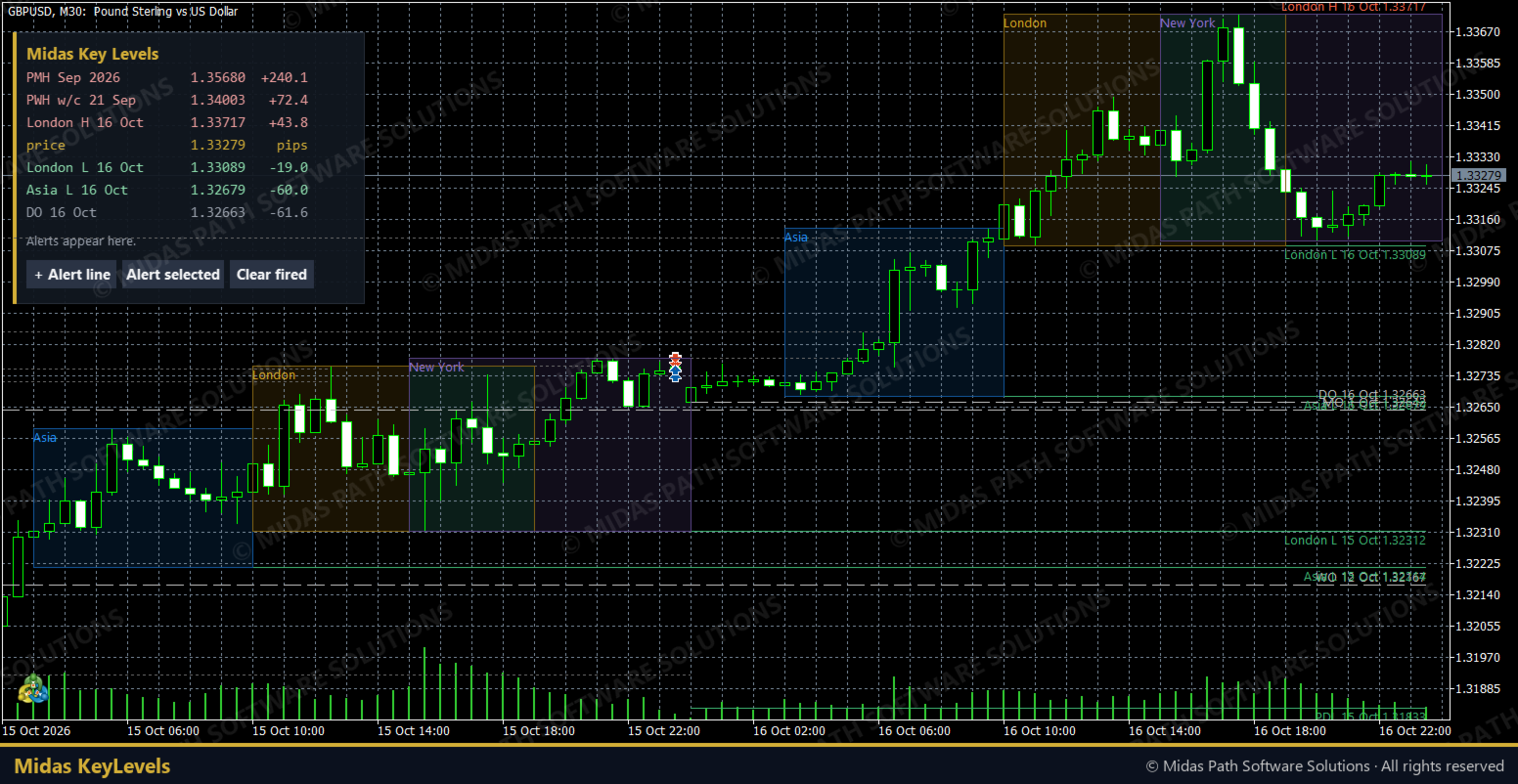
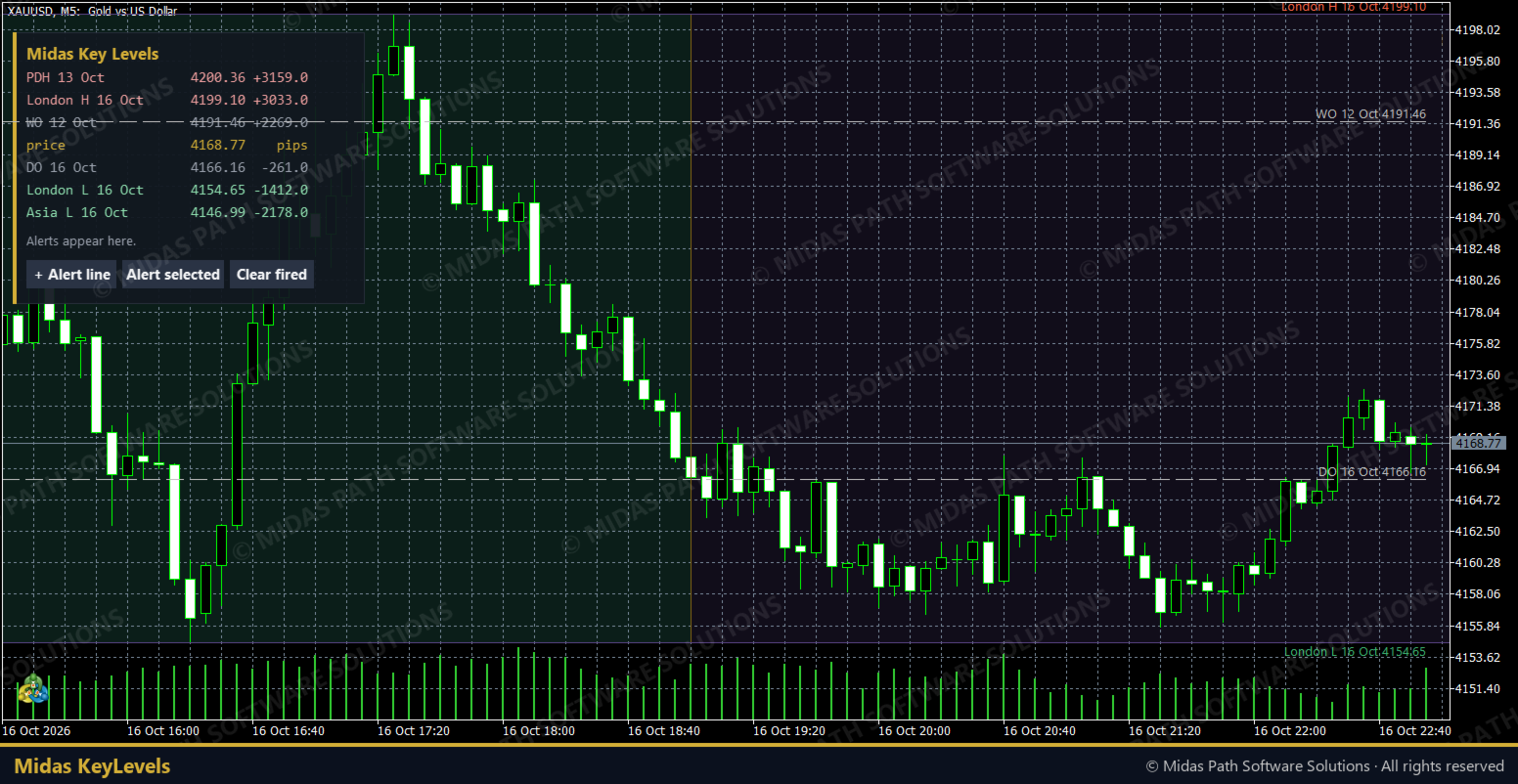
- Previous day, week and month high and low (PDH/PDL, PWH/PWL, PMH/PML), labelled with the day, week or month they come from.
- The day, week and month opens (DO, WO, MO), as dashed reference lines for their period.
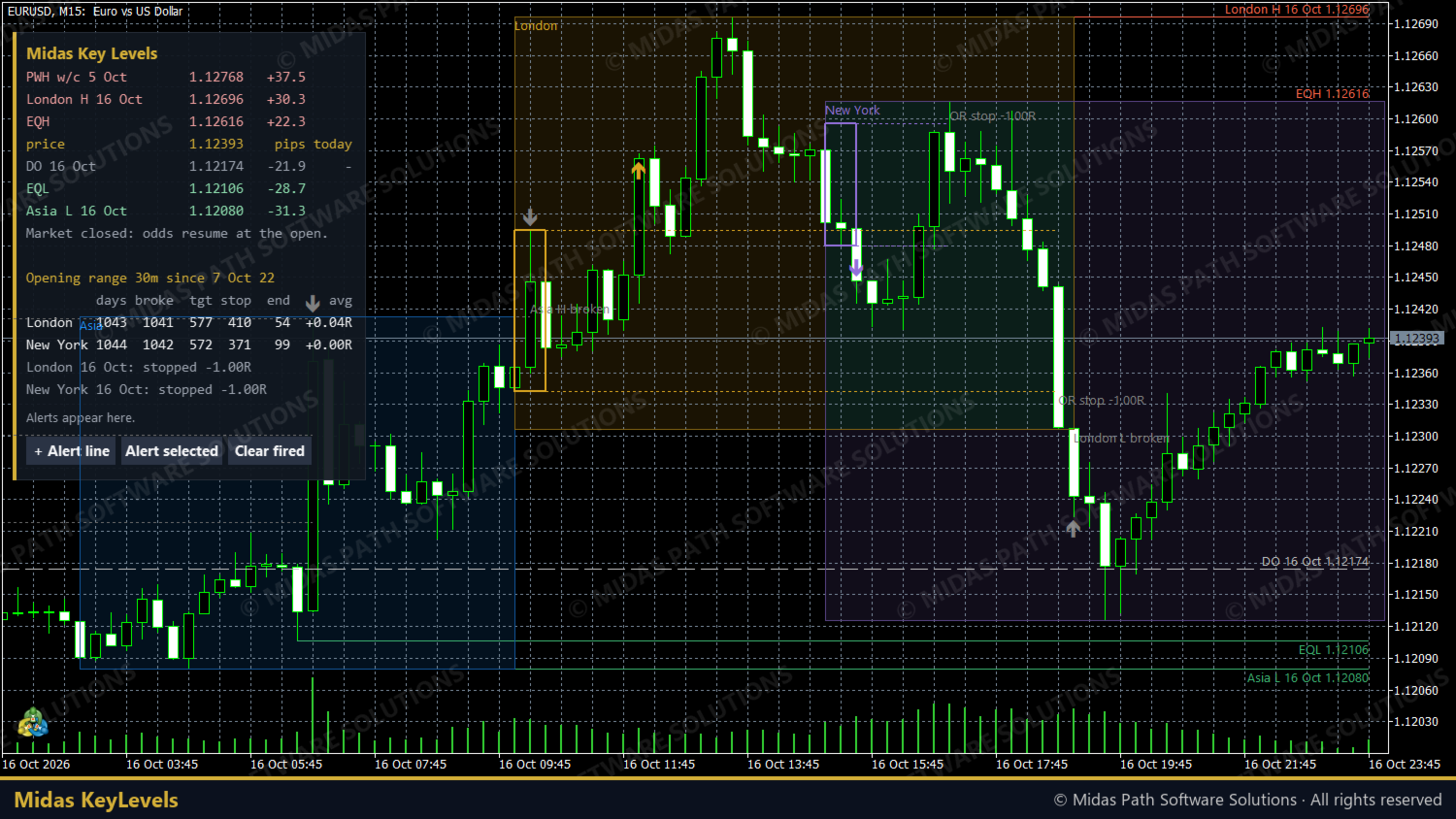
- The Asia, London and New York sessions as boxes, with their high and low as levels when the session ends.
- Equal highs and equal lows: two confirmed swing points within your tolerance, with nothing traded through them in between.
Opening range breakouts
- The opening range of each session: the high and low of its first 30 minutes (5 to 240, adjustable), drawn as a box. London and New York on by default, Asia optional, on the session hours above.
- The breakout is the first close beyond the range, marked with an arrow; while it runs, its target (one range height from the entry) and its stop (the other side of the range) are drawn.
- Each breakout is followed to its outcome: target, stop (a candle touching both counts as stopped), or still open at the session end.
- The record in the panel, per session, from your chart's history: ranges, breakouts, targets, stops, session ends and the average result in R, plus where today's range is.
- On our test data (11 markets, hourly, 2012-2026) a plain opening range breakout averaged about zero R before costs. The record shows what it did on your market, so you can judge it yourself.
Clocks that follow daylight saving
- The trading day starts at 17:00 New York by default, the usual forex day, and moves with US daylight saving; midnight UTC or any UTC hour are options.
- Session hours are in each market's own time (Tokyo, London, New York), so London 08:00 stays London 08:00 through the clock changes; UTC hours are an option.
- Your broker's server clock is detected (most brokers keep New York close time, GMT+2 in winter and GMT+3 in summer) and can be set by hand: New York close, GMT+2/+3 on EU dates, a fixed offset, or UTC.
Swept or broken
- When a closed candle trades through a level and closes back inside, the level is marked swept; when it closes beyond, broken. One arrow per candle and side names the levels it took. Taken levels grey out, so only live levels stay coloured.
- Untaken levels are kept for a number of their own periods (3 by default).
- Several levels at one price share one label at the right edge. Sweeps and breaks are named for the last day (adjustable); older ones keep their arrow only.
The panel
The nearest live levels above and below price, with their distance in pips, today's odds, the opening range record, and the last alerts.
Level Odds
- Each live level shows its chance of being reached before today's close (17:00 New York), in the panel and on its label, updated as price moves and the day runs down.
- A small published formula, not a black box: distance in average-daily-range units, hours left, the day's range used, how far today's extreme still is from the level, the level's kind and age, the weekday.
- Fitted on 2012-2020, checked on 2021-2026 (never seen) on 10 forex pairs and gold, 4.7 million cases: predicted 20-30% were reached 25% of the time, 50-60% 52%, 70-80% 73%; every band within about three points. Hidden while the market is closed; an input turns them off.
Alerts
- When a level is swept or broken (on the candle close), when price touches a level, or when it comes within your distance; equal highs/lows optional. A pop-up, a sound, a push notification to your phone, or an email through the terminal's mail settings.
- Alerts on your own lines too: any horizontal line or trendline whose name or description contains "alert", a selected line at one click, or an alert line from the panel; touch or close-through; optional re-arm.
No repainting
Levels and sweeps come from closed candles only. A period or session that history starts in the middle of produces nothing, because its range would be incomplete.
Inputs
- Levels: day, week, month, opens; trading day start; how long untaken levels are kept; broker server clock.
- Sessions: clock (market time or UTC); for Asia, London and New York: box, levels, start and end hour.
- Opening range: on or off; minutes; Asia, London, New York; target and stop lines; alerts on the breakout, the range and the outcome.
- Equal highs/lows: on or off; swing strength; tolerance in pips; look-back.
- Alerts: swept; broken; touch; approach distance; equal highs/lows; pop-up, sound and sound file, push, email. Line alerts: keyword, type for a selected line, re-arm and its distance.
- Display: days of history; mark sweeps and breaks; how many days of them are named; panel; odds; nearest levels listed; colours; box fill; font size.
Tested
The day, session and daylight-saving logic was checked against an independent model built on the operating system's own time zone data (981,760 clock checks from 2015 to 2035, and 159,017 checks of every level, open, session range, sweep, break and expiry on a 14-month series crossing every clock change, including history that starts mid-week and mid-month, 0 violations). The opening ranges were checked the same way on real hourly candles of 11 markets (2012-2026) and on M15 data with missing candles (3,232,463 checks, 0 violations). This MetaTrader build reproduces the reference engine and the odds line for line on a shared fixture (51,533 lines, identical), and the opening ranges (18,204 lines, identical), and its own check script covers the server clock, the line alerts and the live alerts (31 checks).
Notes
- It marks levels and reports how often levels like them were reached; it does not predict any single day. This is not financial advice.
- Previous-day levels on timeframes below daily, weekly below weekly, monthly below monthly; sessions below 4 hours.
- The terminal must be running with the chart open for alerts to fire. Push alerts need the MetaQuotes ID in the terminal's notification settings.
- It never trades and needs no internet or file access of its own.