How to better filter false entries in trend-following strategies on XAUUSD during volatile periods? - page 2

You are missing trading opportunities:
- Free trading apps
- Over 8,000 signals for copying
- Economic news for exploring financial markets
Registration
Log in
You agree to website policy and terms of use
If you do not have an account, please register
ADX trend strength line is decent for this with Period 14 on H4 timeframe
I agree with the excellent points made by @Daniel-gheorghe Muresan. He said a hard truth that many trend followers resist: real trend‑following systems naturally have a low win rate and relatively tight stops compared to their potential upside, because they are designed to capture fat tails and a few outlier winners. Adding more and more filters to “avoid bad trades” is usually just a way to fight this structural property of the strategy, and in my experience it doesn’t work for long.
It took me years to accept this. Don’t try to be “smarter” than the market. Even if you find a filter that looks great in backtest, it will very likely fail in the near future. And if there were a real, robust edge in combining technical indicators to neutralize the fat‑tail effect, large funds would find it quickly and arbitrage it away – easy money doesn’t stay easy for long.
I’m not saying all filters are useless. They can add some limited value, but the risk of a filter making you skip the one big winner that pays for a whole series of losers is, in my opinion, not worth the supposed benefit. If you still want to try filters, keep it very simple: just a couple of parameters (2–3 at most) and extreme caution with overfitting.
One alternative worth considering: instead of using filters to cut trades entirely, you can adjust your position size based on market conditions – volatility, trend strength, direction, and so on. This way you stay in the game and keep your exposure to potential big winners, while still reducing risk when conditions are less favorable. It is a more nuanced approach than a binary in/out filter, and in my view it aligns much better with the core philosophy of trend following.
One alternative worth considering: instead of using filters to cut trades entirely, you can adjust your position size based on market conditions – volatility, trend strength, direction, and so on. This way you stay in the game and keep your exposure to potential big winners, while still reducing risk when conditions are less favorable.
Fixed trade sizing versus variable trade sizing is an age-old debate. Unless I'm running a strategy designed to stack open profitable trades, I generally stick with a fixed trade size─especially while trading gold. I find that it is easier to collect meaningful statistics when using a fixed trade size due to the KISS principle. Using an everchanging trade size merely adds an additional and complex variable to the equation that I can do without (Murphy's Law applies here as well).
There seems to be fairly popular fallacy among traders (and especially Sellers in the Market) in believing that complexity connotes success.
Don’t try to be “smarter” than the market.
The KISS principle translates to "keep it simple stupid." Fixed trade sizing assumes that we cannot know the direction nor momentum of any future price move, so it does not attempt to do so.
If you think that you can predict the direction and momentum of every future price move, and to the extent that you can assign each move a trade size, then who is really attempting to be smarter than the market?
Likewise, I'm not saying that variable trade sizes can't be used. Professional quants employed by hedge funds use variable trade sizing, but they also have access to state-of-the-art resources unlike retail traders.
Anyway, the factors cited in determining the variable trade size to be used are really just "filters" in and of themselves.
Fixed trade sizing versus variable trade sizing is an age-old debate. Unless I'm running a strategy designed to stack open profitable trades, I generally stick with a fixed trade size─especially while trading gold. I find that it is easier to collect meaningful statistics when using a fixed trade size due to the KISS principle. Using an everchanging trade size merely adds an additional and complex variable to the equation that I can do without (Murphy's Law applies here as well).
There seems to be fairly popular fallacy among traders (and especially Sellers in the Market) in believing that complexity connotes success.
Instead of measure profit, measure points, opr even better ticks. it is position size invariant.
But i agree. Using position sizing as described by Douglas is just the same principle as any filter, your tiny volatility sized position turns out to be a winner which is not able to pay for the normal sized string of losers. Sounds cool, but It does not make any sense.
hi,
Hi,
Personally, I think good indicators can help, but for me the main thing is not to use them to decide what pair to trade or what direction to take.
I normally start with a weekly or daily market view. I look at which currencies are strong or weak, check if there is any important news coming, and only then look for an entry.
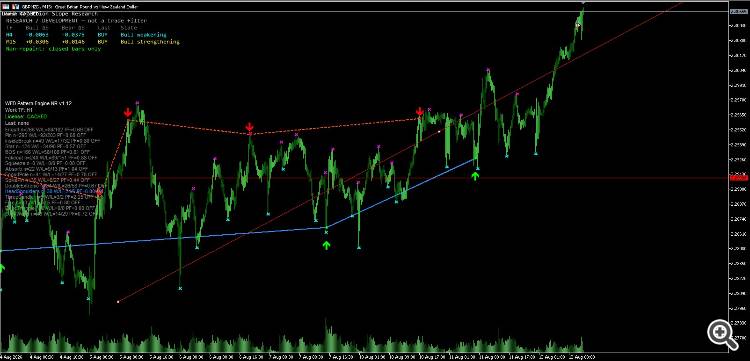
For the actual entry I prefer a clean MT5 chart with a simple indicator. I use a few of them depending on the market, for example WFD Pattern Engine, NR or tools from the same rejection family.
I traded for many years using mostly technical analysis and it can work. The problem is that short-term setups can look perfect while the bigger market environment is changing. For me this is where many false entries come from.
So I don't really try to find an indicator that removes false signals. I prefer to filter the market first, and use the indicator only for timing the entry.
Just my approach.
.