
You are missing trading opportunities:
- Free trading apps
- Over 8,000 signals for copying
- Economic news for exploring financial markets
Registration
Log in
You agree to website policy and terms of use
If you do not have an account, please register
Here is the result of the GA's work on this function in a few minutes. It's close enough in my opinion:
Load up the remote agents in no uncertain terms! :-)
Specifically about this route I wrote "there may not be enough money for a couple of generations of descendants".
Don't lose the physical meaning behind the numbers.
We have decided to open interfaces to write our own datafeeds for MT5.
Specifically about this route I wrote "there may not be enough money for a couple of generations of descendants".
Don't lose the physical meaning behind the numbers.
Function Z = cos(1.5*x)*cos(1.5*x) + sin(2.25*y) + cos(3*x*y); where X and Y are -3 to +3
I'm also wondering how to find its maximums in MT5.
As for the method - idea from article on hubra, implementation in matlab and in C#.
It's elementary:
Run in mathlab full brute force mode for 361,201 passes (53 seconds) with specified limits and steps:
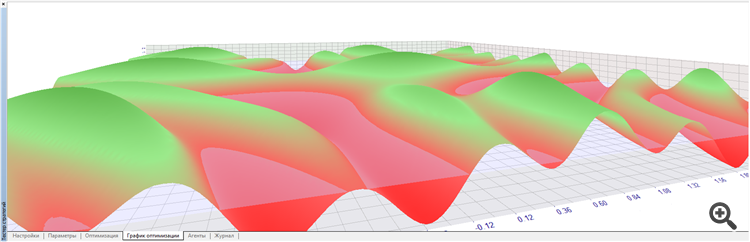
Then run the genetics, which has met the 8,700 passes (12 sec time), finding some clusters of desired maxima:
Moving Average - standard MT5 delivery
Ridges of parameter reliability areas on the search can be seen
It is not clear on the genetics whether they go horizontally or from bottom to left upwards
What difference does it make to you, can I not, maybe I can't, someone else can, profit to you... I'm not suggesting that the GA be removed, I'm suggesting that the user have a choice...
I mean, you still don't get it.
Reread my answers, please.
Is there a detailed description with an example of how to do this?
We won't get into this until after the next release.
MathExp(cos(1.5*x)*cos(1.5*x) + sin(2.25*y) + cos(3*x*y))
total overshoot
Genetics
From -3 to 3 in increments of 0.025